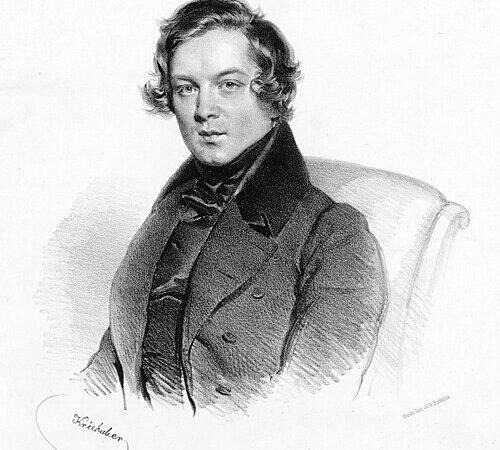
Biography (read more)
Robert Schumann was a German composer, pianist, and influential music critic of the early Romantic era, born 8 June 1810 in Zwickau and died 29 July 1856 in Endenich, near Bonn. After an early ambition to become a virtuoso pianist was ended by a hand injury, he turned fully to composition and criticism, founding the Neue Zeitschrift für Musik, and in 1840 married the pianist and composer Clara Wieck, for whom many of his works were written. He composed extensively for piano, voice, orchestra, and chamber ensemble, and struggled for much of his life with mental illness, which led to his confinement in an asylum in his final years.
Schumann was among the most literary and imaginative of Romantic composers, translating ideas from poetry and fiction into music through character pieces, song cycles, and a deeply personal harmonic language. As a critic he championed Chopin, Brahms, and other emerging composers, shaping the direction of nineteenth-century musical taste, and his fusion of intimate lyricism with structural innovation left a lasting mark on the piano and Lied repertoire.
Sources:
Repertoire
Symphony No. 3 in E Flat Major, Op. 97 “Rheinisch”: I. Lebhaft
Symphony No. 3 “Rhenish”: I. Lebhaft (1984)
Piano Quartet in E-Flat Major: IV. Finale (Live from Verbier Festival)
Performed by Menahem Pressler
Symphony No 3: I. Lebhaft(Excerpt)
Kreisleriana op. 16 – 3. Sehr aufgeregt
Kreisleriana op. 16 – 4. Sehr langsam
Piano Concerto in A Minor: III. Allegro vivace
Kinderszenen, Op. 15: No. 7, Träumerei
Piano Concerto, Op. 54: 2. Intermezzo (excerpt)
The Symphonies
Myrthen, Op. 25
Kinderszenen, Kreisleriana, Carnaval, Études Symphoniques + P°— Alfred Cortot
Performed by Alfred Cortot
Sonata in F# minor // Liszt – Sonata in B minor— Lazar Naumovich Berman
Performed by Lazar Naumovich Berman
Carnaval, Op. 9: Sphinx 1-3— Sergei Rachmaninoff (pianist)
Performed by Sergei Rachmaninoff (pianist)
Carnaval, Op. 9: No. 8a, Réplique— Sergei Rachmaninoff (pianist)
Performed by Sergei Rachmaninoff (pianist)
Carnaval, Op. 9: No. 8b, Sphinxes— Sergei Rachmaninoff (pianist)
Performed by Sergei Rachmaninoff (pianist)
Carnaval, Op. 9 (Scènes mignonnes sur quatre notes) : I. Préambule – Quasi maestoso – Più…— Charles Rosen
Performed by Charles Rosen
Carnaval, Op. 9 (Scènes mignonnes sur quatre notes) : II. Pierrot – Moderato— Charles Rosen
Performed by Charles Rosen
Carnaval, Op. 9 (Scènes mignonnes sur quatre notes) : III. Arlequin – Vivo— Charles Rosen
Performed by Charles Rosen
Carnaval, Op. 9 (Scènes mignonnes sur quatre notes) : IV. Valse noble – Un poco maestoso— Charles Rosen
Performed by Charles Rosen
Carnaval, Op. 9 (Scènes mignonnes sur quatre notes) : V. Eusebius – Adagio— Charles Rosen
Performed by Charles Rosen
Carnaval, Op. 9 (Scènes mignonnes sur quatre notes) : VI. Florestan – Passionato— Charles Rosen
Performed by Charles Rosen
Carnaval, Op. 9 (Scènes mignonnes sur quatre notes) : VII. Coquette – Vivo— Charles Rosen
Performed by Charles Rosen
Carnaval, Op. 9 (Scènes mignonnes sur quatre notes) : VIII. Réplique – L’istesso tempo – Sphinxes— Charles Rosen
Performed by Charles Rosen
Carnaval, Op. 9 (Scènes mignonnes sur quatre notes) : IX. Papillons – Prestissimo— Charles Rosen
Performed by Charles Rosen
Carnaval, Op. 9 (Scènes mignonnes sur quatre notes) : X. A.S.C.H. – S.C.H.A – Lettres Dansantes…— Charles Rosen
Performed by Charles Rosen
Carnaval, Op. 9 (Scènes mignonnes sur quatre notes) : XI. Chiarina – Passionato— Charles Rosen
Performed by Charles Rosen
Carnaval, Op. 9 (Scènes mignonnes sur quatre notes) : XII. Chopin – Agitato— Charles Rosen
Performed by Charles Rosen
Carnaval, Op. 9 (Scènes mignonnes sur quatre notes) : XIII. Estrella – Con affetto— Charles Rosen
Performed by Charles Rosen
Carnaval, Op. 9 (Scènes mignonnes sur quatre notes) : XIV. Reconnaissance – Animato— Charles Rosen
Performed by Charles Rosen
Carnaval, Op. 9 (Scènes mignonnes sur quatre notes) : XV. Pantalon et Colombine – Presto— Charles Rosen
Performed by Charles Rosen
Carnaval, Op. 9 (Scènes mignonnes sur quatre notes) : XVI. Valse allemande – Molto vivace— Charles Rosen
Performed by Charles Rosen
Carnaval, Op. 9 (Scènes mignonnes sur quatre notes) : XVII. Paganini – Intermezzo – Presto— Charles Rosen
Performed by Charles Rosen
Carnaval, Op. 9 (Scènes mignonnes sur quatre notes) : XVIII. Aveu – Passionato— Charles Rosen
Performed by Charles Rosen
Carnaval, Op. 9 (Scènes mignonnes sur quatre notes) : XIX. Promenade – Comodo— Charles Rosen
Performed by Charles Rosen
Carnaval, Op. 9 (Scènes mignonnes sur quatre notes) : XX. Pause – Vivo— Charles Rosen
Performed by Charles Rosen
Carnaval, Op. 9 (Scènes mignonnes sur quatre notes) : XXI. Marche des “Davidsbündler” contre…— Charles Rosen
Performed by Charles Rosen
Carnaval, Op. 9: I. Préambule – Pierrot – Arlequin – Valsenoble – Eusebius – Florestan -…— Sergio Fiorentino
Performed by Sergio Fiorentino
Carnaval, Op. 9: XII. Chopin – Estrella – Reconnaissance – Pantalon Et Colombine – Valse…— Sergio Fiorentino
Performed by Sergio Fiorentino
Schumann: Carnaval, Op. 9 – 10. A.S.C.H.-S.C.H.A. (Lettres dansantes)— Mitsuko Uchida
Performed by Mitsuko Uchida
Schumann: Carnaval, Op. 9 – 16. Valse allemande – Intermezzo: Paganini— Mitsuko Uchida
Performed by Mitsuko Uchida
Schumann: Carnaval, Op. 9 – 20. Marche des “Davidsbündler” contre les Philistins— Mitsuko Uchida
Performed by Mitsuko Uchida
Schumann: Carnaval, Op. 9: 15. Pantalon et Colombine— Paul Badura-Skoda
Performed by Paul Badura-Skoda
Schumann: Carnaval, Op. 9: 21. Marche des “Davidsbündler” contre les Philistins— Paul Badura-Skoda
Performed by Paul Badura-Skoda
Carnaval, Op. 9 (Scènes mignonnes sur quatre notes) : 1. Préambule. Quasi maestoso – Più moto…— Robert Casadesus
Performed by Robert Casadesus
Carnaval, Op. 9 (Scènes mignonnes sur quatre notes) : 2. Pierrot – Moderato— Robert Casadesus
Performed by Robert Casadesus
Carnaval, Op. 9 (Scènes mignonnes sur quatre notes) : 3. Arlequin – Vivo— Robert Casadesus
Performed by Robert Casadesus
Carnaval, Op. 9 (Scènes mignonnes sur quatre notes) : 4. Valse noble – Un poco maestoso— Robert Casadesus
Performed by Robert Casadesus
Carnaval, Op. 9 (Scènes mignonnes sur quatre notes) : 5. Eusebius – Adagio— Robert Casadesus
Performed by Robert Casadesus
Carnaval, Op. 9 (Scènes mignonnes sur quatre notes) : 6. Florestan – Passionato— Robert Casadesus
Performed by Robert Casadesus
Carnaval, Op. 9 (Scènes mignonnes sur quatre notes) : 7. Coquette – Vivo— Robert Casadesus
Performed by Robert Casadesus
Carnaval, Op. 9 (Scènes mignonnes sur quatre notes) : 8. Réplique – L’istesso tempo (Sphinxes)— Robert Casadesus
Performed by Robert Casadesus
Carnaval, Op. 9 (Scènes mignonnes sur quatre notes) : 9. Papillons – Prestissimo— Robert Casadesus
Performed by Robert Casadesus
Carnaval, Op. 9 (Scènes mignonnes sur quatre notes) : 10. A.S.C.H.-S.C.H.A. (Lettres dansantes)…— Robert Casadesus
Performed by Robert Casadesus
Carnaval, Op. 9 (Scènes mignonnes sur quatre notes) : 11. Chiarina – Passionato— Robert Casadesus
Performed by Robert Casadesus
Carnaval, Op. 9 (Scènes mignonnes sur quatre notes) : 12. Chopin – Agitato— Robert Casadesus
Performed by Robert Casadesus
Carnaval, Op. 9 (Scènes mignonnes sur quatre notes) : 13. Estrella – Con affetto— Robert Casadesus
Performed by Robert Casadesus
Carnaval, Op. 9 (Scènes mignonnes sur quatre notes) : 14. Reconnaissance – Animato— Robert Casadesus
Performed by Robert Casadesus
Carnaval, Op. 9 (Scènes mignonnes sur quatre notes) : 15. Pantalon et Colombine – Presto— Robert Casadesus
Performed by Robert Casadesus
Carnaval, Op. 9 (Scènes mignonnes sur quatre notes) : 16. Valse allemande – Molto vivace— Robert Casadesus
Performed by Robert Casadesus
Carnaval, Op. 9 (Scènes mignonnes sur quatre notes) : 17. Paganini Intermezzo – Presto— Robert Casadesus
Performed by Robert Casadesus
Carnaval, Op. 9 (Scènes mignonnes sur quatre notes) : 18. Aveu – Passionato— Robert Casadesus
Performed by Robert Casadesus
Carnaval, Op. 9 (Scènes mignonnes sur quatre notes) : 19. Promenade – Comodo— Robert Casadesus
Performed by Robert Casadesus
Carnaval, Op. 9 (Scènes mignonnes sur quatre notes) : 20. Pause – Vivo— Robert Casadesus
Performed by Robert Casadesus
Carnaval, Op. 9 (Scènes mignonnes sur quatre notes) : 21. March des “Davidsbündler” contre les…— Robert Casadesus
Performed by Robert Casadesus
Carnaval, Op. 9 (Scènes mignonnes sur quatre notes) : I. Préambule – Quasi maestoso – Più…— Robert Casadesus
Performed by Robert Casadesus
Carnaval, Op. 9 (Scènes mignonnes sur quatre notes) : II. Pierrot – Moderato— Robert Casadesus
Performed by Robert Casadesus
Carnaval, Op. 9 (Scènes mignonnes sur quatre notes) : III. Arlequin – Vivo— Robert Casadesus
Performed by Robert Casadesus
Carnaval, Op. 9 (Scènes mignonnes sur quatre notes) : IV. Valse noble – Un poco maestoso— Robert Casadesus
Performed by Robert Casadesus
Carnaval, Op. 9 (Scènes mignonnes sur quatre notes) : V. Eusebius – Adagio— Robert Casadesus
Performed by Robert Casadesus
Carnaval, Op. 9 (Scènes mignonnes sur quatre notes) : VI. Florestan – Passionato— Robert Casadesus
Performed by Robert Casadesus
Carnaval, Op. 9 (Scènes mignonnes sur quatre notes) : VII. Coquette – Vivo— Robert Casadesus
Performed by Robert Casadesus
Carnaval, Op. 9 (Scènes mignonnes sur quatre notes) : VIII. Réplique – L’istesso tempo – Sphinxes— Robert Casadesus
Performed by Robert Casadesus
Carnaval, Op. 9 (Scènes mignonnes sur quatre notes) : IX. Papillons – Prestissimo— Robert Casadesus
Performed by Robert Casadesus
Carnaval, Op. 9 (Scènes mignonnes sur quatre notes) : X. A.S.C.H. – S.C.H.A – Lettres Dansantes…— Robert Casadesus
Performed by Robert Casadesus
Carnaval, Op. 9 (Scènes mignonnes sur quatre notes) : XI. Chiarina – Passionato— Robert Casadesus
Performed by Robert Casadesus
Carnaval, Op. 9 (Scènes mignonnes sur quatre notes) : XII. Chopin – Agitato— Robert Casadesus
Performed by Robert Casadesus
Carnaval, Op. 9 (Scènes mignonnes sur quatre notes) : XIII. Estrella – Con affetto— Robert Casadesus
Performed by Robert Casadesus
Carnaval, Op. 9 (Scènes mignonnes sur quatre notes) : XIV. Reconnaissance – Animato— Robert Casadesus
Performed by Robert Casadesus
Carnaval, Op. 9 (Scènes mignonnes sur quatre notes) : XV. Pantalon et Colombine – Presto— Robert Casadesus
Performed by Robert Casadesus
Carnaval, Op. 9 (Scènes mignonnes sur quatre notes) : XVI. Valse allemande – Molto vivace— Robert Casadesus
Performed by Robert Casadesus
Carnaval, Op. 9 (Scènes mignonnes sur quatre notes) : XVII. Paganini – Intermezzo – Presto— Robert Casadesus
Performed by Robert Casadesus
Carnaval, Op. 9 (Scènes mignonnes sur quatre notes) : XVIII. Aveu – Passionato— Robert Casadesus
Performed by Robert Casadesus
Carnaval, Op. 9 (Scènes mignonnes sur quatre notes) : XIX. Promenade – Comodo— Robert Casadesus
Performed by Robert Casadesus
Carnaval, Op. 9 (Scènes mignonnes sur quatre notes) : XX. Pause – Vivo— Robert Casadesus
Performed by Robert Casadesus
Carnaval, Op. 9 (Scènes mignonnes sur quatre notes) : XXI. Marche des “Davidsbündler” contre…— Robert Casadesus
Performed by Robert Casadesus
Carnaval, Op. 9: XXI. Marsche des Davidsbündler contre les Philistins— Jörg Demus
Performed by Jörg Demus
Schumann: Carnaval, Op. 9: 10. A.S.C.H.-S.C.H.A. (Lettres dansantes)— Andor Földes
Performed by Andor Földes
Schumann: Carnaval, Op. 9: 21. Marche des “Davidsbündler” contre les Philistins— Andor Földes
Performed by Andor Földes
Schumann: Carnaval, Op. 9: IV. Valse noble. Un poco maestoso— Wilhelm Kempff
Performed by Wilhelm Kempff
Schumann: Carnaval, Op. 9: VIII. Réplique. L’istesso tempo – Sphinxes— Wilhelm Kempff
Performed by Wilhelm Kempff
Schumann: Carnaval, Op. 9: X. ASCH–SCHA (Lettres dansantes). Presto— Wilhelm Kempff
Performed by Wilhelm Kempff
Schumann: Carnaval, Op. 9: XV. Pantalon et Colombine. Presto— Wilhelm Kempff
Performed by Wilhelm Kempff
Schumann: Carnaval, Op. 9: XVI. Valse allemande. Molto vivace— Wilhelm Kempff
Performed by Wilhelm Kempff
Schumann: Carnaval, Op. 9: XVII. Paganini (Intermezzo). Presto— Wilhelm Kempff
Performed by Wilhelm Kempff
Schumann: Carnaval, Op. 9: XXI. Marche des Davidsbündler contre les Philistins. Non allegro— Wilhelm Kempff
Performed by Wilhelm Kempff
Schumann: Carnaval, Op. 9: X. ASCH–SCHA (Lettres dansantes) . Presto— Wilhelm Kempff
Performed by Wilhelm Kempff
Schumann: Carnaval, Op. 9: XVII. Paganini (Intermezzo) . Presto— Wilhelm Kempff
Performed by Wilhelm Kempff
Carnaval, Op. 9: VIII. Replique: L’istesso tempo— Vladimir Sofronitsky
Performed by Vladimir Sofronitsky
Carnaval, Op. 9: XI. A.S.C.H. – S.C.H.A. (Lettes dansantes) : Presto— Vladimir Sofronitsky
Performed by Vladimir Sofronitsky
Carnaval, Op. 9: XV. Reconnaissance: Animato— Vladimir Sofronitsky
Performed by Vladimir Sofronitsky
Carnaval, Op. 9: XVII. Valse allemande: Molto vivace— Vladimir Sofronitsky
Performed by Vladimir Sofronitsky
Carnaval, Op. 9: XXI. Marche des Davidsbuendler contre les Phimistines: Non Allegro— Vladimir Sofronitsky
Performed by Vladimir Sofronitsky
Carnaval, Op. 9: XI. A.S.C.H. – S.C.H.A. (Lettres dansantes)— Vladimir Sofronitsky
Performed by Vladimir Sofronitsky
Carnaval, Op. 9: XXI. Marche des “Davidsbuendler” contre les Philistines— Vladimir Sofronitsky
Performed by Vladimir Sofronitsky
Avant-propos de Guy Erismann & Annonce: Schumann, Carnaval (Op. 9)— Pierre Barbizet
Performed by Pierre Barbizet
Carnaval, Op. 9: Marche des Davidsbündler contre les Philistins— Pierre Barbizet
Performed by Pierre Barbizet
Carnaval op. 9 – Preambule (Studio Recording)— Arturo Benedetti Michelangeli
Performed by Arturo Benedetti Michelangeli
Carnaval op. 9 – Pierrot (Studio Recording)— Arturo Benedetti Michelangeli
Performed by Arturo Benedetti Michelangeli
Carnaval op. 9 – Arlequin (Studio Recording)— Arturo Benedetti Michelangeli
Performed by Arturo Benedetti Michelangeli
Carnaval op. 9 – Valse noble (Studio Recording)— Arturo Benedetti Michelangeli
Performed by Arturo Benedetti Michelangeli
Carnaval op. 9 – Eusebius (Studio Recording)— Arturo Benedetti Michelangeli
Performed by Arturo Benedetti Michelangeli
Carnaval op. 9 – Florestan (Studio Recording)— Arturo Benedetti Michelangeli
Performed by Arturo Benedetti Michelangeli
Carnaval op. 9 – Coquette. (Studio Recording)— Arturo Benedetti Michelangeli
Performed by Arturo Benedetti Michelangeli
Carnaval op. 9 – Replique (Studio Recording)— Arturo Benedetti Michelangeli
Performed by Arturo Benedetti Michelangeli
Carnaval op. 9 – Papillons (Studio Recording)— Arturo Benedetti Michelangeli
Performed by Arturo Benedetti Michelangeli
Carnaval op. 9 – ASCH – SCHA (Studio Recording)— Arturo Benedetti Michelangeli
Performed by Arturo Benedetti Michelangeli
Carnaval op. 9 – Chiarina (Studio Recording)— Arturo Benedetti Michelangeli
Performed by Arturo Benedetti Michelangeli
Carnaval op. 9 – Chopin (Studio Recording)— Arturo Benedetti Michelangeli
Performed by Arturo Benedetti Michelangeli
Carnaval op. 9 – Estrella (Live Recording)— Arturo Benedetti Michelangeli
Performed by Arturo Benedetti Michelangeli
Carnaval op. 9 – Reconnaissance (Studio Recording)— Arturo Benedetti Michelangeli
Performed by Arturo Benedetti Michelangeli
Carnaval op. 9 – Pantalon et Colombine (Studio Recording)— Arturo Benedetti Michelangeli
Performed by Arturo Benedetti Michelangeli
Carnaval op. 9 – Valse allemande (Studio Recording)— Arturo Benedetti Michelangeli
Performed by Arturo Benedetti Michelangeli
Carnaval op. 9 – Paganini (Studio Recording)— Arturo Benedetti Michelangeli
Performed by Arturo Benedetti Michelangeli
Carnaval op. 9 – Aveu (Studio Recording)— Arturo Benedetti Michelangeli
Performed by Arturo Benedetti Michelangeli
Carnaval op. 9 – Promenade (Studio Recording)— Arturo Benedetti Michelangeli
Performed by Arturo Benedetti Michelangeli
Carnaval op. 9 – Pause (Studio Recording)— Arturo Benedetti Michelangeli
Performed by Arturo Benedetti Michelangeli
Carnaval op. 9 – Marche des Davidsbundlers contre le Philistins (Studio Recording)— Arturo Benedetti Michelangeli
Performed by Arturo Benedetti Michelangeli
Schumann: Carnaval, Op. 9: I. Préambule— Arturo Benedetti Michelangeli
Performed by Arturo Benedetti Michelangeli
Schumann: Carnaval, Op. 9: II. Pierrot— Arturo Benedetti Michelangeli
Performed by Arturo Benedetti Michelangeli
Schumann: Carnaval, Op. 9: III. Arlequin— Arturo Benedetti Michelangeli
Performed by Arturo Benedetti Michelangeli
Schumann: Carnaval, Op. 9: IV. Valse noble— Arturo Benedetti Michelangeli
Performed by Arturo Benedetti Michelangeli
Schumann: Carnaval, Op. 9: V. Eusebius— Arturo Benedetti Michelangeli
Performed by Arturo Benedetti Michelangeli
Schumann: Carnaval, Op. 9: VI. Florestan— Arturo Benedetti Michelangeli
Performed by Arturo Benedetti Michelangeli
Schumann: Carnaval, Op. 9: VII. Coquette— Arturo Benedetti Michelangeli
Performed by Arturo Benedetti Michelangeli
Schumann: Carnaval, Op. 9: VIII. Réplique – Sphinxes— Arturo Benedetti Michelangeli
Performed by Arturo Benedetti Michelangeli
Schumann: Carnaval, Op. 9: IX. Papillons— Arturo Benedetti Michelangeli
Performed by Arturo Benedetti Michelangeli
Schumann: Carnaval, Op. 9: X. A.S.C.H.-S.C.H.A. (Lettres dansantes)— Arturo Benedetti Michelangeli
Performed by Arturo Benedetti Michelangeli
Schumann: Carnaval, Op. 9: XI. Chiarina— Arturo Benedetti Michelangeli
Performed by Arturo Benedetti Michelangeli
Schumann: Carnaval, Op. 9: XII. Chopin— Arturo Benedetti Michelangeli
Performed by Arturo Benedetti Michelangeli
Schumann: Carnaval, Op. 9: XIV. Reconnaissance— Arturo Benedetti Michelangeli
Performed by Arturo Benedetti Michelangeli
Schumann: Carnaval, Op. 9: XV. Pantalon et Colombine— Arturo Benedetti Michelangeli
Performed by Arturo Benedetti Michelangeli
Schumann: Carnaval, Op. 9: XVIa. Valse Allemande— Arturo Benedetti Michelangeli
Performed by Arturo Benedetti Michelangeli
Schumann: Carnaval, Op. 9: XVIb. Intermezzo: Paganini— Arturo Benedetti Michelangeli
Performed by Arturo Benedetti Michelangeli
Schumann: Carnaval, Op. 9: XVII. Aveu— Arturo Benedetti Michelangeli
Performed by Arturo Benedetti Michelangeli
Schumann: Carnaval, Op. 9: XVIII. Promenade— Arturo Benedetti Michelangeli
Performed by Arturo Benedetti Michelangeli
Schumann: Carnaval, Op. 9: XX. Marche des “Davidsbündler” contre les Philistins— Arturo Benedetti Michelangeli
Performed by Arturo Benedetti Michelangeli
Carnaval, Op. 9 Préambule— Arturo Benedetti Michelangeli
Performed by Arturo Benedetti Michelangeli
Carnaval, Op. 9 Valse Noble— Arturo Benedetti Michelangeli
Performed by Arturo Benedetti Michelangeli
Carnaval, Op. 9 Réplique Sphynxes— Arturo Benedetti Michelangeli
Performed by Arturo Benedetti Michelangeli
Carnaval, Op. 9 A.S.C.H. S.C.H.A.— Arturo Benedetti Michelangeli
Performed by Arturo Benedetti Michelangeli
Carnaval, Op. 9 Reconnaissance— Arturo Benedetti Michelangeli
Performed by Arturo Benedetti Michelangeli
Carnaval, Op. 9 Pantalon Et Colombine— Arturo Benedetti Michelangeli
Performed by Arturo Benedetti Michelangeli
Carnaval, Op. 9 Valse Allemande— Arturo Benedetti Michelangeli
Performed by Arturo Benedetti Michelangeli
Carnaval, Op. 9 Marche Des Davidsbündler Contre Les Philistins— Arturo Benedetti Michelangeli
Performed by Arturo Benedetti Michelangeli
Carnaval, Op. 9 – Préambule— Arturo Benedetti Michelangeli
Performed by Arturo Benedetti Michelangeli
Carnaval, Op. 9 – Arlequin— Arturo Benedetti Michelangeli
Performed by Arturo Benedetti Michelangeli
Carnaval, Op. 9 – Valse Noble— Arturo Benedetti Michelangeli
Performed by Arturo Benedetti Michelangeli
Carnaval, Op. 9 – Eusebius— Arturo Benedetti Michelangeli
Performed by Arturo Benedetti Michelangeli
Carnaval, Op. 9 – Florestan— Arturo Benedetti Michelangeli
Performed by Arturo Benedetti Michelangeli
Carnaval, Op. 9 – Coquette— Arturo Benedetti Michelangeli
Performed by Arturo Benedetti Michelangeli
Carnaval, Op. 9 – Replique— Arturo Benedetti Michelangeli
Performed by Arturo Benedetti Michelangeli
Carnaval, Op. 9 – Papillons— Arturo Benedetti Michelangeli
Performed by Arturo Benedetti Michelangeli
Carnaval, Op. 9 – A.S.C.H. / S.C.H.A. (Lettres Dansantes)— Arturo Benedetti Michelangeli
Performed by Arturo Benedetti Michelangeli
Carnaval, Op. 9 – Chiarina— Arturo Benedetti Michelangeli
Performed by Arturo Benedetti Michelangeli
Carnaval, Op. 9 – Estrella— Arturo Benedetti Michelangeli
Performed by Arturo Benedetti Michelangeli
Carnaval, Op. 9 – Reconnaissance— Arturo Benedetti Michelangeli
Performed by Arturo Benedetti Michelangeli
Carnaval, Op. 9 – Pantalon Et Colombine— Arturo Benedetti Michelangeli
Performed by Arturo Benedetti Michelangeli
Carnaval, Op. 9 – Valse Allemande— Arturo Benedetti Michelangeli
Performed by Arturo Benedetti Michelangeli
Carnaval, Op. 9 – Paganini— Arturo Benedetti Michelangeli
Performed by Arturo Benedetti Michelangeli
Carnaval, Op. 9 – Promenade— Arturo Benedetti Michelangeli
Performed by Arturo Benedetti Michelangeli
Carnaval, Op. 9 – Marche Des Davidsbundler Contre Les Philistins— Arturo Benedetti Michelangeli
Performed by Arturo Benedetti Michelangeli
Carnaval, Op. 9: No. 17a, Valse allemande— Arturo Benedetti Michelangeli
Performed by Arturo Benedetti Michelangeli
Carnaval, Op. 9: No. 17b, Paganini— Arturo Benedetti Michelangeli
Performed by Arturo Benedetti Michelangeli
Schumann: Carnaval, Op. 9 – I. Préambule— Arturo Benedetti Michelangeli
Performed by Arturo Benedetti Michelangeli
Schumann: Carnaval, Op. 9 – II. Pierrot— Arturo Benedetti Michelangeli
Performed by Arturo Benedetti Michelangeli
Schumann: Carnaval, Op. 9 – III. Arlequin— Arturo Benedetti Michelangeli
Performed by Arturo Benedetti Michelangeli
Schumann: Carnaval, Op. 9 – IV. Valse noble— Arturo Benedetti Michelangeli
Performed by Arturo Benedetti Michelangeli
Schumann: Carnaval, Op. 9 – V. Eusebius— Arturo Benedetti Michelangeli
Performed by Arturo Benedetti Michelangeli
Schumann: Carnaval, Op. 9 – VI. Florestan— Arturo Benedetti Michelangeli
Performed by Arturo Benedetti Michelangeli
Schumann: Carnaval, Op. 9 – VII. Coquette— Arturo Benedetti Michelangeli
Performed by Arturo Benedetti Michelangeli
Schumann: Carnaval, Op. 9 – VIII. Réplique – Sphinxes— Arturo Benedetti Michelangeli
Performed by Arturo Benedetti Michelangeli
Schumann: Carnaval, Op. 9 – IX. Papillons— Arturo Benedetti Michelangeli
Performed by Arturo Benedetti Michelangeli
Schumann: Carnaval, Op. 9 – X. A.S.C.H.-S.C.H.A. (Lettres dansantes)— Arturo Benedetti Michelangeli
Performed by Arturo Benedetti Michelangeli
Schumann: Carnaval, Op. 9 – XI. Chiarina— Arturo Benedetti Michelangeli
Performed by Arturo Benedetti Michelangeli
Schumann: Carnaval, Op. 9 – XII. Chopin— Arturo Benedetti Michelangeli
Performed by Arturo Benedetti Michelangeli
Schumann: Carnaval, Op. 9 – XIII. Estrella— Arturo Benedetti Michelangeli
Performed by Arturo Benedetti Michelangeli
Schumann: Carnaval, Op. 9 – XIV. Reconnaissance— Arturo Benedetti Michelangeli
Performed by Arturo Benedetti Michelangeli
Schumann: Carnaval, Op. 9 – XV. Pantalon et Colombine— Arturo Benedetti Michelangeli
Performed by Arturo Benedetti Michelangeli
Schumann: Carnaval, Op. 9 – XVIa. Valse Allemande— Arturo Benedetti Michelangeli
Performed by Arturo Benedetti Michelangeli
Schumann: Carnaval, Op. 9 – XVIb. Intermezzo: Paganini— Arturo Benedetti Michelangeli
Performed by Arturo Benedetti Michelangeli
Schumann: Carnaval, Op. 9 – XVII. Aveu— Arturo Benedetti Michelangeli
Performed by Arturo Benedetti Michelangeli
Schumann: Carnaval, Op. 9 – XVIII. Promenade— Arturo Benedetti Michelangeli
Performed by Arturo Benedetti Michelangeli
Schumann: Carnaval, Op. 9 – XIX. Pause— Arturo Benedetti Michelangeli
Performed by Arturo Benedetti Michelangeli
Schumann: Carnaval, Op. 9 – XX. Marche des “Davidsbündler” contre les Philistins— Arturo Benedetti Michelangeli
Performed by Arturo Benedetti Michelangeli
Carnaval, Op. 9 – Préambule (Remastered 2020, Version 1928)— Alfred Cortot
Performed by Alfred Cortot
Carnaval, Op. 9 – Arlequin (Remastered 2020, Version 1928)— Alfred Cortot
Performed by Alfred Cortot
Carnaval, Op. 9 – Valse noble (Remastered 2020, Version 1928)— Alfred Cortot
Performed by Alfred Cortot
Carnaval, Op. 9 – Eusebius (Remastered 2020, Version 1928)— Alfred Cortot
Performed by Alfred Cortot
Carnaval, Op. 9 – Florestan (Remastered 2020, Version 1928)— Alfred Cortot
Performed by Alfred Cortot
Carnaval, Op. 9 – Coquette (Remastered 2020, Version 1928)— Alfred Cortot
Performed by Alfred Cortot
Carnaval, Op. 9 – Réplique (Remastered 2020, Version 1928)— Alfred Cortot
Performed by Alfred Cortot
Carnaval, Op. 9 – Sphinxes (Remastered 2020, Version 1928)— Alfred Cortot
Performed by Alfred Cortot
Carnaval, Op. 9 – Papillons (Remastered 2020, Version 1928)— Alfred Cortot
Performed by Alfred Cortot
Carnaval, Op. 9 – A.S.C.H.-S.C.H.A. (Lettres dansantes) (Remastered 2020, Version 1928)— Alfred Cortot
Performed by Alfred Cortot
Carnaval, Op. 9 – Chiarina (Remastered 2020, Version 1928)— Alfred Cortot
Performed by Alfred Cortot
Carnaval, Op. 9 – Estrella (Remastered 2020, Version 1928)— Alfred Cortot
Performed by Alfred Cortot
Carnaval, Op. 9 – Reconnaissance (Remastered 2020, Version 1928)— Alfred Cortot
Performed by Alfred Cortot
Carnaval, Op. 9 – Pantalon at Colombine (Remastered 2020, Version 1928)— Alfred Cortot
Performed by Alfred Cortot
Carnaval, Op. 9 – Valse allemande (Remastered 2020, Version 1928)— Alfred Cortot
Performed by Alfred Cortot
Carnaval, Op. 9 – Paganini (Intermezzo) (Remastered 2020, Version 1928)— Alfred Cortot
Performed by Alfred Cortot
Carnaval, Op. 9 – Promenade (Remastered 2020, Version 1928)— Alfred Cortot
Performed by Alfred Cortot
Carnaval, Op. 9 – Marche des ‘’Davidsbündler’’ contre les Philistins (Remastered 2020,…— Alfred Cortot
Performed by Alfred Cortot
Carnaval, Op. 9 – Préambule (Remastered 2020, Version 1923)— Alfred Cortot
Performed by Alfred Cortot
Carnaval, Op. 9 – Arlequin (Remastered 2020, Version 1923)— Alfred Cortot
Performed by Alfred Cortot
Carnaval, Op. 9 – Valse noble (Remastered 2020, Version 1923)— Alfred Cortot
Performed by Alfred Cortot
Carnaval, Op. 9 – Eusebius (Remastered 2020, Version 1923)— Alfred Cortot
Performed by Alfred Cortot
Carnaval, Op. 9 – Florestan (Remastered 2020, Version 1923)— Alfred Cortot
Performed by Alfred Cortot
Carnaval, Op. 9 – Coquette (Remastered 2020, Version 1923)— Alfred Cortot
Performed by Alfred Cortot
Carnaval, Op. 9 – Papillons (Remastered 2020, Version 1923)— Alfred Cortot
Performed by Alfred Cortot
Carnaval, Op. 9 – A.S.C.H.-S.C.H.A. (Lettres dansantes) (Remastered 2020, Version 1923)— Alfred Cortot
Performed by Alfred Cortot
Carnaval, Op. 9 – Chiarina (Remastered 2020, Version 1923)— Alfred Cortot
Performed by Alfred Cortot
Carnaval, Op. 9 – Estrella (Remastered 2020, Version 1923)— Alfred Cortot
Performed by Alfred Cortot
Carnaval, Op. 9 – Reconnaissance (Remastered 2020, Version 1923)— Alfred Cortot
Performed by Alfred Cortot
Carnaval, Op. 9 – Pantalon at Colombine (Remastered 2020, Version 1923)— Alfred Cortot
Performed by Alfred Cortot
Carnaval, Op. 9 – Valse allemande (Remastered 2020, Version 1923)— Alfred Cortot
Performed by Alfred Cortot
Carnaval, Op. 9 – Paganini (Intermezzo) (Remastered 2020, Version 1923)— Alfred Cortot
Performed by Alfred Cortot
Carnaval, Op. 9 – Promenade (Remastered 2020, Version 1923)— Alfred Cortot
Performed by Alfred Cortot
Carnaval, Op. 9: A.S.C.H- S.C.H.A (Lettres Dansantes) . Presto— Alfred Cortot
Performed by Alfred Cortot
Carnaval, Op. 9: Marche des Davidsbundler contre les Phlistings. Non Allegro— Alfred Cortot
Performed by Alfred Cortot
Schumann: Carnaval, Op. 9: 8. Réplique – Sphinxes— Alicia de Larrocha
Performed by Alicia de Larrocha
Schumann: Carnaval, Op. 9: 10. A.S.C.H.-S.C.H.A. (Lettres dansantes)— Alicia de Larrocha
Performed by Alicia de Larrocha
Schumann: Carnaval, Op. 9: 15. Pantalon et Colombine— Alicia de Larrocha
Performed by Alicia de Larrocha
Schumann: Carnaval, Op. 9: 16. Valse allemande – Intermezzo: Paganini— Alicia de Larrocha
Performed by Alicia de Larrocha
Schumann: Carnaval, Op. 9: 20. Marche des “Davidsbündler” contre les Philistins— Alicia de Larrocha
Performed by Alicia de Larrocha
Schumann: Carnaval, Op. 9: Pierrot-Arlequin-Valse noble— Alicia de Larrocha
Performed by Alicia de Larrocha
Schumann: Carnaval, Op. 9: Coquette-Replique-Papillons— Alicia de Larrocha
Performed by Alicia de Larrocha
Schumann: Carnaval, Op. 9: ASCH-SCHA-Chiarina-Chopin-Estrella— Alicia de Larrocha
Performed by Alicia de Larrocha
Schumann: Carnaval, Op. 9: Reconnaissance-Pantalon et Colombine— Alicia de Larrocha
Performed by Alicia de Larrocha
Schumann: Carnaval, Op. 9: Valse allemande-Paganini-Aveu-Promenade— Alicia de Larrocha
Performed by Alicia de Larrocha
Schumann: Carnaval, Op. 9: Pause-Marche des Davidsbundler contre les Philistins— Alicia de Larrocha
Performed by Alicia de Larrocha
Schumann: Carnaval, Op. 9 – Pierrot-Arlequin-Valse noble— Alicia de Larrocha
Performed by Alicia de Larrocha
Schumann: Carnaval, Op. 9 – Coquette-Replique-Papillons— Alicia de Larrocha
Performed by Alicia de Larrocha
Schumann: Carnaval, Op. 9 – ASCH-SCHA-Chiarina-Chopin-Estrella— Alicia de Larrocha
Performed by Alicia de Larrocha
Schumann: Carnaval, Op. 9 – Reconnaissance-Pantalon et Colombine— Alicia de Larrocha
Performed by Alicia de Larrocha
Schumann: Carnaval, Op. 9 – Valse allemande-Paganini-Aveu-Promenade— Alicia de Larrocha
Performed by Alicia de Larrocha
Schumann: Carnaval, Op. 9 – Pause-Marche des Davidsbundler contre les Philistins— Alicia de Larrocha
Performed by Alicia de Larrocha
Schumann: Carnaval, Op. 9 – 8. Réplique – Sphinxes— Alicia de Larrocha
Performed by Alicia de Larrocha
Schumann: Carnaval, Op. 9 – 10. A.S.C.H.-S.C.H.A. (Lettres dansantes)— Alicia de Larrocha
Performed by Alicia de Larrocha
Schumann: Carnaval, Op. 9 – 15. Pantalon et Colombine— Alicia de Larrocha
Performed by Alicia de Larrocha
Schumann: Carnaval, Op. 9 – 16. Valse allemande – Intermezzo: Paganini— Alicia de Larrocha
Performed by Alicia de Larrocha
Schumann: Carnaval, Op. 9 – 20. Marche des “Davidsbündler” contre les Philistins— Alicia de Larrocha
Performed by Alicia de Larrocha
Carnaval, Op. 9: March des “Davidsbündler” contre les Philistins— Nelson Freire
Performed by Nelson Freire
Schumann: Carnaval, Op. 9: 10. A.S.C.H.-S.C.H.A. (Lettres dansantes)— Nelson Freire
Performed by Nelson Freire
Schumann: Carnaval, Op. 9: 16. Valse allemande – Intermezzo: Paganini— Nelson Freire
Performed by Nelson Freire
Schumann: Carnaval, Op. 9: 20. Marche des “Davidsbündler” contre les Philistins— Nelson Freire
Performed by Nelson Freire
Schumann: Carnaval, Op. 9: 2-4. Pierrot-Arlequino-Valse noble— Vladimir Ashkenazy
Performed by Vladimir Ashkenazy
Schumann: Carnaval, Op. 9: 5-6. Eusebius-Florestan— Vladimir Ashkenazy
Performed by Vladimir Ashkenazy
Schumann: Carnaval, Op. 9: 7-9. Coquette-Replique-Papillons— Vladimir Ashkenazy
Performed by Vladimir Ashkenazy
Schumann: Carnaval, Op. 9: 10-13. ASCH-SCHA-Chiarina-Chopin-Estrella— Vladimir Ashkenazy
Performed by Vladimir Ashkenazy
Schumann: Carnaval, Op. 9: 14-15. Reconnaissance-Pantalon et Colombine— Vladimir Ashkenazy
Performed by Vladimir Ashkenazy
Schumann: Carnaval, Op. 9: 16-18. Valse allemande-Paganini-Aveu-Promenade— Vladimir Ashkenazy
Performed by Vladimir Ashkenazy
Schumann: Carnaval, Op. 9: 19-20. Pause-Marche des Davidsbundler contre les Philistins— Vladimir Ashkenazy
Performed by Vladimir Ashkenazy
Schumann: Carnaval, Op. 9 – 2-4. Pierrot-Arlequino-Valse noble— Vladimir Ashkenazy
Performed by Vladimir Ashkenazy
Schumann: Carnaval, Op. 9 – 5-6. Eusebius-Florestan— Vladimir Ashkenazy
Performed by Vladimir Ashkenazy
Schumann: Carnaval, Op. 9 – 7-9. Coquette-Replique-Papillons— Vladimir Ashkenazy
Performed by Vladimir Ashkenazy
Schumann: Carnaval, Op. 9 – 10-13. ASCH-SCHA-Chiarina-Chopin-Estrella— Vladimir Ashkenazy
Performed by Vladimir Ashkenazy
Schumann: Carnaval, Op. 9 – 14-15. Reconnaissance-Pantalon et Colombine— Vladimir Ashkenazy
Performed by Vladimir Ashkenazy
Schumann: Carnaval, Op. 9 – 16-18. Valse allemande-Paganini-Aveu-Promenade— Vladimir Ashkenazy
Performed by Vladimir Ashkenazy
Schumann: Carnaval, Op. 9 – 19-20. Pause-Marche des Davidsbundler contre les Philistins— Vladimir Ashkenazy
Performed by Vladimir Ashkenazy
Kinderszenen, Op. 15: VII. Traumerel (Dreaming) in F Major— Leopold Godowsky
Performed by Leopold Godowsky
Kinderszenen, Op. 15: VII. Traumerel in F Major (Dreaming)— Leopold Godowsky
Performed by Leopold Godowsky
Kinderszenen, Op. 15: VII. Traumerel (Dreaming) in F Major— Leopold Godowsky
Performed by Leopold Godowsky
Kinderszenen, Op. 15, VII. Träumerei (Dreaming) in F major— Leopold Godowsky
Performed by Leopold Godowsky
Robert Schumann – Kinderszenen, Op. 15. VII. Traumerel (Dreaming) in F Major— Leopold Godowsky
Performed by Leopold Godowsky
Kinderszenen, Op. 15: I. Von Fremden Ländern Und Menschen – Kuriose Geschichte – Hasche-Mann…— Sergio Fiorentino
Performed by Sergio Fiorentino
Kinderszenen, Op. 15: VIII. Am Kamin – Ritter Vom Steckenpferd – Fast Zu Ernst – Fürchtenmachen…— Sergio Fiorentino
Performed by Sergio Fiorentino
Schumann: Kinderszenen, Op. 15: 1. Von fremden Ländern und Menschen— Roberto Prosseda
Performed by Roberto Prosseda
Schumann: Kinderszenen, Op. 15: 12. Kind im Einschlummern— Roberto Prosseda
Performed by Roberto Prosseda
Schumann: Kinderszenen, Op. 15: 13. Der Dichter spricht— Roberto Prosseda
Performed by Roberto Prosseda
Schumann: Kinderszenen, Op. 15: 1. Von fremden Ländern und Menschen— Paul Badura-Skoda
Performed by Paul Badura-Skoda
Schumann: Kinderszenen, Op. 15: 2. Kuriose Geschichte— Paul Badura-Skoda
Performed by Paul Badura-Skoda
Schumann: Kinderszenen, Op. 15: 6. Wichtige Begebenheit— Paul Badura-Skoda
Performed by Paul Badura-Skoda
Schumann: Kinderszenen, Op. 15: 9. Ritter vom Steckenpferd— Paul Badura-Skoda
Performed by Paul Badura-Skoda
Schumann: Kinderszenen, Op. 15: 11. Fürchtenmachen— Paul Badura-Skoda
Performed by Paul Badura-Skoda
Schumann: Kinderszenen, Op. 15: 12. Kind im Einschlummern— Paul Badura-Skoda
Performed by Paul Badura-Skoda
Schumann: Kinderszenen, Op. 15: 13. Der Dichter spricht— Paul Badura-Skoda
Performed by Paul Badura-Skoda
Schumann: Kinderszenen, Op. 15: I. Von fremden Ländern und Menschen— András Schiff
Performed by András Schiff
Schumann: Kinderszenen, Op. 15: IX. Ritter vom Steckenpferd— András Schiff
Performed by András Schiff
Schumann: Kinderszenen, Op. 15: XII. Kind im Einschlummern— András Schiff
Performed by András Schiff
Schumann: Kinderszenen, Op. 15: I. Von fremden Ländern und Menschen— Wilhelm Kempff
Performed by Wilhelm Kempff
Schumann: Kinderszenen, Op. 15: XIII. Der Dichter spricht— Wilhelm Kempff
Performed by Wilhelm Kempff
Schumann: Kinderszenen, Op. 15: VI. Wichtige Begebenheit— Wilhelm Kempff
Performed by Wilhelm Kempff
Schumann: Kinderszenen, Op. 15: IX. Ritter vom Steckenpferd— Wilhelm Kempff
Performed by Wilhelm Kempff
Schumann: Kinderszenen, Op. 15: XII. Kind im Einschlummern— Wilhelm Kempff
Performed by Wilhelm Kempff
Kinderszenen, Op.15: I. Von fremden Ländern und Menschen— Arcadi Volodos
Performed by Arcadi Volodos
Kinderszenen Op. 15 – I. Von fremden Ländern und Menschen (Remastered 2022, Version 1952)— Yves Nat
Performed by Yves Nat
Kinderszenen Op. 15 – II. Kuriose Geschichte (Remastered 2022, Version 1952)— Yves Nat
Performed by Yves Nat
Kinderszenen Op. 15 – III. Hasche-Mann (Remastered 2022, Version 1952)— Yves Nat
Performed by Yves Nat
Kinderszenen Op. 15 – IV. Bittendes Kind (Remastered 2022, Version 1952)— Yves Nat
Performed by Yves Nat
Kinderszenen Op. 15 – V. Glückes genug (Remastered 2022, Version 1952)— Yves Nat
Performed by Yves Nat
Kinderszenen Op. 15 – VI. Wichtige Begebenheit (Remastered 2022, Version 1952)— Yves Nat
Performed by Yves Nat
Kinderszenen Op. 15 – VII. Träumerei (Remastered 2022, Version 1952)— Yves Nat
Performed by Yves Nat
Kinderszenen Op. 15 – VIII. Am Kamin (Remastered 2022, Version 1952)— Yves Nat
Performed by Yves Nat
Kinderszenen Op. 15 – IX. Ritter vom Steckenpferd (Remastered 2022, Version 1952)— Yves Nat
Performed by Yves Nat
Kinderszenen Op. 15 – X. Fast zu ernst (Remastered 2022, Version 1952)— Yves Nat
Performed by Yves Nat
Kinderszenen Op. 15 – XI. Fürchtenmachen (Remastered 2022, Version 1952)— Yves Nat
Performed by Yves Nat
Kinderszenen Op. 15 – XII. Kind im Einschlummern (Remastered 2022, Version 1952)— Yves Nat
Performed by Yves Nat
Kinderszenen Op. 15 – XIII. Der Dichter spricht (Remastered 2022, Version 1952)— Yves Nat
Performed by Yves Nat
Kinderszenen Op. 15 – I. Von fremden Ländern und Menschen (Remastered 2022, Version 1930)— Yves Nat
Performed by Yves Nat
Kinderszenen Op. 15 – II. Kuriose Geschichte (Remastered 2022, Version 1930)— Yves Nat
Performed by Yves Nat
Kinderszenen Op. 15 – III. Hasche-Mann (Remastered 2022, Version 1930)— Yves Nat
Performed by Yves Nat
Kinderszenen Op. 15 – IV. Bittendes Kind (Remastered 2022, Version 1930)— Yves Nat
Performed by Yves Nat
Kinderszenen Op. 15 – V. Glückes genug (Remastered 2022, Version 1930)— Yves Nat
Performed by Yves Nat
Kinderszenen Op. 15 – VI. Wichtige Begebenheit (Remastered 2022, Version 1930)— Yves Nat
Performed by Yves Nat
Kinderszenen Op. 15 – VII. Träumerei (Remastered 2022, Version 1930)— Yves Nat
Performed by Yves Nat
Kinderszenen Op. 15 – VIII. Am Kamin (Remastered 2022, Version 1930)— Yves Nat
Performed by Yves Nat
Kinderszenen Op. 15 – IX. Ritter vom Steckenpferd (Remastered 2022, Version 1930)— Yves Nat
Performed by Yves Nat
Kinderszenen Op. 15 – X. Fast zu ernst (Remastered 2022, Version 1930)— Yves Nat
Performed by Yves Nat
Kinderszenen Op. 15 – XI. Fürchtenmachen (Remastered 2022, Version 1930)— Yves Nat
Performed by Yves Nat
Kinderszenen Op. 15 – XII. Kind im Einschlummern (Remastered 2022, Version 1930)— Yves Nat
Performed by Yves Nat
Kinderszenen Op. 15 – XIII. Der Dichter spricht (Remastered 2022, Version 1930)— Yves Nat
Performed by Yves Nat
Schumann: Kinderszenen, Op. 15: 1. Von fremden Ländern und Menschen— Clifford Curzon
Performed by Clifford Curzon
Schumann: Kinderszenen, Op. 15: 6. Wichtige Begebenheit— Clifford Curzon
Performed by Clifford Curzon
Schumann: Kinderszenen, Op. 15: 9. Ritter vom Steckenpferd— Clifford Curzon
Performed by Clifford Curzon
Schumann: Kinderszenen, Op. 15: 12. Kind im Einschlummern— Clifford Curzon
Performed by Clifford Curzon
Schumann: Kinderszenen, Op. 15: 13. Der Dichter spricht— Clifford Curzon
Performed by Clifford Curzon
Kinderszenen, Op. 15: I. Von fremden Ländern und Menschen— Howard Shelley
Performed by Howard Shelley
Schumann: Kinderszenen, Op. 15: 1. Von fremden Ländern und Menschen— Clara Haskil
Performed by Clara Haskil
Kinderszenen, Op. 15: Von fremden Ländern und Menschen, G Major (Of Foreign Lands and Peoples)— Clara Haskil
Performed by Clara Haskil
Kinderszenen, Op. 15: Kuriose Geschichte, D Major (A Curious Story)— Clara Haskil
Performed by Clara Haskil
Kinderszenen, Op. 15: Hasche-Mann, B minor (Blind Man’s Bluff)— Clara Haskil
Performed by Clara Haskil
Kinderszenen, Op. 15: Bittendes Kind, D Major (Pleading Child)— Clara Haskil
Performed by Clara Haskil
Kinderszenen, Op. 15: Wichtige Begebenheit, A Major (An Important Event)— Clara Haskil
Performed by Clara Haskil
Kinderszenen, Op. 15: Ritter vom Steckenpferd, C Major (Knight of the Hobbyhorse)— Clara Haskil
Performed by Clara Haskil
Kinderszenen, Op. 15: Fast zu ernst, G-Sharp minor (Almost Too Serious)— Clara Haskil
Performed by Clara Haskil
Kinderszenen, Op. 15: Kind im Einschlummern, E minor (Child Falling Asleep)— Clara Haskil
Performed by Clara Haskil
Kinderszenen, Op. 15: Der Dichter spricht, G Major (The Poet Speaks)— Clara Haskil
Performed by Clara Haskil
Schumann: Kinderszenen, Op. 15 – 1. Von fremden Ländern und Menschen— Clara Haskil
Performed by Clara Haskil
Kinderszenen, Op. 15: I. Von fremden Ländern und Menschen (About foreign lands and people)— Artur Schnabel
Performed by Artur Schnabel
Kinderszenen, Op. 15: II. Kuriose Geschichte (A curious story)— Artur Schnabel
Performed by Artur Schnabel
Kinderszenen, Op. 15: III. Haschemann (Catch me if you can)— Artur Schnabel
Performed by Artur Schnabel
Kinderszenen, Op. 15: IV. Bittendes Kind (Pleading child)— Artur Schnabel
Performed by Artur Schnabel
Kinderszenen, Op. 15: V. Glückes genug (Perfect happiness)— Artur Schnabel
Performed by Artur Schnabel
Kinderszenen, Op. 15: VI. Wichtige Begebenheit (An important event)— Artur Schnabel
Performed by Artur Schnabel
Kinderszenen, Op. 15: IX. Ritter vom Steckenpferd (Knight of the hobby-horse)— Artur Schnabel
Performed by Artur Schnabel
Kinderszenen, Op. 15: X. Fast zu ernst (Almost too serious)— Artur Schnabel
Performed by Artur Schnabel
Kinderszenen, Op. 15: XII. Kind im Einschlummern (Child falling asleep)— Artur Schnabel
Performed by Artur Schnabel
Kinderszenen, Op. 15: XIII. Der Dichter spricht (The poet speaks)— Artur Schnabel
Performed by Artur Schnabel
Kinderszenen, Op. 15: I. Von fremden Landern und Menschen— Artur Schnabel
Performed by Artur Schnabel
Schumann: Kinderszenen, Op. 15: 1. Von fremden Ländern und Menschen— Nelson Freire
Performed by Nelson Freire
Schumann: Kinderszenen, Op. 15: 9. Ritter vom Steckenpferd— Nelson Freire
Performed by Nelson Freire
Kinderszenen, Op. 15: I. Von fremden Ländern und Menschen— Thomas Hampson
Performed by Martha Argerich
Schumann: Kinderszenen, Op. 15: 1. Von fremden Ländern und Menschen— Vladimir Ashkenazy
Performed by Vladimir Ashkenazy
Schumann: Kinderszenen, Op. 15: 2. Kuriöse Geschichte— Vladimir Ashkenazy
Performed by Vladimir Ashkenazy
Schumann: Kinderszenen, Op. 15: 4. Bittendes Kind— Vladimir Ashkenazy
Performed by Vladimir Ashkenazy
Schumann: Kinderszenen, Op. 15: 5. Glückes genug— Vladimir Ashkenazy
Performed by Vladimir Ashkenazy
Schumann: Kinderszenen, Op. 15: 6. Wichtige Begebenheit— Vladimir Ashkenazy
Performed by Vladimir Ashkenazy
Schumann: Kinderszenen, Op. 15: 9. Ritter vom Steckenpferd— Vladimir Ashkenazy
Performed by Vladimir Ashkenazy
Schumann: Kinderszenen, Op. 15: 10. Fast zu ernst— Vladimir Ashkenazy
Performed by Vladimir Ashkenazy
Schumann: Kinderszenen, Op. 15: 11. Fürchtenmachen— Vladimir Ashkenazy
Performed by Vladimir Ashkenazy
Schumann: Kinderszenen, Op. 15: 12. Kind im Einschlummern— Vladimir Ashkenazy
Performed by Vladimir Ashkenazy
Schumann: Kinderszenen, Op. 15: 13. Der Dichter spricht— Vladimir Ashkenazy
Performed by Vladimir Ashkenazy
Schumann: Kinderszenen, Op. 15: I. Von fremden Ländern und Menschen— Vladimir Horowitz
Performed by Vladimir Horowitz
Schumann: Kinderszenen, Op. 15: VII. Träumerei (Live)— Vladimir Horowitz
Performed by Vladimir Horowitz
Schumann: Kinderszenen, Op. 15: II. Kuriose Geschichte— Vladimir Horowitz
Performed by Vladimir Horowitz
Schumann: Kinderszenen, Op. 15: IV. Bittendes Kind— Vladimir Horowitz
Performed by Vladimir Horowitz
Schumann: Kinderszenen, Op. 15: VI. Wichtige Begebenheit— Vladimir Horowitz
Performed by Vladimir Horowitz
Schumann: Kinderszenen, Op. 15: IX. Ritter vom Steckenpferd— Vladimir Horowitz
Performed by Vladimir Horowitz
Schumann: Kinderszenen, Op. 15: XI. Fürchtenmachen— Vladimir Horowitz
Performed by Vladimir Horowitz
Schumann: Kinderszenen, Op. 15: XII. Kind im Einschlummern— Vladimir Horowitz
Performed by Vladimir Horowitz
Schumann: Kinderszenen, Op. 15: XIII. Der Dichter spricht— Vladimir Horowitz
Performed by Vladimir Horowitz
Schumann: Kinderszenen, Op. 15: 13. Der Dichter spricht (Excerpt)— Vladimir Horowitz
Performed by Vladimir Horowitz
Kinderszenen in F Major, Op.15: VII. Träumerei (Live)— Vladimir Horowitz
Performed by Vladimir Horowitz
Von fremden Ländern und Menschen (From “Kinderszenen”, Op. 15)— Vladimir Horowitz
Performed by Vladimir Horowitz
Kinderszenen, Op. 15: I. Von fremden Ländern und Menschen— Vladimir Horowitz
Performed by Vladimir Horowitz
Kinderszenen, Op. 15: 1. Von fremden Ländern und Menschen— Vladimir Horowitz
Performed by Vladimir Horowitz
Kinderszenen, Op. 15: I. Von fremden Ländern und Menschen— Aimi Kobayashi
Performed by Aimi Kobayashi
Schumann: Kinderszenen, Op. 15: I. Von fremden Ländern und Menschen— Sophie Pacini
Performed by Sophie Pacini
Schumann: Kinderszenen, Op. 15: I. Von fremden Ländern und Menschen— Martha Argerich
Performed by Martha Argerich
Schumann: Kinderszenen, Op. 15: II. Kuriose Geschichte— Martha Argerich
Performed by Martha Argerich
Schumann: Kinderszenen, Op. 15: VI. Wichtige Begebenheit— Martha Argerich
Performed by Martha Argerich
Schumann: Kinderszenen, Op. 15: IX. Ritter vom Steckenpferd— Martha Argerich
Performed by Martha Argerich
Schumann: Kinderszenen, Op. 15: XII. Kind im Einschlummern— Martha Argerich
Performed by Martha Argerich
Schumann: Kinderszenen, Op. 15: XIII. Der Dichter spricht— Martha Argerich
Performed by Martha Argerich
Schumann: Kinderszenen, Op. 15: I. Von fremden Ländern und Menschen (Live)— Martha Argerich
Performed by Martha Argerich
Schumann: Kinderszenen, Op. 15: II. Kuriose Geschichte (Live)— Martha Argerich
Performed by Martha Argerich
Schumann: Kinderszenen, Op. 15: III. Hasche-Mann (Live)— Martha Argerich
Performed by Martha Argerich
Schumann: Kinderszenen, Op. 15: IV. Bittendes Kind (Live)— Martha Argerich
Performed by Martha Argerich
Schumann: Kinderszenen, Op. 15: V. Glückes genug (Live)— Martha Argerich
Performed by Martha Argerich
Schumann: Kinderszenen, Op. 15: VI. Wichtige Begebenheit (Live)— Martha Argerich
Performed by Martha Argerich
Schumann: Kinderszenen, Op. 15: IX. Ritter vom Steckenpferd (Live)— Martha Argerich
Performed by Martha Argerich
Schumann: Kinderszenen, Op. 15: X. Fast zu ernst (Live)— Martha Argerich
Performed by Martha Argerich
Schumann: Kinderszenen, Op. 15: XI. Fürchtenmachen (Live)— Martha Argerich
Performed by Martha Argerich
Schumann: Kinderszenen, Op. 15: XII. Kind im Einschlummern (Live)— Martha Argerich
Performed by Martha Argerich
Schumann: Kinderszenen, Op. 15: XIII. Der Dichter spricht (Live)— Martha Argerich
Performed by Martha Argerich
Kinderszenen, Op. 15: I. Von fremden Ländern und Menschen (Live)— Martha Argerich
Performed by Martha Argerich
Kinderszenen, Op. 15: IX. Ritter vom Steckenpferd (Live)— Martha Argerich
Performed by Martha Argerich
Kinderszenen, Op. 15: XII. Kind im Einschlummern (Live)— Martha Argerich
Performed by Martha Argerich
Kinderszenen, Op. 15: XIII. Der Dichter spricht (Live)— Martha Argerich
Performed by Martha Argerich
Symphonic Etudes, Op. 13: Theme – Etude I – Etude II – Etude III – Etude IV – Etude V – Etude…— Sergio Fiorentino
Performed by Sergio Fiorentino
Symphonic Etudes, Op. 13: Etude VIII – Etude IX – Etude X – Etude XI – Etude XII (Finale)— Sergio Fiorentino
Performed by Sergio Fiorentino
Symphonic Etudes, Op. 13 (1852 Version) : Thema: Andante— Tatiana Nikolayeva
Performed by Tatiana Nikolayeva
Symphonic Etudes, Op. 13 (1852 Version) : Etude 1: Un poco più vivo— Tatiana Nikolayeva
Performed by Tatiana Nikolayeva
Symphonic Etudes, Op. 13 (1852 Version) : III. Etude II (Variation 2) – Andante— Tatiana Nikolayeva
Performed by Tatiana Nikolayeva
Symphonic Etudes, Op. 13 (1852 Version) : Etude 3: Vivace— Tatiana Nikolayeva
Performed by Tatiana Nikolayeva
Symphonic Etudes, Op. 13 (1852 Version) : V. Etude IV (Variation 3) – Allegro marcato— Tatiana Nikolayeva
Performed by Tatiana Nikolayeva
Symphonic Etudes, Op. 13 (1852 Version) : Etude 5: Scherzando— Tatiana Nikolayeva
Performed by Tatiana Nikolayeva
Symphonic Etudes, Op. 13 (1852 Version) : Etude 6: Agitato— Tatiana Nikolayeva
Performed by Tatiana Nikolayeva
Symphonic Etudes, Op. 13 (1852 Version) : Etude 7: Allegro molto— Tatiana Nikolayeva
Performed by Tatiana Nikolayeva
Symphonic Etudes, Op. 13 (1852 Version) : IX. Posthumous Variation I – Andante, Tempo del tema— Tatiana Nikolayeva
Performed by Tatiana Nikolayeva
Symphonic Etudes, Op. 13 (1852 Version) : Etude 8: Sempre marcatissimo— Tatiana Nikolayeva
Performed by Tatiana Nikolayeva
Symphonic Etudes, Op. 13 (1852 Version) : Etude 9: Presto possibile— Tatiana Nikolayeva
Performed by Tatiana Nikolayeva
Symphonic Etudes, Op. 13 (1852 Version) : Etude 10: Sempre con energia— Tatiana Nikolayeva
Performed by Tatiana Nikolayeva
Symphonic Etudes, Op. 13 (1852 Version) : Etude 11: Con espressione— Tatiana Nikolayeva
Performed by Tatiana Nikolayeva
Symphonic Etudes, Op. 13 (1852 Version) : Etude 12: Finale: Allegro brillante— Tatiana Nikolayeva
Performed by Tatiana Nikolayeva
Études Symphoniques, Op. 13: Étude I. Un poco più vivo— Alexis Weissenberg
Performed by Alexis Weissenberg
Études Symphoniques, Op. 13: Étude II. Marcato il canto— Alexis Weissenberg
Performed by Alexis Weissenberg
Études Symphoniques, Op. 13: Étude IV. Allegro marcato— Alexis Weissenberg
Performed by Alexis Weissenberg
Études Symphoniques, Op. 13: Étude V. Scherzando— Alexis Weissenberg
Performed by Alexis Weissenberg
Schumann: Symphonic Etudes, Op. 13: Thema. Andante— Paul Badura-Skoda
Performed by Paul Badura-Skoda
Schumann: Symphonic Etudes, Op. 13: Etude I (Var. I).— Paul Badura-Skoda
Performed by Paul Badura-Skoda
Schumann: Symphonic Etudes, Op. 13: Variation (posthume) I— Paul Badura-Skoda
Performed by Paul Badura-Skoda
Schumann: Symphonic Etudes, Op. 13: Etude II (Var. II)— Paul Badura-Skoda
Performed by Paul Badura-Skoda
Schumann: Symphonic Etudes, Op. 13: Etude IV (Var. III)— Paul Badura-Skoda
Performed by Paul Badura-Skoda
Schumann: Symphonic Etudes, Op. 13: Etude V (Var. IV). Vivacissimo— Paul Badura-Skoda
Performed by Paul Badura-Skoda
Schumann: Symphonic Etudes, Op. 13: Etude VI (Var. V).— Paul Badura-Skoda
Performed by Paul Badura-Skoda
Schumann: Symphonic Etudes, Op. 13: Etude VII (Var. VI).— Paul Badura-Skoda
Performed by Paul Badura-Skoda
Schumann: Symphonic Etudes, Op. 13: Variation (posthume) II— Paul Badura-Skoda
Performed by Paul Badura-Skoda
Schumann: Symphonic Etudes, Op. 13: Variation (posthume) IV— Paul Badura-Skoda
Performed by Paul Badura-Skoda
Schumann: Symphonic Etudes, Op. 13: Variation (posthume) V— Paul Badura-Skoda
Performed by Paul Badura-Skoda
Schumann: Symphonic Etudes, Op. 13: Etude VIII (Var. VII). Andante— Paul Badura-Skoda
Performed by Paul Badura-Skoda
Schumann: Symphonic Etudes, Op. 13: Etude X (Var. VIII).— Paul Badura-Skoda
Performed by Paul Badura-Skoda
Schumann: Symphonic Etudes, Op. 13: Etude XI (Var. IX).— Paul Badura-Skoda
Performed by Paul Badura-Skoda
Symphonic Etudes for Piano, Op. 13: Étude I. Un poco più vivo— Robert Casadesus
Performed by Robert Casadesus
Symphonic Etudes for Piano, Op. 13: Étude II. Marcato il Canto— Robert Casadesus
Performed by Robert Casadesus
Symphonic Etudes for Piano, Op. 13: Étude III. Vivace— Robert Casadesus
Performed by Robert Casadesus
Symphonic Etudes for Piano, Op. 13: Étude VI. Agitato— Robert Casadesus
Performed by Robert Casadesus
Symphonic Etudes for Piano, Op. 13: Étude VII. Allegro molto— Robert Casadesus
Performed by Robert Casadesus
Symphonic Etudes for Piano, Op. 13: Étude IX. Presto possibile— Robert Casadesus
Performed by Robert Casadesus
Symphonic Etudes for Piano, Op. 13: Étude XII. Allegro brillante— Robert Casadesus
Performed by Robert Casadesus
Symphonic Etudes for Piano, Op. 13: Étude V. Scherzando— Robert Casadesus
Performed by Robert Casadesus
Symphonic Etudes for Piano, Op. 13: Étude VIII. Sempre marcatissimo— Robert Casadesus
Performed by Robert Casadesus
Symphonic Etudes for Piano, Op. 13: Étude X. Con energia sempre— Robert Casadesus
Performed by Robert Casadesus
Symphonic Etudes for Piano, Op. 13: Étude XI. Sotto voce, ma marcato— Robert Casadesus
Performed by Robert Casadesus
Schumann: Symphonic Etudes, Op. 13: Etude 1/Var. 1. Un poco più vivo— Mikhail Pletnev
Performed by Mikhail Pletnev
Schumann: Symphonic Etudes, Op. 13: Etude 2/Var. 2. Marcato il canto— Mikhail Pletnev
Performed by Mikhail Pletnev
Schumann: Symphonic Etudes, Op. 13: Etude 3. Vivace (From 1837 Version)— Mikhail Pletnev
Performed by Mikhail Pletnev
Schumann: Symphonic Etudes, Op. 13: Etude 5/Var. 4. Vivacissimo— Mikhail Pletnev
Performed by Mikhail Pletnev
Schumann: Symphonic Etudes, Op. 13: Etude 6/Var. 5. Agitato— Mikhail Pletnev
Performed by Mikhail Pletnev
Schumann: Symphonic Etudes, Op. 13: Etude 7/Var. 6. Allegro molto— Mikhail Pletnev
Performed by Mikhail Pletnev
Schumann: Symphonic Etudes, Op. 13: Etude 8/Var. 7. Andante— Mikhail Pletnev
Performed by Mikhail Pletnev
Schumann: Symphonic Etudes, Op. 13: Supplementary Variation 1, RSW Op13 Anh.5— Mikhail Pletnev
Performed by Mikhail Pletnev
Schumann: Symphonic Etudes, Op. 13: Supplementary Variation 1, RSW Op13 Anh.1— Mikhail Pletnev
Performed by Mikhail Pletnev
Schumann: Symphonic Etudes, Op. 13: Etude 9. Presto possibile (From 1837 Version)— Mikhail Pletnev
Performed by Mikhail Pletnev
Schumann: Symphonic Etudes, Op. 13: Etude 11/Var. 9. Con espressione— Mikhail Pletnev
Performed by Mikhail Pletnev
Schumann: Symphonic Etudes, Op. 13: Etude 12. Finale, Allegro brillante— Mikhail Pletnev
Performed by Mikhail Pletnev
Schumann: Symphonic Etudes, Op. 13: Etude 1/Var. 1. Un poco più vivo— Wilhelm Kempff
Performed by Wilhelm Kempff
Schumann: Symphonic Etudes, Op. 13: Etude 2/Var. 2. Marcato il canto— Wilhelm Kempff
Performed by Wilhelm Kempff
Schumann: Symphonic Etudes, Op. 13: Etude 5/Var. 4. Vivacissimo— Wilhelm Kempff
Performed by Wilhelm Kempff
Schumann: Symphonic Etudes, Op. 13: Etude 6/Var. 5. Agitato— Wilhelm Kempff
Performed by Wilhelm Kempff
Schumann: Symphonic Etudes, Op. 13: Etude 7/Var. 6. Allegro molto— Wilhelm Kempff
Performed by Wilhelm Kempff
Schumann: Symphonic Etudes, Op. 13: Etude 8/Var. 7. Andante— Wilhelm Kempff
Performed by Wilhelm Kempff
Schumann: Symphonic Etudes, Op. 13: Etude 9. Presto possibile— Wilhelm Kempff
Performed by Wilhelm Kempff
Schumann: Symphonic Etudes, Op. 13: Etude 10/Var. 8. Allegro— Wilhelm Kempff
Performed by Wilhelm Kempff
Schumann: Symphonic Etudes, Op. 13: Etude 11/Var. 9. Con espressione— Wilhelm Kempff
Performed by Wilhelm Kempff
Schumann: Symphonic Etudes, Op. 13: Etude 12. Finale, Allegro brillante— Wilhelm Kempff
Performed by Wilhelm Kempff
Symphonic Etudes, Op. 13: Etude I – Variation 1 (Un poco piu vivo)— Wilhelm Kempff
Performed by Wilhelm Kempff
Symphonic Etudes, Op. 13: Etude II – Variation 2 (Andante)— Wilhelm Kempff
Performed by Wilhelm Kempff
Symphonic Etudes, Op. 13: Etude IV – Variation 3 (Allegro marcato)— Wilhelm Kempff
Performed by Wilhelm Kempff
Symphonic Etudes, Op. 13: Etude VI – Variation 5 (Agitato)— Wilhelm Kempff
Performed by Wilhelm Kempff
Symphonic Etudes, Op. 13: Etude VII – Variation 6 (Allegro molto)— Wilhelm Kempff
Performed by Wilhelm Kempff
Symphonic Etudes, Op. 13: Etude VIII – Variation 7 (Sempre marcatissimo)— Wilhelm Kempff
Performed by Wilhelm Kempff
Symphonic Etudes, Op. 13: Etude X – Variation 8 (Allegro con energia)— Wilhelm Kempff
Performed by Wilhelm Kempff
Symphonic Etudes, Op. 13: Etude XII – Finale (Allegro brillante)— Wilhelm Kempff
Performed by Wilhelm Kempff
Schumann – Symphonische Etüden Op. 13, 1834–37: 13. Etüde XII: Finale: Allegro brillante— Wilhelm Kempff
Performed by Wilhelm Kempff
Schumann – Symphonische Etüden Op. 13, 1834–37: 12. Etüde XI: Con espressione— Wilhelm Kempff
Performed by Wilhelm Kempff
Schumann – Symphonische Etüden Op. 13, 1834–37: 11. Etüde X: Allegro— Wilhelm Kempff
Performed by Wilhelm Kempff
Schumann – Symphonische Etüden Op. 13, 1834–37: 10. Etüde IX: Presto possibile— Wilhelm Kempff
Performed by Wilhelm Kempff
Schumann – Symphonische Etüden Op. 13, 1834–37: 9. Etüde VIII: Andante— Wilhelm Kempff
Performed by Wilhelm Kempff
Schumann – Symphonische Etüden Op. 13, 1834–37: 8. Etüde VII: Allegro molto— Wilhelm Kempff
Performed by Wilhelm Kempff
Schumann – Symphonische Etüden Op. 13, 1834–37: 7. Etüde VI: Agitato— Wilhelm Kempff
Performed by Wilhelm Kempff
Schumann – Symphonische Etüden Op. 13, 1834–37: 6. Etüde V: Vivacissimo— Wilhelm Kempff
Performed by Wilhelm Kempff
Schumann – Symphonische Etüden Op. 13, 1834–37: 5. Etüde IV— Wilhelm Kempff
Performed by Wilhelm Kempff
Schumann – Symphonische Etüden Op. 13, 1834–37: 4. Etüde III: Vivace— Wilhelm Kempff
Performed by Wilhelm Kempff
Schumann – Symphonische Etüden Op. 13, 1834–37: 3. Etüde II— Wilhelm Kempff
Performed by Wilhelm Kempff
Schumann – Symphonische Etüden Op. 13, 1834–37: 2. Etüde I: Un poco più vivo— Wilhelm Kempff
Performed by Wilhelm Kempff
Schumann – Symphonische Etüden Op. 13, 1834–37: 1. Thema: Andante— Wilhelm Kempff
Performed by Wilhelm Kempff
Études Symphoniques en forme de variations Op. 13 – Tema (Remastered 2022, Version 1953)— Yves Nat
Performed by Yves Nat
Études Symphoniques en forme de variations Op. 13 – Variation I (Remastered 2022, Version 1953)— Yves Nat
Performed by Yves Nat
Études Symphoniques en forme de variations Op. 13 – Variation II (Remastered 2022, Version 1953)— Yves Nat
Performed by Yves Nat
Études Symphoniques en forme de variations Op. 13 – Variation III (Remastered 2022, Version 1953)— Yves Nat
Performed by Yves Nat
Études Symphoniques en forme de variations Op. 13 – Variation IV (Remastered 2022, Version 1953)— Yves Nat
Performed by Yves Nat
Études Symphoniques en forme de variations Op. 13 – Variation V (Remastered 2022, Version 1953)— Yves Nat
Performed by Yves Nat
Études Symphoniques en forme de variations Op. 13 – Variation VI (Remastered 2022, Version 1953)— Yves Nat
Performed by Yves Nat
Études Symphoniques en forme de variations Op. 13 – Variation VII (Remastered 2022, Version 1953)— Yves Nat
Performed by Yves Nat
Études Symphoniques en forme de variations Op. 13 – Variation VIII (Remastered 2022, Version 1953)— Yves Nat
Performed by Yves Nat
Études Symphoniques en forme de variations Op. 13 – Variation IX (Remastered 2022, Version 1953)— Yves Nat
Performed by Yves Nat
Études Symphoniques en forme de variations Op. 13 – Variation X (Remastered 2022, Version 1953)— Yves Nat
Performed by Yves Nat
Études Symphoniques en forme de variations Op. 13 – Variation XI (Remastered 2022, Version 1953)— Yves Nat
Performed by Yves Nat
Études Symphoniques en forme de variations Op. 13 – Finale (Variation XII) (Remastered 2022,…— Yves Nat
Performed by Yves Nat
Etudes Symphoniques, Op. 13: Study VII. Allegro molto— Vlado Perlemuter
Performed by Vlado Perlemuter
Etudes Symphoniques, Op. 13: Study XII. Allegro brillante— Vlado Perlemuter
Performed by Vlado Perlemuter
Symphonic Studies, Op. 13 – Etude III (Remastered 2020, Version 1929)— Alfred Cortot
Performed by Alfred Cortot
Symphonic Studies, Op. 13 – Variation III (Etude IV) (Remastered 2020, Version 1929)— Alfred Cortot
Performed by Alfred Cortot
Symphonic Studies, Op. 13 – Variation V (Etude VI) (Remastered 2020, Version 1929)— Alfred Cortot
Performed by Alfred Cortot
Symphonic Studies, Op. 13 – Variation VIII (Etude VIII) (Remastered 2020, Version 1929)— Alfred Cortot
Performed by Alfred Cortot
Symphonic Studies, Op. 13 – Etude IX (Remastered 2020, Version 1929)— Alfred Cortot
Performed by Alfred Cortot
Symphonic Studies, Op. 13 – Posthumous variation III (Remastered 2020, Version 1929)— Alfred Cortot
Performed by Alfred Cortot
Symphonic Studies, Op. 13 – Variation X (Etude X) (Remastered 2020, Version 1929)— Alfred Cortot
Performed by Alfred Cortot
Symphonic Studies, Op. 13 – Variation XI (Etude XI) (Remastered 2020, Version 1929)— Alfred Cortot
Performed by Alfred Cortot
Symphonic Studies, Op. 13 – Finale (Etude XII) (Remastered 2020, Version 1929)— Alfred Cortot
Performed by Alfred Cortot
Symphonic Études, Op. 13, Appendix: Variation III (Extract)— Alfred Cortot
Performed by Alfred Cortot
Symphonic Etudes op.13 and Op. Posth. – Etude I: Un poco più vivo— Alfred Cortot
Performed by Alfred Cortot
Symphonic Etudes op.13 and Op. Posth. – Oasthumous Variation 1— Alfred Cortot
Performed by Alfred Cortot
Symphonic Etudes op.13 and Op. Posth. – Posthumous Variation 4— Alfred Cortot
Performed by Alfred Cortot
Symphonic Etudes op.13 and Op. Posth. – Etude VII: Allegro molto— Alfred Cortot
Performed by Alfred Cortot
Symphonic Etudes op.13 and Op. Posth. – Posthumous Variation 2— Alfred Cortot
Performed by Alfred Cortot
Symphonic Etudes op.13 and Op. Posth. – Posthumous Variation 5— Alfred Cortot
Performed by Alfred Cortot
Symphonic Etudes op.13 and Op. Posth. – Etude IX: Presto possibile— Alfred Cortot
Performed by Alfred Cortot
Symphonic Etudes op.13 and Op. Posth. – Posthumous Variation 3— Alfred Cortot
Performed by Alfred Cortot
Symphonic Etudes op.13 and Op. Posth. – Etude XII: Allegro brillante— Alfred Cortot
Performed by Alfred Cortot
Symphonic Etudes Op. 13 and Op. Posth, Etude I : Un poco più vivo— Alfred Cortot
Performed by Alfred Cortot
Symphonic Etudes Op. 13 and Op. Posth, Oasthumous Variation 1— Alfred Cortot
Performed by Alfred Cortot
Symphonic Etudes Op. 13 and Op. Posth, Posthumous variation 4— Alfred Cortot
Performed by Alfred Cortot
Symphonic Etudes Op. 13 and Op. Posth, Etude VII : Allegro molto— Alfred Cortot
Performed by Alfred Cortot
Symphonic Etudes Op. 13 and Op. Posth, Posthumous Variation 2— Alfred Cortot
Performed by Alfred Cortot
Symphonic Etudes Op. 13 and Op. Posth, Posthumous Variation 5— Alfred Cortot
Performed by Alfred Cortot
Symphonic Etudes Op. 13 and Op. Posth, Etude ix: Presto possibile— Alfred Cortot
Performed by Alfred Cortot
Symphonic Etudes Op. 13 and Op. Posth, posthumous variation 3— Alfred Cortot
Performed by Alfred Cortot
Symphonic Etudes Op. 13 and Op. Posth, Etude xii: Allegro brillante— Alfred Cortot
Performed by Alfred Cortot
Etüden im Orchestercharakter für Pianoforte von Florestan und Eusebius, Op. 13: Thema (Andante)— Nelson Goerner
Performed by Nelson Goerner
Etüden im Orchestercharakter für Pianoforte von Florestan und Eusebius, Op. 13: Etude 1— Nelson Goerner
Performed by Nelson Goerner
Etüden im Orchestercharakter für Pianoforte von Florestan und Eusebius, Op. 13: Etude 2— Nelson Goerner
Performed by Nelson Goerner
Etüden im Orchestercharakter für Pianoforte von Florestan und Eusebius, Op. 13: Etude 3— Nelson Goerner
Performed by Nelson Goerner
Etüden im Orchestercharakter für Pianoforte von Florestan und Eusebius, Op. 13: Etude 4— Nelson Goerner
Performed by Nelson Goerner
Etüden im Orchestercharakter für Pianoforte von Florestan und Eusebius, Op. 13: Etude 5— Nelson Goerner
Performed by Nelson Goerner
Etüden im Orchestercharakter für Pianoforte von Florestan und Eusebius, Op. 13: Etude 6— Nelson Goerner
Performed by Nelson Goerner
Etüden im Orchestercharakter für Pianoforte von Florestan und Eusebius, Op. 13: Etude 7— Nelson Goerner
Performed by Nelson Goerner
Etüden im Orchestercharakter für Pianoforte von Florestan und Eusebius, Op. 13: Etude 8— Nelson Goerner
Performed by Nelson Goerner
Etüden im Orchestercharakter für Pianoforte von Florestan und Eusebius, Op. 13: Etude 9— Nelson Goerner
Performed by Nelson Goerner
Etüden im Orchestercharakter für Pianoforte von Florestan und Eusebius, Op. 13: Posthumous…— Nelson Goerner
Performed by Nelson Goerner
Etüden im Orchestercharakter für Pianoforte von Florestan und Eusebius, Op. 13: Etude 10— Nelson Goerner
Performed by Nelson Goerner
Etüden im Orchestercharakter für Pianoforte von Florestan und Eusebius, Op. 13: Etude 11— Nelson Goerner
Performed by Nelson Goerner
Etüden im Orchestercharakter für Pianoforte von Florestan und Eusebius, Op. 13: Etude 12— Nelson Goerner
Performed by Nelson Goerner
Schumann: Variation I [Symphonic Studies, Op. 13]— Vladimir Ashkenazy
Performed by Vladimir Ashkenazy
Schumann: Variation II [Symphonic Studies, Op. 13]— Vladimir Ashkenazy
Performed by Vladimir Ashkenazy
Schumann: Variation III [Symphonic Studies, Op. 13]— Vladimir Ashkenazy
Performed by Vladimir Ashkenazy
Schumann: Variation IV [Symphonic Studies, Op. 13]— Vladimir Ashkenazy
Performed by Vladimir Ashkenazy
Schumann: Variation V [Symphonic Studies, Op. 13]— Vladimir Ashkenazy
Performed by Vladimir Ashkenazy
Schumann: Symphonic Studies, Op. 13: Etude XII (Finale)— Vladimir Ashkenazy
Performed by Vladimir Ashkenazy
Schumann: Symphonic Studies, Op. 13 – Etude VIII— Vladimir Ashkenazy
Performed by Vladimir Ashkenazy
Schumann: Symphonic Studies, Op. 13 – Etude XII (Finale)— Vladimir Ashkenazy
Performed by Vladimir Ashkenazy
Schumann: Symphonic Studies, Op. 13 – 1852 version – Theme: Andante— Vladimir Ashkenazy
Performed by Vladimir Ashkenazy
Schumann: Symphonic Studies, Op. 13 – 1852 version – Variation I: Un poco più vivo— Vladimir Ashkenazy
Performed by Vladimir Ashkenazy
Schumann: Symphonic Studies, Op. 13 – 1852 version – Variation II— Vladimir Ashkenazy
Performed by Vladimir Ashkenazy
Schumann: Symphonic Studies, Op. 13 – 1852 version – Etude III; Vivace— Vladimir Ashkenazy
Performed by Vladimir Ashkenazy
Schumann: Symphonic Studies, Op. 13 – 1852 version – Variation III— Vladimir Ashkenazy
Performed by Vladimir Ashkenazy
Schumann: Symphonic Studies, Op. 13 – 1852 version – Variation IV— Vladimir Ashkenazy
Performed by Vladimir Ashkenazy
Schumann: Symphonic Studies, Op. 13 – 1852 version – Variation V: Agitato— Vladimir Ashkenazy
Performed by Vladimir Ashkenazy
Schumann: Symphonic Studies, Op. 13 – 1852 version – Variation VI: Allegro molto— Vladimir Ashkenazy
Performed by Vladimir Ashkenazy
Schumann: Symphonic Studies, Op. 13 – 1852 version – Variation VII— Vladimir Ashkenazy
Performed by Vladimir Ashkenazy
Schumann: Symphonic Studies, Op. 13 – 1852 version – Etude IX: Presto possibile— Vladimir Ashkenazy
Performed by Vladimir Ashkenazy
Schumann: Symphonic Studies, Op. 13 – Appendix – Variation I— Vladimir Ashkenazy
Performed by Vladimir Ashkenazy
Schumann: Symphonic Studies, Op. 13 – Appendix – Variation II— Vladimir Ashkenazy
Performed by Vladimir Ashkenazy
Schumann: Symphonic Studies, Op. 13 – Appendix – Variation III— Vladimir Ashkenazy
Performed by Vladimir Ashkenazy
Schumann: Symphonic Studies, Op. 13 – Appendix – Variation IV— Vladimir Ashkenazy
Performed by Vladimir Ashkenazy
Schumann: Symphonic Studies, Op. 13 – Appendix – Variation V— Vladimir Ashkenazy
Performed by Vladimir Ashkenazy
Schumann: Symphonic Studies, Op. 13 – 1852 version – Variation VIII— Vladimir Ashkenazy
Performed by Vladimir Ashkenazy
Schumann: Symphonic Studies, Op. 13 – 1852 version – Variation IX— Vladimir Ashkenazy
Performed by Vladimir Ashkenazy
Schumann: Symphonic Studies, Op. 13 – 1852 version – Finale: Allegro brillante— Vladimir Ashkenazy
Performed by Vladimir Ashkenazy
Symphonic Etudes, Op. 13: Etude 12, Finale. Allegro brillante— Murray Perahia
Performed by Murray Perahia
Schumann: Symphonic Studies, Op. 13 – Appendix – Variation I— Valentina Lisitsa
Performed by Valentina Lisitsa
Schumann: Symphonic Studies, Op. 13 – Appendix – Variation II— Valentina Lisitsa
Performed by Valentina Lisitsa
Schumann: Symphonic Studies, Op. 13 – Appendix – Variation III— Valentina Lisitsa
Performed by Valentina Lisitsa
Schumann: Symphonic Studies, Op. 13 – Appendix – Variation IV— Valentina Lisitsa
Performed by Valentina Lisitsa
Schumann: Symphonic Studies, Op. 13 – Appendix – Variation V— Valentina Lisitsa
Performed by Valentina Lisitsa
Schumann: Symphonic Studies, Op. 13 – Etude XII (Finale)— Valentina Lisitsa
Performed by Valentina Lisitsa
Kreisleriana, Op. 16: II. Sehr innig und nicht zu rasch— Stanislav Neuhaus
Performed by Stanislav Neuhaus
Kreisleriana, Op. 16: III. Sehr Aufgeregt – Etwas langsamer – Erstes Tempo…— Fou Ts’ong
Performed by Fou Ts'ong
Kreisleriana, Op. 16: IV. Sehr langam – Bewegter – Erstes Tempo – Adagio— Fou Ts’ong
Performed by Fou Ts'ong
Kreisleriana, Op. 16: VI. Sehr langsam – Etwas bewegter – Erstes Tempo— Fou Ts’ong
Performed by Fou Ts'ong
Kreisleriana, Op. 16: VII. Sehr rasch – Noch schneller – Etwas langsamer— Fou Ts’ong
Performed by Fou Ts'ong
Kreisleriana, Op. 16, First Edition: II. Sehr innig und nicht rasch— Charles Rosen
Performed by Charles Rosen
Kreisleriana, Op. 16, First Edition: VIII. Schnell und spielend— Charles Rosen
Performed by Charles Rosen
Schumann: Kreisleriana, Op. 16: 2. Sehr innig und nicht zu rasch – Intermezzo I (Sehr lebhaft)…— Mitsuko Uchida
Performed by Mitsuko Uchida
Schumann: Kreisleriana, Op. 16 – 2. Sehr innig und nicht zu rasch – Intermezzo I (Sehr lebhaft)…— Mitsuko Uchida
Performed by Mitsuko Uchida
Schumann: Kreisleriana, Op. 16 – 8. Schnell und spielend— Mitsuko Uchida
Performed by Mitsuko Uchida
Kreisleriana, Op. 16: II. Sehr innig und nicht zu rasch— Michel Dalberto
Performed by Michel Dalberto
Schumann: Kreisleriana, Op. 16: II. Sehr innig und nicht zu rasch— Wilhelm Kempff
Performed by Wilhelm Kempff
Schumann: Kreisleriana, Op. 16: VIII. Schnell und spielend— Wilhelm Kempff
Performed by Wilhelm Kempff
Schumann – Kreisleriana, Op. 16, 1838 rev1850: 8. Schnell und spielend— Wilhelm Kempff
Performed by Wilhelm Kempff
Schumann – Kreisleriana, Op. 16, 1838 rev1850: 7. Sehr rasch— Wilhelm Kempff
Performed by Wilhelm Kempff
Schumann – Kreisleriana, Op. 16, 1838 rev1850: 6. Sehr langsam— Wilhelm Kempff
Performed by Wilhelm Kempff
Schumann – Kreisleriana, Op. 16, 1838 rev1850: 5. Sehr lebhaft— Wilhelm Kempff
Performed by Wilhelm Kempff
Schumann – Kreisleriana, Op. 16, 1838 rev1850: 4. Sehr langsam— Wilhelm Kempff
Performed by Wilhelm Kempff
Schumann – Kreisleriana, Op. 16, 1838 rev1850: 3. Sehr aufgeregt— Wilhelm Kempff
Performed by Wilhelm Kempff
Schumann – Kreisleriana, Op. 16, 1838 rev1850: 2. Sehr innig und nicht zu rasch – Intermezzo I…— Wilhelm Kempff
Performed by Wilhelm Kempff
Schumann – Kreisleriana, Op. 16, 1838 rev1850: 1. Äußerst bewegt— Wilhelm Kempff
Performed by Wilhelm Kempff
Kreisleriana Op. 16 – I. Agitato assai (Remastered 2022, Version 1951)— Yves Nat
Performed by Yves Nat
Kreisleriana Op. 16 – II. Intimissimo e non troppo allegro (Remastered 2022, Version 1951)— Yves Nat
Performed by Yves Nat
Kreisleriana Op. 16 – III. Molto agitato (Remastered 2022, Version 1951)— Yves Nat
Performed by Yves Nat
Kreisleriana Op. 16 – VI. Lento assai (Remastered 2022, Version 1951)— Yves Nat
Performed by Yves Nat
Kreisleriana Op. 16 – VIII. Vivo e giocoso (Remastered 2022, Version 1951)— Yves Nat
Performed by Yves Nat
Kreisleriana, Op. 16: II. Sehr innig und nicht zu rasch— Vlado Perlemuter
Performed by Vlado Perlemuter
Kreisleriana, Op. 16: Äußerst bewegt (Extremely Animated) in D Minor— Vlado Perlemuter
Performed by Vlado Perlemuter
Kreisleriana, Op. 16: Sehr langsam (Very Slowly) in B-Flat Major— Vlado Perlemuter
Performed by Vlado Perlemuter
Schumann: Kreisleriana, Op. 16: 1. Äusserst bewegt— Alicia de Larrocha
Performed by Alicia de Larrocha
Schumann: Kreisleriana, Op. 16: 2. Sehr innig und nicht zu rasch – Intermezzo I (Sehr lebhaft)…— Alicia de Larrocha
Performed by Alicia de Larrocha
Schumann: Kreisleriana, Op. 16: 3. Sehr aufgeregt— Alicia de Larrocha
Performed by Alicia de Larrocha
Schumann: Kreisleriana, Op. 16: 8. Schnell und spielend— Alicia de Larrocha
Performed by Alicia de Larrocha
Kreisleriana, Op. 16: II. Sehr innig und nicht zu rasch – Intermezzo I (Sehr lebhaft) – Tempo I…— Nelson Goerner
Performed by Nelson Goerner
Schumann: Kreisleriana, Op. 16: 1. Äusserst bewegt— Vladimir Ashkenazy
Performed by Vladimir Ashkenazy
Schumann: Kreisleriana, Op. 16: 2. Sehr innig und nicht zu rasch – Intermezzo I (Sehr lebhaft)…— Vladimir Ashkenazy
Performed by Vladimir Ashkenazy
Schumann: Kreisleriana, Op. 16: 3. Sehr aufgeregt— Vladimir Ashkenazy
Performed by Vladimir Ashkenazy
Schumann: Kreisleriana, Op. 16: 8. Schnell und spielend— Vladimir Ashkenazy
Performed by Vladimir Ashkenazy
Schumann: Kreisleriana, Op. 16 – 1. Äusserst bewegt— Vladimir Ashkenazy
Performed by Vladimir Ashkenazy
Schumann: Kreisleriana, Op. 16 – 2. Sehr innig und nicht zu rasch – Intermezzo I (Sehr lebhaft)…— Vladimir Ashkenazy
Performed by Vladimir Ashkenazy
Schumann: Kreisleriana, Op. 16 – 3. Sehr aufgeregt— Vladimir Ashkenazy
Performed by Vladimir Ashkenazy
Schumann: Kreisleriana, Op. 16 – 4. Sehr langsam— Vladimir Ashkenazy
Performed by Vladimir Ashkenazy
Schumann: Kreisleriana, Op. 16 – 5. Sehr lebhaft— Vladimir Ashkenazy
Performed by Vladimir Ashkenazy
Schumann: Kreisleriana, Op. 16 – 6. Sehr langsam— Vladimir Ashkenazy
Performed by Vladimir Ashkenazy
Schumann: Kreisleriana, Op. 16 – 8. Schnell und spielend— Vladimir Ashkenazy
Performed by Vladimir Ashkenazy
Schumann: Kreisleriana, Op. 16 – 2. Sehr innig und nicht zu rasch— Vladimir Ashkenazy
Performed by Vladimir Ashkenazy
Schumann: Kreisleriana, Op. 16: II. Sehr innig und nicht zu rasch— Vladimir Horowitz
Performed by Vladimir Horowitz
Schumann: Kreisleriana, Op. 16: III. Sehr aufgeregt— Vladimir Horowitz
Performed by Vladimir Horowitz
Schumann: Kreisleriana, Op. 16: VIII. Schnell und spielend— Vladimir Horowitz
Performed by Vladimir Horowitz
Kreisleriana, Op. 16: II. Sehr innig und nicht zu rasch— Vladimir Horowitz
Performed by Vladimir Horowitz
Kreisleriana, Op. 16: 2. Sehr innig und nicht zu rasch— Vladimir Horowitz
Performed by Vladimir Horowitz
Kreisleriana, Op. 16 (Instrumental): 1. Äusserst bewegt— Vladimir Horowitz
Performed by Vladimir Horowitz
Kreisleriana, Op. 16 (Instrumental): 2. Sehr innig und nicht zu rasch— Vladimir Horowitz
Performed by Vladimir Horowitz
Kreisleriana, Op. 16 (Instrumental): 3. Sehr aufgeregt— Vladimir Horowitz
Performed by Vladimir Horowitz
Kreisleriana, Op. 16 (Instrumental): 4. Sehr langsam— Vladimir Horowitz
Performed by Vladimir Horowitz
Kreisleriana, Op. 16 (Instrumental): 5. Sehr lebhaft— Vladimir Horowitz
Performed by Vladimir Horowitz
Kreisleriana, Op. 16 (Instrumental): 6. Sehr langsam— Vladimir Horowitz
Performed by Vladimir Horowitz
Kreisleriana, Op. 16 (Instrumental): 7. Sehr rasch— Vladimir Horowitz
Performed by Vladimir Horowitz
Kreisleriana, Op. 16 (Instrumental): 8. Schnell und spielend— Vladimir Horowitz
Performed by Vladimir Horowitz
Schumann: Kreisleriana, Op. 16: VIII. Schnell und spielend— Martha Argerich
Performed by Martha Argerich
Schumann: Kreisleriana, Op. 16: II. Sehr innig und nicht zu rasch— Martha Argerich
Performed by Martha Argerich
Dichterliebe, Op. 48: 3. Die Rose, die Lilie, die Taube, die Sonne— Robert Casadesus
Performed by Robert Casadesus
Dichterliebe, Op. 48: 4. Wenn ich in deine Augen seh’— Robert Casadesus
Performed by Robert Casadesus
Dichterliebe, Op. 48: 5. Ich will meine Seele tauchen— Robert Casadesus
Performed by Robert Casadesus
Dichterliebe, Op. 48: 6. Im Rhein, im heiligen Strome— Robert Casadesus
Performed by Robert Casadesus
Dichterliebe, Op. 48: 8. Und wüßten’s die Blumen, die kleinen— Robert Casadesus
Performed by Robert Casadesus
Dichterliebe, Op. 48: 9. Das ist ein Flöten und Geigen— Robert Casadesus
Performed by Robert Casadesus
Dichterliebe, Op. 48: 10. Hör ich das Liedchen klingen— Robert Casadesus
Performed by Robert Casadesus
Dichterliebe, Op. 48: 11. Ein Jüngling liebt ein Mädchen— Robert Casadesus
Performed by Robert Casadesus
Dichterliebe, Op. 48: 12. Am leuchtenden Sommermorgen— Robert Casadesus
Performed by Robert Casadesus
Dichterliebe, Op. 48: 13. Ich hab’ im Traum geweinet— Robert Casadesus
Performed by Robert Casadesus
Schumann : Dichterliebe Op.48 : I “Im wunderschönen Monat Mai”— Dietrich Fischer-Dieskau
Performed by Dietrich Fischer-Dieskau
Schumann : Dichterliebe Op.48 : II “Aus meinen Tränen”— Dietrich Fischer-Dieskau
Performed by Dietrich Fischer-Dieskau
Schumann : Dichterliebe Op.48 : III “Die Rose, die Lilie, die Taube”— Dietrich Fischer-Dieskau
Performed by Dietrich Fischer-Dieskau
Schumann : Dichterliebe Op.48 : IV “Wenn ich in deine Augen seh’”— Dietrich Fischer-Dieskau
Performed by Dietrich Fischer-Dieskau
Schumann : Dichterliebe Op.48 : V “Ich will meine Seele tauchen”— Dietrich Fischer-Dieskau
Performed by Dietrich Fischer-Dieskau
Schumann : Dichterliebe Op.48 : VI “Im Rhein, im heiligen Strome”— Dietrich Fischer-Dieskau
Performed by Dietrich Fischer-Dieskau
Schumann : Dichterliebe Op.48 : VII “Ich grolle nicht”— Dietrich Fischer-Dieskau
Performed by Dietrich Fischer-Dieskau
Schumann : Dichterliebe Op.48 : VIII “Und wüssten’s die Blumen”— Dietrich Fischer-Dieskau
Performed by Dietrich Fischer-Dieskau
Schumann : Dichterliebe Op.48 : IX “Das ist ein Flöten und Geigen”— Dietrich Fischer-Dieskau
Performed by Dietrich Fischer-Dieskau
Schumann : Dichterliebe Op.48 : X “Hör’ ich das Liedchen klingen”— Dietrich Fischer-Dieskau
Performed by Dietrich Fischer-Dieskau
Schumann : Dichterliebe Op.48 : XI “Ein Jüngling liebt ein Mädchen”— Dietrich Fischer-Dieskau
Performed by Dietrich Fischer-Dieskau
Dichterliebe Op.48 : XII “Am leuchtenden Sommermorgen”— Dietrich Fischer-Dieskau
Performed by Dietrich Fischer-Dieskau
Schumann : Dichterliebe Op.48 : XIII “Ich hab’ im Traum geweinet”— Dietrich Fischer-Dieskau
Performed by Dietrich Fischer-Dieskau
Schumann : Dichterliebe Op.48 : XIV “Allnächtlich im Traume seh’ ich dich”— Dietrich Fischer-Dieskau
Performed by Dietrich Fischer-Dieskau
Schumann : Dichterliebe Op.48 : XV “Aus alten Märchen”— Dietrich Fischer-Dieskau
Performed by Dietrich Fischer-Dieskau
Schumann : Dichterliebe Op.48 : XVI “Die alten, bösen Lieder”— Dietrich Fischer-Dieskau
Performed by Dietrich Fischer-Dieskau
Dichterliebe, Op. 48: I. Im wunderschönen Monat Mai (First Edition from 1840)— Thomas Hampson
Performed by Martha Argerich
Dichterliebe, Op. 48: II. Aus meinen Tränen sprießen (First Edition from 1840)— Thomas Hampson
Performed by Martha Argerich
Dichterliebe, Op. 48: III. Die Rose, die Lilie, die Taube, die Sonne (First Edition from 1840)— Thomas Hampson
Performed by Martha Argerich
Dichterliebe, Op. 48: IV. Wenn ich in deine Augen seh (First Edition from 1840)— Thomas Hampson
Performed by Martha Argerich
Dichterliebe, Op. 48: V. Dein Angesicht so lieb und schön (First Edition from 1840)— Thomas Hampson
Performed by Martha Argerich
Dichterliebe, Op. 48: VI. Lehn’ deine Wang’ an meine Wang’ (First Edition from 1840)— Thomas Hampson
Performed by Martha Argerich
Dichterliebe, Op. 48: VII. Ich will meine Seele tauchen (First Edition from 1840)— Thomas Hampson
Performed by Martha Argerich
Dichterliebe, Op. 48: VIII. Im Rhein, im heiligen Strome (First Edition from 1840)— Thomas Hampson
Performed by Martha Argerich
Dichterliebe, Op. 48: IX. Ich grolle nicht (First Edition from 1840)— Thomas Hampson
Performed by Martha Argerich
Dichterliebe, Op. 48: X. Und wüßten’s die Blumen, die kleinen (First Edition from 1840)— Thomas Hampson
Performed by Martha Argerich
Dichterliebe, Op. 48: XI. Das ist ein Flöten und Geigen (First Edition from 1840)— Thomas Hampson
Performed by Martha Argerich
Dichterliebe, Op. 48: XII. Hör’ ich das Liedchen klingen (First Edition from 1840)— Thomas Hampson
Performed by Martha Argerich
Dichterliebe, Op. 48: XIII. Ein Jüngling liebt ein Mädchen (First Edition from 1840)— Thomas Hampson
Performed by Martha Argerich
Dichterliebe, Op. 48: XIV. Am leuchtenden Sommermorgen (First Edition from 1840)— Thomas Hampson
Performed by Martha Argerich
Dichterliebe, Op. 48: XV. Es leuchtet meine Liebe in ihrer dunkeln Pracht (First Edition from 1840)— Thomas Hampson
Performed by Martha Argerich
Dichterliebe, Op. 48: XVI. Meine Wagen rollet langsam durch lustiges Waldesgrün (First Edition…— Thomas Hampson
Performed by Martha Argerich
Dichterliebe, Op. 48: XVII. Ich hab’ im Traum geweinet (First Edition from 1840)— Thomas Hampson
Performed by Martha Argerich
Dichterliebe, Op. 48: XVIII. Allnächtlich im Traume (First Edition from 1840)— Thomas Hampson
Performed by Martha Argerich
Dichterliebe, Op. 48: XIX. Aus alten Märchen winkt es (First Edition from 1840)— Thomas Hampson
Performed by Martha Argerich
Dichterliebe, Op. 48: XX. Die alten, bösen Lieder (First Edition from 1840)— Thomas Hampson
Performed by Martha Argerich
Schumann: Dichterliebe, Op. 48 – 1. Im wunderschönen Monat Mai— Vladimir Ashkenazy
Performed by Vladimir Ashkenazy
Schumann: Dichterliebe, Op. 48 – 2. Aus meinen Tränen sprießen— Vladimir Ashkenazy
Performed by Vladimir Ashkenazy
Schumann: Dichterliebe, Op. 48 – 3. Die Rose, die Lilie, die Taube, die Sonne— Vladimir Ashkenazy
Performed by Vladimir Ashkenazy
Schumann: Dichterliebe, Op. 48 – 4. Wenn ich in deine Augen seh’— Vladimir Ashkenazy
Performed by Vladimir Ashkenazy
Schumann: Dichterliebe, Op. 48 – 5. Ich will meine Seele tauchen— Vladimir Ashkenazy
Performed by Vladimir Ashkenazy
Schumann: Dichterliebe, Op. 48 – 6. Im Rhein, im heiligen Strome— Vladimir Ashkenazy
Performed by Vladimir Ashkenazy
Schumann: Dichterliebe, Op. 48 – 7. Ich grolle nicht— Vladimir Ashkenazy
Performed by Vladimir Ashkenazy
Schumann: Dichterliebe, Op. 48 – 8. Und wüßten’s die Blumen, die kleinen— Vladimir Ashkenazy
Performed by Vladimir Ashkenazy
Schumann: Dichterliebe, Op. 48 – 9. Das ist ein Flöten und Geigen— Vladimir Ashkenazy
Performed by Vladimir Ashkenazy
Schumann: Dichterliebe, Op. 48 – 10. Hör’ ich das Liedchen klingen— Vladimir Ashkenazy
Performed by Vladimir Ashkenazy
Schumann: Dichterliebe, Op. 48 – 11. Ein Jüngling liebt ein Mädchen— Vladimir Ashkenazy
Performed by Vladimir Ashkenazy
Schumann: Dichterliebe, Op. 48 – 12. Am leuchtenden Sommermorgen— Vladimir Ashkenazy
Performed by Vladimir Ashkenazy
Schumann: Dichterliebe, Op. 48 – 13. Ich hab’ im Traum geweinet— Vladimir Ashkenazy
Performed by Vladimir Ashkenazy
Schumann: Dichterliebe, Op. 48 – 14. Allnächtlich im Traume seh’ ich dich— Vladimir Ashkenazy
Performed by Vladimir Ashkenazy
Schumann: Dichterliebe, Op. 48 – 15. Aus alten Märchen winkt es— Vladimir Ashkenazy
Performed by Vladimir Ashkenazy
Schumann: Dichterliebe, Op. 48 – 16 Die alten, bösen Lieder— Vladimir Ashkenazy
Performed by Vladimir Ashkenazy
Dichterliebe, Op. 48: 1. Im wunderschönen Monat Mai— Vladimir Horowitz
Performed by Vladimir Horowitz
Dichterliebe, Op. 48: 2. Aus meinen Tränen sprießen— Vladimir Horowitz
Performed by Vladimir Horowitz
Dichterliebe, Op. 48: 4. Wenn ich in deine Augen seh’— Vladimir Horowitz
Performed by Vladimir Horowitz
Dichterliebe, Op. 48: 5. Ich will meine Seele tauchen— Vladimir Horowitz
Performed by Vladimir Horowitz
Dichterliebe, Op. 48: 6. Im Rhein, im heiligen Strome— Vladimir Horowitz
Performed by Vladimir Horowitz
Dichterliebe, Op. 48: 9. Das ist ein Flöten und Geigen— Vladimir Horowitz
Performed by Vladimir Horowitz
Dichterliebe, Op. 48: 10. Hör’ ich das Liedchen klingen— Vladimir Horowitz
Performed by Vladimir Horowitz
Dichterliebe, Op. 48: 11. Ein Jüngling liebt ein Mädchen— Vladimir Horowitz
Performed by Vladimir Horowitz
Dichterliebe, Op. 48: 12. Am leuchtenden Sommermorgen— Vladimir Horowitz
Performed by Vladimir Horowitz
Dichterliebe, Op. 48: 13. Ich hab’ im Traum geweinet— Vladimir Horowitz
Performed by Vladimir Horowitz
Dichterliebe, Op. 48: 15. Aus alten Märchen winkt es— Vladimir Horowitz
Performed by Vladimir Horowitz
Dichterliebe, Op. 48: 3. Die Rose, die Lilie, die Taube, die Sonne— Jonas Kaufmann
Performed by Jonas Kaufmann
Dichterliebe, Op. 48: 11. Ein Jüngling liebt ein Mädchen— Jonas Kaufmann
Performed by Jonas Kaufmann
Dichterliebe, Op. 48: 14. Allnächtlich im Traume sehe ich dich— Jonas Kaufmann
Performed by Jonas Kaufmann
Dichterliebe, Op. 48: 1. Im wunderschönen Monat Mai (1994 Recording)— Jonas Kaufmann
Performed by Jonas Kaufmann
Dichterliebe, Op. 48: 2. Aus meinen Tränen sprießen (1994 Recording)— Jonas Kaufmann
Performed by Jonas Kaufmann
Dichterliebe, Op. 48: 3. Die Rose, die Lilie, die Taube, die Sonne (1994 Recording)— Jonas Kaufmann
Performed by Jonas Kaufmann
Dichterliebe, Op. 48: 4. Wenn ich in deine Augen seh’ (1994 Recording)— Jonas Kaufmann
Performed by Jonas Kaufmann
Dichterliebe, Op. 48: 5. Ich will meine Seele tauchen (1994 Recording)— Jonas Kaufmann
Performed by Jonas Kaufmann
Dichterliebe, Op. 48: 7. Ich grolle nicht (1994 Recording)— Jonas Kaufmann
Performed by Jonas Kaufmann
Schumann: Dichterliebe, Op. 48: 1. Im wunderschönen Monat Mai— Hermann Prey
Performed by Hermann Prey
Schumann: Dichterliebe, Op. 48: 2. Aus meinen Tränen sprießen— Hermann Prey
Performed by Hermann Prey
Schumann: Dichterliebe, Op. 48: 3. Die Rose, die Lilie, die Taube, die Sonne— Hermann Prey
Performed by Hermann Prey
Schumann: Dichterliebe, Op. 48: 4. Wenn ich in deine Augen seh’— Hermann Prey
Performed by Hermann Prey
Schumann: Dichterliebe, Op. 48: 5. Ich will meine Seele tauchen— Hermann Prey
Performed by Hermann Prey
Schumann: Dichterliebe, Op. 48: 6. Im Rhein, im heiligen Strome— Hermann Prey
Performed by Hermann Prey
Schumann: Dichterliebe, Op. 48: 8. Und wüßten’s die Blumen, die kleinen— Hermann Prey
Performed by Hermann Prey
Schumann: Dichterliebe, Op. 48: 9. Das ist ein Flöten und Geigen— Hermann Prey
Performed by Hermann Prey
Schumann: Dichterliebe, Op. 48: 10. Hör’ ich das Liedchen klingen— Hermann Prey
Performed by Hermann Prey
Schumann: Dichterliebe, Op. 48: 11. Ein Jüngling liebt ein Mädchen— Hermann Prey
Performed by Hermann Prey
Schumann: Dichterliebe, Op. 48: 12. Am leuchtenden Sommermorgen— Hermann Prey
Performed by Hermann Prey
Schumann: Dichterliebe, Op. 48: 13. Ich hab’ im Traum geweinet— Hermann Prey
Performed by Hermann Prey
Schumann: Dichterliebe, Op. 48: 14. Allnächtlich im Traume seh’ ich dich— Hermann Prey
Performed by Hermann Prey
Schumann: Dichterliebe, Op. 48: 15. Aus alten Märchen winkt es— Hermann Prey
Performed by Hermann Prey
Schumann: Dichterliebe, Op. 48: 1. Im wunderschönen Monat Mai— Barbara Bonney
Performed by Barbara Bonney
Schumann: Dichterliebe, Op. 48: 2. Aus meinen Tränen sprießen— Barbara Bonney
Performed by Barbara Bonney
Schumann: Dichterliebe, Op. 48: 3. Die Rose, die Lilie, die Taube, die Sonne— Barbara Bonney
Performed by Barbara Bonney
Schumann: Dichterliebe, Op. 48: 4. Wenn ich in deine Augen seh’— Barbara Bonney
Performed by Barbara Bonney
Schumann: Dichterliebe, Op. 48: 5. Ich will meine Seele tauchen— Barbara Bonney
Performed by Barbara Bonney
Schumann: Dichterliebe, Op. 48: 6. Im Rhein, im heiligen Strome— Barbara Bonney
Performed by Barbara Bonney
Schumann: Dichterliebe, Op. 48: 8. Und wüßten’s die Blumen, die kleinen— Barbara Bonney
Performed by Barbara Bonney
Schumann: Dichterliebe, Op. 48: 9. Das ist ein Flöten und Geigen— Barbara Bonney
Performed by Barbara Bonney
Schumann: Dichterliebe, Op. 48: 10. Hör’ ich das Liedchen klingen— Barbara Bonney
Performed by Barbara Bonney
Schumann: Dichterliebe, Op. 48: 11. Ein Jüngling liebt ein Mädchen— Barbara Bonney
Performed by Barbara Bonney
Schumann: Dichterliebe, Op. 48: 12. Am leuchtenden Sommermorgen— Barbara Bonney
Performed by Barbara Bonney
Schumann: Dichterliebe, Op. 48: 13. Ich hab’ im Traum geweinet— Barbara Bonney
Performed by Barbara Bonney
Schumann: Dichterliebe, Op. 48: 14. Allnächtlich im Traume seh’ ich dich— Barbara Bonney
Performed by Barbara Bonney
Schumann: Dichterliebe, Op. 48: 15. Aus alten Märchen winkt es— Barbara Bonney
Performed by Barbara Bonney
Schumann: Dichterliebe, Op. 48: 16 Die alten, bösen Lieder— Barbara Bonney
Performed by Barbara Bonney
Schumann: Dichterliebe, Op. 48: I. Im wunderschönen Monat Mai— Daniil Trifonov
Performed by Daniil Trifonov
Schumann: Dichterliebe, Op. 48: II. Aus meinen Tränen sprießen— Daniil Trifonov
Performed by Daniil Trifonov
Schumann: Dichterliebe, Op. 48: III. Die Rose, die Lilie, die Taube, die Sonne— Daniil Trifonov
Performed by Daniil Trifonov
Schumann: Dichterliebe, Op. 48: IV. Wenn ich in deine Augen seh’— Daniil Trifonov
Performed by Daniil Trifonov
Schumann: Dichterliebe, Op. 48: V. Ich will meine Seele tauchen— Daniil Trifonov
Performed by Daniil Trifonov
Schumann: Dichterliebe, Op. 48: VI. Im Rhein, im heiligen Strome— Daniil Trifonov
Performed by Daniil Trifonov
Schumann: Dichterliebe, Op. 48: VIII. Und wüßten’s die Blumen, die kleinen— Daniil Trifonov
Performed by Daniil Trifonov
Schumann: Dichterliebe, Op. 48: IX. Das ist ein Flöten und Geigen— Daniil Trifonov
Performed by Daniil Trifonov
Schumann: Dichterliebe, Op. 48: X. Hör’ ich das Liedchen klingen— Daniil Trifonov
Performed by Daniil Trifonov
Schumann: Dichterliebe, Op. 48: XI. Ein Jüngling liebt ein Mädchen— Daniil Trifonov
Performed by Daniil Trifonov
Schumann: Dichterliebe, Op. 48: XII. Am leuchtenden Sommermorgen— Daniil Trifonov
Performed by Daniil Trifonov
Schumann: Dichterliebe, Op. 48: XIII. Ich hab’ im Traum geweinet— Daniil Trifonov
Performed by Daniil Trifonov
Schumann: Dichterliebe, Op. 48: XIV. Allnächtlich im Traume seh’ ich dich— Daniil Trifonov
Performed by Daniil Trifonov
Schumann: Dichterliebe, Op. 48: XV. Aus alten Märchen winkt es— Daniil Trifonov
Performed by Daniil Trifonov
Schumann: Dichterliebe, Op. 48: XVI. Die alten, bösen Lieder— Daniil Trifonov
Performed by Daniil Trifonov
Schumann: Dichterliebe, Op. 48 – I. Im wunderschönen Monat Mai— Daniil Trifonov
Performed by Daniil Trifonov
Dichterliebe, Op. 48, Arr. for Cello and Piano: I. im wunderschönen Monat Mai— Hélène Grimaud
Performed by Hélène Grimaud
Dichterliebe, Op. 48, Arr. for Cello and Piano: II. Aus meinen Tränen sprießen— Hélène Grimaud
Performed by Hélène Grimaud
Dichterliebe, Op. 48, Arr. for Cello and Piano: III. Die Rose, die Lilie, die Taube— Hélène Grimaud
Performed by Hélène Grimaud
Dichterliebe, Op. 48, Arr. for Cello and Piano: IV. Wenn ich in deine Augen seh— Hélène Grimaud
Performed by Hélène Grimaud
Dichterliebe, Op. 48, Arr. for Cello and Piano: V. Ich will meine Seele tauchen— Hélène Grimaud
Performed by Hélène Grimaud
Dichterliebe, Op. 48, Arr. for Cello and Piano: VI. Im Rhein, im heiligen Strome— Hélène Grimaud
Performed by Hélène Grimaud
Dichterliebe, Op. 48, Arr. for Cello and Piano: VII. Ich grolle nicht— Hélène Grimaud
Performed by Hélène Grimaud
Dichterliebe, Op. 48, Arr. for Cello and Piano: VIII. Und wüssten’s die Blumen— Hélène Grimaud
Performed by Hélène Grimaud
Dichterliebe, Op. 48, Arr. for Cello and Piano: IX. Das ist ein Flöten und Geigen— Hélène Grimaud
Performed by Hélène Grimaud
Dichterliebe, Op. 48, Arr. for Cello and Piano: X. Hör ich das Liedchen klingen— Hélène Grimaud
Performed by Hélène Grimaud
Dichterliebe, Op. 48, Arr. for Cello and Piano: XI. Ein Jüngling liebt’ ein Mädchen— Hélène Grimaud
Performed by Hélène Grimaud
Dichterliebe, Op. 48, Arr. for Cello and Piano: XII. Am leuchtenden Sommermorgen— Hélène Grimaud
Performed by Hélène Grimaud
Dichterliebe, Op. 48, Arr. for Cello and Piano: XIII. Ich hab im Traum geweinet— Hélène Grimaud
Performed by Hélène Grimaud
Dichterliebe, Op. 48, Arr. for Cello and Piano: XIV. Allnächtlich im Traume— Hélène Grimaud
Performed by Hélène Grimaud
Dichterliebe, Op. 48, Arr. for Cello and Piano: XV. Aus alten Märchen— Hélène Grimaud
Performed by Hélène Grimaud
Dichterliebe, Op. 48, Arr. for Cello and Piano: XVI. Die alten bösen Lieder— Hélène Grimaud
Performed by Hélène Grimaud
Davidsbündlertänze, Op. 6 (18 Characteristic Pieces) : 1. Lebhaft— Charles Rosen
Performed by Charles Rosen
Davidsbündlertänze, Op. 6 (18 Characteristic Pieces) : 2. Innig— Charles Rosen
Performed by Charles Rosen
Davidsbündlertänze, Op. 6 (18 Characteristic Pieces) : 3. Mit Humor— Charles Rosen
Performed by Charles Rosen
Davidsbündlertänze, Op. 6 (18 Characteristic Pieces) : 4. Ungeduldig— Charles Rosen
Performed by Charles Rosen
Davidsbündlertänze, Op. 6 (18 Characteristic Pieces) : 5. Einfach— Charles Rosen
Performed by Charles Rosen
Davidsbündlertänze, Op. 6 (18 Characteristic Pieces) : 6. Sehr rasch— Charles Rosen
Performed by Charles Rosen
Davidsbündlertänze, Op. 6 (18 Characteristic Pieces) : 7. Nicht schnell— Charles Rosen
Performed by Charles Rosen
Davidsbündlertänze, Op. 6 (18 Characteristic Pieces) : 8. Frisch— Charles Rosen
Performed by Charles Rosen
Davidsbündlertänze, Op. 6 (18 Characteristic Pieces) : 9. Lebhaft— Charles Rosen
Performed by Charles Rosen
Davidsbündlertänze, Op. 6 (18 Characteristic Pieces) : 10. Balladenmäßig – Sehr rasch— Charles Rosen
Performed by Charles Rosen
Davidsbündlertänze, Op. 6 (18 Characteristic Pieces) : 11. Einfach— Charles Rosen
Performed by Charles Rosen
Davidsbündlertänze, Op. 6 (18 Characteristic Pieces) : 12. Mit humor— Charles Rosen
Performed by Charles Rosen
Davidsbündlertänze, Op. 6 (18 Characteristic Pieces) : 13. Wild und lustig— Charles Rosen
Performed by Charles Rosen
Davidsbündlertänze, Op. 6 (18 Characteristic Pieces) : 14. Zart und singend— Charles Rosen
Performed by Charles Rosen
Davidsbündlertänze, Op. 6 (18 Characteristic Pieces) : 15. Frisch— Charles Rosen
Performed by Charles Rosen
Davidsbündlertänze, Op. 6 (18 Characteristic Pieces) : 16. Mit gutem Humor— Charles Rosen
Performed by Charles Rosen
Davidsbündlertänze, Op. 6 (18 Characteristic Pieces) : 17. Wie aus der Ferne— Charles Rosen
Performed by Charles Rosen
Davidsbündlertänze, Op. 6 (18 Characteristic Pieces) : 18. Nicht schnell— Charles Rosen
Performed by Charles Rosen
Davidsbundlertanze, Op. 6: X. Balladenmassig, sehr rasch— Jean-Marc Luisada
Performed by Jean-Marc Luisada
Davidsbundlertanze, Op. 6: XVII. Wie aus der Ferne— Jean-Marc Luisada
Performed by Jean-Marc Luisada
Schumann: Davidsbündlertänze, Op. 6 – 3. Etwas hahnbüchen— Mitsuko Uchida
Performed by Mitsuko Uchida
Schumann: Davidsbündlertänze, Op. 6 – 10. Balladenmässig, sehr rasch— Mitsuko Uchida
Performed by Mitsuko Uchida
Schumann: Davidsbündlertänze, Op. 6 – 13. Wild und lustig— Mitsuko Uchida
Performed by Mitsuko Uchida
Schumann: Davidsbündlertänze, Op. 6 – 14. Zart und singend— Mitsuko Uchida
Performed by Mitsuko Uchida
Schumann: Davidsbündlertänze, Op. 6 – 16. Mit gutem Humor— Mitsuko Uchida
Performed by Mitsuko Uchida
Schumann: Davidsbündlertänze, Op. 6 – 17. Wie aus der Ferne— Mitsuko Uchida
Performed by Mitsuko Uchida
Davidsbündlertänze, Op. 6 (18 Characteristic Pieces) : 1. Lebhaft— Robert Casadesus
Performed by Robert Casadesus
Davidsbündlertänze, Op. 6 (18 Characteristic Pieces) : 2. Innig— Robert Casadesus
Performed by Robert Casadesus
Davidsbündlertänze, Op. 6 (18 Characteristic Pieces) : 3. Mit Humor— Robert Casadesus
Performed by Robert Casadesus
Davidsbündlertänze, Op. 6 (18 Characteristic Pieces) : 4. Ungeduldig— Robert Casadesus
Performed by Robert Casadesus
Davidsbündlertänze, Op. 6 (18 Characteristic Pieces) : 5. Einfach— Robert Casadesus
Performed by Robert Casadesus
Davidsbündlertänze, Op. 6 (18 Characteristic Pieces) : 6. Sehr rasch— Robert Casadesus
Performed by Robert Casadesus
Davidsbündlertänze, Op. 6 (18 Characteristic Pieces) : 7. Nicht schnell— Robert Casadesus
Performed by Robert Casadesus
Davidsbündlertänze, Op. 6 (18 Characteristic Pieces) : 8. Frisch— Robert Casadesus
Performed by Robert Casadesus
Davidsbündlertänze, Op. 6 (18 Characteristic Pieces) : 9. Lebhaft— Robert Casadesus
Performed by Robert Casadesus
Davidsbündlertänze, Op. 6 (18 Characteristic Pieces) : 10. Balladenmäßig – Sehr rasch— Robert Casadesus
Performed by Robert Casadesus
Davidsbündlertänze, Op. 6 (18 Characteristic Pieces) : 11. Einfach— Robert Casadesus
Performed by Robert Casadesus
Davidsbündlertänze, Op. 6 (18 Characteristic Pieces) : 12. Mit humor— Robert Casadesus
Performed by Robert Casadesus
Davidsbündlertänze, Op. 6 (18 Characteristic Pieces) : 13. Wild und lustig— Robert Casadesus
Performed by Robert Casadesus
Davidsbündlertänze, Op. 6 (18 Characteristic Pieces) : 14. Zart und singend— Robert Casadesus
Performed by Robert Casadesus
Davidsbündlertänze, Op. 6 (18 Characteristic Pieces) : 15. Frisch— Robert Casadesus
Performed by Robert Casadesus
Davidsbündlertänze, Op. 6 (18 Characteristic Pieces) : 16. Mit gutem Humor— Robert Casadesus
Performed by Robert Casadesus
Davidsbündlertänze, Op. 6 (18 Characteristic Pieces) : 17. Wie aus der Ferne— Robert Casadesus
Performed by Robert Casadesus
Davidsbündlertänze, Op. 6 (18 Characteristic Pieces) : 18. Nicht schnell— Robert Casadesus
Performed by Robert Casadesus
Schumann: Davidsbündlertänze, Op. 6: X. Balladenmässig, sehr rasch— Wilhelm Kempff
Performed by Wilhelm Kempff
Schumann: Davidsbündlertänze, Op. 6: XIII. Wild und lustig— Wilhelm Kempff
Performed by Wilhelm Kempff
Schumann: Davidsbündlertänze, Op. 6: XIV. Zart und singend— Wilhelm Kempff
Performed by Wilhelm Kempff
Schumann: Davidsbündlertänze, Op. 6: XVI. Mit gutem Humor— Wilhelm Kempff
Performed by Wilhelm Kempff
Schumann: Davidsbündlertänze, Op. 6: XVII. Wie aus der Ferne— Wilhelm Kempff
Performed by Wilhelm Kempff
Schumann: Davidsbündlertänze, Op. 6: XVIII. Nicht schnell— Wilhelm Kempff
Performed by Wilhelm Kempff
Davidsbündlertänze, Op. 6: I. Lebhaft (Florestan und Eusebius)— Wilhelm Kempff
Performed by Wilhelm Kempff
Davidsbündlertänze, Op. 6: VII. Nicht schnell (Eusebius)— Wilhelm Kempff
Performed by Wilhelm Kempff
Davidsbündlertänze, Op. 6: X. Balladenmäßig sehr rasch (Florestan)— Wilhelm Kempff
Performed by Wilhelm Kempff
Davidsbündlertänze, Op. 6: XIII. Wild und lustig (Florestan und Eusebius)— Wilhelm Kempff
Performed by Wilhelm Kempff
Davidsbündlertänze, Op. 6: XIV. Zart und singend (Eusebius)— Wilhelm Kempff
Performed by Wilhelm Kempff
Davidsbündlertänze, Op. 6: XV. Frisch (Florestan und Eusebius)— Wilhelm Kempff
Performed by Wilhelm Kempff
Davidsbündlertänze, Op. 6: XVI. Mit gutem Humor (Florestan)— Wilhelm Kempff
Performed by Wilhelm Kempff
Davidsbündlertänze, Op. 6: XVII. Wie aus der Ferne (Florestan und Eusebius)— Wilhelm Kempff
Performed by Wilhelm Kempff
Davidsbündlertänze, Op. 6: XVIII. Nicht schnell (Eusebius)— Wilhelm Kempff
Performed by Wilhelm Kempff
Schumann: Davidsbündlertänze, Op. 6: 3. Etwas hahnbüchen— Vladimir Ashkenazy
Performed by Vladimir Ashkenazy
Schumann: Davidsbündlertänze, Op. 6: 4. Ungeduldig— Vladimir Ashkenazy
Performed by Vladimir Ashkenazy
Schumann: Davidsbündlertänze, Op. 6: 6. Sehr rasch— Vladimir Ashkenazy
Performed by Vladimir Ashkenazy
Schumann: Davidsbündlertänze, Op. 6: 7. Nicht schnell— Vladimir Ashkenazy
Performed by Vladimir Ashkenazy
Schumann: Davidsbündlertänze, Op. 6: 10. Balladenmässig, sehr rasch— Vladimir Ashkenazy
Performed by Vladimir Ashkenazy
Schumann: Davidsbündlertänze, Op. 6: 11. Einfach— Vladimir Ashkenazy
Performed by Vladimir Ashkenazy
Schumann: Davidsbündlertänze, Op. 6: 12. Mit Humor— Vladimir Ashkenazy
Performed by Vladimir Ashkenazy
Schumann: Davidsbündlertänze, Op. 6: 13. Wild und lustig— Vladimir Ashkenazy
Performed by Vladimir Ashkenazy
Schumann: Davidsbündlertänze, Op. 6: 14. Zart und singend— Vladimir Ashkenazy
Performed by Vladimir Ashkenazy
Schumann: Davidsbündlertänze, Op. 6: 16. Mit gutem Humor— Vladimir Ashkenazy
Performed by Vladimir Ashkenazy
Schumann: Davidsbündlertänze, Op. 6: 17. Wie aus der Ferne— Vladimir Ashkenazy
Performed by Vladimir Ashkenazy
Schumann: Davidsbündlertänze, Op. 6: 18. Nicht schnell— Vladimir Ashkenazy
Performed by Vladimir Ashkenazy
Schumann: Davidsbündlertänze, Op. 6 – 1. Lebhaft— Vladimir Ashkenazy
Performed by Vladimir Ashkenazy
Schumann: Davidsbündlertänze, Op. 6 – 3. Etwas hahnbüchen— Vladimir Ashkenazy
Performed by Vladimir Ashkenazy
Schumann: Davidsbündlertänze, Op. 6 – 4. Ungeduldig— Vladimir Ashkenazy
Performed by Vladimir Ashkenazy
Schumann: Davidsbündlertänze, Op. 6 – 5. Einfach— Vladimir Ashkenazy
Performed by Vladimir Ashkenazy
Schumann: Davidsbündlertänze, Op. 6 – 6. Sehr rasch— Vladimir Ashkenazy
Performed by Vladimir Ashkenazy
Schumann: Davidsbündlertänze, Op. 6 – 7. Nicht schnell— Vladimir Ashkenazy
Performed by Vladimir Ashkenazy
Schumann: Davidsbündlertänze, Op. 6 – 10. Balladenmässig, sehr rasch— Vladimir Ashkenazy
Performed by Vladimir Ashkenazy
Schumann: Davidsbündlertänze, Op. 6 – 11. Einfach— Vladimir Ashkenazy
Performed by Vladimir Ashkenazy
Schumann: Davidsbündlertänze, Op. 6 – 12. Mit Humor— Vladimir Ashkenazy
Performed by Vladimir Ashkenazy
Schumann: Davidsbündlertänze, Op. 6 – 13. Wild und lustig— Vladimir Ashkenazy
Performed by Vladimir Ashkenazy
Schumann: Davidsbündlertänze, Op. 6 – 14. Zart und singend— Vladimir Ashkenazy
Performed by Vladimir Ashkenazy
Schumann: Davidsbündlertänze, Op. 6 – 15. Frisch— Vladimir Ashkenazy
Performed by Vladimir Ashkenazy
Schumann: Davidsbündlertänze, Op. 6 – 16. Mit gutem Humor— Vladimir Ashkenazy
Performed by Vladimir Ashkenazy
Schumann: Davidsbündlertänze, Op. 6 – 17. Wie aus der Ferne— Vladimir Ashkenazy
Performed by Vladimir Ashkenazy
Schumann: Davidsbündlertänze, Op. 6 – 18. Nicht schnell— Vladimir Ashkenazy
Performed by Vladimir Ashkenazy
Piano Concerto in A Minor, Op. 54: I. Allegro affettuoso— Leonard Pennario
Performed by Leonard Pennario
Piano Concerto in A Minor, Op. 54: II. Intermezzo: Andante grazioso— Leonard Pennario
Performed by Leonard Pennario
Piano Concerto in A Minor, Op. 54: III. Allegro vivace— Leonard Pennario
Performed by Leonard Pennario
Schumann: Piano Concerto in A Minor, Op. 54: I. Allegro affettuoso— Fou Ts’ong
Performed by Fou Ts'ong
Schumann: Piano Concerto in A Minor, Op. 54: II. Intermezzo (Andantino grazioso)— Fou Ts’ong
Performed by Fou Ts'ong
Schumann: Piano Concerto in A Minor, Op. 54: III. Allegro vivace— Fou Ts’ong
Performed by Fou Ts'ong
Piano Concerto in A Minor, Op. 54: I. Allegro affettuoso— Eugene Istomin
Performed by Eugene Istomin
Piano Concerto in A Minor, Op. 54: II. Intermezzo – Andantino grazioso— Eugene Istomin
Performed by Eugene Istomin
Concerto pour piano in A Minor, Op. 54: I. Allegro affetuoso— Eugene Istomin
Performed by Eugene Istomin
Concerto pour piano in A Minor, Op. 54: III. Allegro vivace— Eugene Istomin
Performed by Eugene Istomin
Piano Concerto in A Minor, Op. 54: II. Intermezzo. Andante grazioso— Eugene Istomin
Performed by Arturo Benedetti Michelangeli
Schumann: Piano Concerto in A Minor, Op. 54: 1. Allegro affettuoso— Byron Janis
Performed by Byron Janis
Schumann: Piano Concerto in A Minor, Op. 54: 2. Intermezzo. Andantino grazioso— Byron Janis
Performed by Byron Janis
Schumann: Piano Concerto in A Minor, Op. 54: 3. Allegro vivace— Byron Janis
Performed by Byron Janis
Piano Concerto in A Minor, Op. 54: II. Intermezzo. Andantino grazioso— Annie Fischer
Performed by Annie Fischer
Piano Concerto in A Minor, Op. 54: I. Allegro affettuoso (Live)— Annie Fischer
Performed by Annie Fischer
Piano Concerto in A Minor, Op. 54: II. Intermezzo. Andantino grazioso (Live)— Annie Fischer
Performed by Annie Fischer
Piano Concerto in A Minor, Op. 54: III. Allegro vivace (Live)— Annie Fischer
Performed by Annie Fischer
Schumann: Concerto pour Piano et Orchestre, Op. 54 – 1. Allegro affettuoso— Karl Engel
Performed by Karl Engel
Schumann: Concerto pour Piano et Orchestre, Op. 54 – 2. Intermezzo – Andantino grazioso— Karl Engel
Performed by Karl Engel
Schumann: Concerto pour Piano et Orchestre, Op. 54 – 3. Allegro vivace— Karl Engel
Performed by Karl Engel
Schumann: Piano Concerto in A Minor, Op. 54: I. Allegro affettuoso— Jean-Marc Luisada
Performed by Jean-Marc Luisada
Schumann: Piano Concerto in A Minor, Op. 54: II. Intermezzo. Andantino grazioso— Jean-Marc Luisada
Performed by Jean-Marc Luisada
Schumann: Piano Concerto in A Minor, Op. 54: III. Allegro vivace— Jean-Marc Luisada
Performed by Jean-Marc Luisada
Piano Concerto in A Minor, Op. 54: I. Allegro affettuoso— Rudolf Firkušný
Performed by Rudolf Firkušný
Piano Concerto in A Minor, Op. 54: III. Allegro vivace— Rudolf Firkušný
Performed by Rudolf Firkušný
Piano Concerto in A Minor, Op. 54: II. Intermezzo. Andantino grazioso— Rudolf Firkušný
Performed by Rudolf Firkušný
Piano Concerto in A Minor, Op. 54: II. Intermezzo. Andantino grazioso— John Ogdon
Performed by John Ogdon
Piano Concerto in A Minor, Op. 54: I. Allegro affettuoso (2023 Remastered Version)— Guiomar Novaes
Performed by Guiomar Novaes
Piano Concerto in A Minor, Op. 54: II. Intermezzo. Andantino grazioso (2023 Remastered Version)— Guiomar Novaes
Performed by Guiomar Novaes
Piano Concerto in A Minor, Op. 54: III. Allegro vivace (2023 Remastered Version)— Guiomar Novaes
Performed by Guiomar Novaes
Piano Concerto in A Minor, Op. 54: I. Allegro affettuoso— Guiomar Novaes
Performed by Guiomar Novaes
Piano Concerto in A Minor, Op. 54: II. Intermezzo. Andantino grazioso— Guiomar Novaes
Performed by Guiomar Novaes
Concerto pour piano in A Minor, Op. 54: I. Allegro affetuoso— Guiomar Novaes
Performed by Guiomar Novaes
Concerto pour piano in A Minor, Op. 54: III. Allegro vivace— Guiomar Novaes
Performed by Guiomar Novaes
Schumann: Piano Concerto in A Minor, Op. 54: I. Allegro affettuoso— André Previn
Performed by André Previn
Schumann: Piano Concerto in A Minor, Op. 54: II. Intermezzo. Andantino grazioso –— André Previn
Performed by André Previn
Schumann: Piano Concerto in A Minor, Op. 54: III. Allegro vivace— André Previn
Performed by André Previn
Piano Concerto in A Minor, Op. 54: I. Allegro affetuoso— Robert Casadesus
Performed by Robert Casadesus
Piano Concerto in A Minor, Op. 54: II. Intermezzo. Andantino grazioso— Robert Casadesus
Performed by Robert Casadesus
Piano Concerto in A Minor, Op. 54: III. Allegro vivace— Robert Casadesus
Performed by Robert Casadesus
Piano Concerto in A Minor, Op. 54: I. Allegro affettuoso— Cyprien Katsaris
Performed by Cyprien Katsaris
Piano Concerto in A Minor, Op. 54: II. Intermezzo. Andantino grazioso— Cyprien Katsaris
Performed by Cyprien Katsaris
Piano Concerto in A Minor, Op. 54: III. Allegro vivace— Cyprien Katsaris
Performed by Cyprien Katsaris
Piano Concerto in A Minor, Op. 54: I. Allegro affettuoso— Wilhelm Kempff
Performed by Wilhelm Kempff
Piano Concerto in A Minor, Op. 54: II. Intermezzo – Andantino grazioso— Wilhelm Kempff
Performed by Wilhelm Kempff
Schumann: Piano Concerto in A Minor, Op. 54: I. Allegro affettuoso— Wilhelm Kempff
Performed by Wilhelm Kempff
Schumann: Piano Concerto in A Minor, Op. 54: II. Intermezzo. Andantino grazioso –— Wilhelm Kempff
Performed by Wilhelm Kempff
Schumann: Piano Concerto in A Minor, Op. 54: III. Allegro vivace— Wilhelm Kempff
Performed by Wilhelm Kempff
Concerto pour piano in A Minor, Op. 54: I. Allegro affetuoso— Wilhelm Kempff
Performed by Wilhelm Kempff
Concerto pour piano in A Minor, Op. 54: III. Allegro vivace— Wilhelm Kempff
Performed by Wilhelm Kempff
Piano Concerto in A Minor, Op. 54: II. Intermezzo: Andantino grazioso— Moura Lympany
Performed by Moura Lympany
Piano Concerto in A minor Op. 54 – I. Allegro affetuoso (Orchestre Symphonique, Eugène Bigot)…— Yves Nat
Performed by Yves Nat
Piano Concerto in A minor Op. 54 – II. Intermezzo. Andantino grazioso (Orchestre Symphonique,…— Yves Nat
Performed by Yves Nat
Piano Concerto in A minor Op. 54 – III. Allegro vivace (Orchestre Symphonique, Eugène Bigot)…— Yves Nat
Performed by Yves Nat
Schumann: Piano Concerto in A Minor, Op. 54: I. Allegro affettuoso— Clifford Curzon
Performed by Clifford Curzon
Schumann: Piano Concerto in A Minor, Op. 54: II. Intermezzo. Andantino grazioso— Clifford Curzon
Performed by Clifford Curzon
Schumann: Piano Concerto in A Minor, Op. 54: III. Allegro vivace— Clifford Curzon
Performed by Clifford Curzon
Piano Concerto in A Minor, Op. 54: 1. Allegro affettuoso – Andante espressivo – Allegro molto— Solomon Cutner
Performed by Solomon Cutner
Piano Concerto in A Minor, Op. 54: 2. Intermezzo (Andante grazioso)— Solomon Cutner
Performed by Solomon Cutner
Piano Concerto in A Minor, Op.54: I. Allegro affettuoso – Andantino espressivo – Tempo I –…— Solomon Cutner
Performed by Solomon Cutner
Piano Concerto in A Minor, Op.54: II. Intermezzo (Andantino grazioso)— Solomon Cutner
Performed by Solomon Cutner
Piano Concerto in A Minor, Op. 54: II. Intermezzo. Andante grazioso— Solomon Cutner
Performed by Solomon Cutner
Piano Concerto in A Minor, Op. 54: I. Allegro affettuoso— Howard Shelley
Performed by Howard Shelley
Piano Concerto in A Minor, Op. 54: II. Intermezzo. Andantino grazioso— Howard Shelley
Performed by Howard Shelley
Piano Concerto in A Minor, Op. 54: I. Allegro affettuso (Remastered 2023)— Clara Haskil
Performed by Clara Haskil
Piano Concerto in A Minor, Op. 54: II. Intermezzo. Andantino grazioso (Remastered 2023)— Clara Haskil
Performed by Clara Haskil
Piano Concerto in A Minor, Op. 54: III. Allegro Vivace (Remastered 2023)— Clara Haskil
Performed by Clara Haskil
Piano Concerto in a Minor, Op. 54: II. Intermezzo: Andantino grazioso— Clara Haskil
Performed by Clara Haskil
Schumann: Piano Concerto in A Minor, Op. 54: 1. Allegro affettuoso— Clara Haskil
Performed by Clara Haskil
Schumann: Piano Concerto in A Minor, Op. 54: 2. Intermezzo (Andantino grazioso)— Clara Haskil
Performed by Clara Haskil
Schumann: Piano Concerto in A Minor, Op. 54: 3. Allegro vivace— Clara Haskil
Performed by Clara Haskil
Piano Concerto in A Minor, Op. 54 : II. Intermezzo. Andantino grazioso— Clara Haskil
Performed by Clara Haskil
Piano Concerto in A Minor, Op. 54: II. Intermesso (Andantino grazioso)— Clara Haskil
Performed by Clara Haskil
Piano Concerto in A Minor, Op. 54: III. Finale: Allegro vivace (Live Recordings)— Clara Haskil
Performed by Clara Haskil
Schumann: Piano Concerto in A Minor, Op. 54 – 1. Allegro affettuoso— Clara Haskil
Performed by Clara Haskil
Schumann: Piano Concerto in A Minor, Op. 54 – 2. Intermezzo (Andantino grazioso)— Clara Haskil
Performed by Clara Haskil
Schumann: Piano Concerto in A Minor, Op. 54 – 3. Allegro vivace— Clara Haskil
Performed by Clara Haskil
Klavierkonzert A Minor, op. 54: Intermezzo. Andantino – attaca / Allegro vivace— Clara Haskil
Performed by Clara Haskil
Concerto pour piano in A Minor, Op. 54: I. Allegro affetuoso— Clara Haskil
Performed by Clara Haskil
Piano Concerto in A Minor, Op. 54: I. Allegro affettuoso— Artur Schnabel
Performed by Artur Schnabel
Piano Concerto in A Minor, Op. 54: II. Intermezzo: Andantino grazioso— Artur Schnabel
Performed by Artur Schnabel
Concerto in A minor for piano and orchestra op. 54 – Allegro affettuoso (Live Recording)— Arturo Benedetti Michelangeli
Performed by Arturo Benedetti Michelangeli
Concerto in A minor for piano and orchestra op. 54 – Intermezzo. Andantino grazioso.wav (Live…— Arturo Benedetti Michelangeli
Performed by Arturo Benedetti Michelangeli
Concerto in A minor for piano and orchestra op. 54 – Allegro vivace (Live Recording)— Arturo Benedetti Michelangeli
Performed by Arturo Benedetti Michelangeli
Concerto for Piano in A Minor, Op.54, IRS 108: I. Allegro affettuoso— Arturo Benedetti Michelangeli
Performed by Arturo Benedetti Michelangeli
Concerto for Piano in A Minor, Op.54, IRS 108: II. Intermezzo— Arturo Benedetti Michelangeli
Performed by Arturo Benedetti Michelangeli
Concerto for Piano in A Minor, Op.54, IRS 108: III. Allegro vivace— Arturo Benedetti Michelangeli
Performed by Arturo Benedetti Michelangeli
Piano Concerto in A Minor, Op. 54: I. Allegro affetuoso— Arturo Benedetti Michelangeli
Performed by Arturo Benedetti Michelangeli
Piano Concerto in A Minor, Op. 54: II. Intermezzo. Andantino grazioso— Arturo Benedetti Michelangeli
Performed by Arturo Benedetti Michelangeli
Piano Concerto in A Minor, Op. 54: III. Allegro vivace— Arturo Benedetti Michelangeli
Performed by Arturo Benedetti Michelangeli
Concerto per pianoforte e orchestra in La Minore, Op. 54: Allegro affettuoso— Arturo Benedetti Michelangeli
Performed by Arturo Benedetti Michelangeli
Concerto per pianoforte e orchestra in La Minore, Op. 54: Intermezzo— Arturo Benedetti Michelangeli
Performed by Arturo Benedetti Michelangeli
Concerto per pianoforte e orchestra in La Minore, Op. 54: Allegro vivace— Arturo Benedetti Michelangeli
Performed by Arturo Benedetti Michelangeli
Piano Concerto in A Minor, Op. 54: II. Intermezzo— Arturo Benedetti Michelangeli
Performed by Arturo Benedetti Michelangeli
Piano Concerto in A Minor, Op. 54: II. Intermezzo: Andantino grazioso— Arturo Benedetti Michelangeli
Performed by Arturo Benedetti Michelangeli
Piano Concerto in A Minor, Op. 54: I. Allegro affettuoso— Arturo Benedetti Michelangeli
Performed by Arturo Benedetti Michelangeli
Piano Concerto In A Minor, Op. 54 – 1. Allegro Affettuoso— Arturo Benedetti Michelangeli
Performed by Arturo Benedetti Michelangeli
Piano Concerto In A Minor, Op. 54 – 2. Intermezzo— Arturo Benedetti Michelangeli
Performed by Arturo Benedetti Michelangeli
Piano Concerto In A Minor, Op. 54 – 3. Allegro Vivace— Arturo Benedetti Michelangeli
Performed by Arturo Benedetti Michelangeli
Piano Concerto in A Minor, Op. 54: I. Allegro affettuoso (Remastered 2023)— Arturo Benedetti Michelangeli
Performed by Arturo Benedetti Michelangeli
Piano Concerto in A Minor, Op. 54: II. Intermezzo (Remastered 2023)— Arturo Benedetti Michelangeli
Performed by Arturo Benedetti Michelangeli
Piano Concerto in A Minor, Op. 54: III. Allegro vivace (Remastered 2023)— Arturo Benedetti Michelangeli
Performed by Arturo Benedetti Michelangeli
Piano Concerto in A Minor, Op. 54— Arturo Benedetti Michelangeli
Performed by Arturo Benedetti Michelangeli
Piano Concerto in A Minor, Op. 54: I. Allegro affettuoso (Live)— Arturo Benedetti Michelangeli
Performed by Arturo Benedetti Michelangeli
Piano Concerto in A Minor, Op. 54: II. Intermezzo (Live)— Arturo Benedetti Michelangeli
Performed by Arturo Benedetti Michelangeli
Piano Concerto in A Minor, Op. 54: III. Allegro vivace (Live)— Arturo Benedetti Michelangeli
Performed by Arturo Benedetti Michelangeli
Piano Concerto in A Minor, Op. 54: II. Intermezzo. Andantino grazioso (Live)— Arturo Benedetti Michelangeli
Performed by Arturo Benedetti Michelangeli
Piano Concerto in A Minor, Op. 54: II. Intermezzo, Andantino grazioso— Arturo Benedetti Michelangeli
Performed by Arturo Benedetti Michelangeli
Piano Concerto in A Minor, Op. 54: I – Allegro affettuoso— Arturo Benedetti Michelangeli
Performed by Arturo Benedetti Michelangeli
Piano Concerto in A Minor, Op. 54: II. Intermezzo: Andantino grazioso. III. Allegro vivance— Arturo Benedetti Michelangeli
Performed by Arturo Benedetti Michelangeli
Concert für das Pianoforte mit Begleitung des Orchesters, in A Minor, Op.54, IRS 108: I….— Arturo Benedetti Michelangeli
Performed by Arturo Benedetti Michelangeli
Concert für das Pianoforte mit Begleitung des Orchesters, in A Minor, Op.54, IRS 108: II….— Arturo Benedetti Michelangeli
Performed by Arturo Benedetti Michelangeli
Concert für das Pianoforte mit Begleitung des Orchesters, in A Minor, Op.54, IRS 108: III….— Arturo Benedetti Michelangeli
Performed by Arturo Benedetti Michelangeli
Concert für das Pianoforte mit Begleitung des Orchesters in A Minor, Op. 54, IRS 108: I….— Arturo Benedetti Michelangeli
Performed by Arturo Benedetti Michelangeli
Concert für das Pianoforte mit Begleitung des Orchesters in A Minor, Op. 54, IRS 108: II….— Arturo Benedetti Michelangeli
Performed by Arturo Benedetti Michelangeli
Concert für das Pianoforte mit Begleitung des Orchesters in A Minor, Op. 54, IRS 108: III….— Arturo Benedetti Michelangeli
Performed by Arturo Benedetti Michelangeli
Piano Concerto in A Minor, Op. 54: II. Intermezzo (Andantino grazioso)— Arturo Benedetti Michelangeli
Performed by Arturo Benedetti Michelangeli
Piano Concerto in A Minor, Op. 54: II. Intermezzo. Andantino grazioso— Alfred Cortot
Performed by Alfred Cortot
Schumann: Piano Concerto in A Minor, Op. 54: 1. Allegro affettuoso— Alicia de Larrocha
Performed by Alicia de Larrocha
Schumann: Piano Concerto in A Minor, Op. 54: 2. Intermezzo (Andantino grazioso)— Alicia de Larrocha
Performed by Alicia de Larrocha
Schumann: Piano Concerto in A Minor, Op. 54: 3. Allegro vivace— Alicia de Larrocha
Performed by Alicia de Larrocha
Piano Concerto in A Minor, Op. 54: I. Allegro affettuoso— Alicia de Larrocha
Performed by Alicia de Larrocha
Piano Concerto in A Minor, Op. 54: II. Intermezzo – Andantino grazioso— Alicia de Larrocha
Performed by Alicia de Larrocha
Piano Concerto in A Minor, Op. 54: III. Allegro vivace— Alicia de Larrocha
Performed by Alicia de Larrocha
Piano Concerto in A Minor, Op. 54: II. Intermezzo – Andantino grazioso— Nelson Freire
Performed by Nelson Freire
Schumann: Piano Concerto in A Minor, Op. 54: I. Allegro affettuoso— Vladimir Ashkenazy
Performed by Vladimir Ashkenazy
Piano Concerto in A Minor, Op. 54: I. Allegro affettuoso— Murray Perahia
Performed by Murray Perahia
Piano Concerto in A Minor, Op. 54: II. Intermezzo. Andantino grazioso— Murray Perahia
Performed by Murray Perahia
Piano Concerto in A Minor, Op. 54: I. Allegro affettuoso— Gerhard Oppitz
Performed by Gerhard Oppitz
Piano Concerto in A Minor, Op. 54: II. Intermezzo: Andantino grazioso— Gerhard Oppitz
Performed by Gerhard Oppitz
Piano Concerto in A Minor, Op. 54 (Intermediate Version) : I. Allegro affettuoso— John Eliot Gardiner
Performed by John Eliot Gardiner
Schumann: Piano Concerto in A Minor, Op. 54: II. Intermezzo. Andantino grazioso –— Martha Argerich
Performed by Martha Argerich
Piano Concerto in A Minor, Op. 54: I. Allegro affettuoso – Andante espressivo – Allegro molto— Martha Argerich
Performed by Martha Argerich
Piano Concerto in A Minor, Op. 54: II. Intermezzo. Andante grazioso— Martha Argerich
Performed by Martha Argerich
Piano Concerto in A Minor, Op. 54: III. Allegro vivace— Martha Argerich
Performed by Martha Argerich
Piano Concerto in A Minor, Op. 54: I. Allegro affettuoso (Live)— Martha Argerich
Performed by Martha Argerich
Piano Concerto in A Minor, Op. 54: II. Intermezzo (Live)— Martha Argerich
Performed by Martha Argerich
Piano Concerto in A Minor, Op. 54: III. Allegro vivace (Live)— Martha Argerich
Performed by Martha Argerich
Piano Concerto in A Minor, Op. 54: I. Allegro affettuoso— Martha Argerich
Performed by Martha Argerich
Piano Concerto in A Minor, Op. 54: II. Intermezzo. Andantino grazioso— Martha Argerich
Performed by Martha Argerich
Piano Concerto in A Minor, Op. 54: II. Intermezzo: Andantino grazioso— Martha Argerich
Performed by Martha Argerich
Piano Concerto in A Minor, Op. 54: III. Finale: Allegro vivace— Martha Argerich
Performed by Martha Argerich
Piano Concerto in A Minor, Op. 54: II. Intermezzo (Andantino grazioso)— Martha Argerich
Performed by Martha Argerich
Piano Concerto in A Minor, Op. 54: II. Intermezzo. Andantino grazioso (Live)— Martha Argerich
Performed by Martha Argerich
Piano Concerto in A Minor, Op. 54: II. Intermezzo (Andante grazioso) (Live)— Martha Argerich
Performed by Martha Argerich
Schumann: Piano Concerto in A Minor, Op. 54: I. Allegro affettuoso (Live at Palazzo dei…— Martha Argerich
Performed by Martha Argerich
Schumann: Piano Concerto in A Minor, Op. 54: II. Intermezzo. Andantino grazioso – (Live at…— Martha Argerich
Performed by Martha Argerich
Schumann: Piano Concerto in A Minor, Op. 54: III. Allegro vivace (Live at Palazzo dei…— Martha Argerich
Performed by Martha Argerich
Schumann: Piano Concerto in A Minor, Op. 54: I. Allegro affettuoso (Live at Gewandhaus Leipzig,…— Martha Argerich
Performed by Martha Argerich
Schumann: Piano Concerto in A Minor, Op. 54: III. Allegro vivace (Live at Gewandhaus Leipzig, 2006)— Martha Argerich
Performed by Martha Argerich
Schumann: Piano Concerto in A Minor, Op. 54: I. Allegro affettuoso— Martha Argerich
Performed by Martha Argerich
Schumann: Piano Concerto in A Minor, Op. 54: III. Allegro vivace— Martha Argerich
Performed by Martha Argerich
Piano Concerto in A Minor, Op. 54: II. Intermezzo – Andantino grazioso— Martha Argerich
Performed by Martha Argerich
Schumann: Piano Concerto in A Minor, Op. 54: I. Allegro affettuoso— Hélène Grimaud
Performed by Hélène Grimaud
Schumann: Piano Concerto in A Minor, Op. 54: II. Intermezzo. Andantino grazioso— Hélène Grimaud
Performed by Hélène Grimaud
Schumann: Piano Concerto in A Minor, Op. 54: III. Allegro vivace— Hélène Grimaud
Performed by Hélène Grimaud
Schumann: Piano Concerto in A Minor, Op. 54: II. Intermezzo (Andantino grazioso)— Hélène Grimaud
Performed by Hélène Grimaud
Piano Concerto in A Minor, Op. 54: I. Allegro affettuoso— Hélène Grimaud
Performed by Hélène Grimaud
Piano Concerto in A Minor, Op. 54: II. Intermezzo. Andantino grazioso— Hélène Grimaud
Performed by Hélène Grimaud
Waldszenen, Op. 82: 2. Jäger auf der Lauer. Höchst lebhaft— Robert Casadesus
Performed by Robert Casadesus
Waldszenen, Op. 82: 4. Verrufene Stelle. Ziemlich langsam— Robert Casadesus
Performed by Robert Casadesus
Waldszenen, Op. 82: 5. Freundliche Landschaft. Schnell— Robert Casadesus
Performed by Robert Casadesus
Waldszenen, Op. 82: 7. Vogel als Prophet. Langsam, sehr zart— Robert Casadesus
Performed by Robert Casadesus
Waldscenen, Op. 82: VII. Vogel als Prophet (Remastered)— Robert Casadesus
Performed by Robert Casadesus
Forest Scenes, Op. 82 – Jäger auf der Lauer— Abdel Rahman El Bacha
Performed by Abdel Rahman El Bacha
Forest Scenes, Op. 82 – Freundliche Landschaft— Abdel Rahman El Bacha
Performed by Abdel Rahman El Bacha
Waldszenen, Op. 82: Freundliche Landschaft— Abdel Rahman El Bacha
Performed by Abdel Rahman El Bacha
Schumann: Waldszenen, Op. 82: 2. Jäger auf der Lauer— Vladimir Ashkenazy
Performed by Vladimir Ashkenazy
Schumann: Waldszenen, Op. 82: 4. Verrufene Stelle— Vladimir Ashkenazy
Performed by Vladimir Ashkenazy
Schumann: Waldszenen, Op. 82: 5. Freundliche Landschaft— Vladimir Ashkenazy
Performed by Vladimir Ashkenazy
Schumann: Waldszenen, Op. 82: 7. Vogel als Prophet— Vladimir Ashkenazy
Performed by Vladimir Ashkenazy
Schumann: Papillons, Op. 2: Introduction. Moderato – Nos. 1-12— Wilhelm Kempff
Performed by Wilhelm Kempff
Dichtungen für das Pianoforte (First version of Fantasy in C Major, Op. 17) : a. Ruinen…— Charles Rosen
Performed by Charles Rosen
Dichtungen für das Pianoforte (First version of Fantasy in C Major, Op. 17) : b. Triumphbogen…— Charles Rosen
Performed by Charles Rosen
Dichtungen für das Pianoforte (First version of Fantasy in C Major, Op. 17) : c. Sternenkranz…— Charles Rosen
Performed by Charles Rosen
Fantaisie in C Major, Op. 17: I. Durchaus phantastisch und leidenschaftlich vorzutragen— Annie Fischer
Performed by Annie Fischer
Fantaisie in C Major, Op. 17: II. Mässig. Durchaus energisch— Annie Fischer
Performed by Annie Fischer
Fantaisie in C Major, Op. 17: III. Langsam getragen. Durchweg leise zu halten— Annie Fischer
Performed by Annie Fischer
Fantasy in C Major, Op. 17: I. Durchaus phantastisch und leidenschaftlich vorzutragen – Im…— Karl Engel
Performed by Karl Engel
Fantasy in C Major, Op. 17: III. Langsam getragen. Durchweg leise zu halten— Karl Engel
Performed by Karl Engel
Fantasy in C Major, Op. 17: I. Durchaus fantastich und leidenschaftlich vorzutragen – im…— Jean-Philippe Collard
Performed by Jean-Philippe Collard
Fantasy in C Major, Op. 17: II. Mäßig. Durchaus energisch— Jean-Philippe Collard
Performed by Jean-Philippe Collard
Fantasy in C Major, Op. 17: III. Langsam getragen. Durchweg leise zu halten— Jean-Philippe Collard
Performed by Jean-Philippe Collard
Fantasie in C Major, Op. 17: I. Durchaus Phantastisch Und Leidenschaftlich Vorzutragen— Sergio Fiorentino
Performed by Sergio Fiorentino
Fantasie in C Major, Op. 17: II. Mässig, Durchaus Energisch— Sergio Fiorentino
Performed by Sergio Fiorentino
Fantasie in C Major, Op. 17: III. Langsam Getragen, Durchweg Leise Zu Halten— Sergio Fiorentino
Performed by Sergio Fiorentino
Fantasie in C Major, Op. 17: I. Durchaus phantastisch und leidenschaftlich vorzutragen (Live)— Sergio Fiorentino
Performed by Sergio Fiorentino
Fantasie in C Major, Op. 17: II. Mässig. Durchaus energisch (Live)— Sergio Fiorentino
Performed by Sergio Fiorentino
Fantasie in C Major, Op. 17: III. Langsam getragen. Durchaus leise zu halten (Live)— Sergio Fiorentino
Performed by Sergio Fiorentino
Schumann: Fantasie in C, Op. 17 – 1. Durchaus fantastisch und leidenschaftlich vorzutragen – Im…— Mitsuko Uchida
Performed by Mitsuko Uchida
Schumann: Fantasie in C, Op. 17 – 2. Mäßig. Durchaus energisch – Etwas langsamer – Vielbewegter— Mitsuko Uchida
Performed by Mitsuko Uchida
Schumann: Fantasie in C, Op. 17 – 3. Langsam getragen. Durchweg leise zu halten – Etwas bewegter— Mitsuko Uchida
Performed by Mitsuko Uchida
Fantasia in C Major Op. 17: I. Durchaus fantastisch und leidenschaftlich vorzutragen im…— Rudolf Firkušný
Performed by Rudolf Firkušný
Fantasie in C Major, Op. 17: I. Durchaus phantastisch und leidenschaftlich vorzutragen (2019…— Rudolf Firkušný
Performed by Rudolf Firkušný
Fantasie in C Major, Op. 17: II. Mässig. Durchaus energisch (2019 Remastered Version)— Rudolf Firkušný
Performed by Rudolf Firkušný
Fantasie in C Major, Op. 17: III. Langsam getragen. Durchweg leise zu halten (2019 Remastered…— Rudolf Firkušný
Performed by Rudolf Firkušný
Fantasie in C Major, Op. 17: I. Durchaus phantastisch und leidenschaftlich vorzutragen— Michel Dalberto
Performed by Michel Dalberto
Fantasie in C Major, Op. 17: II. Mässig, durchaus energisch— Michel Dalberto
Performed by Michel Dalberto
Fantasie in C Major, Op. 17: III. Langsam getragen – Durchweg leise zu halten— Michel Dalberto
Performed by Michel Dalberto
Fantasie in C Major, Op. 17: II. Mässig. Durchaus energisch— Michel Dalberto
Performed by Michel Dalberto
Fantasie in C Major, Op. 17: III. Langsam getragen. Durchweg leise zu halten— Michel Dalberto
Performed by Michel Dalberto
Fantasie in C Major, Op. 17: I. Durchaus phantastisch und leidenschaftlich vorzutragen – Im…— Alexis Weissenberg
Performed by Alexis Weissenberg
Fantasie in C Major, Op. 17: III. Langsam getragen (Live)— Alexis Weissenberg
Performed by Alexis Weissenberg
Fantasie in C Major, Op. 17: I. Durchaus phantastisch und leidenschaftlich vorzutragen— Robert Casadesus
Performed by Robert Casadesus
Fantasie in C Major, Op. 17: II. Mässig. Durchaus energisch— Robert Casadesus
Performed by Robert Casadesus
Fantasie in C Major, Op. 17: III. Langsam getragen. Durchweg leise zu halten.— Robert Casadesus
Performed by Robert Casadesus
Fantasie in C Major, Op. 17: III. Langsam getragen. Durchweg leise zu halten— Robert Casadesus
Performed by Robert Casadesus
Fantasie in C Major, Op. 17: I. Durchaus phantastisch und leidenschaftlich vorzutragen— Jörg Demus
Performed by Jörg Demus
Fantasie in C Major, Op. 17: III. Langsam getragen – Durchwegs leise gehalten— Jörg Demus
Performed by Jörg Demus
Schumann: Fantasie in C Major, Op. 17: I. Durchaus phantastisch und leidenschaftlich vorzutragen— Mikhail Pletnev
Performed by Mikhail Pletnev
Schumann: Fantasie in C Major, Op. 17: II. Mässig. Durchaus energisch— Mikhail Pletnev
Performed by Mikhail Pletnev
Schumann: Fantasie in C Major, Op. 17: III. Langsam getragen. Durchweg leise zu halten— Mikhail Pletnev
Performed by Mikhail Pletnev
Schumann: Fantasie in C Major , Op. 17: 1. Durchaus fantastisch und leidenschaftlich…— Andor Földes
Performed by Andor Földes
Schumann: Fantasie in C Major , Op. 17: 2. Mäßig. Durchaus energisch – Etwas langsamer – Viel…— Andor Földes
Performed by Andor Földes
Schumann: Fantasie in C Major , Op. 17: 3. Langsam getragen. Durchweg leise zu halten – Etwas…— Andor Földes
Performed by Andor Földes
Phantasie in C Major, Op. 17: I. Durchaus phantastisch und leidenschaftlich vorzutragen— Cyprien Katsaris
Performed by Cyprien Katsaris
Phantasie in C Major, Op. 17: II. Mässig. Durchaus energisch— Cyprien Katsaris
Performed by Cyprien Katsaris
Phantasie in C Major, Op. 17: III. Langsam getragen. Durchweg leise zu halten— Cyprien Katsaris
Performed by Cyprien Katsaris
Schumann: Fantasie in C Major, Op. 17: I. Durchaus phantastisch und leidenschaftlich vorzutragen— András Schiff
Performed by András Schiff
Schumann: Fantasie in C Major, Op. 17: II. Mässig. Durchaus energisch— András Schiff
Performed by András Schiff
Schumann: Fantasie in C Major, Op. 17: III. Langsam getragen. Durchweg leise zu halten (Early…— András Schiff
Performed by András Schiff
Schumann: Fantasie in C Major, Op. 17: III. Langsam getragen. Durchweg leise zu halten— András Schiff
Performed by András Schiff
Schumann: Fantasie in C Major, Op. 17: I. Durchaus phantastisch und leidenschaftlich vorzutragen— Wilhelm Kempff
Performed by Wilhelm Kempff
Schumann: Fantasie in C Major, Op. 17: II. Mässig. Durchaus energisch— Wilhelm Kempff
Performed by Wilhelm Kempff
Schumann: Fantasie in C Major, Op. 17: III. Langsam getragen. Durchweg leise zu halten— Wilhelm Kempff
Performed by Wilhelm Kempff
Fantasie in C Major, Op. 17: I. Durchaus phantastisch und leidenschaftlich vorzutragen (Live)— Wilhelm Kempff
Performed by Wilhelm Kempff
Fantasie in C Major, Op. 17: III. Langsam getragen (Live)— Wilhelm Kempff
Performed by Wilhelm Kempff
Phantasie in C Major, Op. 17: I. Durchaus phantastisch und leidenschaftlich vorzutragen – Im…— Wilhelm Kempff
Performed by Wilhelm Kempff
Phantasie in C Major, Op. 17: II. Mässig. Durchaus energisch— Wilhelm Kempff
Performed by Wilhelm Kempff
Phantasie in C Major, Op. 17: III. Langsam getragen. Durchweg leise zu halten— Wilhelm Kempff
Performed by Wilhelm Kempff
Schumann – Fantasia In C Major, Op. 17 – 3. Langsam Getragen. Durchweg Leise Zu Halten – Etwas…— Wilhelm Kempff
Performed by Wilhelm Kempff
Schumann – Fantasia In C Major, Op. 17 – 2. MaBig. Durchaus Energisch – Etwas Langsamer – Viel…— Wilhelm Kempff
Performed by Wilhelm Kempff
Schumann – Fantasia In C Major, Op. 17 – 1. Durchaus Phantastisch Und Leidenschaftlich…— Wilhelm Kempff
Performed by Wilhelm Kempff
Fantasie in C Major, Op. 17: I. Durchaus phantastisch und leidenschaftlich vorzutragen— Catherine Collard
Performed by Catherine Collard
Fantasie in C Major, Op. 17: II. Mässig. Durchaus energisch— Catherine Collard
Performed by Catherine Collard
Fantasie in C Major, Op. 17: III. Langsam getragen. Durchweg leise zu halten— Catherine Collard
Performed by Catherine Collard
Fantaisie in C Major Op. 17 – I. Durchaus phantastisch und leidenschaftlich vorzutragen…— Yves Nat
Performed by Yves Nat
Fantaisie in C Major Op. 17 – II. Mäßig, Durchaus energisch (Remastered 2022, Version 1952)— Yves Nat
Performed by Yves Nat
Fantaisie in C Major Op. 17 – III. Langsam getragen, Durchweg leise zu halten (Remastered 2022,…— Yves Nat
Performed by Yves Nat
Fantasie in C Major, Op. 17: I. Durchaus phantastisch und leidenschaftlich vorzutragen (Live)— Vladimir Sofronitsky
Performed by Vladimir Sofronitsky
Fantasie in C Major, Op. 17: II. Mässig. Durchaus energisch (Live)— Vladimir Sofronitsky
Performed by Vladimir Sofronitsky
Fantasie in C Major, Op. 17: III. Langsam getragen. Durchweg leise zu halten (Live)— Vladimir Sofronitsky
Performed by Vladimir Sofronitsky
Fantasie in C Major, Op. 17: II. Mässig. Durchaus energisch (Extract)— Vlado Perlemuter
Performed by Vlado Perlemuter
Fantaisie in C Major, Op. 17: I. Durchaus phantastisch und leidenschaftlich vorzutragen – Im…— Vlado Perlemuter
Performed by Vlado Perlemuter
Fantaisie in C Major, Op. 17: II. Mässig. Durchaus energisch— Vlado Perlemuter
Performed by Vlado Perlemuter
Fantaisie in C Major, Op. 17: III. Langsam getragen. Durchweg leise zu halten— Vlado Perlemuter
Performed by Vlado Perlemuter
Phantasie in C Major, Op. 17: III. Langsam getragen. Durchweg leise zu halten— Vlado Perlemuter
Performed by Vlado Perlemuter
Fantasie in C Major, Op. 17: I. Durchaus phantastisch und leidenschaftlich vorzutragen – Im…— Vlado Perlemuter
Performed by Vlado Perlemuter
Fantasie in C Major, Op. 17: II. Mässig. Durchaus energisch – Etwas bewegter – Viel bewegter— Vlado Perlemuter
Performed by Vlado Perlemuter
Fantasie in C Major, Op. 17: III. Langsam getragen. Durchweg leise zu halten – Etwas bewegter -…— Vlado Perlemuter
Performed by Vlado Perlemuter
Schumann: Fantasie in C, Op. 17: 1. Durchaus fantastisch und leidenschaftlich vorzutragen – Im…— Clifford Curzon
Performed by Clifford Curzon
Schumann: Fantasie in C, Op. 17: 2. Mäßig. Durchaus energisch – Etwas langsamer – Vielbewegter— Clifford Curzon
Performed by Clifford Curzon
Schumann: Fantasie in C, Op. 17: 3. Langsam getragen. Durchweg leise zu halten – Etwas bewegter— Clifford Curzon
Performed by Clifford Curzon
Fantasie in C Major, Op. 17: II. Mäßig. Durchaus energisch— Edwin Fischer
Performed by Edwin Fischer
Fantasie in C Major, Op. 17: III. Langsam getragen. Durchweg leise zu halten— Edwin Fischer
Performed by Edwin Fischer
Fantaisie in C Major, Op. 17: I. Durchaus phantastisch und leidenschaftlich vorzutragen— Edwin Fischer
Performed by Edwin Fischer
Fantaisie in C Major, Op. 17: I. Mässig. Durchaus energisch— Edwin Fischer
Performed by Edwin Fischer
Fantaisie in C Major, Op. 17: I. Langsam getragen. Durchweg leise zu halten— Edwin Fischer
Performed by Edwin Fischer
Schumann: Fantasie in C, Op. 17: 1. Durchaus fantastisch und leidenschaftlich vorzutragen – Im…— Alicia de Larrocha
Performed by Alicia de Larrocha
Schumann: Fantasie in C, Op. 17: 2. Mäßig. Durchaus energisch – Etwas langsamer – Vielbewegter— Alicia de Larrocha
Performed by Alicia de Larrocha
Schumann: Fantasie in C, Op. 17: 3. Langsam getragen. Durchweg leise zu halten – Etwas bewegter— Alicia de Larrocha
Performed by Alicia de Larrocha
Schumann: Fantasie in C Major, Op. 17: I. Durchaus phantastisch und leidenschaftlich vorzutragen— Nelson Freire
Performed by Nelson Freire
Schumann: Fantasie in C Major, Op. 17: II. Mässig. Durchaus energisch— Nelson Freire
Performed by Nelson Freire
Schumann: Fantasie in C Major, Op. 17: III. Langsam getragen. Durchweg leise zu halten— Nelson Freire
Performed by Nelson Freire
Schumann: Fantasie in C, Op. 17: 1. Durchaus fantastisch und leidenschaftlich vorzutragen – Im…— Vladimir Ashkenazy
Performed by Vladimir Ashkenazy
Schumann: Fantasie in C, Op. 17: 2. Mäßig. Durchaus energisch – Etwas langsamer – Vielbewegter— Vladimir Ashkenazy
Performed by Vladimir Ashkenazy
Schumann: Fantasie in C, Op. 17: 3. Langsam getragen. Durchweg leise zu halten – Etwas bewegter— Vladimir Ashkenazy
Performed by Vladimir Ashkenazy
Schumann: Fantasie in C, Op. 17 – 1. Durchaus fantastisch und leidenschaftlich vorzutragen – Im…— Vladimir Ashkenazy
Performed by Vladimir Ashkenazy
Schumann: Fantasie in C, Op. 17 – 2. Mäßig. Durchaus energisch – Etwas langsamer – Vielbewegter— Vladimir Ashkenazy
Performed by Vladimir Ashkenazy
Schumann: Fantasie in C, Op. 17 – 3. Langsam getragen. Durchweg leise zu halten – Etwas bewegter— Vladimir Ashkenazy
Performed by Vladimir Ashkenazy
Fantasie in C Major, Op. 17: I. Durchaus phantastisch und leidenschaftlich vorzutragen— Vladimir Horowitz
Performed by Vladimir Horowitz
Fantasie in C Major, Op. 17: II. Mässig. Durchaus energisch— Vladimir Horowitz
Performed by Vladimir Horowitz
Fantasie in C Major, Op. 17: III. Langsam getragen. Durchweg leise zu halten— Vladimir Horowitz
Performed by Vladimir Horowitz
Fantasy in C Major, Op. 17: I. Durchaus phantastisch und leidenschaftlich vorzutragen— Vladimir Horowitz
Performed by Vladimir Horowitz
Fantasy in C Major, Op. 17: II. Mässig – Durchaus energisch— Vladimir Horowitz
Performed by Vladimir Horowitz
Fantasy in C Major, Op. 17: III. Langsam getragen – Durchweg leise zu halten— Vladimir Horowitz
Performed by Vladimir Horowitz
Fantasie in C Major, Op. 17: II. Mässig – Durchaus energisch— Vladimir Horowitz
Performed by Vladimir Horowitz
Fantasie in C Major, Op. 17: III. Langsam getragen – Durchweg leise zu halten— Vladimir Horowitz
Performed by Vladimir Horowitz
Fantasy in C Major, Op. 17: III. Langsam getragen. Durchweg leise zu halten— Vladimir Horowitz
Performed by Vladimir Horowitz
Fantasy in C Major, Op. 17: II. Mässig. Durchaus energisch— Vladimir Horowitz
Performed by Vladimir Horowitz
Fantaisie in C Major, Op. 17: I. Durchaus phantastisch und leidenschaftlich vorzutragen— Yoav Levanon
Performed by Yoav Levanon
Fantasie in C Major, Op. 17: I. Durchaus phantastisch und leidenschaftlich vorzutragen – Im…— Murray Perahia
Performed by Murray Perahia
Fantasia in C Major, Op. 17: I. Durchaus phantastisch und leidenschaftlich vorzutragen (Live)…— Martha Argerich
Performed by Martha Argerich
Fantasia in C Major, Op. 17: II. Mässig. Durchaus energisch (Live) (Remastered 2022)— Martha Argerich
Performed by Martha Argerich
Fantasia in C Major, Op. 17: III. Langsam getragen. Durchweg leise zu halten (Live) (Remastered…— Martha Argerich
Performed by Martha Argerich
Fantasia in Do Magg, Op. 17: Durchaus phantastisch und leidenschaftlich vorzutragen – Im…— Martha Argerich
Performed by Martha Argerich
Fantasia in Do Magg, Op. 17: Massig. Durchaus energisch – Etwas langsamer – Viel bewegter— Martha Argerich
Performed by Martha Argerich
Fantasia in Do Magg, Op. 17: Langsam getragen. Durchweg leise zu halten – etwas bewegter— Martha Argerich
Performed by Martha Argerich
Fantasie in C Major, Op. 17: I. Durchaus phantastisch und leidenschaftlich vorzutragen— Martha Argerich
Performed by Martha Argerich
Fantasie in C Major, Op. 17: II. Mässig. Durchaus energisch— Martha Argerich
Performed by Martha Argerich
Fantasie in C Major, Op. 17: III. Langsam getragen. Durchweg leise zu halten— Martha Argerich
Performed by Martha Argerich
Fantasie in C Major, Op. 17: I. Durchaus phantastisch und leidenschaftlich vorzutragen – Im…— Martha Argerich
Performed by Martha Argerich
Schumann: Liederkreis, Op. 39: 8. In der Fremde (“Ich hör die Bachlein rauschen”)— András Schiff
Performed by András Schiff
Liederkreis Op. 39: In der Fremde (Ver. 1)— Dietrich Fischer-Dieskau
Performed by Dietrich Fischer-Dieskau
Schumann : Liederkreis Op.39 : VI Schöne Fremde— Dietrich Fischer-Dieskau
Performed by Dietrich Fischer-Dieskau
Liederkreis “nach Joseph Freiherrn von Eichendorff”, Op. 39: 1. In der Fremde— Dietrich Fischer-Dieskau
Performed by Dietrich Fischer-Dieskau
Liederkreis “nach Joseph Freiherrn von Eichendorff”, Op. 39: 2. Intermezzo— Dietrich Fischer-Dieskau
Performed by Dietrich Fischer-Dieskau
Liederkreis “nach Joseph Freiherrn von Eichendorff”, Op. 39: 3. Waldesgespräch— Dietrich Fischer-Dieskau
Performed by Dietrich Fischer-Dieskau
Liederkreis “nach Joseph Freiherrn von Eichendorff”, Op. 39: 4. Die Stille— Dietrich Fischer-Dieskau
Performed by Dietrich Fischer-Dieskau
Liederkreis “nach Joseph Freiherrn von Eichendorff”, Op. 39: 5. Mondnacht— Dietrich Fischer-Dieskau
Performed by Dietrich Fischer-Dieskau
Liederkreis “nach Joseph Freiherrn von Eichendorff”, Op. 39: 6. Schöne Fremde— Dietrich Fischer-Dieskau
Performed by Dietrich Fischer-Dieskau
Liederkreis “nach Joseph Freiherrn von Eichendorff”, Op. 39: 7. Auf einer Burg— Dietrich Fischer-Dieskau
Performed by Dietrich Fischer-Dieskau
Liederkreis “nach Joseph Freiherrn von Eichendorff”, Op. 39: 8. In der Fremde— Dietrich Fischer-Dieskau
Performed by Dietrich Fischer-Dieskau
Liederkreis “nach Joseph Freiherrn von Eichendorff”, Op. 39: 9. Wehmut— Dietrich Fischer-Dieskau
Performed by Dietrich Fischer-Dieskau
Liederkreis “nach Joseph Freiherrn von Eichendorff”, Op. 39: 10. Zwielicht— Dietrich Fischer-Dieskau
Performed by Dietrich Fischer-Dieskau
Liederkreis “nach Joseph Freiherrn von Eichendorff”, Op. 39: 11. Im Walde— Dietrich Fischer-Dieskau
Performed by Dietrich Fischer-Dieskau
Liederkreis “nach Joseph Freiherrn von Eichendorff”, Op. 39: 12. Frühlingsnacht— Dietrich Fischer-Dieskau
Performed by Dietrich Fischer-Dieskau
Schumann: Liederkreis, Op. 39: In der Fremde (“Ich hör die Bachlein rauschen”)— Hermann Prey
Performed by Hermann Prey
Schumann – Faschingsschwank aus Wien, Op.26 – Intermezzo— Karl Engel
Performed by Arturo Benedetti Michelangeli
Ein Faschingsschwank Aus Wien, Op. 26: I. Allegro. Sehr Lebhaft— Sergio Fiorentino
Performed by Sergio Fiorentino
Ein Faschingsschwank Aus Wien, Op. 26: II. Romanze. Ziemlich Langsam— Sergio Fiorentino
Performed by Sergio Fiorentino
Ein Faschingsschwank Aus Wien, Op. 26: III. Scherzino— Sergio Fiorentino
Performed by Sergio Fiorentino
Ein Faschingsschwank Aus Wien, Op. 26: IV. Intermezzo. Mit Größter Energie— Sergio Fiorentino
Performed by Sergio Fiorentino
Ein Faschingsschwank Aus Wien, Op. 26: V. Finale. Höchst Lebhaft— Sergio Fiorentino
Performed by Sergio Fiorentino
Faschingschwank aus Wien Op. 26 – I. Allegro (Remastered 2022, Version 1938)— Yves Nat
Performed by Yves Nat
Faschingschwank aus Wien Op. 26 – II. Romanze (Remastered 2022, Version 1938)— Yves Nat
Performed by Yves Nat
Faschingschwank aus Wien Op. 26 – III. Scherzino (Remastered 2022, Version 1938)— Yves Nat
Performed by Yves Nat
Faschingschwank aus Wien Op. 26 – IV. Intermezzo (Remastered 2022, Version 1938)— Yves Nat
Performed by Yves Nat
Faschingschwank aus Wien Op. 26 – V. Final (Remastered 2022, Version 1938)— Yves Nat
Performed by Yves Nat
Faschingsschwank aus Wien, Op. 26: I. Allegro (Vivace assai) (2026 Remastered, Paris 2008)— Éric Heidsieck
Performed by Éric Heidsieck
Faschingsschwank aus Wien, Op. 26: II. Romanze (Piuttosto lento) (2026 Remastered, Paris 2008)— Éric Heidsieck
Performed by Éric Heidsieck
Faschingsschwank aus Wien, Op. 26: III. Scherzino (2026 Remastered, Paris 2008)— Éric Heidsieck
Performed by Éric Heidsieck
Faschingsschwank aus Wien, Op. 26: IV. Intermezzo (Colla più grande energia) (2026 Remastered,…— Éric Heidsieck
Performed by Éric Heidsieck
Faschingsschwank aus Wien, Op. 26: V. Finale (Il più vivace possibile) (2026 Remastered, Paris…— Éric Heidsieck
Performed by Éric Heidsieck
Schumann: Faschingsschwank aus Wien, Op. 26: I. Allegro (Vivace assai)— Arturo Benedetti Michelangeli
Performed by Arturo Benedetti Michelangeli
Schumann: Faschingsschwank aus Wien, Op. 26: II. Romanze (Piuttosto lento)— Arturo Benedetti Michelangeli
Performed by Arturo Benedetti Michelangeli
Schumann: Faschingsschwank aus Wien, Op. 26: III. Scherzino— Arturo Benedetti Michelangeli
Performed by Arturo Benedetti Michelangeli
Schumann: Faschingsschwank aus Wien, Op. 26: IV. Intermezzo (Colla più grande energia)— Arturo Benedetti Michelangeli
Performed by Arturo Benedetti Michelangeli
Schumann: Faschingsschwank aus Wien, Op. 26: V. Finale (Il più vivace possibile)— Arturo Benedetti Michelangeli
Performed by Arturo Benedetti Michelangeli
Faschingsschwank Aus Wien, Op. 26 1. Allegro— Arturo Benedetti Michelangeli
Performed by Arturo Benedetti Michelangeli
Faschingsschwank Aus Wien, Op. 26 2. Romanze— Arturo Benedetti Michelangeli
Performed by Arturo Benedetti Michelangeli
Faschingsschwank Aus Wien, Op. 26 3. Scherzino— Arturo Benedetti Michelangeli
Performed by Arturo Benedetti Michelangeli
Faschingsschwank Aus Wien, Op. 26 4. Intermezzo— Arturo Benedetti Michelangeli
Performed by Arturo Benedetti Michelangeli
Faschingsschwank Aus Wien, Op. 26 5. Finale— Arturo Benedetti Michelangeli
Performed by Arturo Benedetti Michelangeli
Carnevale di Vienna, Op. 26: 1. Allegro (Live)— Arturo Benedetti Michelangeli
Performed by Arturo Benedetti Michelangeli
Carnevale di Vienna, Op. 26: 2. Romanze (Live)— Arturo Benedetti Michelangeli
Performed by Arturo Benedetti Michelangeli
Carnevale di Vienna, Op. 26: 3. Scherzino (Live)— Arturo Benedetti Michelangeli
Performed by Arturo Benedetti Michelangeli
Carnevale di Vienna, Op. 26: 4. Intermezzo (Live)— Arturo Benedetti Michelangeli
Performed by Arturo Benedetti Michelangeli
Carnevale di Vienna, Op. 26: 5. Finale (Live)— Arturo Benedetti Michelangeli
Performed by Arturo Benedetti Michelangeli
Faschingsschwank Aus Wien, Op. 26: I. Sehr lebhaft – Allegro— Arturo Benedetti Michelangeli
Performed by Arturo Benedetti Michelangeli
Faschingsschwank Aus Wien, Op. 26: II. Ziemlich langsam – Romanze— Arturo Benedetti Michelangeli
Performed by Arturo Benedetti Michelangeli
Faschingsschwank Aus Wien, Op. 26: III. Scherzino— Arturo Benedetti Michelangeli
Performed by Arturo Benedetti Michelangeli
Faschingsschwank Aus Wien, Op. 26: IV. Mit Größter Energie – Intermezzo— Arturo Benedetti Michelangeli
Performed by Arturo Benedetti Michelangeli
Faschingsschwank Aus Wien, Op. 26: V. Höchst lebhaft – Finale— Arturo Benedetti Michelangeli
Performed by Arturo Benedetti Michelangeli
Faschingsschwank aus Wein, Op. 26: I. Allegro— Arturo Benedetti Michelangeli
Performed by Arturo Benedetti Michelangeli
Faschingsschwank aus Wein, Op. 26: II. Romaze— Arturo Benedetti Michelangeli
Performed by Arturo Benedetti Michelangeli
Faschingsschwank aus Wein, Op. 26: III. Scherzino— Arturo Benedetti Michelangeli
Performed by Arturo Benedetti Michelangeli
Faschingsschwank aus Wein, Op. 26: IV. Intermezzo— Arturo Benedetti Michelangeli
Performed by Arturo Benedetti Michelangeli
Faschingsschwank aus Wein, Op. 26: V. Finale— Arturo Benedetti Michelangeli
Performed by Arturo Benedetti Michelangeli
Faschingsschwank Aus Wien, Op. 26 – 1. Allegro— Arturo Benedetti Michelangeli
Performed by Arturo Benedetti Michelangeli
Faschingsschwank Aus Wien, Op. 26 – 2. Romanze— Arturo Benedetti Michelangeli
Performed by Arturo Benedetti Michelangeli
Faschingsschwank Aus Wien, Op. 26 – 3. Scherzino— Arturo Benedetti Michelangeli
Performed by Arturo Benedetti Michelangeli
Faschingsschwank Aus Wien, Op. 26 – 4. Intermezzo— Arturo Benedetti Michelangeli
Performed by Arturo Benedetti Michelangeli
Faschingsschwank Aus Wien, Op. 26 – 5. Finale— Arturo Benedetti Michelangeli
Performed by Arturo Benedetti Michelangeli
Carnavale di Vienna, Op. 26: I. Allegro— Arturo Benedetti Michelangeli
Performed by Arturo Benedetti Michelangeli
Carnavale di Vienna, Op. 26: II. Romanza— Arturo Benedetti Michelangeli
Performed by Arturo Benedetti Michelangeli
Carnavale di Vienna, Op. 26: III. Scherzino— Arturo Benedetti Michelangeli
Performed by Arturo Benedetti Michelangeli
Carnavale di Vienna, Op. 26: IV. Intermezzo— Arturo Benedetti Michelangeli
Performed by Arturo Benedetti Michelangeli
Carnavale di Vienna, Op. 26: V. Finale— Arturo Benedetti Michelangeli
Performed by Arturo Benedetti Michelangeli
Faschingsschwank aus Wien, Op. 26: I. Allegro. Sehr lebhaft (Live)— Arturo Benedetti Michelangeli
Performed by Arturo Benedetti Michelangeli
Faschingsschwank aus Wien, Op. 26: II. Romanze (Live)— Arturo Benedetti Michelangeli
Performed by Arturo Benedetti Michelangeli
Faschingsschwank aus Wien, Op. 26: III. Scherzino (Live)— Arturo Benedetti Michelangeli
Performed by Arturo Benedetti Michelangeli
Faschingsschwank aus Wien, Op. 26: IV. Intermezzo (Live)— Arturo Benedetti Michelangeli
Performed by Arturo Benedetti Michelangeli
Faschingsschwank aus Wien, Op. 26: V. Finale (Live)— Arturo Benedetti Michelangeli
Performed by Arturo Benedetti Michelangeli
Faschingsschwank aus Wien, Op. 26: I. Allegro— Arturo Benedetti Michelangeli
Performed by Arturo Benedetti Michelangeli
Faschingsschwank aus Wien, Op. 26: II. Romanze— Arturo Benedetti Michelangeli
Performed by Arturo Benedetti Michelangeli
Faschingsschwank aus Wien, Op. 26: IV. Intermezzo— Arturo Benedetti Michelangeli
Performed by Arturo Benedetti Michelangeli
Faschingsschwank aus Wien, Op. 26: V. Finale— Arturo Benedetti Michelangeli
Performed by Arturo Benedetti Michelangeli
Faschingsschwank aus Wien, Op.26: Allegro— Arturo Benedetti Michelangeli
Performed by Arturo Benedetti Michelangeli
Schumann: Faschingsschwank aus Wien, Op. 26 – I. Allegro (Vivace assai)— Arturo Benedetti Michelangeli
Performed by Arturo Benedetti Michelangeli
Schumann: Faschingsschwank aus Wien, Op. 26 – II. Romanze (Piuttosto lento)— Arturo Benedetti Michelangeli
Performed by Arturo Benedetti Michelangeli
Schumann: Faschingsschwank aus Wien, Op. 26 – III. Scherzino— Arturo Benedetti Michelangeli
Performed by Arturo Benedetti Michelangeli
Schumann: Faschingsschwank aus Wien, Op. 26 – IV. Intermezzo (Colla più grande energia)— Arturo Benedetti Michelangeli
Performed by Arturo Benedetti Michelangeli
Schumann: Faschingsschwank aus Wien, Op. 26 – V. Finale (Il più vivace possibile)— Arturo Benedetti Michelangeli
Performed by Arturo Benedetti Michelangeli
Schumann: Faschingsschwank aus Wien, Op. 26: 1. Allegro (Vivace assai)— Alicia de Larrocha
Performed by Alicia de Larrocha
Schumann: Faschingsschwank aus Wien, Op. 26: 2. Romanze (Piuttosto lento)— Alicia de Larrocha
Performed by Alicia de Larrocha
Schumann: Faschingsschwank aus Wien, Op. 26: 3. Scherzino— Alicia de Larrocha
Performed by Alicia de Larrocha
Schumann: Faschingsschwank aus Wien, Op. 26: 4. Intermezzo (Colla più grande energia)— Alicia de Larrocha
Performed by Alicia de Larrocha
Schumann: Faschingsschwank aus Wien, Op. 26: 5. Finale (Il più vivace possibile)— Alicia de Larrocha
Performed by Alicia de Larrocha
Schumann: Faschingsschwank aus Wien, Op. 26 – 1. Allegro (Vivace assai)— Alicia de Larrocha
Performed by Alicia de Larrocha
Schumann: Faschingsschwank aus Wien, Op. 26 – 2. Romanze (Piuttosto lento)— Alicia de Larrocha
Performed by Alicia de Larrocha
Schumann: Faschingsschwank aus Wien, Op. 26 – 3. Scherzino— Alicia de Larrocha
Performed by Alicia de Larrocha
Schumann: Faschingsschwank aus Wien, Op. 26 – 4. Intermezzo (Colla più grande energia)— Alicia de Larrocha
Performed by Alicia de Larrocha
Schumann: Faschingsschwank aus Wien, Op. 26 – 5. Finale (Il più vivace possibile)— Alicia de Larrocha
Performed by Alicia de Larrocha
Schumann: Faschingsschwank aus Wien, Op. 26: 1. Allegro (Vivace assai)— Vladimir Ashkenazy
Performed by Vladimir Ashkenazy
Schumann: Faschingsschwank aus Wien, Op. 26: 2. Romanze (Piuttosto lento)— Vladimir Ashkenazy
Performed by Vladimir Ashkenazy
Schumann: Faschingsschwank aus Wien, Op. 26: 3. Scherzino— Vladimir Ashkenazy
Performed by Vladimir Ashkenazy
Schumann: Faschingsschwank aus Wien, Op. 26: 4. Intermezzo (Colla più grande energia)— Vladimir Ashkenazy
Performed by Vladimir Ashkenazy
Schumann: Faschingsschwank aus Wien, Op. 26: 5. Finale (Il più vivace possibile)— Vladimir Ashkenazy
Performed by Vladimir Ashkenazy
Schumann: Piano Sonata No. 3 in F minor, Op. 14 – “Concerto without Orchestra”: 3. Quasi…— Byron Janis
Performed by Byron Janis
Grand Sonata No. 3 in F Minor, Op. 14 “Concert sans orchestre”: I. Allegro brillante— Karl Engel
Performed by Karl Engel
Grand Sonata No. 3 in F Minor, Op. 14 “Concert sans orchestre”: III. Quasi variazioni….— Karl Engel
Performed by Karl Engel
Grand Sonata No. 3 in F Minor, Op. 14 “Concert sans orchestre”: IV. Prestissimo possibile— Karl Engel
Performed by Karl Engel
Grand Sonata No. 3 in F Minor, Op. 14 “Concert sans orchestre”: II. Scherzo. Molto comodo— Karl Engel
Performed by Karl Engel
Piano Sonata No. 3 in F Minor, Op. 14 “Concerto Without Orchestra”: I. Allegro— Jean-Philippe Collard
Performed by Jean-Philippe Collard
Piano Sonata No. 3 in F Minor, Op. 14 “Concerto Without Orchestra”: II. Scherzo. Molto commodo— Jean-Philippe Collard
Performed by Jean-Philippe Collard
Piano Sonata No. 3 in F Minor, Op. 14 “Concerto Without Orchestra”: III. Quasi variazioni….— Jean-Philippe Collard
Performed by Jean-Philippe Collard
Piano Sonata No. 3 in F Minor, Op. 14 “Concerto Without Orchestra”: IV. Prestissimo possibile— Jean-Philippe Collard
Performed by Jean-Philippe Collard
Piano Sonata No. 3 in F Minor, Op. 14: I. Allegro— Edith Picht-Axenfeld
Performed by Edith Picht-Axenfeld
Piano Sonata No. 3 in F Minor, Op. 14: II. Scherzo— Edith Picht-Axenfeld
Performed by Edith Picht-Axenfeld
Piano Sonata No. 3 in F Minor, Op. 14: III. Andantino— Edith Picht-Axenfeld
Performed by Edith Picht-Axenfeld
Piano Sonata No. 3 in F Minor, Op. 14: IV. Prestissimo possibile— Edith Picht-Axenfeld
Performed by Edith Picht-Axenfeld
Grand Sonata No. 3 in F Minor, Op. 14 “Concert sans orchestre”: I. Allegro— Edith Picht-Axenfeld
Performed by Edith Picht-Axenfeld
Grand Sonata No. 3 in F Minor, Op. 14 “Concert sans orchestre”: II. Scherzo. Molto commodo— Edith Picht-Axenfeld
Performed by Edith Picht-Axenfeld
Grand Sonata No. 3 in F Minor, Op. 14 “Concert sans orchestre”: III. Quasi variazioni….— Edith Picht-Axenfeld
Performed by Edith Picht-Axenfeld
Grand Sonata No. 3 in F Minor, Op. 14 “Concert sans orchestre”: IV. Prestissimo possibile— Edith Picht-Axenfeld
Performed by Edith Picht-Axenfeld
Sonata No. 3 for Piano in F Minor, Op. 14: I. Allegro— Edith Picht-Axenfeld
Performed by Edith Picht-Axenfeld
Sonata No. 3 for Piano in F Minor, Op. 14: II. Scherzo: Molto comodo— Edith Picht-Axenfeld
Performed by Edith Picht-Axenfeld
Sonata No. 3 for Piano in F Minor, Op. 14: III. Quasi variazioni: Andantino de Clara Wieck— Edith Picht-Axenfeld
Performed by Edith Picht-Axenfeld
Sonata No. 3 for Piano in F Minor, Op. 14: IV. Prestissimo possibile— Edith Picht-Axenfeld
Performed by Edith Picht-Axenfeld
Sonate Nr. 3 in F-Moll, Op. 14: III. Quasi variazioni: Andantino de Clara Wieck— Jörg Demus
Performed by Jörg Demus
Piano Sonata No. 3 in F Minor, Op. 14: III. Quasi variazioni. Andantino de Clara Wieck— Jörg Demus
Performed by Jörg Demus
Piano Sonata No. 3 in F Minor, Op. 14: IV. Prestissimo possibile— Jörg Demus
Performed by Jörg Demus
Piano Sonata No. 3 in F Minor, Op. 14 “Concerto Without Orchestra”: III. Andantino de Clara Wieck— Cyprien Katsaris
Performed by Cyprien Katsaris
Piano Sonata No. 3 in F Minor, Op. 14 “Concerto without Orchestra”: III. Quasi variazioni….— Cyprien Katsaris
Performed by Cyprien Katsaris
Schumann: Piano Sonata No. 3 in F Minor, Op. 14 “Grande”: I. Allegro brillante (1836 Original…— András Schiff
Performed by András Schiff
Schumann: Piano Sonata No. 3 in F Minor, Op. 14 “Grande”: II. Scherzo. Molto commodo— András Schiff
Performed by András Schiff
Schumann: Piano Sonata No. 3 in F Minor, Op. 14 “Grande”: III. Quasi variazioni. Andantino de…— András Schiff
Performed by András Schiff
Schumann: Piano Sonata No. 3 in F Minor, Op. 14 “Grande”: IV. Prestissimo possibile— András Schiff
Performed by András Schiff
Sonate No. 3 in F Minor, Op. 14 “Concert sans orchestre”: I. Allegro brillante— Abdel Rahman El Bacha
Performed by Abdel Rahman El Bacha
Sonate No. 3 in F Minor, Op. 14 “Concert sans orchestre”: II. Scherzo, Vivacissimo— Abdel Rahman El Bacha
Performed by Abdel Rahman El Bacha
Sonate No. 3 in F Minor, Op. 14 “Concert sans orchestre”: III. Quasi variazioni, Andante de…— Abdel Rahman El Bacha
Performed by Abdel Rahman El Bacha
Sonate No. 3 in F Minor, Op. 14 “Concert sans orchestre”: IV. Prestissimo possibile— Abdel Rahman El Bacha
Performed by Abdel Rahman El Bacha
Piano Sonata No. 3 in F minor, Op. 14 (Konzert ohne orchester) – Allegro brillante— Abdel Rahman El Bacha
Performed by Abdel Rahman El Bacha
Piano Sonata No. 3 in F minor, Op. 14 (Konzert ohne orchester) – Scherzo— Abdel Rahman El Bacha
Performed by Abdel Rahman El Bacha
Piano Sonata No. 3 in F minor, Op. 14 (Konzert ohne orchester) – Quasi variazoni— Abdel Rahman El Bacha
Performed by Abdel Rahman El Bacha
Piano Sonata No. 3 in F minor, Op. 14 (Konzert ohne orchester) – Prestissimo possibile— Abdel Rahman El Bacha
Performed by Abdel Rahman El Bacha
Sonate No. 3 en Fa mineur, Op 14: Allegro brillante. Concert sans orchestre— Abdel Rahman El Bacha
Performed by Abdel Rahman El Bacha
Sonate No. 3 en Fa mineur, Op 14: Scherzo vivacissimo. Concert sans orchestre— Abdel Rahman El Bacha
Performed by Abdel Rahman El Bacha
Sonate No. 3 en Fa mineur, Op 14: Quasi variazoni andantino de Clara Wieck. Concert sans orchestre— Abdel Rahman El Bacha
Performed by Abdel Rahman El Bacha
Sonate No. 3 en Fa mineur, Op 14: Prestissimo possibile. Concert sans orchestre— Abdel Rahman El Bacha
Performed by Abdel Rahman El Bacha
Piano Sonata No. 3 in F Minor, Op. 14: III. Andantino de Clara Wieck (Live)— Vladimir Sofronitsky
Performed by Vladimir Sofronitsky
Piano Sonata No. 3 in F Minor, Op. 14: III. Quasi Variazioni. Andantino de Clara Wieck -…— Vladimir Horowitz
Performed by Vladimir Horowitz
Concerto Without Orchestra, Op. 14 (Grand Sonata No. 3 in F Minor): III. Quasi variazioni….— Vladimir Horowitz
Performed by Vladimir Horowitz
Concerto Without Orchestra (Grand Sonata No. 3 in F Minor, Op. 14): Quasi variazioni: Andantino…— Vladimir Horowitz
Performed by Vladimir Horowitz
Piano Sonata No. 3 in F Minor, Op. 14 (Concerto Without Orchestra): I. Allegro brilliante— Vladimir Horowitz
Performed by Vladimir Horowitz
Piano Sonata No. 3 in F Minor, Op. 14 (Concerto Without Orchestra): II. Scherzo. Molto commodo— Vladimir Horowitz
Performed by Vladimir Horowitz
Piano Sonata No. 3 in F Minor, Op. 14 (Concerto Without Orchestra): III. Quasi variazioni….— Vladimir Horowitz
Performed by Vladimir Horowitz
Piano Sonata No. 3 in F Minor, Op. 14 (Concerto Without Orchestra): IV. Prestissimo possibile— Vladimir Horowitz
Performed by Vladimir Horowitz
Grand Sonata No. 3, Op. 14 “Concerto Without Orchestra”: I. Allegro brillante— Vladimir Horowitz
Performed by Vladimir Horowitz
Grand Sonata No. 3, Op. 14 “Concerto Without Orchestra”: II. Scherzo – Molto commodo— Vladimir Horowitz
Performed by Vladimir Horowitz
Grand Sonata No. 3, Op. 14 “Concerto Without Orchestra”: III. Quasi variazioni – Andantino de…— Vladimir Horowitz
Performed by Vladimir Horowitz
Grand Sonata No. 3, Op. 14 “Concerto Without Orchestra”: IV. Prestissimo possibile— Vladimir Horowitz
Performed by Vladimir Horowitz
Grand Sonata No. 3, Op. 14 “Concerto Without Orchestra”: I. Allegro— Vladimir Horowitz
Performed by Vladimir Horowitz
Concerto Without Orchestra (Grand Sonata No. 3 in F Minor, Op. 14): I. Allegro brillante— Vladimir Horowitz
Performed by Vladimir Horowitz
Concerto Without Orchestra (Grand Sonata No. 3 in F Minor, Op. 14): II. Scherzo. Molto commodo— Vladimir Horowitz
Performed by Vladimir Horowitz
Concerto Without Orchestra (Grand Sonata No. 3 in F Minor, Op. 14): III. Quasi variazioni:…— Vladimir Horowitz
Performed by Vladimir Horowitz
Concerto Without Orchestra (Grand Sonata No. 3 in F Minor, Op. 14): IV. Prestissimo possibile— Vladimir Horowitz
Performed by Vladimir Horowitz
Sonata No. 3 in F Minor, Op. 14 (Concerto Without Orchestra): Allegro brillante— Vladimir Horowitz
Performed by Vladimir Horowitz
Sonata No. 3 in F Minor, Op. 14 (Concerto Without Orchestra): Scherzo: Molto commodo— Vladimir Horowitz
Performed by Vladimir Horowitz
Sonata No. 3 in F Minor, Op. 14 (Concerto Without Orchestra): Quasi variazioni: Andantino de…— Vladimir Horowitz
Performed by Vladimir Horowitz
Sonata No. 3 in F Minor, Op. 14 (Concerto Without Orchestra): Prestissimo possibile— Vladimir Horowitz
Performed by Vladimir Horowitz
Grand Sonata No. 3 in F Minor, Op. 14 “Concert sans Orchestra”— Vladimir Horowitz
Performed by Vladimir Horowitz
Grand Sonata No. 3 in F Minor, Op. 14 (Excerpts) : I. Allegro— Gerhard Oppitz
Performed by Gerhard Oppitz
Grand Sonata No. 3 in F Minor, Op. 14 (Excerpts) : II. Scherzo. Molto comodo— Gerhard Oppitz
Performed by Gerhard Oppitz
Grand Sonata No. 3 in F Minor, Op. 14 (Excerpts) : III. Quasi Variazioni— Gerhard Oppitz
Performed by Gerhard Oppitz
Grand Sonata No. 3 in F Minor, Op. 14 (Excerpts) : IV. Prestissimo possible— Gerhard Oppitz
Performed by Gerhard Oppitz
Humoreske in B-Flar Major, Op. 20: Sehr rasch und leicht— Jean-Marc Luisada
Performed by Jean-Marc Luisada
Humoreske in B-Flar Major, Op. 20: Nach und nach immer lebhafter und starker— Jean-Marc Luisada
Performed by Jean-Marc Luisada
Humoreske in B-Flar Major, Op. 20: Einfach und zart— Jean-Marc Luisada
Performed by Jean-Marc Luisada
Humoreske in B-Flar Major, Op. 20: Mit einigem Pomp— Jean-Marc Luisada
Performed by Jean-Marc Luisada
Humoreske, Op. 20: IV. Nach und nach immer lebhafter und stärker— Michel Dalberto
Performed by Michel Dalberto
Schumann: Humoreske, Op. 20: I. Einfach – Sehr rasch und leicht – Wie im Anfang— Wilhelm Kempff
Performed by Wilhelm Kempff
Schumann: Humoreske, Op. 20: II. Hastig – Nach und nach immer lebhafter und stärker – Adagio— Wilhelm Kempff
Performed by Wilhelm Kempff
Schumann: Humoreske, Op. 20: III. Einfach und zart – Intermezzo – IV. Innig— Wilhelm Kempff
Performed by Wilhelm Kempff
Schumann: Humoreske, Op. 20: V. Sehr lebhaft – VI. Mit einigem Pomp – VII. Finale. Zum…— Wilhelm Kempff
Performed by Wilhelm Kempff
Humoresque in B flat Major Op. 20 – I. Einfach (Remastered 2022, Version 1955)— Yves Nat
Performed by Yves Nat
Humoresque in B flat Major Op. 20 – II. Hastig (Remastered 2022, Version 1955)— Yves Nat
Performed by Yves Nat
Humoresque in B flat Major Op. 20 – III. Einfachund zart (Remastered 2022, Version 1955)— Yves Nat
Performed by Yves Nat
Humoresque in B flat Major Op. 20 – IV. Innig (Remastered 2022, Version 1955)— Yves Nat
Performed by Yves Nat
Humoresque in B flat Major Op. 20 – V. Sehr lebhaft (Remastered 2022, Version 1955)— Yves Nat
Performed by Yves Nat
Humoresque in B flat Major Op. 20 – VI. Finale (Remastered 2022, Version 1955)— Yves Nat
Performed by Yves Nat
Schumann: Humoreske, Op. 20: 1-2. Einfach – Sehr rasch und leicht— Vladimir Ashkenazy
Performed by Vladimir Ashkenazy
Schumann: Humoreske, Op. 20: 4-5. Einfach und zart – Intermezzo— Vladimir Ashkenazy
Performed by Vladimir Ashkenazy
Schumann: Humoreske, Op. 20 – 1-2. Einfach – Sehr rasch und leicht— Vladimir Ashkenazy
Performed by Vladimir Ashkenazy
Schumann: Humoreske, Op. 20 – 4-5. Einfach und zart – Intermezzo— Vladimir Ashkenazy
Performed by Vladimir Ashkenazy
Schumann: Humoreske, Op. 20 – 3. Einfach und zart— Vladimir Ashkenazy
Performed by Vladimir Ashkenazy
Humoreske, Op. 20: Nach und nach immer lebhafter und stärker— Vladimir Horowitz
Performed by Vladimir Horowitz
Schumann: Bunte Blätter, Op. 99: IV. Albumblätter. Ziemlich langsam— Mikhail Pletnev
Performed by Mikhail Pletnev
Schumann: Bunte Blätter, Op. 99: V. Albumblätter. Schnell— Mikhail Pletnev
Performed by Mikhail Pletnev
Schumann: Bunte Blätter, Op. 99: VI. Albumblätter. Ziemlich langsam, sehr gesangvoll— Mikhail Pletnev
Performed by Mikhail Pletnev
Schumann: Bunte Blätter, Op. 99: VII. Albumblätter. Sehr langsam— Mikhail Pletnev
Performed by Mikhail Pletnev
Schumann: Bunte Blätter, Op. 99: VIII. Albumblätter. Langsam— Mikhail Pletnev
Performed by Mikhail Pletnev
Schumann: Bunte Blätter, Op. 99: IX. Novellette. Lebhaft— Wilhelm Kempff
Performed by Wilhelm Kempff
Bunte Blätter Op. 99 (Ausz.) : Ziemlich langsam, sehr gesangvoll— Clara Haskil
Performed by Clara Haskil
Bunte blätter, Op. 99 (Albumblätter) : III. Ziemlich langsam— Clara Haskil
Performed by Clara Haskil
Bunte Blätter I., Op. 99, 5 Stücklein : Nicht schnell, mit Innigkeit— Clara Haskil
Performed by Clara Haskil
Bunte Blätter II., Op. 99, 5 Albumblätter : Ziemlich langsam— Clara Haskil
Performed by Clara Haskil
Bunte Blätter II., Op. 99, 5 Albumblätter : Ziemlich langsam, sehr gesangvoll— Clara Haskil
Performed by Clara Haskil
Schumann: Bunte Blätter, Op. 99: Stücklein I: Nicht schnell, mit Innigkeit— Clara Haskil
Performed by Clara Haskil
Schumann: Bunte Blätter, Op. 99: Albumblatter I: Ziemlich langsam, sehr gesangvoll— Clara Haskil
Performed by Clara Haskil
Schumann: Bunte Blätter, Op. 99: Albumblatter III: Ziemlich langsam, sehr gesangvoll— Clara Haskil
Performed by Clara Haskil
Schumann: Bunte Blätter, Op. 99: Albumblatter V: Sehr langsam— Clara Haskil
Performed by Clara Haskil
Schumann: Bunte Blätter, Op. 99: Stücklein I: Nicht schnell, mit Innigkeit— Vladimir Ashkenazy
Performed by Vladimir Ashkenazy
Schumann: Bunte Blätter, Op. 99: Stücklein II: Sehr rasch— Vladimir Ashkenazy
Performed by Vladimir Ashkenazy
Schumann: Bunte Blätter, Op. 99: Stücklein III: Frisch— Vladimir Ashkenazy
Performed by Vladimir Ashkenazy
Schumann: Bunte Blätter, Op. 99: Albumblätter I: Ziemlich langsam, sehr gesangvoll— Vladimir Ashkenazy
Performed by Vladimir Ashkenazy
Schumann: Bunte Blätter, Op. 99: Albumblätter II: Schnell— Vladimir Ashkenazy
Performed by Vladimir Ashkenazy
Schumann: Bunte Blätter, Op. 99: Albumblätter III: Ziemlich langsam, sehr gesangvoll— Vladimir Ashkenazy
Performed by Vladimir Ashkenazy
Schumann: Bunte Blätter, Op. 99: Albumblätter IV. Sehr langsam— Vladimir Ashkenazy
Performed by Vladimir Ashkenazy
Schumann: Bunte Blätter, Op. 99: Albumblätter V. Langsam— Vladimir Ashkenazy
Performed by Vladimir Ashkenazy
Schumann: Bunte Blätter, Op. 99: 12. Abendsmusik— Vladimir Ashkenazy
Performed by Vladimir Ashkenazy
Schumann: Bunte Blätter, Op. 99: 14. Geschwindmarsch— Vladimir Ashkenazy
Performed by Vladimir Ashkenazy
Schumann: Bunte Blätter, Op. 99 – Stücklein I: Nicht schnell, mit Innigkeit— Vladimir Ashkenazy
Performed by Vladimir Ashkenazy
Schumann: Bunte Blätter, Op. 99 – Stücklein II: Sehr rasch— Vladimir Ashkenazy
Performed by Vladimir Ashkenazy
Schumann: Bunte Blätter, Op. 99 – Stücklein III: Frisch— Vladimir Ashkenazy
Performed by Vladimir Ashkenazy
Schumann: Bunte Blätter, Op. 99 – Albumblätter I: Ziemlich langsam, sehr gesangvoll— Vladimir Ashkenazy
Performed by Vladimir Ashkenazy
Schumann: Bunte Blätter, Op. 99 – Albumblätter II: Schnell— Vladimir Ashkenazy
Performed by Vladimir Ashkenazy
Schumann: Bunte Blätter, Op. 99 – Albumblätter III: Ziemlich langsam, sehr gesangvoll— Vladimir Ashkenazy
Performed by Vladimir Ashkenazy
Schumann: Bunte Blätter, Op. 99 – Albumblätter IV. Sehr langsam— Vladimir Ashkenazy
Performed by Vladimir Ashkenazy
Schumann: Bunte Blätter, Op. 99 – Albumblätter V. Langsam— Vladimir Ashkenazy
Performed by Vladimir Ashkenazy
Schumann: Bunte Blätter, Op. 99 – 10. Praeludium— Vladimir Ashkenazy
Performed by Vladimir Ashkenazy
Schumann: Bunte Blätter, Op. 99 – 12. Abendsmusik— Vladimir Ashkenazy
Performed by Vladimir Ashkenazy
Schumann: Bunte Blätter, Op. 99 – 14. Geschwindmarsch— Vladimir Ashkenazy
Performed by Vladimir Ashkenazy
Fantasiestücke Op. 12 – I. Des Abends (Remastered 2022, Version 1955)— Yves Nat
Performed by Yves Nat
Fantasiestücke Op. 12 – II. Aufschwung (Remastered 2022, Version 1955)— Yves Nat
Performed by Yves Nat
Fantasiestücke Op. 12 – V. In der Nacht (Remastered 2022, Version 1955)— Yves Nat
Performed by Yves Nat
Fantasiestücke Op. 12 – VII. Traumeswirren (Remastered 2022, Version 1955)— Yves Nat
Performed by Yves Nat
Fantasiestücke Op. 12 – VIII. Ende vom Lied (Remastered 2022, Version 1955)— Yves Nat
Performed by Yves Nat
Fantasiestücke Op. 12 – I. Des Abends (Remastered 2022, Version 1937)— Yves Nat
Performed by Yves Nat
Schumann: 8 Fantasiestücke, Op. 12: 1. Des Abends— Vladimir Ashkenazy
Performed by Vladimir Ashkenazy
Schumann: 8 Fantasiestücke, Op. 12: 2. Aufschwung— Vladimir Ashkenazy
Performed by Vladimir Ashkenazy
Schumann: 8 Fantasiestücke, Op. 12: 5. In der Nacht— Vladimir Ashkenazy
Performed by Vladimir Ashkenazy
Schumann: 8 Fantasiestücke, Op. 12: 7. Traumes-Wirren— Vladimir Ashkenazy
Performed by Vladimir Ashkenazy
Schumann: 8 Fantasiestücke, Op. 12: 8. Ende vom Lied— Vladimir Ashkenazy
Performed by Vladimir Ashkenazy
Schumann: 8 Fantasiestücke, Op. 12 – 1. Des Abends— Vladimir Ashkenazy
Performed by Vladimir Ashkenazy
Schumann: 8 Fantasiestücke, Op. 12 – 2. Aufschwung— Vladimir Ashkenazy
Performed by Vladimir Ashkenazy
Schumann: 8 Fantasiestücke, Op. 12 – 5. In der Nacht— Vladimir Ashkenazy
Performed by Vladimir Ashkenazy
Schumann: 8 Fantasiestücke, Op. 12 – 7. Traumes-Wirren— Vladimir Ashkenazy
Performed by Vladimir Ashkenazy
Schumann: 8 Fantasiestücke, Op. 12 – 8. Ende vom Lied— Vladimir Ashkenazy
Performed by Vladimir Ashkenazy
Fantasiestücke, Op. 12: I. Des Abends – II. Aufschwung – III. Warum? – IV. Grillen – V. In der…— Martha Argerich
Performed by Martha Argerich
Schumann: 8 Fantasiestücke, Op. 12: 7. Traumes-Wirren (Live In Buenos Aires / 2014)— Martha Argerich
Performed by Martha Argerich
Fantasiestücke, Op. 12: I. Des Abends (Sehr innig und spielend)— Martha Argerich
Performed by Martha Argerich
Fantasiestücke, Op. 12: III. Warum? (Langsam und zart)— Martha Argerich
Performed by Martha Argerich
Fantasiestücke, Op. 12: V. In der Nacht (Mit Leidenschaft – Etwas langsamer – Tempo primo)— Martha Argerich
Performed by Martha Argerich
Fantasiestücke, Op. 12: VII. Traumeswirren (Äusserst lebhaft)— Martha Argerich
Performed by Martha Argerich
Fantasiestücke, Op. 12: VIII. Ende vom Lied (Mit gutem Humor – Etwas lebhafter – Tempo primo -…— Martha Argerich
Performed by Martha Argerich
Piano Sonata No. 2 in G Minor, Op. 22: I. So Rasch Wie Möglich— Sergio Fiorentino
Performed by Sergio Fiorentino
Piano Sonata No. 2 in G Minor, Op. 22: II. Andantino, Getragen— Sergio Fiorentino
Performed by Sergio Fiorentino
Piano Sonata No. 2 in G Minor, Op. 22: III. Scherzo, Sehr Rasch Und Markiert— Sergio Fiorentino
Performed by Sergio Fiorentino
Piano Sonata No. 2 in G Minor, Op. 22: IV. Rondo, Presto— Sergio Fiorentino
Performed by Sergio Fiorentino
Schumann: Piano Sonata No. 2 in G minor, Op. 22: 1. So rasch wie möglich – Schneller – Noch…— Mitsuko Uchida
Performed by Mitsuko Uchida
Schumann: Piano Sonata No. 2 in G minor, Op. 22: 2. Andantino— Mitsuko Uchida
Performed by Mitsuko Uchida
Schumann: Piano Sonata No. 2 in G minor, Op. 22: 3. Scherzo (Sehr rasch und markiert)— Mitsuko Uchida
Performed by Mitsuko Uchida
Schumann: Piano Sonata No. 2 in G minor, Op. 22: 4. Rondo (Presto – Etwas langsamer -…— Mitsuko Uchida
Performed by Mitsuko Uchida
Schumann: Piano Sonata No. 2 in G Minor, Op. 22: I. So rasch wie möglich— Wilhelm Kempff
Performed by Wilhelm Kempff
Schumann: Piano Sonata No. 2 in G Minor, Op. 22: II. Andantino. Getragen— Wilhelm Kempff
Performed by Wilhelm Kempff
Schumann: Piano Sonata No. 2 in G Minor, Op. 22: III. Scherzo. Sehr rasch und markiert— Wilhelm Kempff
Performed by Wilhelm Kempff
Schumann: Piano Sonata No. 2 in G Minor, Op. 22: IV. Rondo. Presto— Wilhelm Kempff
Performed by Wilhelm Kempff
Sonate No. 2 in G Minor, Op. 22: I. So Rasch wie Möglich— Abdel Rahman El Bacha
Performed by Abdel Rahman El Bacha
Sonate No. 2 in G Minor, Op. 22: II. Andantino, Getragen— Abdel Rahman El Bacha
Performed by Abdel Rahman El Bacha
Sonate No. 2 in G Minor, Op. 22: III. Scherzo, Sehr Rasch und Markiert— Abdel Rahman El Bacha
Performed by Abdel Rahman El Bacha
Sonate No. 2 in G Minor, Op. 22: IV. Rondo, Presto – Prestissimo— Abdel Rahman El Bacha
Performed by Abdel Rahman El Bacha
Piano Sonata No. 2 in G minor, Op. 22 – So rasch wie möglich— Abdel Rahman El Bacha
Performed by Abdel Rahman El Bacha
Piano Sonata No. 2 in G minor, Op. 22 – Andantino getragen— Abdel Rahman El Bacha
Performed by Abdel Rahman El Bacha
Piano Sonata No. 2 in G minor, Op. 22 – Scherzo: sehr rasch und markiert— Abdel Rahman El Bacha
Performed by Abdel Rahman El Bacha
Piano Sonata No. 2 in G minor, Op. 22 – Rondo: Presto – Prestissimo— Abdel Rahman El Bacha
Performed by Abdel Rahman El Bacha
Sonate No. 2 en Sol mineur, Op. 22: So rasch wie möglich— Abdel Rahman El Bacha
Performed by Abdel Rahman El Bacha
Sonate No. 2 en Sol mineur, Op. 22: Andantino getragen— Abdel Rahman El Bacha
Performed by Abdel Rahman El Bacha
Sonate No. 2 en Sol mineur, Op. 22: Scherzo sehr rasch und markiert— Abdel Rahman El Bacha
Performed by Abdel Rahman El Bacha
Sonate No. 2 en Sol mineur, Op. 22: Rondo presto prestissimo— Abdel Rahman El Bacha
Performed by Abdel Rahman El Bacha
Piano Sonata No. 2 in G Minor, Op. 22: I. So rasch wie möglich— Catherine Collard
Performed by Catherine Collard
Piano Sonata No. 2 in G Minor, Op. 22: II. Andantino. Getragen— Catherine Collard
Performed by Catherine Collard
Piano Sonata No. 2 in G Minor, Op. 22: III. Scherzo. Sehr rasch und markirt— Catherine Collard
Performed by Catherine Collard
Piano Sonata No. 2 in G Minor, Op. 22: IV. Rondo. Presto— Catherine Collard
Performed by Catherine Collard
Piano Sonata No. 2 in G Minor, Op. 22: III. Scherzo. Sehr rasch und markiert— Catherine Collard
Performed by Catherine Collard
Schumann: Piano Sonata No. 2 in G minor, Op. 22: 1. So rasch wie möglich – Schneller – Noch…— Vladimir Ashkenazy
Performed by Vladimir Ashkenazy
Schumann: Piano Sonata No. 2 in G minor, Op. 22: 2. Andantino— Vladimir Ashkenazy
Performed by Vladimir Ashkenazy
Schumann: Piano Sonata No. 2 in G minor, Op. 22: 3. Scherzo (Sehr rasch und markiert)— Vladimir Ashkenazy
Performed by Vladimir Ashkenazy
Schumann: Piano Sonata No. 2 in G minor, Op. 22: 4. Rondo (Presto – Etwas langsamer -…— Vladimir Ashkenazy
Performed by Vladimir Ashkenazy
Schumann: Piano Sonata No. 2 in G minor, Op. 22 – 1. So rasch wie möglich – Schneller – Noch…— Vladimir Ashkenazy
Performed by Vladimir Ashkenazy
Schumann: Piano Sonata No. 2 in G minor, Op. 22 – 2. Andantino— Vladimir Ashkenazy
Performed by Vladimir Ashkenazy
Schumann: Piano Sonata No. 2 in G minor, Op. 22 – 3. Scherzo (Sehr rasch und markiert)— Vladimir Ashkenazy
Performed by Vladimir Ashkenazy
Schumann: Piano Sonata No. 2 in G minor, Op. 22 – 4. Rondo (Presto – Etwas langsamer -…— Vladimir Ashkenazy
Performed by Vladimir Ashkenazy
Piano Sonata No. 2 in G Minor, Op. 22: IV. Rondo. Presto— Vladimir Horowitz
Performed by Vladimir Horowitz
Piano Sonata No. 2 in G Minor, Op. 22: Urspungliches Finale. Presto – Passionato— Vladimir Horowitz
Performed by Vladimir Horowitz
Piano Sonata No. 2 in G Minor, Op. 22: I. So rasch wie möglich— Murray Perahia
Performed by Murray Perahia
Piano Sonata No. 2 in G Minor, Op. 22: III. Scherzo. Sehr rasch und markiert— Murray Perahia
Performed by Murray Perahia
Piano Sonata No. 2 in G Minor, Op. 22: IV. Rondo. Presto— Murray Perahia
Performed by Murray Perahia
Schumann: Piano Sonata No. 2 in G Minor, Op. 22: I. So rasch wie möglich— Martha Argerich
Performed by Martha Argerich
Schumann: Piano Sonata No. 2 in G Minor, Op. 22: II. Andantino. Getragen— Martha Argerich
Performed by Martha Argerich
Schumann: Piano Sonata No. 2 in G Minor, Op. 22: III. Scherzo. Sehr rasch und markiert— Martha Argerich
Performed by Martha Argerich
Schumann: Piano Sonata No. 2 in G Minor, Op. 22: IV. Rondo. Presto— Martha Argerich
Performed by Martha Argerich
Piano Sonata No. 2 in G Minor, Op. 22 “Grand”: I. So rasch wie möglich (Live)— Martha Argerich
Performed by Martha Argerich
Piano Sonata No. 2 in G Minor, Op. 22 “Grand”: II. Andantino. Getragen (Live)— Martha Argerich
Performed by Martha Argerich
Piano Sonata No. 2 in G Minor, Op. 22 “Grand”: III. Scherzo. Sehr rasch und markiert (Live)— Martha Argerich
Performed by Martha Argerich
Piano Sonata No. 2 in G Minor, Op. 22 “Grand”: IV. Rondo. Presto (Live)— Martha Argerich
Performed by Martha Argerich
Piano Sonata No. 2 in G Minor, Op. 22: I. So rasch wie möglich (Live)— Martha Argerich
Performed by Martha Argerich
Piano Sonata No. 2 in G Minor, Op. 22: II. Andantino. Getragen (Live)— Martha Argerich
Performed by Martha Argerich
Piano Sonata No. 2 in G Minor, Op. 22: III. Scherzo. Sehr rasch und markiert (Live)— Martha Argerich
Performed by Martha Argerich
Piano Sonata No. 2 in G Minor, Op. 22: IV. Rondo. Presto (Live)— Martha Argerich
Performed by Martha Argerich
Piano Sonata No. 2 in G Minor, Op. 22: I. So rasch wie möglich (Live) (Remastered 2022)— Martha Argerich
Performed by Martha Argerich
Piano Sonata No. 2 in G Minor, Op. 22: II. Andantino (Live) (Remastered 2022)— Martha Argerich
Performed by Martha Argerich
Piano Sonata No. 2 in G Minor, Op. 22: III. Scherzo (Live) (Remastered 2022)— Martha Argerich
Performed by Martha Argerich
Piano Sonata No. 2 in G Minor, Op. 22: IV. Rondo (Live) (Remastered 2022)— Martha Argerich
Performed by Martha Argerich
Piano Sonata No. 2 in G Minor, Op. 22: II. Andantino. Getragen (Live) (Remastered 2022)— Martha Argerich
Performed by Martha Argerich
Piano Sonata No. 2 in G Minor, Op. 22: III. Scherzo. Sehr rasch und markiert (Live) (Remastered…— Martha Argerich
Performed by Martha Argerich
Piano Sonata No. 2 in G Minor, Op. 22: IV. Rondo. Presto (Live) (Remastered 2022)— Martha Argerich
Performed by Martha Argerich
Schumann: Liederalbum für die Jugend, Op. 79: III. Frühlingsbotschaft— Jörg Demus
Performed by Jörg Demus
Schumann: Liederalbum für die Jugend, Op. 79: IV. Frühlingsgruss— Jörg Demus
Performed by Jörg Demus
Schumann: Liederalbum für die Jugend, Op. 79: V. Vom Schlaraffenland— Jörg Demus
Performed by Jörg Demus
Schumann: Liederalbum für die Jugend, Op. 79: IX. Des Knaben Berglied— Jörg Demus
Performed by Jörg Demus
Schumann: Liederalbum für die Jugend, Op. 79: XII. Hinaus ins Freie!— Jörg Demus
Performed by Jörg Demus
Schumann: Liederalbum für die Jugend, Op. 79: XIII. Der Sandmann— Jörg Demus
Performed by Jörg Demus
Schumann: Liederalbum für die Jugend, Op. 79: XIV. Marienwürmchen— Jörg Demus
Performed by Jörg Demus
Schumann: Liederalbum für die Jugend, Op. 79: XVII. Weihnachtslied— Jörg Demus
Performed by Jörg Demus
Schumann: Liederalbum für die Jugend, Op. 79: XVIII. Die wandelnde Glocke— Jörg Demus
Performed by Jörg Demus
Schumann: Liederalbum für die Jugend, Op. 79: XIX. Frühlingslied— Jörg Demus
Performed by Jörg Demus
Schumann: Liederalbum für die Jugend, Op. 79: XX. Frühlings Ankunft— Jörg Demus
Performed by Jörg Demus
Schumann: Liederalbum für die Jugend, Op. 79: XXI. Die Schwalben— Jörg Demus
Performed by Jörg Demus
Schumann: Liederalbum für die Jugend, Op. 79: XXIII. Des Sennen Abschied— Jörg Demus
Performed by Jörg Demus
Schumann: Liederalbum für die Jugend, Op. 79: XXVI. Des Buben Schützenlied— Jörg Demus
Performed by Jörg Demus
Schumann: Liederalbum für die Jugend, Op. 79: XXVII. Schneeglöckchen— Jörg Demus
Performed by Jörg Demus
Schumann: Liederalbum für die Jugend, Op. 79: XXVIII. Lied Lynceus des Türmers— Jörg Demus
Performed by Jörg Demus
Schumann: Liederalbum für die Jugend, Op. 79: No. 7a, Zigeunerliedchen I— Jörg Demus
Performed by Jörg Demus
Schumann: Liederalbum für die Jugend, Op. 79: No. 7b, Zigeunerliedchen II— Jörg Demus
Performed by Jörg Demus
Schumann: Liederalbum für die Jugend, Op. 79: No. 7a, Zigeunerliedchen I— Dietrich Fischer-Dieskau
Performed by Dietrich Fischer-Dieskau
Schumann: Liederalbum für die Jugend, Op. 79: No. 7b, Zigeunerliedchen II— Dietrich Fischer-Dieskau
Performed by Dietrich Fischer-Dieskau
Schumann: Lieder-Album für die Jugend, Op. 79: 23. Er ist’s— Vladimir Ashkenazy
Performed by Barbara Bonney
Schumann: Lieder-Album für die Jugend, Op. 79: 28. Mignon— Vladimir Ashkenazy
Performed by Barbara Bonney
Liederalbum für die Jugend, Op. 79: Der Abendstern, Op. 79/1: Du lieblicher Stern— Nathalie Stutzmann
Performed by Nathalie Stutzmann
Liederalbum für die Jugend, Op. 79: Schmetterling, Op. 79/2: O Schmetterling sprich— Nathalie Stutzmann
Performed by Nathalie Stutzmann
Liederalbum für die Jugend, Op. 79: Frühlingsbotschaft, Op. 79/3: Kuckuck, Kuckuck ruft aus…— Nathalie Stutzmann
Performed by Nathalie Stutzmann
Liederalbum für die Jugend, Op. 79: Frühlingsgruß, Op. 79/4: So sei gegrüßt vieltausendmal— Nathalie Stutzmann
Performed by Nathalie Stutzmann
Liederalbum für die Jugend, Op. 79: Vom Schlaraffenland, Op. 79/5: Kommt, wir wollen uns begeben— Nathalie Stutzmann
Performed by Nathalie Stutzmann
Liederalbum für die Jugend, Op. 79: Sonntag, Op. 79/6: Der Sonntag ist gekommen— Nathalie Stutzmann
Performed by Nathalie Stutzmann
Liederalbum für die Jugend, Op. 79: Zigeunerliedchen 1, Op. 79/7: Unter die Soldaten ist en…— Nathalie Stutzmann
Performed by Nathalie Stutzmann
Liederalbum für die Jugend, Op. 79: Zigeunerliedchen 2, Op. 79/7b: Jeden Morgen, in der Frühe— Nathalie Stutzmann
Performed by Nathalie Stutzmann
Liederalbum für die Jugend, Op. 79: Des Knaben Berglied, Op. 79/8: Ich bin vom Berg der Hirtenknab— Nathalie Stutzmann
Performed by Nathalie Stutzmann
Liederalbum für die Jugend, Op. 79: Käuzlein, Op. 79/10: Ich armes Käuzlein kleine— Nathalie Stutzmann
Performed by Nathalie Stutzmann
Liederalbum für die Jugend, Op. 79: Hinaus ins Freie!, Op. 79/11: Wie blüht es im Tale— Nathalie Stutzmann
Performed by Nathalie Stutzmann
Liederalbum für die Jugend, Op. 79: Der Sandmann, Op. 79/12: Zwei feine Stieflein hab ich an— Nathalie Stutzmann
Performed by Nathalie Stutzmann
Liederalbum für die Jugend, Op. 79: Marienwürmchen, Op. 79/13: Setze dich auf meine Hand— Nathalie Stutzmann
Performed by Nathalie Stutzmann
Liederalbum für die Jugend, Op. 79: Die Waise, Op. 79/14: Der Frühling kehret wieder— Nathalie Stutzmann
Performed by Nathalie Stutzmann
Liederalbum für die Jugend, Op. 79: Weihnachtslied, Op. 79/16: Als das Christkind ward zur Welt…— Nathalie Stutzmann
Performed by Nathalie Stutzmann
Liederalbum für die Jugend, Op. 79: Die wandelnde Glocke, Op. 79/17: Es war ein Kind— Nathalie Stutzmann
Performed by Nathalie Stutzmann
Liederalbum für die Jugend, Op. 79: Frühlings Ankunft, Op. 79/19: Nach diesen trüben Tagen— Nathalie Stutzmann
Performed by Nathalie Stutzmann
Liederalbum für die Jugend, Op. 79: Kinderwacht, Op. 79/21: Wenn fromme Kindlein schlafen gehn— Nathalie Stutzmann
Performed by Nathalie Stutzmann
Liederalbum für die Jugend, Op. 79: Des Sennen Abschied, Op. 79/22: Ihr Matten lebt wohl, ihr…— Nathalie Stutzmann
Performed by Nathalie Stutzmann
Liederalbum für die Jugend, Op. 79: Er ist’s, Op. 79/23: Frühling läßt sein blaues Band— Nathalie Stutzmann
Performed by Nathalie Stutzmann
Liederalbum für die Jugend, Op. 79: Des Buben Schützenlied, Op. 79/25: Mit dem Pfeil, dem Bogen— Nathalie Stutzmann
Performed by Nathalie Stutzmann
Liederalbum für die Jugend, Op. 79: Schneeglöckchen, Op. 79/26: Der Schnee, der gestern noch…— Nathalie Stutzmann
Performed by Nathalie Stutzmann
Liederalbum für die Jugend, Op. 79: Lied Lynceus des Türmers, Op. 79/27: Zum Sehen geboren— Nathalie Stutzmann
Performed by Nathalie Stutzmann
Liederalbum für die Jugend, Op. 79: Mignon, Op. 79/28: Kennst du das Land, wo die Zitronen blühn— Nathalie Stutzmann
Performed by Nathalie Stutzmann
Schumann: Lieder-Album für die Jugend, Op. 79: 17. “Die wandelnde Glocke”— Hermann Prey
Performed by Hermann Prey
Schumann: Lieder-Album für die Jugend, Op. 79: 27. Lied Lynceus des Türmers— Hermann Prey
Performed by Hermann Prey
Tema e variazioni, for piano Op. 1 sul nome ABEGG: I. Tema e variazioni— Clara Haskil
Performed by Clara Haskil
Variations On the Name Abegg, Op. 1: Finale alla fantasia. Vivace— Clara Haskil
Performed by Clara Haskil
Theme and Variations on the name Abegg, Op. 1: Variation 4: Cantabile— Clara Haskil
Performed by Clara Haskil
Theme and Variations on the name Abegg, Op. 1: Variation 5: Finale alla Fantasia— Clara Haskil
Performed by Clara Haskil
Variations on the Name ABEGG, Op. 1: Thema – Variations I, II, III – Cantabile – Finale alla…— Clara Haskil
Performed by Clara Haskil
Dreaming (From ‘Scenes from Childhood’), Op. 15, No. 7— Leopold Godowsky
Performed by Leopold Godowsky
Scenes From Childhood, Op. 15: No. 7 in F Major, Dreaming— Leopold Godowsky
Performed by Leopold Godowsky
Kinderszenen Op. 15 – No. 7 Träumerei (Remastered 2020, Version 1947)— Alfred Cortot
Performed by Alfred Cortot
Kinderszenen Op. 15 – No. 7 Träumerei (Remastered 2020, Version 1935)— Alfred Cortot
Performed by Alfred Cortot
Kinderszenen (Scenes of Childhood) , Op. 15: No. 7. Traumerei (Dreaming)— Alfred Cortot
Performed by Alfred Cortot
Kinderszenen, Op. 15: No. 7, Träumerei (Arranged for Clarinet Trio)— Steven Isserlis
Performed by Steven Isserlis
Kinderszenen, Op. 15, No. 7: Träumerei (Remastered)— Vladimir Horowitz
Performed by Vladimir Horowitz
Kinderszenen, Op. 15: No. 7, Träumerei (Recorded January 2, 1968) (Remastered)— Vladimir Horowitz
Performed by Vladimir Horowitz
Kinderszenen, Op. 15: No. 7, Träumerei (Recorded February 1, 1968) [Version 1] (Remastered)— Vladimir Horowitz
Performed by Vladimir Horowitz
Kinderszenen, Op. 15: No. 7, Träumerei (Recorded February 1, 1968) [Version 2] (Remastered)— Vladimir Horowitz
Performed by Vladimir Horowitz
Kinderszenen, Op. 15: No. 7 in F Major, Träumerei (Live)— Vladimir Horowitz
Performed by Vladimir Horowitz
Kinderszenen, Op. 15: No. 7, Träumerei (1965 Recording)— Vladimir Horowitz
Performed by Vladimir Horowitz
Kinderszenen, Op. 15: No. 7, Träumerei (1968 Recording)— Vladimir Horowitz
Performed by Vladimir Horowitz
Kinderszenen, Op. 15: No. 7, Träumerei (Instrumental)— Vladimir Horowitz
Performed by Vladimir Horowitz
Kinderszenen, Op. 15: No. 7, Träumerei (Remastered 2022)— Vladimir Horowitz
Performed by Vladimir Horowitz
Schumann: Fantasiestücke, Op. 73: I. Zart und mit Ausdruck— Steven Isserlis
Performed by Steven Isserlis
Schumann: Fantasiestücke, Op. 73: III. Rasch und mit Feuer— Steven Isserlis
Performed by Steven Isserlis
Schumann: Fantasiestücke, Op. 73 – 1. Zart und mit Ausdruck— Vladimir Ashkenazy
Performed by Vladimir Ashkenazy
Schumann: Fantasiestücke, Op. 73 – 2. Lebhaft, leicht— Vladimir Ashkenazy
Performed by Vladimir Ashkenazy
Schumann: Fantasiestücke, Op. 73 – 3. Rasch und mit Feuer— Vladimir Ashkenazy
Performed by Vladimir Ashkenazy
Fantasiestücke Op. 73: I. Zart und mit Ausdruck (Arr. Lenaerts & Grammenos)— Anneleen Lenaerts
Performed by Anneleen Lenaerts
Fantasiestücke Op. 73: II. Lebhaft, leicht (Arr. Lenaerts & Grammenos)— Anneleen Lenaerts
Performed by Anneleen Lenaerts
Fantasiestücke, Op. 73: III. Rasch und mit Feuer (Arr. Lenaerts & Grammenos)— Anneleen Lenaerts
Performed by Anneleen Lenaerts
Schumann: Fantasiestücke, Op. 73 (Version for Violin): I. Zart und mit Ausdruck— Janine Jansen
Performed by Janine Jansen
Schumann: Fantasiestücke, Op. 73: I. Zart und mit Ausdruck— Martha Argerich
Performed by Martha Argerich
Schumann: Fantasiestücke, Op. 73: III. Rasch und mit Feuer— Martha Argerich
Performed by Martha Argerich
Fantasiestücke, Op. 73: I. Zart und mit Ausdruck (Arr. for Flugelhorn and Piano) [Live]— Martha Argerich
Performed by Martha Argerich
Fantasiestücke, Op. 73: II. Lebhaft, leicht (Arr. for Flugelhorn and Piano) [Live]— Martha Argerich
Performed by Martha Argerich
Fantasiestücke, Op. 73: III. Rasch und mit Feuer (Arr. for Flugelhorn and Piano) [Live]— Martha Argerich
Performed by Martha Argerich
Fantasiestücke, Op. 73: I. Zart und mit Ausdruck (Arr. for Flugelhorn and Piano) (Live)— Martha Argerich
Performed by Martha Argerich
Fantasiestücke, Op. 73: II. Lebhaft, leicht (Arr. for Flugelhorn and Piano) (Live)— Martha Argerich
Performed by Martha Argerich
Fantasiestücke, Op. 73: III. Rasch und mit Feuer (Arr. for Flugelhorn and Piano) (Live)— Martha Argerich
Performed by Martha Argerich
Schumann: Fantasiestücke, Op. 73 (Version for Cello): I. Zart und mit Ausdruck— Martha Argerich
Performed by Martha Argerich
Schumann: Fantasiestücke, Op. 73 (Version for Cello): II. Lebhaft, leicht— Martha Argerich
Performed by Martha Argerich
Schumann: Fantasiestücke, Op. 73 (Version for Cello): III. Rasch und mit Feuer— Martha Argerich
Performed by Martha Argerich
Phantasiestücke, Op. 73: I. Zart und mit Ausdruck (Live)— Martha Argerich
Performed by Martha Argerich
Phantasiestücke, Op. 73: III. Rasch und mit Feuer (Live)— Martha Argerich
Performed by Martha Argerich
Phantasiestücke, Op. 73: I. Zart und mit Ausdruck (Arr. for Flugelhorn and Piano) (Live)— Martha Argerich
Performed by Martha Argerich
Phantasiestücke, Op. 73: II. Lebhaft, leicht (Arr. for Flugelhorn and Piano) (Live)— Martha Argerich
Performed by Martha Argerich
Phantasiestücke, Op. 73: III. Rasch und mit Feuer (Arr. for Flugelhorn and Piano) (Live)— Martha Argerich
Performed by Martha Argerich
Variations and Fugue in E flat major on an Original Theme of „Eroica“, Op. 35: Variation XV— Annie Fischer
Performed by Annie Fischer
Variations and Fugue in E flat major on an Original Theme of „Eroica“, Op. 35: Finale: Alla…— Annie Fischer
Performed by Annie Fischer
Schumann : 12 Gedichte Op.35 : IV Erstes Grün— Dietrich Fischer-Dieskau
Performed by Dietrich Fischer-Dieskau
Kerner Lieder “Eine Liederreihe nach Justinus Kerner”, Op. 35: Lust der Sturmnacht— Dietrich Fischer-Dieskau
Performed by Dietrich Fischer-Dieskau
Kerner Lieder “Eine Liederreihe nach Justinus Kerner”, Op. 35: 2. Stirb, Lieb’ und Freud’— Dietrich Fischer-Dieskau
Performed by Dietrich Fischer-Dieskau
Kerner Lieder “Eine Liederreihe nach Justinus Kerner”, Op. 35: 3. Wanderlied— Dietrich Fischer-Dieskau
Performed by Dietrich Fischer-Dieskau
Kerner Lieder “Eine Liederreihe nach Justinus Kerner”, Op. 35: 4. Erstes Grün— Dietrich Fischer-Dieskau
Performed by Dietrich Fischer-Dieskau
Kerner Lieder “Eine Liederreihe nach Justinus Kerner”, Op. 35: 5. Sehnsucht nach der Waldgegend— Dietrich Fischer-Dieskau
Performed by Dietrich Fischer-Dieskau
Kerner Lieder “Eine Liederreihe nach Justinus Kerner”, Op. 35: 6. Auf das Trinkglas eines…— Dietrich Fischer-Dieskau
Performed by Dietrich Fischer-Dieskau
Kerner Lieder “Eine Liederreihe nach Justinus Kerner”, Op. 35: 7. Wanderung— Dietrich Fischer-Dieskau
Performed by Dietrich Fischer-Dieskau
Kerner Lieder “Eine Liederreihe nach Justinus Kerner”, Op. 35: 9. Frage— Dietrich Fischer-Dieskau
Performed by Dietrich Fischer-Dieskau
Kerner Lieder “Eine Liederreihe nach Justinus Kerner”, Op. 35: 10. Stille Tränen— Dietrich Fischer-Dieskau
Performed by Dietrich Fischer-Dieskau
Kerner Lieder “Eine Liederreihe nach Justinus Kerner”, Op. 35: 11. Wer machte dich so Krank?— Dietrich Fischer-Dieskau
Performed by Dietrich Fischer-Dieskau
Kerner Lieder “Eine Liederreihe nach Justinus Kerner”, Op. 35: 12. Alte Laute— Dietrich Fischer-Dieskau
Performed by Dietrich Fischer-Dieskau
Zwölf Gedichte, Op. 35: V. Sehnsucht nach der Waldgegend— Stéphane Degout
Performed by Stéphane Degout
Zwölf Gedichte, Op. 35: VI. Auf das Trinkglas eines verstorbenen Freundes— Stéphane Degout
Performed by Stéphane Degout
Zwölf Gedichte, Op. 35: XI. Wer machte dich so krank ?— Stéphane Degout
Performed by Stéphane Degout
12 Gedichte, Op. 35 “Kerner-Lieder”: 1. Lust der Sturmnacht— Jonas Kaufmann
Performed by Jonas Kaufmann
12 Gedichte, Op. 35 “Kerner-Lieder”: 2. Stirb, Lieb’ und Freud’— Jonas Kaufmann
Performed by Jonas Kaufmann
12 Gedichte, Op. 35 “Kerner-Lieder”: 5. Sehnsucht nach der Waldgegend— Jonas Kaufmann
Performed by Jonas Kaufmann
12 Gedichte, Op. 35 “Kerner-Lieder”: 6. Auf das Trinkglas eines verstorbenen Freundes— Jonas Kaufmann
Performed by Jonas Kaufmann
12 Gedichte, Op. 35 “Kerner-Lieder”: 11. Wer machte dich so krank?— Jonas Kaufmann
Performed by Jonas Kaufmann
Schumann: Zwölf Gedichte, Op. 35: Sehnsucht nach der Waldgegend— Hermann Prey
Performed by Hermann Prey
Schumann: Zwölf Gedichte, Op. 35: Auf das Trinkglas eines verstorbenen Freundes— Hermann Prey
Performed by Hermann Prey
Liederkreis, Op. 24: Morgens steh’ich auf und frage— Dietrich Fischer-Dieskau
Performed by Dietrich Fischer-Dieskau
Liederkreis, Op. 24: Schöne Wiege meiner Leiden— Dietrich Fischer-Dieskau
Performed by Dietrich Fischer-Dieskau
Liederkreis, Op. 24: Berg’ und Burgen schaun herunter— Dietrich Fischer-Dieskau
Performed by Dietrich Fischer-Dieskau
Schumann : Liederkreis Op.24 : I “Morgens steh’ ich auf und frage”— Dietrich Fischer-Dieskau
Performed by Dietrich Fischer-Dieskau
Schumann : Liederkreis Op.24 : II “Es treibt mich hin”— Dietrich Fischer-Dieskau
Performed by Dietrich Fischer-Dieskau
Liederkreis Op.24 : III “Ich wandelte unter den Bäumen”— Dietrich Fischer-Dieskau
Performed by Dietrich Fischer-Dieskau
Schumann : Liederkreis Op.24 : IV “Lieb’ Liebchen, leg’s Händchen”— Dietrich Fischer-Dieskau
Performed by Dietrich Fischer-Dieskau
Liederkreis Op.24 : V “Schöne Wiege meiner Leiden”— Dietrich Fischer-Dieskau
Performed by Dietrich Fischer-Dieskau
Liederkreis Op.24 : VI “Warte, warte, wilder Schiffsmann”— Dietrich Fischer-Dieskau
Performed by Dietrich Fischer-Dieskau
Schumann : Liederkreis Op.24 : VII “Berg’ und Burgen schaun herunter”— Dietrich Fischer-Dieskau
Performed by Dietrich Fischer-Dieskau
Schumann : Liederkreis Op.24 : VIII “Anfangs wollt’ ich fast verzagen”— Dietrich Fischer-Dieskau
Performed by Dietrich Fischer-Dieskau
Liederkreis Op.24 : IX “Mit Myrten und Rosen, lieblich und hold”— Dietrich Fischer-Dieskau
Performed by Dietrich Fischer-Dieskau
Schumann: Liederkreis, Op. 24 – 1. Morgens steh’ ich auf und frage— Vladimir Ashkenazy
Performed by Vladimir Ashkenazy
Schumann: Liederkreis, Op. 24 – 2. Es treibt mich hin, es treibt mich her— Vladimir Ashkenazy
Performed by Vladimir Ashkenazy
Schumann: Liederkreis, Op. 24 – 3. Ich wandelte unter den Bäumen— Vladimir Ashkenazy
Performed by Vladimir Ashkenazy
Schumann: Liederkreis, Op. 24 – 4. Lieb’ Liebchen, leg’s Händchen auf Herze mein— Vladimir Ashkenazy
Performed by Vladimir Ashkenazy
Schumann: Liederkreis, Op. 24 – 5. Schöne Wiege meiner Leiden— Vladimir Ashkenazy
Performed by Vladimir Ashkenazy
Schumann: Liederkreis, Op. 24 – 6. Warte, warte, wilder Schiffsmann— Vladimir Ashkenazy
Performed by Vladimir Ashkenazy
Schumann: Liederkreis, Op. 24 – 7. Berg’ und Burgen schaun herunter— Vladimir Ashkenazy
Performed by Vladimir Ashkenazy
Schumann: Liederkreis, Op. 24 – 8. Anfangs wollt’ ich fast verzagen— Vladimir Ashkenazy
Performed by Vladimir Ashkenazy
Schumann: Liederkreis, Op. 24 – 9. Mit Myrten und Rosen, lieblich und hold— Vladimir Ashkenazy
Performed by Vladimir Ashkenazy
Liederkreis, Op. 24: Morgens steh ich auf und frage, Op. 24/1— Nathalie Stutzmann
Performed by Nathalie Stutzmann
Liederkreis, Op. 24: Es treibt mich hin, Op. 24/2— Nathalie Stutzmann
Performed by Nathalie Stutzmann
Liederkreis, Op. 24: Ich wandelte unter den Bäumen, Op. 24/3— Nathalie Stutzmann
Performed by Nathalie Stutzmann
Liederkreis, Op. 24: Lieb Liebchen, leg’s Händchen, Op. 24/4— Nathalie Stutzmann
Performed by Nathalie Stutzmann
Liederkreis, Op. 24: Schöne Wiege meiner Leiden, Op. 24/5— Nathalie Stutzmann
Performed by Nathalie Stutzmann
Liederkreis, Op. 24: Warte, warte, wilder Schiffmann, Op. 24/6— Nathalie Stutzmann
Performed by Nathalie Stutzmann
Liederkreis, Op. 24: Berg und Burgen schau’n herunter, Op. 24/7— Nathalie Stutzmann
Performed by Nathalie Stutzmann
Liederkreis, Op. 24: Anfangs wollt ich fast verzagen, Op. 24/8— Nathalie Stutzmann
Performed by Nathalie Stutzmann
Liederkreis, Op. 24: Mit Myrthen und Rosen, Op. 24/9— Nathalie Stutzmann
Performed by Nathalie Stutzmann
Schumann: Liederkreis, Op. 24: 1. Morgens steh’ ich auf und frage— Hermann Prey
Performed by Hermann Prey
Schumann: Liederkreis, Op. 24: 2. Es treibt mich hin, es treibt mich her— Hermann Prey
Performed by Hermann Prey
Schumann: Liederkreis, Op. 24: 3. Ich wandelte unter den Bäumen— Hermann Prey
Performed by Hermann Prey
Schumann: Liederkreis, Op. 24: 4. Lieb’ Liebchen, leg’s Händchen auf Herze mein— Hermann Prey
Performed by Hermann Prey
Schumann: Liederkreis, Op. 24: 5. Schöne Wiege meiner Leiden— Hermann Prey
Performed by Hermann Prey
Schumann: Liederkreis, Op. 24: 6. Warte, warte, wilder Schiffsmann— Hermann Prey
Performed by Hermann Prey
Schumann: Liederkreis, Op. 24: 7. Berg’ und Burgen schaun herunter— Hermann Prey
Performed by Hermann Prey
Schumann: Liederkreis, Op. 24: 8. Anfangs wollt’ ich fast verzagen— Hermann Prey
Performed by Hermann Prey
Schumann: Liederkreis, Op. 24: 9. Mit Myrten und Rosen, lieblich und hold— Hermann Prey
Performed by Hermann Prey
Sonata No. 1 in F-Sharp Minor, Op. 11: I. Introduzione. Un poco Adagio – Allegro vivace— Charles Rosen
Performed by Charles Rosen
Sonata No. 1 in F-Sharp Minor, Op. 11: III. Scherzo e Intermezzo— Charles Rosen
Performed by Charles Rosen
Sonata No. 1 in F-Sharp Minor, Op. 11: IV. Finale. Allegro un poco maestoso— Charles Rosen
Performed by Charles Rosen
Piano Sonata No. 1 in F-Sharp Minor Op. 11: I. Introduzione. Un poco adagio – Allegro vivace…— Annie Fischer
Performed by Annie Fischer
Piano Sonata No. 1 in F-Sharp Minor Op. 11: II. Aria. Senza passion, ma espressivo— Annie Fischer
Performed by Annie Fischer
Piano Sonata No. 1 in F-Sharp Minor Op. 11: III. Scherzo ed Intermezzo –— Annie Fischer
Performed by Annie Fischer
Piano Sonata No. 1 in F-Sharp Minor Op. 11: IV. Finale. Allegro un poco maestoso – Più allegro— Annie Fischer
Performed by Annie Fischer
Piano Sonata No. 1 in F-Flat Minor, Op. 11: I. Introduzione. Un poco adagio – Allegro vivace— Karl Engel
Performed by Karl Engel
Piano Sonata No. 1 in F-Flat Minor, Op. 11: III. Scherzo. Allegrissimo – Intermezzo. Lento— Karl Engel
Performed by Karl Engel
Piano Sonata No. 1 in F-Flat Minor, Op. 11: IV. Finale. Allegro, un poco maestoso— Karl Engel
Performed by Karl Engel
Sonata for Piano No. 1 in F-sharp Minor, Op. 11 “Grosse Sonate”: II. Aria— Rudolf Firkušný
Performed by Rudolf Firkušný
Sonate pour piano No. 1 in F-Sharp Minor, Op. 11: I. Introduzione. Un poco Adagio – Allegro vivace— Paul Badura-Skoda
Performed by Paul Badura-Skoda
Sonate pour piano No. 1 in F-Sharp Minor, Op. 11: II. Aria— Paul Badura-Skoda
Performed by Paul Badura-Skoda
Sonate pour piano No. 1 in F-Sharp Minor, Op. 11: III. Scherzo. Allegrissimo – Intermezzo. Lento— Paul Badura-Skoda
Performed by Paul Badura-Skoda
Sonate pour piano No. 1 in F-Sharp Minor, Op. 11: IV. Finale. Allegro, un poco maestoso— Paul Badura-Skoda
Performed by Paul Badura-Skoda
Piano Sonata No. 1 in F-Sharp Minor, Op. 11: I. Introduzione. Un poco adagio – Allegro vivace— Jörg Demus
Performed by Jörg Demus
Piano Sonata No. 1 in F-Sharp Minor, Op. 11: IV. Finale. Allegro un poco maestoso— Jörg Demus
Performed by Jörg Demus
Schumann: Piano Sonata No. 1 in F-Sharp Minor, Op. 11: I. Introduzione. Un poco adagio –…— András Schiff
Performed by András Schiff
Schumann: Piano Sonata No. 1 in F-Sharp Minor, Op. 11: II. Aria— András Schiff
Performed by András Schiff
Schumann: Piano Sonata No. 1 in F-Sharp Minor, Op. 11: III. Scherzo. Allegrissimo –…— András Schiff
Performed by András Schiff
Schumann: Piano Sonata No. 1 in F-Sharp Minor, Op. 11: IV. Finale. Allegro un poco maestoso— András Schiff
Performed by András Schiff
Piano Sonata No. 1 in F-Sharp Minor, Op. 11: I. Introduzione. Un poco Adagio – Allegro vivace— Catherine Collard
Performed by Catherine Collard
Piano Sonata No. 1 in F-Sharp Minor, Op. 11: II. Aria. Senza passione, ma espressivo— Catherine Collard
Performed by Catherine Collard
Piano Sonata No. 1 in F-Sharp Minor, Op. 11: III. Scherzo e Intermezzo. Allegrissimo— Catherine Collard
Performed by Catherine Collard
Piano Sonata No. 1 in F-Sharp Minor, Op. 11: IV. Finale. Allegro un poco maestoso— Catherine Collard
Performed by Catherine Collard
Piano Sonata No. 1 in F-Sharp Minor, Op. 11: I. Introduzione. Un poco adagio – Allegro vivace…— Vladimir Sofronitsky
Performed by Vladimir Sofronitsky
Piano Sonata No. 1 in F-Sharp Minor, Op. 11: II. Aria (Live)— Vladimir Sofronitsky
Performed by Vladimir Sofronitsky
Piano Sonata No. 1 in F-Sharp Minor, Op. 11: III. Scherzo. Allegrissimo – Intermezzo. Lento (Live)— Vladimir Sofronitsky
Performed by Vladimir Sofronitsky
Piano Sonata No. 1 in F-Sharp Minor, Op. 11: IV. Finale. Allegro, un poco maestoso (Live)— Vladimir Sofronitsky
Performed by Vladimir Sofronitsky
Schumann: Piano Sonata No. 1 In F-Sharp Minor, Op. 11: 1. Introduzione (Un poco adagio -…— Vladimir Ashkenazy
Performed by Vladimir Ashkenazy
Schumann: Piano Sonata No. 1 In F-Sharp Minor, Op. 11: 2. Aria— Vladimir Ashkenazy
Performed by Vladimir Ashkenazy
Schumann: Piano Sonata No. 1 In F-Sharp Minor, Op. 11: 3. Scherzo (Allegrissimo) ed Intermezzo— Vladimir Ashkenazy
Performed by Vladimir Ashkenazy
Schumann: Piano Sonata No. 1 In F-Sharp Minor, Op. 11: 4. Finale (Allegro un poco maestoso -…— Vladimir Ashkenazy
Performed by Vladimir Ashkenazy
Piano Sonata No. 1 in F-Sharp Minor, Op. 11: I. Introduzione. Un poco adagio – Allegro vivace— Murray Perahia
Performed by Murray Perahia
Piano Sonata No. 1 in F-Sharp Minor, Op. 11: III. Scherzo. Allegrissimo – Intermezzo. Lento— Murray Perahia
Performed by Murray Perahia
Piano Sonata No. 1 in F-Sharp Minor, Op. 11: IV. Finale. Allegro, un poco maestoso— Murray Perahia
Performed by Murray Perahia
Piano Sonata No. 1 in F-Sharp Minor, Op. 11: I. Introduzione. Un poco adagio – Allegro vivace— Gerhard Oppitz
Performed by Gerhard Oppitz
Piano Sonata No. 1 in F-Sharp Minor, Op. 11: III. Scherzo. Allegrissimo – Intermezzo. Lentoz— Gerhard Oppitz
Performed by Gerhard Oppitz
Piano Sonata No. 1 in F-Sharp Minor, Op. 11: IV. Finale. Allegro, un poco maestoso— Gerhard Oppitz
Performed by Gerhard Oppitz
Album für die Jugend, Op. 68 “Album for the Young”: No. 38a, Winterzeit— Karl Engel
Performed by Karl Engel
Album für die Jugend, Op. 68 “Album for the Young”: No. 38b, Winterzeit— Karl Engel
Performed by Karl Engel
Album für die Jugend, Op. 68: No. 40a, Kleine Fuge. Prelude— Alexis Weissenberg
Performed by Alexis Weissenberg
Album für die Jugend, Op. 68: No. 40b, Kleine Fuge. Fugue— Alexis Weissenberg
Performed by Alexis Weissenberg
Album for the Young, Op. 68, Appendix: Ein Trinklied von Carl Maria von Weber— Jörg Demus
Performed by Jörg Demus
Album für die Jugend, Op. 68: 25. Nachklänge aus dem Theater— Harald Stampa
Performed by Harald Stampa
Album für die Jugend, Op. 68: 33. Weinlesezeit, fröhliche Zeit— Harald Stampa
Performed by Harald Stampa
Album für die Jugend, Op. 68: 36. Lied italienischer Marinari— Harald Stampa
Performed by Harald Stampa
Piano Trio No. 1 in D Minor, Op. 63: I. Mit Energie und Leidenschaft— André Previn
Performed by André Previn
Piano Trio No. 1 in D Minor, Op. 63: II. Lebhaft, doch nicht zu rasch— André Previn
Performed by André Previn
Piano Trio No. 1 in D Minor, Op. 63: III. Langsam, mit inniger Empfindung— André Previn
Performed by André Previn
Piano Trio No. 1 in D Minor, Op. 63: I. Mit Energie und Leidenschaft (Live)— Edwin Fischer
Performed by Edwin Fischer
Piano Trio No. 1 in D Minor, Op. 63: II. Lebhaft, doch nicht zu rasch (Live)— Edwin Fischer
Performed by Edwin Fischer
Piano Trio No. 1 in D Minor, Op. 63: III. Langsam, mit inniger Empfindung (Live)— Edwin Fischer
Performed by Edwin Fischer
Piano Trio NO.1 in D Minor, Op. 63: I. Mit Energie Und Leidenschaft (Live)— Edwin Fischer
Performed by Edwin Fischer
Piano Trio NO.1 in D Minor, Op. 63: II. Lebhaft, Doch Nicht Zu Rasch (Live)— Edwin Fischer
Performed by Edwin Fischer
Piano Trio NO.1 in D Minor, Op. 63: III. Langsam, Mit Inniger Empfindung – Bewegter – Tempo I -…— Edwin Fischer
Performed by Edwin Fischer
Piano Trio NO.1 in D Minor, Op. 63: IV. Mit Feuer – Nach Und Nach Schneller (Live)— Edwin Fischer
Performed by Edwin Fischer
Piano Trio in D minor Op. 63 – No. 1 Mit Energie und Leidenschaft (Remastered 2020, Version 1928)— Alfred Cortot
Performed by Alfred Cortot
Piano Trio No. 1 in D Minor, Op. 63: I. Mit Energie und Leidenschaft— Alfred Cortot
Performed by Alfred Cortot
Piano Trio No. 1 in D Minor, Op. 63: II. Lebhaft, doch nicht zu rasch— Alfred Cortot
Performed by Alfred Cortot
Piano Trio No. 1 in D Minor, Op. 63: III. Langsam, mit inniger Empfindung— Alfred Cortot
Performed by Alfred Cortot
Piano Trio No. 1 in D Minor, Op. 63: III. Langsam, mit inniger Empfindung – Bewegter – Tempo I…— Alfred Cortot
Performed by Alfred Cortot
Piano Trio No. 1 in D Minor, Op. 63: IV. Mit Feuer – Nach und nach schneller— Alfred Cortot
Performed by Alfred Cortot
Piano Trio No. 1 D Minor, Op. 63: Mit Energie und Leidenschaft— Alfred Cortot
Performed by Alfred Cortot
Piano Trio No. 1 D Minor, Op. 63: Lebhaft, doch nicht zu rasch— Alfred Cortot
Performed by Alfred Cortot
Piano Trio No. 1 D Minor, Op. 63: Langsam mit inniger Empfindung— Alfred Cortot
Performed by Alfred Cortot
Trio for violin, cello and piano No. 1 in D Major Op. 63: I Mit Energie und Leidenschaft— Alfred Cortot
Performed by Alfred Cortot
Trio for violin, cello and piano No. 1 in D Major Op. 63: II Lebhaft, doch nic zu rasch— Alfred Cortot
Performed by Alfred Cortot
Trio for violin, cello and piano No. 1 in D Major Op. 63: III Langsam, mit inniger empfindung— Alfred Cortot
Performed by Alfred Cortot
Trio for violin, cello and piano No. 1 in D Major Op. 63: IV Mit feuer— Alfred Cortot
Performed by Alfred Cortot
Piano Trio No. 1 in D Minor, Op. 63: I. Allegro appassionato— Alfred Cortot
Performed by Alfred Cortot
Piano Trio NO.1 in D Minor, Op. 63: I. Mit Energie Und Leidenschraft (Live)— Alfred Cortot
Performed by Alfred Cortot
Piano Trio No. 1 in D Minor, Op. 63: II. Allegro ma non troppo— Alfred Cortot
Performed by Alfred Cortot
Piano Trio No. 1 in D Minor, Op. 63: III. Andante espressivo— Alfred Cortot
Performed by Alfred Cortot
Piano Trio No. 1 in D Minor, Op. 63: I. Mit Energie und Leidenschaft— Martha Argerich
Performed by Martha Argerich
Piano Trio No. 1 in D Minor, Op. 63: II. Lebhaft, doch nicht zu rasch— Martha Argerich
Performed by Martha Argerich
Piano Trio No. 1 in D Minor, Op. 63: III. Langsam, mit inniger Empfindung— Martha Argerich
Performed by Martha Argerich
Sonata for Violin and Piano No. 2 in D minor, Op. 121: Ziemlich langsam— Bruno Canino
Performed by Bruno Canino
Sonata for Violin and Piano No. 2 in D minor, Op. 121: Sehr lebhaft— Bruno Canino
Performed by Bruno Canino
Sonata for Violin and Piano No. 2 in D minor, Op. 121: Leise, einfach— Bruno Canino
Performed by Bruno Canino
Sonata for Violin and Piano No. 2 in D minor, Op. 121: Bewegt— Bruno Canino
Performed by Bruno Canino
Schumann: Violin Sonata No. 2 in D Minor, Op. 121: I. Ziemlich langsam – Lebhaft— András Schiff
Performed by András Schiff
Schumann: Violin Sonata No. 2 in D Minor, Op. 121: II. Sehr lebhaft— András Schiff
Performed by András Schiff
Schumann: Violin Sonata No. 2 in D Minor, Op. 121: III. Leise, einfach— András Schiff
Performed by András Schiff
Schumann: Violin Sonata No. 2 in D Minor, Op. 121: IV. Bewegt— András Schiff
Performed by András Schiff
Violin Sonata No. 2 in D Minor, Op. 121: I. Ziemlich langsam – Lebhaft— Catherine Collard
Performed by Catherine Collard
Violin Sonata No. 2 in D Minor, Op. 121: II. Sehr lebhaft— Catherine Collard
Performed by Catherine Collard
Violin Sonata No. 2 in D Minor, Op. 121: III. Leise, einfach— Catherine Collard
Performed by Catherine Collard
Violin Sonata No. 2 in D Minor, Op. 121: IV. Bewegt— Catherine Collard
Performed by Catherine Collard
Schumann: Violin Sonata No. 2 in D Minor, Op. 121: I. Ziemlich langsam – Lebhaft— Pierre Barbizet
Performed by Pierre Barbizet
Schumann: Violin Sonata No. 2 in D Minor, Op. 121: II. Sehr lebhaft— Pierre Barbizet
Performed by Pierre Barbizet
Schumann: Violin Sonata No. 2 in D Minor, Op. 121: III. Leise, einfach— Pierre Barbizet
Performed by Pierre Barbizet
Schumann: Violin Sonata No. 2 in D Minor, Op. 121: IV. Bewegt— Pierre Barbizet
Performed by Pierre Barbizet
Schumann: Violin Sonata No. 2 in D Minor, Op. 121 (Arr. Isserlis for Cello & Piano): I….— Steven Isserlis
Performed by Steven Isserlis
Schumann: Violin Sonata No. 2 in D Minor, Op. 121 (Arr. Isserlis for Cello & Piano): II. Sehr…— Steven Isserlis
Performed by Steven Isserlis
Schumann: Violin Sonata No. 2 in D Minor, Op. 121 (Arr. Isserlis for Cello & Piano): III….— Steven Isserlis
Performed by Steven Isserlis
Schumann: Violin Sonata No. 2 in D Minor, Op. 121 (Arr. Isserlis for Cello & Piano): IV. Bewegt— Steven Isserlis
Performed by Steven Isserlis
Violin Sonata No. 2 in D Minor, Op. 121: I. Ziemlich langsam – Lebhaft— Gerhard Oppitz
Performed by Gerhard Oppitz
Violin Sonata No. 2 in D Minor, Op. 121: II. Sehr lebhaft— Gerhard Oppitz
Performed by Gerhard Oppitz
Violin Sonata No. 2 in D Minor, Op. 121: III. Leise einfach— Gerhard Oppitz
Performed by Gerhard Oppitz
Schumann: Sonata No. 2 for Violin and Piano in D Minor, Op. 121: II. Sehr lebhaft— Martha Argerich
Performed by Martha Argerich
Schumann: Sonata No. 2 for Violin and Piano in D Minor, Op. 121: III. Leise, einfach— Martha Argerich
Performed by Martha Argerich
Schumann: Sonata No. 2 for Violin and Piano in D Minor, Op. 121: I. Ziemlich langsam – Lebhaft— Martha Argerich
Performed by Martha Argerich
Schumann: Sonata No. 2 for Violin and Piano in D Minor, Op. 121: IV. Bewegt— Martha Argerich
Performed by Martha Argerich
Violin Sonata No. 2 in D Minor, Op. 121: I. Ziemlich langsam – Lebhaft— Martha Argerich
Performed by Martha Argerich
Violin Sonata No. 2 in D Minor, Op. 121: II. Sehr lebhaft— Martha Argerich
Performed by Martha Argerich
Violin Sonata No. 2 in D Minor, Op. 121: III. Leise, einfach— Martha Argerich
Performed by Martha Argerich
Violin Sonata No. 2 in D Minor, Op. 121: I. Ziemlich langsam – Lebhaft (Live)— Martha Argerich
Performed by Martha Argerich
Violin Sonata No. 2 in D Minor, Op. 121: II. Sehr lebhaft (Live)— Martha Argerich
Performed by Martha Argerich
Violin Sonata No. 2 in D Minor, Op. 121: III. Leise, einfach (Live)— Martha Argerich
Performed by Martha Argerich
Violin Sonata No. 2 in D Minor, Op. 121: IV. Bewegt (Live)— Martha Argerich
Performed by Martha Argerich
Violin Sonata No. 2 in D Minor, Op. 121: I. Ziemlich langsam und energisch – Lebhaft— Martha Argerich
Performed by Martha Argerich
Violin Sonata No. 2 in D Minor, Op. 121: III. Leise und einfach— Martha Argerich
Performed by Martha Argerich
Myrten, Op. 25: V. Lieder aus dem Schenkenbuch im Divan (I)— Nelson Goerner
Performed by Nelson Goerner
Myrten, Op. 25: VI. Lieder aus dem Schenkenbuch im Divan (II)— Nelson Goerner
Performed by Nelson Goerner
Schumann : Myrthen Op.25 : XXIV “Du bist wie eine Blume”— Dietrich Fischer-Dieskau
Performed by Dietrich Fischer-Dieskau
Schumann : Myrthen Op.25 : V “Sitz’ ich allein”— Dietrich Fischer-Dieskau
Performed by Dietrich Fischer-Dieskau
Schumann: Myrten, Op. 25 – Zyklus von 26 Liedern: 8. Talismane— Hermann Prey
Performed by Hermann Prey
Schumann: Myrten, Op. 25 – Zyklus von 26 Liedern: 2. Freisinn – Laßt mich nur in meinem Sattel…— Hermann Prey
Performed by Hermann Prey
Schumann: Myrten, Op. 25 – Zyklus von 26 Liedern: 1. Widmung – Du meine Seele, du mein Herz— Hermann Prey
Performed by Hermann Prey
Schumann: Myrten, Op. 25 – Zyklus von 26 Liedern: 7. Die Lotusblume ängstigt sich— Hermann Prey
Performed by Hermann Prey
Arabeske, Op. 18 (Recorded January 2, 1968) (Remastered)— Vladimir Horowitz
Performed by Vladimir Horowitz
Arabeske in C Major, Op. 18 (Recorded February 1, 1968) (Remastered)— Vladimir Horowitz
Performed by Vladimir Horowitz
Arabeske in C Major, Op. 18: Arabesque in C Major, Op. 18— Vladimir Horowitz
Performed by Vladimir Horowitz
Schumann: Novelletten, Op. 21: II. Äusserst rasch und mit Bravour— András Schiff
Performed by András Schiff
Schumann: Novelletten, Op. 21: VI. Sehr lebhaft, mit vielem Humor— András Schiff
Performed by András Schiff
Schumann: Noveletten, Op. 21: I. Markiert und kräftig— Vladimir Horowitz
Performed by Vladimir Horowitz
Toccata for Piano in C Major, Op. 7 (Live) (Remastered 2022)— Martha Argerich
Performed by Martha Argerich
Schumann: Frauenliebe und -leben Op. 42: 1. Seit ich ihn gesehen— Vladimir Ashkenazy
Performed by Barbara Bonney
Schumann: Frauenliebe und -leben Op. 42: 2. Er, der Herrlichste von allen— Vladimir Ashkenazy
Performed by Barbara Bonney
Schumann: Frauenliebe und -leben Op. 42: 3. Ich kann’s nicht fassen, nicht glauben— Vladimir Ashkenazy
Performed by Barbara Bonney
Schumann: Frauenliebe und -leben Op. 42: 4. Du Ring an meinem Finger— Vladimir Ashkenazy
Performed by Barbara Bonney
Schumann: Frauenliebe und -leben Op. 42: 5. Helft mir, ihr Schwestern— Vladimir Ashkenazy
Performed by Barbara Bonney
Schumann: Frauenliebe und -leben Op. 42: 6. Süsser Freund, du blickest mich verwundert an— Vladimir Ashkenazy
Performed by Barbara Bonney
Schumann: Frauenliebe und -leben Op. 42: 7. An meinem Herzen, an meiner Brust— Vladimir Ashkenazy
Performed by Barbara Bonney
Schumann: Frauenliebe und -leben Op. 42: 8. Nun hast du mir den ersten Schmerz getan— Vladimir Ashkenazy
Performed by Barbara Bonney
Schumann: Frauenliebe und -leben Op. 42: 3. Ich kann’s nicht fassen, nicht glauben— Dorothea Röschmann
Performed by Dorothea Röschmann
Schumann: Frauenliebe und -leben Op. 42: 6. Süsser Freund, du blickest mich verwundert an— Dorothea Röschmann
Performed by Dorothea Röschmann
Schumann: Frauenliebe und -leben Op. 42: 7. An meinem Herzen, an meiner Brust— Dorothea Röschmann
Performed by Dorothea Röschmann
Schumann: Frauenliebe und -leben Op. 42: 8. Nun hast du mir den ersten Schmerz getan— Dorothea Röschmann
Performed by Dorothea Röschmann
Frauenliebe und -leben, Op. 42: II. Er, der Herrlichste von allen— Christa Ludwig
Performed by Christa Ludwig
Frauenliebe und -leben, Op. 42: III. Ich kann’s nicht fassen— Christa Ludwig
Performed by Christa Ludwig
Frauenliebe und -leben, Op. 42: IV. Du Ring an meinem Finger— Christa Ludwig
Performed by Christa Ludwig
Frauenliebe und -leben, Op. 42: V. Helft mir, ihr Schwestern— Christa Ludwig
Performed by Christa Ludwig
Frauenliebe und -leben, Op. 42: VI. Süsser Freund, du blickest— Christa Ludwig
Performed by Christa Ludwig
Frauenliebe und -leben, Op. 42: VIII. Nun hast du mir den ersten Schmerz getan— Christa Ludwig
Performed by Christa Ludwig
Frauenliebe und -leben, Op. 42: III. Ich kann’s nicht fassen— Bernarda Fink
Performed by Bernarda Fink
Frauenliebe und -leben, Op. 42: IV. Du Ring an meinem Finger— Bernarda Fink
Performed by Bernarda Fink
Frauenliebe und -leben, Op. 42: V. Helft mir, ihr Schwestern— Bernarda Fink
Performed by Bernarda Fink
Frauenliebe und -leben, Op. 42: VIII. Nun hast du mir den ersten Schmerz getan— Bernarda Fink
Performed by Bernarda Fink
Piano Quintet in E-Flat Major, Op. 44: I. Allegro brillante (Live)— Artur Balsam
Performed by Artur Balsam
Piano Quintet in E-Flat Major, Op. 44: II. In modo d’una marcia. Un poco largamente (Live)— Artur Balsam
Performed by Artur Balsam
Piano Quintet in E-Flat Major, Op. 44: III. Scherzo. Molto vivace (Live)— Artur Balsam
Performed by Artur Balsam
Piano Quintet in E-Flat Major, Op. 44: IV. Allegro ma non troppo (Live)— Artur Balsam
Performed by Artur Balsam
Piano Quintet in E-Flat Major, Op. 44: I. Allegro brillante (Arr. for Piano)— Cyprien Katsaris
Performed by Cyprien Katsaris
Piano Quintet in E-Flat Major, Op. 44: II. Un poco largamente, in modo d’una marcia (Arr. for…— Cyprien Katsaris
Performed by Cyprien Katsaris
Piano Quintet in E-Flat Major, Op. 44: III. Scherzo. Molto vivace (Arr. for Piano)— Cyprien Katsaris
Performed by Cyprien Katsaris
Piano Quintet in E-Flat Major, Op. 44: IV. Finale. Allegro non troppo (Arr. for Piano)— Cyprien Katsaris
Performed by Cyprien Katsaris
Piano Quintet in E-Flat Major, Op. 44: I. Allegro Brilliante— Artur Schnabel
Performed by Artur Schnabel
Piano Quintet in E-Flat Major, Op. 44: II. in Modo D’una Marcia. Un Poco Largamente— Artur Schnabel
Performed by Artur Schnabel
Piano Quintet in E-Flat Major, Op. 44: III. Scherzo. Molto Vivace — Trio I — Trio II— Artur Schnabel
Performed by Artur Schnabel
Piano Quintet in E-Flat Major, Op. 44: IV. Allegro Ma Non Troppo— Artur Schnabel
Performed by Artur Schnabel
Piano Quintet in E-Flat Major, Op. 44: I. Allegro brillante— Artur Schnabel
Performed by Artur Schnabel
Piano Quintet in E-Flat Major, Op. 44: III. Scherzo. Molto vivace— Artur Schnabel
Performed by Artur Schnabel
Piano Quintet in E-Flat, Op. 44: Allegro brillante— Alicia de Larrocha
Performed by Alicia de Larrocha
Piano Quintet in E-Flat, Op. 44: In modo d’una marcia; Un poco largamente; Agitato— Alicia de Larrocha
Performed by Alicia de Larrocha
Piano Quintet in E-Flat, Op. 44: Scherzo: Molto vivace— Alicia de Larrocha
Performed by Alicia de Larrocha
Piano Quintet in E-Flat, Op. 44: Allegro, ma non troppo— Alicia de Larrocha
Performed by Alicia de Larrocha
Piano Quintet in E-Flat Major, Op. 44: I. Allegro brillante (Live)— Martha Argerich
Performed by Martha Argerich
Piano Quintet in E-Flat Major, Op. 44: II. In modo d’una marcia. Un poco largamente (Live)— Martha Argerich
Performed by Martha Argerich
Piano Quintet in E-Flat Major, Op. 44: III. Scherzo. Molto vivace (Live)— Martha Argerich
Performed by Martha Argerich
Piano Quintet in E-Flat Major, Op. 44: IV. Allegro, ma non troppo (Live)— Martha Argerich
Performed by Martha Argerich
Piano Quintet in E-Flat Major, Op. 44: I. Allegro brillante— Martha Argerich
Performed by Martha Argerich
Piano Quintet in E-Flat Major, Op. 44: II. In modo d’una marcia. Un poco largamente— Martha Argerich
Performed by Martha Argerich
Piano Quintet in E-Flat Major, Op. 44: III. Scherzo. Molto vivace— Martha Argerich
Performed by Martha Argerich
Piano Quintet in E-Flat Major, Op. 44: IV. Allegro, ma non troppo— Martha Argerich
Performed by Martha Argerich
Piano Quintet in E-Flat Major, Op. 44: IV. Allegro ma non troppo (Live)— Martha Argerich
Performed by Martha Argerich
Piano Quintet in E-Flat Major, Op. 44: II. In modo d’una marcia. Un poco largamente – Agitato— Martha Argerich
Performed by Martha Argerich
Piano Quintet in E-Flat Major, Op. 44: III. Scherzo. Molto vivace – Trio— Martha Argerich
Performed by Martha Argerich
Piano Quintet in E-Flat Major, Op. 44: IV. Allegro ma non troppo— Martha Argerich
Performed by Martha Argerich
Kinderszenen, Op. 15: No. 1, Von fremden Ländern und Menschen— Zhu Xiao-Mei
Performed by Zhu Xiao-Mei
Kinderszenen, Op. 15: No. 1, Von fremden Ländern und Menschen— Alexis Weissenberg
Performed by Alexis Weissenberg
Kinderszenen, Op. 15: No. 1, Von fremden Ländern und Menschen— Guiomar Novaes
Performed by Guiomar Novaes
Kinderszenen, Op. 15: No. 1 in G Major, Von fremden Länden und Menschen— Paul Badura-Skoda
Performed by Paul Badura-Skoda
Kinderszenen, Op. 15: No. 1, Von fremden Ländern und Menschen— Paul Badura-Skoda
Performed by Paul Badura-Skoda
Scenes from Childhood, Op. 15: No. 1, Von fremden Ländern und Menschen— Jörg Demus
Performed by Jörg Demus
Kinderszenen, Op. 15: No. 1. Von fremden Landern und Menschen (Of Foreign Lands and People)— Andor Földes
Performed by Andor Földes
Kinderszenen, Op. 15: No. 1 in G Major, Von fremden Ländern und Menschen— Cyprien Katsaris
Performed by Cyprien Katsaris
Kinderszenen, Op. 15: No. 1, Von fremden Ländern und Menschen— Catherine Collard
Performed by Catherine Collard
Scenes from Childhood, Op. 15: No. 1, Of Foreign Lands and Peoples— Clara Haskil
Performed by Clara Haskil
Kinderszenen, Op. 15: No. 1, Von fremden Ländern und Menschen— Clara Haskil
Performed by Clara Haskil
Scenes from Childhood, Op. 15: No. 1, Von fremden Ländern und Menschen— Clara Haskil
Performed by Clara Haskil
Kinderszenen, Op. 15: No. 1. Von fremden Ländern und Menschen— Clara Haskil
Performed by Clara Haskil
Scenes from Childhood, Op. 15: No. 1, Von fremden Ländern und Menschen— Artur Schnabel
Performed by Artur Schnabel
Kinderszenen, Op. 15: No. 1, Von fremden Ländern und Menschen— Artur Schnabel
Performed by Artur Schnabel
Kinderszenen Op. 15 – No. 1 Von fremden Landern und Menschen (Remastered 2020, Version 1947)— Alfred Cortot
Performed by Alfred Cortot
Kinderszenen Op. 15 – No. 1 Von fremden Landern und Menschen (Remastered 2020, Version 1953)— Alfred Cortot
Performed by Alfred Cortot
Kinderszenen Op. 15 – No. 1 Von fremden Landern und Menschen (Remastered 2020, Version 1935)— Alfred Cortot
Performed by Alfred Cortot
Kinderszenen, Op. 15: No. 1, Von fremden Ländern und Menschen— Alfred Cortot
Performed by Alfred Cortot
Kinderszenen (Scenes of Childhood) , Op. 15: No. 1. Von fremden Landern und Menschen (Of…— Alfred Cortot
Performed by Alfred Cortot
Kinderszenen No. 1 in G Major, Op. 15, Von fremden Ländern und Menschen— Alfred Cortot
Performed by Alfred Cortot
Kinderszenen, Op. 15: No. 1 in G Major, Von fremden Ländern und Menschen— Alfred Cortot
Performed by Alfred Cortot
Kinderszenen, Op. 15: No. 1, Von fremden Ländern und Menschen— Vladimir Horowitz
Performed by Vladimir Horowitz
Kinderszenen, Op. 15: No. 1 in G Major, Von fremden Ländern und Menschen— Vladimir Horowitz
Performed by Vladimir Horowitz
Kinderszenen, Op. 15: No. 1, Von fremden Ländern und Menschen— Gerhard Oppitz
Performed by Gerhard Oppitz
Kinderszenen, Op. 15: No. 1. Von fremden Landern und Menschen— Valentina Lisitsa
Performed by Valentina Lisitsa
Kinderszenen, Op. 15: No. 1, Von fremden Ländern und Menschen (Live)— Martha Argerich
Performed by Martha Argerich
Kinderszenen, Op. 15: No. 1, Von fremden Ländern und Menschen— Martha Argerich
Performed by Martha Argerich
Kinderszenen, Op. 15: No. 2 in D Major, Kuriose Geschichte— Paul Badura-Skoda
Performed by Paul Badura-Skoda
Kinderszenen, Op. 15: No. 2. Curiose Geschichte (A Strange Story)— Andor Földes
Performed by Andor Földes
Kinderszenen, Op. 15: No. 2 in D Major, Kuriose Geschichte— Cyprien Katsaris
Performed by Cyprien Katsaris
Scenes from Childhood, Op. 15: No. 2, Kuriose Geschichte— Artur Schnabel
Performed by Artur Schnabel
Kinderszenen Op. 15 – No. 2 Kuriose Geschichte (Remastered 2020, Version 1947)— Alfred Cortot
Performed by Alfred Cortot
Kinderszenen Op. 15 – No. 2 Kuriose Geschichte (Remastered 2020, Version 1935)— Alfred Cortot
Performed by Alfred Cortot
Kinderszenen (Scenes of Childhood) , Op. 15: No. 2. Curiose Geschichte (A Strange Story)— Alfred Cortot
Performed by Alfred Cortot
Kinderszenen, Op. 15: No. 2 in D Major, Kuriose Geschichte— Alfred Cortot
Performed by Alfred Cortot
Kinderszenen, Op. 15: No. 2 in D Major, Kuriose Geschichte— Vladimir Horowitz
Performed by Vladimir Horowitz
Kinderszenen, Op. 15: No. 2, Kuriose Geschichte (Live)— Martha Argerich
Performed by Martha Argerich
Kinderszenen Op. 15 – No. 8 Am Kamin (Remastered 2020, Version 1953)— Alfred Cortot
Performed by Alfred Cortot
Kinderszenen Op. 15 – No. 8 Am Kamin (Remastered 2020, Version 1935)— Alfred Cortot
Performed by Alfred Cortot
Kinderszenen (Scenes of Childhood) , Op. 15: No. 8. Am Camin (By the Fire-side)— Alfred Cortot
Performed by Alfred Cortot
Spanish Romance, Op. 74 – The Smuggler (Arr. For Solo Piano by Carl Tausig)— Josef Hofmann
Performed by Josef Hofmann
Spanish Romance, Op. 74 – The Smuggler (Arr. For Solo Piano by Carl Tausig)— Josef Hofmann
Performed by Josef Hofmann
Spanish Romance, Op. 74 – The Smuggler (Arr. For Solo Piano by Carl Tausig)— Josef Hofmann
Performed by Josef Hofmann
Spanish Romance, Op. 74 – The Smuggler (Arr. For Solo Piano by Carl Tausig)— Josef Hofmann
Performed by Josef Hofmann
Spanisches Liederspiel, Op. 74: Der Kontrabandiste (Arr. C. Tausig)— Josef Lhévinne
Performed by Josef Lhévinne
Spanisches Liederspiel, Op. 74: X. Anhang: Der Contrabandiste— Anke Vondung
Performed by Anke Vondung
Schumann : Spanisches Liederspiel Op.74 : X Der Kontrabandiste— Dietrich Fischer-Dieskau
Performed by Dietrich Fischer-Dieskau
Spanisches Liederspiel, Op. 74: X. Anhang: Der Contrabandiste— Marlis Petersen
Performed by Marlis Petersen
Schumann: Spanish Romance, Op. 74: The Smuggler (Transcr. for Concert Performance by Carl Tausig)— Yuja Wang
Performed by Yuja Wang
Kinderszenen, Op. 15: No. 3 in B Minor, Hasche-Mann— Paul Badura-Skoda
Performed by Paul Badura-Skoda
Kinderszenen Op. 15 – No. 3 Hasche-Mann (Remastered 2020, Version 1947)— Alfred Cortot
Performed by Alfred Cortot
Kinderszenen Op. 15 – No. 3 Hasche-Mann (Remastered 2020, Version 1935)— Alfred Cortot
Performed by Alfred Cortot
Kinderszenen (Scenes of Childhood) , Op. 15: No. 3. Hasche-Mann (Catch-as-catch-can)— Alfred Cortot
Performed by Alfred Cortot
Kinderszenen, Op. 15: No. 3 in B Minor, Hasche-Mann— Vladimir Horowitz
Performed by Vladimir Horowitz
Kinderszenen, Op. 15: No. 9, Ritter vom Steckenpferd— Alexis Weissenberg
Performed by Alexis Weissenberg
Kinderszenen, Op. 15: No. 9 in C Major, Ritter vom Steckenpferd— Paul Badura-Skoda
Performed by Paul Badura-Skoda
Kinderszenen, Op. 15: No. 9 in C Major, Ritter vom Steckenpferd— Cyprien Katsaris
Performed by Cyprien Katsaris
Kinderszenen, Op. 15: No. 9, Ritter vom Steckenpferd— Catherine Collard
Performed by Catherine Collard
Scenes from Childhood, Op. 15: No. 9, Knight of the Hobbyhorse— Clara Haskil
Performed by Clara Haskil
Scenes from Childhood, Op. 15: No. 9, Ritter vom Steckenpferd— Clara Haskil
Performed by Clara Haskil
Scenes from Childhood, Op. 15: No. 9, Ritter vom Steckenpferd— Artur Schnabel
Performed by Artur Schnabel
Kinderszenen Op. 15 – No. 9 Ritter vom Steckenpferd (Remastered 2020, Version 1953)— Alfred Cortot
Performed by Alfred Cortot
Kinderszenen Op. 15 – No. 9 Ritter vom Steckenpferd (Remastered 2020, Version 1935)— Alfred Cortot
Performed by Alfred Cortot
Kinderszenen, Op. 15: No. 9 in C Major, Ritter vom Steckenpferd— Alfred Cortot
Performed by Alfred Cortot
Kinderszenen No. 9 in C Major, Op. 15, Ritter vom Steckenpferd— Alfred Cortot
Performed by Alfred Cortot
Kinderszenen (Scenes of Childhood) , Op. 15: No. 9. Ritter vom Steckenpferd (Knight of the…— Alfred Cortot
Performed by Alfred Cortot
Kinderszenen, Op. 15: No. 9, Ritter vom Steckenpferd— Vladimir Horowitz
Performed by Vladimir Horowitz
Kinderszenen, Op. 15: No. 9 in C Major, Ritter vom Steckenpferd— Vladimir Horowitz
Performed by Vladimir Horowitz
Kinderszenen, Op. 15: No. 9. Ritter vom Steckenpferd— Valentina Lisitsa
Performed by Valentina Lisitsa
Kinderszenen, Op. 15: No. 9, Ritter vom Steckenpferd (Live)— Martha Argerich
Performed by Martha Argerich
Kinderszenen, Op. 15: No. 13, Der Dichter spricht— Alexis Weissenberg
Performed by Alexis Weissenberg
Kinderszenen, Op. 15: No. 13 in G Major, Der Dichter spricht— Paul Badura-Skoda
Performed by Paul Badura-Skoda
Kinderszenen, Op. 15: No. 13. Der Dichter spricht (The Poet Speaks)— Andor Földes
Performed by Andor Földes
Kinderszenen, Op. 15: No. 13 in G Major, Der Dichter spricht— Cyprien Katsaris
Performed by Cyprien Katsaris
Scenes from Childhood, Op. 15: No. 13, Der Dichter spricht— Artur Schnabel
Performed by Artur Schnabel
Kinderszenen Op. 15 – No. 13 Der Dichter spricht (Remastered 2020, Version 1953)— Alfred Cortot
Performed by Alfred Cortot
Kinderszenen Op. 15 – No. 13 Der Dichter spricht (Remastered 2020, Version 1935)— Alfred Cortot
Performed by Alfred Cortot
Kinderszenen (Scenes of Childhood) , Op. 15: No. 13. Der Dichter spricht (The Poet Speaks)— Alfred Cortot
Performed by Alfred Cortot
Kinderszenen No. 13 in G Major, Op. 15, Der Dichter Spricht— Alfred Cortot
Performed by Alfred Cortot
Kinderszenen, Op. 15: No. 13 in G Major, Der Dichter Spricht— Alfred Cortot
Performed by Alfred Cortot
Kinderszenen, Op. 15: No. 13 in G Major, Der Dichter Spricht— Vladimir Horowitz
Performed by Vladimir Horowitz
Kinderszenen, Op. 15: No. 13, Der Dichter spricht (Live)— Martha Argerich
Performed by Martha Argerich
Kinderszenen, Op. 15: No. 6, Wichtige Begebenheit— Alexis Weissenberg
Performed by Alexis Weissenberg
Kinderszenen, Op. 15: No. 6 in A Major, Wichtige Begebenheit— Paul Badura-Skoda
Performed by Paul Badura-Skoda
Kinderszenen, Op. 15: No. 6. Wichtige Begebenheit (An Important Event)— Andor Földes
Performed by Andor Földes
Kinderszenen, Op. 15: No. 6 in A Major, Wichtige Begebenheit— Cyprien Katsaris
Performed by Cyprien Katsaris
Scenes from Childhood, Op. 15: No. 6, Wichtige Begebenheit— Artur Schnabel
Performed by Artur Schnabel
Kinderszenen Op. 15 – No. 6 Wichtige Begebenheit (Remastered 2020, Version 1947)— Alfred Cortot
Performed by Alfred Cortot
Kinderszenen Op. 15 – No. 6 Wichtige Begebenheit (Remastered 2020, Version 1935)— Alfred Cortot
Performed by Alfred Cortot
Kinderszenen (Scenes of Childhood) , Op. 15: No. 6. Wichtige Begebenheit (An Important Event)— Alfred Cortot
Performed by Alfred Cortot
Kinderszenen, Op. 15: No. 6 in A Major, Wichtige Begebenheit— Alfred Cortot
Performed by Alfred Cortot
Kinderszenen, Op. 15: No. 6 in A Major, Wichtige Begebenheit— Vladimir Horowitz
Performed by Vladimir Horowitz
Kinderszenen, Op. 15: No. 6, Wichtige Begebenheit (Live)— Martha Argerich
Performed by Martha Argerich
Kinderszenen, Op. 15: No. 10 in G-Sharp Minor, Fast zu ernst— Paul Badura-Skoda
Performed by Paul Badura-Skoda
Kinderszenen, Op. 15: No. 10. Fast zu ernst (Almost Too Serious)— Andor Földes
Performed by Andor Földes
Kinderszenen, Op. 15: No. 10 in G-Sharp Minor, Fast zu ernst— Cyprien Katsaris
Performed by Cyprien Katsaris
Kinderszenen Op. 15 – No. 10 Fast zu ernst (Remastered 2020, Version 1953)— Alfred Cortot
Performed by Alfred Cortot
Kinderszenen Op. 15 – No. 10 Fast zu ernst (Remastered 2020, Version 1935)— Alfred Cortot
Performed by Alfred Cortot
Kinderszenen (Scenes of Childhood) , Op. 15: No. 10. Fast zu ernst (Almost Too Serious)— Alfred Cortot
Performed by Alfred Cortot
Kinderszenen, Op. 15: No. 10 in G-Sharp Minor, Fast zu Ernst— Alfred Cortot
Performed by Alfred Cortot
Kinderszenen, Op. 15: No. 10 in G-Sharp Minor, Fast zu ernst— Vladimir Horowitz
Performed by Vladimir Horowitz
Kinderszenen, Op. 15: No. 11 in E Minor, Fürchtenmachen— Paul Badura-Skoda
Performed by Paul Badura-Skoda
Kinderszenen, Op. 15: No. 11 in E Minor, Fürchtenmachen— Cyprien Katsaris
Performed by Cyprien Katsaris
Kinderszenen Op. 15 – No. 11 Furchtenmachen (Remastered 2020, Version 1953)— Alfred Cortot
Performed by Alfred Cortot
Kinderszenen Op. 15 – No. 11 Furchtenmachen (Remastered 2020, Version 1935)— Alfred Cortot
Performed by Alfred Cortot
Kinderszenen (Scenes of Childhood) , Op. 15: No. 11. Furchtenmachen (Frightening)— Alfred Cortot
Performed by Alfred Cortot
Kinderszenen, Op. 15: No. 11 in E Minor, Fürchtenmachen— Vladimir Horowitz
Performed by Vladimir Horowitz
Kinderszenen, Op. 15: No. 4. Bittendes Kind (Pleading Child)— Andor Földes
Performed by Andor Földes
Kinderszenen, Op. 15: No. 4 in D Major, Bittendes Kind— Cyprien Katsaris
Performed by Cyprien Katsaris
Kinderszenen Op. 15 – No. 4 Bittendes Kind (Remastered 2020, Version 1947)— Alfred Cortot
Performed by Alfred Cortot
Kinderszenen Op. 15 – No. 4 Bittendes Kind (Remastered 2020, Version 1935)— Alfred Cortot
Performed by Alfred Cortot
Kinderszenen (Scenes of Childhood) , Op. 15: No. 4. Bittendes Kind (Pleading Child)— Alfred Cortot
Performed by Alfred Cortot
Kinderszenen, Op. 15: No. 4 in D Major, Bittendes Kind— Vladimir Horowitz
Performed by Vladimir Horowitz
Kinderszenen, Op. 15: No. 5 in D Major, Glückes genug— Cyprien Katsaris
Performed by Cyprien Katsaris
Kinderszenen Op. 15 – No. 5 Glückes genug (Remastered 2020, Version 1947)— Alfred Cortot
Performed by Alfred Cortot
Kinderszenen Op. 15 – No. 5 Glückes genug (Remastered 2020, Version 1935)— Alfred Cortot
Performed by Alfred Cortot
Kinderszenen (Scenes of Childhood) , Op. 15: No. 5. Gluckes genug (Happy Enough)— Alfred Cortot
Performed by Alfred Cortot
Kinderszenen, Op. 15: No. 5 in D Major, Glückes genug— Vladimir Horowitz
Performed by Vladimir Horowitz
Kinderszenen, Op. 15: No. 12, Kind im Einschlummern— Alexis Weissenberg
Performed by Alexis Weissenberg
Kinderszenen, Op. 15: No. 12 in E Minor, Kind im Einschlummern— Paul Badura-Skoda
Performed by Paul Badura-Skoda
Kinderszenen, Op. 15: No. 12. Kind im Einschlummern (Child Falling Asleep)— Andor Földes
Performed by Andor Földes
Kinderszenen, Op. 15: No. 12 in E Minor, Kind im Einschlummern— Cyprien Katsaris
Performed by Cyprien Katsaris
Kinderszenen, Op. 15: No. 12, Kind im Einschlummern— Catherine Collard
Performed by Catherine Collard
Scenes from Childhood, Op. 15: No. 12, Kind im Einschlummern— Clara Haskil
Performed by Clara Haskil
Scenes from Childhood, Op. 15: No. 12, Kind im Einschlummern— Artur Schnabel
Performed by Artur Schnabel
Kinderszenen Op. 15 – No. 12 Kind im Einschlummern (Remastered 2020, Version 1953)— Alfred Cortot
Performed by Alfred Cortot
Kinderszenen Op. 15 – No. 12 Kind im Einschlummern (Remastered 2020, Version 1935)— Alfred Cortot
Performed by Alfred Cortot
Kinderszenen (Scenes of Childhood) , Op. 15: No. 12. Kind im Einschlummern (Child Falling Asleep)— Alfred Cortot
Performed by Alfred Cortot
Kinderszenen No. 12 in E Minor, Op. 15, Kind im Einschlummern— Alfred Cortot
Performed by Alfred Cortot
Kinderszenen, Op. 15: No. 12 in E Minor, Kind im Einschlummern— Alfred Cortot
Performed by Alfred Cortot
Kinderszenen, Op. 15: No. 12, Kind im Einschlummern— Vladimir Horowitz
Performed by Vladimir Horowitz
Kinderszenen, Op. 15: No. 12 in E Minor, Kind im Einschlummern— Vladimir Horowitz
Performed by Vladimir Horowitz
Kinderszenen, Op. 15: No. 12. Kind im Einschlummern— Valentina Lisitsa
Performed by Valentina Lisitsa
Kinderszenen, Op. 15: No. 12, Kind im Einschlummern (Live)— Martha Argerich
Performed by Martha Argerich
Schumann: Gesänge der Frühe, Op. 133 (1853): 1. Im ruhigen Tempo— Mitsuko Uchida
Performed by Mitsuko Uchida
Schumann: Gesänge der Frühe, Op. 133 (1853): 2. Belebt, nicht zu rasch— Mitsuko Uchida
Performed by Mitsuko Uchida
Schumann: Gesänge der Frühe, Op. 133 (1853): 5. Im Anfang ruhiges, im Verlauf bewegtes Tempo— Mitsuko Uchida
Performed by Mitsuko Uchida
Gesänge der Frühe, Op. 133: I. Im ruhigen tempo— Edith Picht-Axenfeld
Performed by Edith Picht-Axenfeld
Gesänge der Frühe, Op. 133: II. Belebt, nicht zu rasch— Edith Picht-Axenfeld
Performed by Edith Picht-Axenfeld
Gesänge der Frühe, Op. 133: V. Im anfang ruhiges— Edith Picht-Axenfeld
Performed by Edith Picht-Axenfeld
Gesänge der Frühe (Songs of Dawn) for Piano, Op. 133: I. Im ruhigen Tempo— Edith Picht-Axenfeld
Performed by Edith Picht-Axenfeld
Gesänge der Frühe (Songs of Dawn) for Piano, Op. 133: II. Belebt, nicht zu rasch— Edith Picht-Axenfeld
Performed by Edith Picht-Axenfeld
Gesänge der Frühe (Songs of Dawn) for Piano, Op. 133: III. Lebhaft— Edith Picht-Axenfeld
Performed by Edith Picht-Axenfeld
Gesänge der Frühe (Songs of Dawn) for Piano, Op. 133: IV. Bewegt— Edith Picht-Axenfeld
Performed by Edith Picht-Axenfeld
Gesänge der Frühe (Songs of Dawn) for Piano, Op. 133: V. Im Anfang ruhiges, im Verlauf…— Edith Picht-Axenfeld
Performed by Edith Picht-Axenfeld
Gesänge der Frühe for Piano “Songs of Youth”, Op.133: I. Im ruhigen Tempo— Edith Picht-Axenfeld
Performed by Edith Picht-Axenfeld
Gesänge der Frühe for Piano “Songs of Youth”, Op.133: II. Belebt, nicht zu rasch— Edith Picht-Axenfeld
Performed by Edith Picht-Axenfeld
Gesänge der Frühe for Piano “Songs of Youth”, Op.133: III. Lebhaft— Edith Picht-Axenfeld
Performed by Edith Picht-Axenfeld
Gesänge der Frühe for Piano “Songs of Youth”, Op.133: IV. Bewegt— Edith Picht-Axenfeld
Performed by Edith Picht-Axenfeld
Gesänge der Frühe for Piano “Songs of Youth”, Op.133: V. Im Anfang ruhiges, im Verlauf…— Edith Picht-Axenfeld
Performed by Edith Picht-Axenfeld
Gesänge der Frühe, Op. 133: V. Im Anfange ruhiges, im Verlauf bewegtes Tempo— András Schiff
Performed by András Schiff
Impromptus on a Theme of Clara Wieck, Op. 5 (First Version)— Charles Rosen
Performed by Charles Rosen
Impromptus on a Theme of Clara Wieck, Op. 5— Jean-Philippe Collard
Performed by Jean-Philippe Collard
Carnaval, Op. 9: No. 10 A.S.C.H. – S.C.H.A. (Lettres dansantes)— Leopold Godowsky
Performed by Leopold Godowsky
Carnaval, Op. 9: No. 10. ASCH – SCHA (Lettres dansantes)— Sergei Rachmaninoff (pianist)
Performed by Sergei Rachmaninoff (pianist)
Carnaval, Op. 9: No. 10, Lettres dansantes— Sergei Rachmaninoff (pianist)
Performed by Sergei Rachmaninoff (pianist)
Carnaval, Op. 9: No. 10, A.S.C.H. – S.C.H.A. “Lettres dansantes”— Guiomar Novaes
Performed by Guiomar Novaes
Carnaval, Op. 9: No. 10 in E-Flat Major, Lettres dansantes— Paul Badura-Skoda
Performed by Paul Badura-Skoda
Carnaval, Op. 9: No. 10, ASCH – SCHA (Lettres dansantes) (Live)— Vladimir Sofronitsky
Performed by Vladimir Sofronitsky
Carnaval, Op. 9: No. 10, Lettres dansantes (Live)— Vladimir Sofronitsky
Performed by Vladimir Sofronitsky
Carnaval, Op. 9: No. 10, A.S.C.H.-S.C.H.A. Lettres dansantes— Howard Shelley
Performed by Howard Shelley
Carnaval, Op. 9: No. 10, Papillons— Arturo Benedetti Michelangeli
Performed by Arturo Benedetti Michelangeli
Carnaval, Op. 9: No. 10, A.S.C.H. – S.C.H.A “Lettres dansantes”— Alfred Cortot
Performed by Alfred Cortot
Schumann: Carnaval, Op. 9: No. 10, Lettres Dansantes. Presto— Sophie Pacini
Performed by Sophie Pacini
Piano Quartet in E-Flat Major, Op. 47: I. Sostenuto assai – Allegro ma non troppo— Pierre Barbizet
Performed by Pierre Barbizet
Piano Quartet in E-Flat Major, Op. 47: II. Scherzo. Molto vivace – Trios I & II— Pierre Barbizet
Performed by Pierre Barbizet
Piano Quartet in E-Flat Major, Op. 47: III. Andante cantabile— Pierre Barbizet
Performed by Pierre Barbizet
Piano Quartet in E-Flat Major, Op. 47: IV. Finale. Vivace— Pierre Barbizet
Performed by Pierre Barbizet
Piano Quartet in E-Flat Major, Op. 47: I. Sostenuto assai – Allegro ma non troppo— Yevgeny Sudbin
Performed by Yevgeny Sudbin
Piano Quartet in E-Flat Major, Op. 47: II. Scherzo. Molto vivace— Yevgeny Sudbin
Performed by Yevgeny Sudbin
Piano Quartet in E-Flat Major, Op. 47: III. Andante cantabile— Yevgeny Sudbin
Performed by Yevgeny Sudbin
Piano Quartet in E-Flat Major, Op. 47: IV. Finale. Vivace— Yevgeny Sudbin
Performed by Yevgeny Sudbin
Piano Quartet in E-Flat Major, Op. 47: I. Sostenuto assai – Allegro ma non troppo— Yo-Yo Ma
Performed by Yo-Yo Ma
Piano Quartet in E-Flat Major, Op. 47: I. Sostenuto assai – Allegro, ma non troppo (Live)— Martha Argerich
Performed by Martha Argerich
Piano Quartet in E-Flat Major, Op. 47: II. Scherzo. Molto vivace (Live)— Martha Argerich
Performed by Martha Argerich
Piano Quartet in E-Flat Major, Op. 47: III. Andante cantabile (Live)— Martha Argerich
Performed by Martha Argerich
Piano Quartet in E-Flat Major, Op. 47: IV. Finale. Vivace (Live)— Martha Argerich
Performed by Martha Argerich
Piano Quartet in E-Flat Major, Op. 47: I. Sostenuto assai – Allegro, ma non troppo— Martha Argerich
Performed by Martha Argerich
Piano Quartet in E-Flat Major, Op. 47: II. Scherzo. Molto vivace— Martha Argerich
Performed by Martha Argerich
Piano Quartet in E-Flat Major, Op. 47: III. Andante cantabile— Martha Argerich
Performed by Martha Argerich
Piano Quartet in E-Flat Major, Op. 47: IV. Finale. Vivace— Martha Argerich
Performed by Martha Argerich
Piano Quartet in E-Flat Major, Op. 47: I. Sostenuto assai – Allegro ma non troppo (Live)— Martha Argerich
Performed by Martha Argerich
Piano Quartet in E-Flat Major, Op. 47: II. Scherzo (Molto vivace) (Live)— Martha Argerich
Performed by Martha Argerich
Piano Quartet in E-Flat Major, Op. 47: IV. Finale (Vivace) (Live)— Martha Argerich
Performed by Martha Argerich
Minnespiel, Op. 101: II. Gesang “Liebster, deine Worte stehlen”— Anke Vondung
Performed by Anke Vondung
Minnespiel, Op. 101: III. Duett “Ich bin dein Baum, o Gärtner”— Anke Vondung
Performed by Anke Vondung
Minnespiel, Op. 101: V. Quartett “Schön ist das Fest des Lenzes”— Anke Vondung
Performed by Anke Vondung
Minnespiel, Op. 101: VI. Lied “O Freund, mein Schirm, mein Schutz”— Anke Vondung
Performed by Anke Vondung
Minnespiel, Op. 101: VII. Duett “Die tausend Grüsse, die wir dir senden”— Anke Vondung
Performed by Anke Vondung
Minnespiel, Op. 101: VIII. Quartett “So wahr die Sonne scheinet”— Anke Vondung
Performed by Anke Vondung
Duette: Die tausend Grüße, die wir dir senden op. 101/7— Dietrich Fischer-Dieskau
Performed by Dietrich Fischer-Dieskau
Schumann: Minnespiel, Op. 101: 4. Mein schöner Stern!— Vladimir Ashkenazy
Performed by Barbara Bonney
Minnespiel, Op. 101: I. Lied “Meine Töne still und heiter”— Marlis Petersen
Performed by Marlis Petersen
Minnespiel, Op. 101: II. Gesang “Liebster, deine Worte stehlen”— Marlis Petersen
Performed by Marlis Petersen
Minnespiel, Op. 101: III. Duett “Ich bin dein Baum, o Gärtner”— Marlis Petersen
Performed by Marlis Petersen
Minnespiel, Op. 101: IV. Mein schöner Stern, ich bitte dich— Marlis Petersen
Performed by Marlis Petersen
Minnespiel, Op. 101: V. Quartett “Schön ist das Fest des Lenzes”— Marlis Petersen
Performed by Marlis Petersen
Minnespiel, Op. 101: VI. Lied “O Freund, mein Schirm, mein Schutz”— Marlis Petersen
Performed by Marlis Petersen
Minnespiel, Op. 101: VII. Duett “Die tausend Grüsse, die wir dir senden”— Marlis Petersen
Performed by Marlis Petersen
Minnespiel, Op. 101: VIII. Quartett “So wahr die Sonne scheinet”— Marlis Petersen
Performed by Marlis Petersen
Minnespiel, Op. 101: IV. Mein schöner Stern, ich bitte dich— Bernarda Fink
Performed by Bernarda Fink
Fünf Stücke im Volkston Op. 102 III. Nicht schnell, mit viel Ton zu spielen— Zoltán Kocsis
Performed by Zoltán Kocsis
Funf Stucke Im Volkston, Op. 102: III. Nicht schnell, mit viel Ton zu spielen— Jörg Demus
Performed by Jörg Demus
Fünf Stücke im Volkston for Cello and Piano, Op. 102: I. Mit Humor— Steven Isserlis
Performed by Steven Isserlis
Fünf Stücke im Volkston for Cello and Piano, Op. 102: II. Langsam— Steven Isserlis
Performed by Steven Isserlis
Fünf Stücke im Volkston for Cello and Piano, Op. 102: III. Nicht schnell, mit viel Ton zu spielen— Steven Isserlis
Performed by Steven Isserlis
Fünf Stücke im Volkston for Cello and Piano, Op. 102: IV. Nicht zu rasch— Steven Isserlis
Performed by Steven Isserlis
Fünf Stücke im Volkston for Cello and Piano, Op. 102: V. Stark und markiert— Steven Isserlis
Performed by Steven Isserlis
I. Vanitas vanitatum (from “Five Pieces in the Popular Style”, Op. 102)— Yo-Yo Ma
Performed by Yo-Yo Ma
5 Stücke im Volkston, Op. 102: I. Mit Humor – Vanitas vanitatum (Live)— Martha Argerich
Performed by Martha Argerich
5 Stücke im Volkston, Op. 102: III. Nicht schnell, mit viel Ton zu spielen (Live)— Martha Argerich
Performed by Martha Argerich
5 Stücke im Volkston, Op. 102: IV. Nicht zu rasch (Live)— Martha Argerich
Performed by Martha Argerich
5 Stücke im Volkston, Op. 102: V. Stark and markirt (Live)— Martha Argerich
Performed by Martha Argerich
Schumann: Nachtstücke, Op. 23: I. Mehr langsam, oft zurückhaltend— Wilhelm Kempff
Performed by Wilhelm Kempff
Schumann: Nachtstücke, Op. 23: III. Mit grosser Lebhaftigkeit— Wilhelm Kempff
Performed by Wilhelm Kempff
Schumann: Nachtstücke, Op. 23: 1. Mehr langsam, oft zurückhaltend— Vladimir Ashkenazy
Performed by Vladimir Ashkenazy
Schumann: Nachtstücke, Op. 23: 2. Markiert und lebhaft— Vladimir Ashkenazy
Performed by Vladimir Ashkenazy
Schumann: Nachtstücke, Op. 23: 3. Mit grosser Lebhaftigkeit— Vladimir Ashkenazy
Performed by Vladimir Ashkenazy
Schumann: Nachtstücke, Op. 23 – 1. Mehr langsam, oft zurückhaltend— Vladimir Ashkenazy
Performed by Vladimir Ashkenazy
Schumann: Nachtstücke, Op. 23 – 2. Markiert und lebhaft— Vladimir Ashkenazy
Performed by Vladimir Ashkenazy
Schumann: Nachtstücke, Op. 23 – 3. Mit grosser Lebhaftigkeit— Vladimir Ashkenazy
Performed by Vladimir Ashkenazy
Carnaval, Op. 9: No. 13. Estrella— Sergei Rachmaninoff (pianist)
Performed by Sergei Rachmaninoff (pianist)
Carnaval, Op. 9: No. 13, Estrella— Sergei Rachmaninoff (pianist)
Performed by Sergei Rachmaninoff (pianist)
Carnaval, Op. 9: No. 13, Chopin— Arturo Benedetti Michelangeli
Performed by Arturo Benedetti Michelangeli
Carnaval, Op. 9: No. 12. Chopin— Sergei Rachmaninoff (pianist)
Performed by Sergei Rachmaninoff (pianist)
Carnaval, Op. 9: No. 12, Chopin— Sergei Rachmaninoff (pianist)
Performed by Sergei Rachmaninoff (pianist)
Carnaval, Op. 9: No. 12, Chiarina— Arturo Benedetti Michelangeli
Performed by Arturo Benedetti Michelangeli
Spanische Liebeslieder, Op. 138: II. Lied “Tief im Herzen trag’ ich Pein”— Anke Vondung
Performed by Anke Vondung
Spanische Liebeslieder, Op. 138: III. Lied “O wie lieblich ist das Mädchen”— Anke Vondung
Performed by Anke Vondung
Spanische Liebeslieder, Op. 138: IV. Duett “Bedeckt mich mit Blumen”— Anke Vondung
Performed by Anke Vondung
Spanische Liebeslieder, Op. 138: V. Romanze “Flutenreicher Ebro”— Anke Vondung
Performed by Anke Vondung
Spanische Liebeslieder, Op. 138: VII. Lied “Weh, wie zornig ist das Mädchen”— Anke Vondung
Performed by Anke Vondung
Spanische Liebeslieder, Op. 138: VIII. Lied “Hoch, hoch sind die Berge”— Anke Vondung
Performed by Anke Vondung
Spanische Liebeslieder, Op. 138: IX. Duett “Blaue Augen hat das Mädchen”— Anke Vondung
Performed by Anke Vondung
Spanische Liebeslieder, Op. 138: X. Quartett: “Dunkler Lichtglanz”— Anke Vondung
Performed by Anke Vondung
Spanische Liebeslieder, Op. 138: II. Lied “Tief im Herzen trag’ ich Pein”— Marlis Petersen
Performed by Marlis Petersen
Spanische Liebeslieder, Op. 138: III. Lied “O wie lieblich ist das Mädchen”— Marlis Petersen
Performed by Marlis Petersen
Spanische Liebeslieder, Op. 138: IV. Duett “Bedeckt mich mit Blumen”— Marlis Petersen
Performed by Marlis Petersen
Spanische Liebeslieder, Op. 138: V. Romanze “Flutenreicher Ebro”— Marlis Petersen
Performed by Marlis Petersen
Spanische Liebeslieder, Op. 138: VII. Lied “Weh, wie zornig ist das Mädchen”— Marlis Petersen
Performed by Marlis Petersen
Spanische Liebeslieder, Op. 138: VIII. Lied “Hoch, hoch sind die Berge”— Marlis Petersen
Performed by Marlis Petersen
Spanische Liebeslieder, Op. 138: IX. Duett “Blaue Augen hat das Mädchen”— Marlis Petersen
Performed by Marlis Petersen
Spanische Liebeslieder, Op. 138: X. Quartett: “Dunkler Lichtglanz”— Marlis Petersen
Performed by Marlis Petersen
Carnaval, Op. 9: No. 14. Reconnaissance— Sergei Rachmaninoff (pianist)
Performed by Sergei Rachmaninoff (pianist)
Carnaval, Op. 9: No. 14, Reconnaissance— Sergei Rachmaninoff (pianist)
Performed by Sergei Rachmaninoff (pianist)
Carnaval, Op. 9: No. 14 in A-Flat Major, Reconnaissance— Paul Badura-Skoda
Performed by Paul Badura-Skoda
Carnaval, Op. 9: No. 14, Reconnaissance (Live)— Vladimir Sofronitsky
Performed by Vladimir Sofronitsky
Carnaval, Op. 9: No. 14, Estrella— Arturo Benedetti Michelangeli
Performed by Arturo Benedetti Michelangeli
Schumann: Carnaval, Op. 9: No. 14, Reconnaissance. Animato— Sophie Pacini
Performed by Sophie Pacini
Carnaval, Op. 9: No. 15. Pantalon et Colombine— Sergei Rachmaninoff (pianist)
Performed by Sergei Rachmaninoff (pianist)
Carnaval, Op. 9: No. 15, Pantalon et colombine— Sergei Rachmaninoff (pianist)
Performed by Sergei Rachmaninoff (pianist)
Carnaval, Op. 9: No. 15 in F Minor, Pantalon et Colombine— Paul Badura-Skoda
Performed by Paul Badura-Skoda
Carnaval, Op. 9: No. 15, Pantalon et Colombine (Live)— Vladimir Sofronitsky
Performed by Vladimir Sofronitsky
Carnaval, Op. 9: No. 15, Reconnaissance— Arturo Benedetti Michelangeli
Performed by Arturo Benedetti Michelangeli
Carnaval, Op. 9 (Excerpts) : No. 15, Pantalon et Colombine— Alfred Cortot
Performed by Alfred Cortot
Schumann: Carnaval, Op. 9: No. 15, Pantalon et Colombine. Presto— Sophie Pacini
Performed by Sophie Pacini
Carnaval, Op. 9: No. 11. Chiarina— Sergei Rachmaninoff (pianist)
Performed by Sergei Rachmaninoff (pianist)
Carnaval, Op. 9: No. 11, Chiarina— Sergei Rachmaninoff (pianist)
Performed by Sergei Rachmaninoff (pianist)
Carnaval, Op. 9: No. 11, Lettres dansantes— Arturo Benedetti Michelangeli
Performed by Arturo Benedetti Michelangeli
Carnaval, Op. 9: No. 18. Aveu— Sergei Rachmaninoff (pianist)
Performed by Sergei Rachmaninoff (pianist)
Carnaval, Op. 9: No. 18, Aveu— Sergei Rachmaninoff (pianist)
Performed by Sergei Rachmaninoff (pianist)
Carnaval, Op. 9: No. 18, Aveu— Arturo Benedetti Michelangeli
Performed by Arturo Benedetti Michelangeli
Carnaval, Op. 9: No. 19. Promenade— Sergei Rachmaninoff (pianist)
Performed by Sergei Rachmaninoff (pianist)
Carnaval, Op. 9: No. 19, Promenade— Sergei Rachmaninoff (pianist)
Performed by Sergei Rachmaninoff (pianist)
Carnaval, Op. 9: No. 19 in A-Flat Major, Promenade— Paul Badura-Skoda
Performed by Paul Badura-Skoda
Carnaval, Op. 9: No. 19, Promenade— Arturo Benedetti Michelangeli
Performed by Arturo Benedetti Michelangeli
Carnaval, Op. 9: No. 16. Valse allemande— Sergei Rachmaninoff (pianist)
Performed by Sergei Rachmaninoff (pianist)
Carnaval, Op. 9: No. 16, Valse allemande— Sergei Rachmaninoff (pianist)
Performed by Sergei Rachmaninoff (pianist)
Carnaval, Op. 9: No. 16, Pantalon et Columbine— Arturo Benedetti Michelangeli
Performed by Arturo Benedetti Michelangeli
Schumann: Carnaval, Op. 9: No. 16, Valse allemande. Molto vivace— Sophie Pacini
Performed by Sophie Pacini
Violin Sonata No. 1 in A Minor, Op. 105: I. Mit leidenschaftlichem Ausdruck— Catherine Collard
Performed by Catherine Collard
Violin Sonata No. 1 in A Minor, Op. 105: II. Allegretto— Catherine Collard
Performed by Catherine Collard
Violin Sonata No. 1 in A Minor, Op. 105: III. Lebhaft— Catherine Collard
Performed by Catherine Collard
Schumann: Violin Sonata No. 1 in A Minor, Op. 105: I. Mit leidenschaftlichem Ausdruck— Pierre Barbizet
Performed by Pierre Barbizet
Schumann: Violin Sonata No. 1 in A Minor, Op. 105: II. Allegretto— Pierre Barbizet
Performed by Pierre Barbizet
Schumann: Violin Sonata No. 1 in A Minor, Op. 105: III. Lebhaft— Pierre Barbizet
Performed by Pierre Barbizet
Violin Sonata No. 1 in A Minor, Op. 105: I. Mit leidenschaftlichem Ausdruck— Gerhard Oppitz
Performed by Gerhard Oppitz
Violin Sonata No. 1 in A Minor, Op. 105: II. Allegretto (Live)— Martha Argerich
Performed by Martha Argerich
Schumann: Violin Sonata No. 1 in A Minor, Op. 105: II. Allegretto— Martha Argerich
Performed by Martha Argerich
Schumann: Sonata No. 1 for Violin and Piano in A Minor, Op. 105: II. Allegretto— Martha Argerich
Performed by Martha Argerich
Schumann: Violin Sonata No. 1 in A Minor, Op. 105: I. Mit leidenschaftlichem Ausdruck— Martha Argerich
Performed by Martha Argerich
Schumann: Violin Sonata No. 1 in A Minor, Op. 105: III. Lebhaft— Martha Argerich
Performed by Martha Argerich
Violin Sonata No. 1 in A Minor, Op. 105: I. Mit leidenschaftlichem Ausdruck (Live)— Martha Argerich
Performed by Martha Argerich
Violin Sonata No. 1 in A Minor, Op. 105: III. Lebhaft (Live)— Martha Argerich
Performed by Martha Argerich
Schumann: Sonata No. 1 for Violin and Piano in A Minor, Op. 105: I. Mit leidenschaftlichem Ausdruck— Martha Argerich
Performed by Martha Argerich
Schumann: Sonata No. 1 for Violin and Piano in A Minor, Op. 105: III. Lebhaft— Martha Argerich
Performed by Martha Argerich
Schumann: Violin Sonata No. 1 in A Minor, Op. 105: II. Allegretto— Hélène Grimaud
Performed by Hélène Grimaud
Carnaval, Op. 9: No. 8. Replique— Sergei Rachmaninoff (pianist)
Performed by Sergei Rachmaninoff (pianist)
Carnaval, Op. 9: No. 8, Réplique – Sphinxes (Live)— Vladimir Sofronitsky
Performed by Vladimir Sofronitsky
Carnaval, Op. 9: No. 8, Réplique— Arturo Benedetti Michelangeli
Performed by Arturo Benedetti Michelangeli
Schumann: Carnaval, Op. 9: No. 8, Réplique. L’istesso tempo— Sophie Pacini
Performed by Sophie Pacini
Carnaval, Op. 9: No. 1. Preambule— Sergei Rachmaninoff (pianist)
Performed by Sergei Rachmaninoff (pianist)
Carnaval, Op. 9: No. 1, Preambule— Sergei Rachmaninoff (pianist)
Performed by Sergei Rachmaninoff (pianist)
Carnaval, Op. 9: No. 1, Préambule— Arturo Benedetti Michelangeli
Performed by Arturo Benedetti Michelangeli
Schumann: Carnaval, Op. 9: No. 1, Préambule. Quasi maestoso— Sophie Pacini
Performed by Sophie Pacini
Carnaval, Op. 9: No. 2. Pierrot— Sergei Rachmaninoff (pianist)
Performed by Sergei Rachmaninoff (pianist)
Carnaval, Op. 9: No. 2, Pierrot— Sergei Rachmaninoff (pianist)
Performed by Sergei Rachmaninoff (pianist)
Carnaval, Op. 9: No. 2, Pierrot— Arturo Benedetti Michelangeli
Performed by Arturo Benedetti Michelangeli
Carnaval, Op. 9: No. 20 Marche des “Davidsbündler”contra les Philstins— Leopold Godowsky
Performed by Leopold Godowsky
Carnaval, Op. 9: No. 20. Pause— Sergei Rachmaninoff (pianist)
Performed by Sergei Rachmaninoff (pianist)
Carnaval, Op. 9: No. 20, Pause— Sergei Rachmaninoff (pianist)
Performed by Sergei Rachmaninoff (pianist)
Carnaval, Op. 9: No. 20, Pause— Arturo Benedetti Michelangeli
Performed by Arturo Benedetti Michelangeli
Schumann: Carnaval, Op. 9: No. 20, Pause. Intervall – Presto— Sophie Pacini
Performed by Sophie Pacini
Carnaval, Op. 9: No. 9. Papillons— Sergei Rachmaninoff (pianist)
Performed by Sergei Rachmaninoff (pianist)
Carnaval, Op. 9: No. 9, Papillons— Sergei Rachmaninoff (pianist)
Performed by Sergei Rachmaninoff (pianist)
Carnaval, Op. 9: No. 21. Marche des Davidsbundler contre les Philistins— Sergei Rachmaninoff (pianist)
Performed by Sergei Rachmaninoff (pianist)
Carnaval, Op. 9: No. 21, Marche des Davidsbündler contre les Philistins— Sergei Rachmaninoff (pianist)
Performed by Sergei Rachmaninoff (pianist)
Carnaval, Op. 9: No. 21, Marche des Davidsbündler contre les Philistins— Annie Fischer
Performed by Annie Fischer
Carnaval, Op. 9: No. 21, Marche des Davidsbündler contre les Philistins— Guiomar Novaes
Performed by Guiomar Novaes
Carnaval, Op. 9: No. 21, Marche des Davidsbündler contres les Philistins— Paul Badura-Skoda
Performed by Paul Badura-Skoda
Carnaval, Op. 9: No. 21, Marche des Davidsbündler contre les Philistins (Live)— Vladimir Sofronitsky
Performed by Vladimir Sofronitsky
Carnaval, Op. 9: No. 21, Marche de Davidsbündler contre les Philistins— Howard Shelley
Performed by Howard Shelley
Carnaval, Op. 9: No. 21, Marche des Davidsbündler contre les Philistins— Arturo Benedetti Michelangeli
Performed by Arturo Benedetti Michelangeli
Carnaval, Op. 9: No. 21, Marche des Davidsbündler contres les Philistins— Alfred Cortot
Performed by Alfred Cortot
Carnaval, Op. 9: No. 21, Marche des Davidsbündler contre les Philistins— Alfred Cortot
Performed by Alfred Cortot
Carnaval, Op. 9: No. 21. Marche des Davidsbundler contre les Philistins— Alfred Cortot
Performed by Alfred Cortot
Carnaval No. 21 in A-Flat Major, Op. 9, Marche des Davidsbündler contre les Philistins— Alfred Cortot
Performed by Alfred Cortot
Carnaval, Op. 9 (Excerpts) : No. 21, Marche des Davidsbündler contre les Philistins— Alfred Cortot
Performed by Alfred Cortot
Carnaval, Op. 9: No. 21, Marche des Davidsbündler contre les Philistins— Andrei Gavrilov
Performed by Andrei Gavrilov
Carnaval, Op. 9: No. 21, Marche des Davidsbündler contre les Philistins— Valentina Igoshina
Performed by Valentina Igoshina
Schumann: Carnaval, Op. 9: No. 21, Marche des Davidsbündler contre les Philistins— Sophie Pacini
Performed by Sophie Pacini
Carnaval, Op. 9: No. 21, Marche des Davidsbündler contre les Philistins— Gerhard Oppitz
Performed by Gerhard Oppitz
Schumann: 3 Romances, Op. 28: No. 2 in F-Sharp Major. Einfach— Wilhelm Kempff
Performed by Wilhelm Kempff
3 Romances Op. 28 – No. 2 in F sharp minor (Remastered 2022, Version 1952)— Yves Nat
Performed by Yves Nat
3 Romanzen, Op. 28: No. 2 in F-Sharp Major (Live)— Vladimir Sofronitsky
Performed by Vladimir Sofronitsky
Schumann: 3 Romanzen, Op. 28: No. 2 in F Sharp Major (Einfach)— Alicia de Larrocha
Performed by Alicia de Larrocha
Schumann: 3 Romanzen, Op. 28: No. 2 in F sharp (Einfach)— Vladimir Ashkenazy
Performed by Vladimir Ashkenazy
Schumann: 3 Romanzen, Op. 28 – No. 2 in F sharp (Einfach)— Vladimir Ashkenazy
Performed by Vladimir Ashkenazy
Romance in F-Sharp Major, Op. 28 No. 2 (Arr. for Viola and Piano by Lionel Tertis)— James Baillieu
Performed by James Baillieu
Fantasiestücke, Op. 12: No. 1 in D-Flat Major, Des Abends— Ignaz Friedman
Performed by Ignaz Friedman
Fantasiestücke in D-Flat Major, Op. 12: No. 1, Des abends— Paul Badura-Skoda
Performed by Paul Badura-Skoda
Fantasiestücke, Op. 12: No. 1, Des Abends (Live)— Vladimir Sofronitsky
Performed by Vladimir Sofronitsky
Des Abends (from Fantasiestücke Op. 12 – No. 1) (Remastered 2020, Version 1937)— Alfred Cortot
Performed by Alfred Cortot
Schumann: Dichterliebe, Op. 48: No. 8, Und wüssten’s die Blumen, die kleinen— Jörg Demus
Performed by Jörg Demus
Dichterliebe, Op. 48: No. 8, Und wußten’s die Blumen, die kleinen— Jörg Demus
Performed by Jörg Demus
Dichterliebe, Op. 48: No. 8. Und wussten’s die Blumen, die kleinen— András Schiff
Performed by András Schiff
Dichterliebe Op. 48 – No. 8 Und wüßten’s die Blumen (Remastered 2020, Version 1935)— Alfred Cortot
Performed by Alfred Cortot
Dichterliebe, Op. 48: No. 8, Und wüssten’s die Blumen, die kleinen— Alfred Cortot
Performed by Alfred Cortot
Schumann: Dichterliebe, Op. 48: No. 8, Und wüssten’s die Blumen, die kleinen— Dietrich Fischer-Dieskau
Performed by Dietrich Fischer-Dieskau
Dichterliebe, Op.48, IRS 24: No. 8, Und wüssten’s die Blumen— Dietrich Fischer-Dieskau
Performed by Dietrich Fischer-Dieskau
Dichterliebe, Op. 48: No. 8, Und wüssten’s die Blumen, die kleinen— Dietrich Fischer-Dieskau
Performed by Dietrich Fischer-Dieskau
Dichterliebe, Op. 48: No. 8, Und wüßten’s die Blumen— Dietrich Fischer-Dieskau
Performed by Dietrich Fischer-Dieskau
Dichterliebe, Op. 48: No. 8, Und wüßten’s die Blumen, die kleinen (Live)— Dietrich Fischer-Dieskau
Performed by Dietrich Fischer-Dieskau
Dichterliebe, Op. 48: No. 8, Und wüßten’s die Blumen, die kleinen— Dietrich Fischer-Dieskau
Performed by Dietrich Fischer-Dieskau
Dichterliebe, Op. 48: No. 8, Und wüßten’s die Blumen, die Kleinen— Peter Schreier
Performed by Peter Schreier
Dichterliebe, Op. 48: No. 8, Und wussten’s die Blumen, die kleinen— Peter Schreier
Performed by Peter Schreier
Schumann: Dichterliebe, Op. 48: No. 8, Und wüssten’s die Blumen, die kleinen— Peter Schreier
Performed by Peter Schreier
Dichterliebe, Op. 48: No. 8, Und wüssten’s die Blumen, die kleinen— Hermann Prey
Performed by Hermann Prey
Adagio and Allegro for Piano and Cello in A-Flat Major, Op. 70: Langsam, mit innigem Ausdruck— Steven Isserlis
Performed by Steven Isserlis
Adagio and Allegro for Piano and Cello in A-Flat Major, Op. 70: Rasch und feurig— Steven Isserlis
Performed by Steven Isserlis
Schumann: Adagio and Allegro in A-Flat Major, Op. 70: I. Adagio, Langsam, mit innigem Ausdruck— Steven Isserlis
Performed by Steven Isserlis
Schumann: Adagio and Allegro in A-Flat Major, Op. 70: II. Allegro, Rasch und feurig— Steven Isserlis
Performed by Steven Isserlis
Adagio and Allegro for Piano and Cello, Op. 70 in A-Flat: Langsam, mit innigem Ausdruck (Adagio)— Yo-Yo Ma
Performed by Yo-Yo Ma
Adagio and Allegro for Piano and Cello, Op. 70 in A-Flat: Rasch und feurig (Allegro con brio);…— Yo-Yo Ma
Performed by Yo-Yo Ma
Adagio and Allegro, Op. 70: I. Langsam, mit innigem Ausdruck (Live)— Martha Argerich
Performed by Martha Argerich
Adagio and Allegro, Op. 70: II. Rasch und feurig (Live)— Martha Argerich
Performed by Martha Argerich
Schumann: Adagio & Allegro in A-Flat Major, Op. 70 (Version for Cello): I. Langsam, mit innigem…— Martha Argerich
Performed by Martha Argerich
Schumann: Adagio & Allegro in A-Flat Major, Op. 70 (Version for Cello): II. Rasch und feurig— Martha Argerich
Performed by Martha Argerich
Schumann: Adagio & Allegro in A-Flat Major, Op. 70 (Version for Cello): I. Adagio – II. Allegro— Martha Argerich
Performed by Martha Argerich
Adagio and Allegro in A-Flat Major, Op. 70: I. Langsam, mit innigem Ausdruck (Live)— Martha Argerich
Performed by Martha Argerich
Adagio and Allegro in A-Flat Major, Op. 70: II. Allegro, rasch und feurig (Live)— Martha Argerich
Performed by Martha Argerich
Carnaval, Op. 9: No. 3. Arlequin— Sergei Rachmaninoff (pianist)
Performed by Sergei Rachmaninoff (pianist)
Carnaval, Op. 9: No. 3, Arlequin— Sergei Rachmaninoff (pianist)
Performed by Sergei Rachmaninoff (pianist)
Carnaval, Op. 9: No. 3, Arlequin— Arturo Benedetti Michelangeli
Performed by Arturo Benedetti Michelangeli
Carnaval, Op. 9: No. 5. Eusebius— Sergei Rachmaninoff (pianist)
Performed by Sergei Rachmaninoff (pianist)
Carnaval, Op. 9: No. 5, Eusebius— Sergei Rachmaninoff (pianist)
Performed by Sergei Rachmaninoff (pianist)
Carnaval, Op. 9: No. 5, Eusebius— Arturo Benedetti Michelangeli
Performed by Arturo Benedetti Michelangeli
Carnaval, Op. 9: No. 4. Valse noble— Sergei Rachmaninoff (pianist)
Performed by Sergei Rachmaninoff (pianist)
Carnaval, Op. 9: No. 4, Valse noble— Sergei Rachmaninoff (pianist)
Performed by Sergei Rachmaninoff (pianist)
Carnaval, Op. 9: No. 4, Valse noble— Arturo Benedetti Michelangeli
Performed by Arturo Benedetti Michelangeli
Schumann: Carnaval, Op. 9: No. 4, Valse noble. Un poco maestoso— Sophie Pacini
Performed by Sophie Pacini
Carnaval, Op. 9: No. 6. Florestan— Sergei Rachmaninoff (pianist)
Performed by Sergei Rachmaninoff (pianist)
Carnaval, Op. 9: No. 6, Florestan— Sergei Rachmaninoff (pianist)
Performed by Sergei Rachmaninoff (pianist)
Carnaval, Op. 9: No. 6, Florestan— Arturo Benedetti Michelangeli
Performed by Arturo Benedetti Michelangeli
Carnaval, Op. 9: No. 7. Coquette— Sergei Rachmaninoff (pianist)
Performed by Sergei Rachmaninoff (pianist)
Carnaval, Op. 9: No. 7, Coquette— Sergei Rachmaninoff (pianist)
Performed by Sergei Rachmaninoff (pianist)
Carnaval, Op. 9: No. 7, Coquette— Arturo Benedetti Michelangeli
Performed by Arturo Benedetti Michelangeli
Schumann: Noveletten, Op. 21: No. 8 in F sharp minor : Sehr lebhaft – Fortsetzung und Schluss….— Yvonne Loriod
Performed by Yvonne Loriod
Novelletten, Op. 21: No. 8, Sehr lebhaft – Fortsetzung und Schluss. Munter, nicht zu rasch— Yvonne Loriod
Performed by Yvonne Loriod
8 Noveletten Op. 21 – No. 8 In F sharp minor (Remastered 2022, Version 1950)— Yves Nat
Performed by Yves Nat
Novelletten, Op. 21 (Excerpts) : No. 8, Sehr lebhaft (Live)— Vladimir Sofronitsky
Performed by Vladimir Sofronitsky
Schumann: Noveletten, Op. 21: No. 8 in F Sharp Minor (Sehr lebhaft)— Alicia de Larrocha
Performed by Alicia de Larrocha
Schumann: Noveletten, Op. 21: No. 8 in F sharp minor (Sehr lebhaft)— Vladimir Ashkenazy
Performed by Vladimir Ashkenazy
Schumann: Noveletten, Op. 21 – No. 8 in F sharp minor (Sehr lebhaft)— Vladimir Ashkenazy
Performed by Vladimir Ashkenazy
Liederkreis, Op. 39: No. 5, Mondnacht (Arr. for Piano, World Premiere Recording)— Cyprien Katsaris
Performed by Cyprien Katsaris
Schumann: Liederkreis, Op. 39: No. 5, Mondnacht— Dietrich Fischer-Dieskau
Performed by Dietrich Fischer-Dieskau
Liederkreis, Op.39, IRS 90: No. 5, Mondnacht— Dietrich Fischer-Dieskau
Performed by Dietrich Fischer-Dieskau
Liederkreis, Op. 39: No. 5, Mondnacht— Dietrich Fischer-Dieskau
Performed by Dietrich Fischer-Dieskau
Liederkreis, Op. 39: No. 5, Mondnacht. “Es war, als hätt’ der Himmel die Erde still geküsst”— Dietrich Fischer-Dieskau
Performed by Dietrich Fischer-Dieskau
Liederkreis, Op. 39: No. 5, Mondnacht (Live)— Dietrich Fischer-Dieskau
Performed by Dietrich Fischer-Dieskau
Liederkreis, Op. 39: No. 5, Mondnacht, “Es war, als hätt’ der Himmel” (Zart, heimlich)— Hermann Prey
Performed by Hermann Prey
Fantasiestücke, Op. 12: No. 3 in D Major, Warum? Langsam und zart— Jörg Demus
Performed by Jörg Demus
Concerto for Cello and Orchestra in A Minor, Op. 129: Nicht zu schnell— Steven Isserlis
Performed by Steven Isserlis
Concerto for Cello and Orchestra in A Minor, Op. 129: Langsam II— Steven Isserlis
Performed by Steven Isserlis
Concerto for Cello and Orchestra in A Minor, Op. 129: Sehr lebhaft— Steven Isserlis
Performed by Steven Isserlis
Concerto for Cello and Orchestra in A Minor, Op. 129: Cadenza – Revised Ending— Steven Isserlis
Performed by Steven Isserlis
Concerto for Cello and Orchestra in A Minor, Op. 129: Cadenza – Original Ending— Steven Isserlis
Performed by Steven Isserlis
Schumann: Cello Concerto in A Minor, Op. 129: II. Langsam— Martha Argerich
Performed by Martha Argerich
Schumann: Cello Concerto in A Minor, Op. 129: I. Nicht zu schnell— Martha Argerich
Performed by Martha Argerich
Schumann: Cello Concerto in A Minor, Op. 129: III. Etwas lebhafter— Martha Argerich
Performed by Martha Argerich
Schumann: Cello Concerto in A Minor, Op. 129: I. Nicht zu schnell –— Martha Argerich
Performed by Martha Argerich
Schumann: Cello Concerto in A Minor, Op. 129: II. Langsam – Etwas lebhafter –— Martha Argerich
Performed by Martha Argerich
Schumann: Cello Concerto in A Minor, Op. 129: III. Sehr lebhaft— Martha Argerich
Performed by Martha Argerich
Schumann: Dichterliebe, Op. 48: No. 10, Hör’ ich das Liedchen klingen— Jörg Demus
Performed by Jörg Demus
Dichterliebe, Op. 48: No. 10. Hor’ ich das Liedchen klingen— András Schiff
Performed by András Schiff
Dichterliebe Op. 48 – No. 10 Hör’ ich das Liedchen klingen (Remastered 2020, Version 1935)— Alfred Cortot
Performed by Alfred Cortot
Dichterliebe, Op. 48: No. 10, Hör’ ich das Liedchen klingen— Alfred Cortot
Performed by Alfred Cortot
Schumann: Dichterliebe, Op. 48: No. 10, Hör’ ich das Liedchen klingen— Dietrich Fischer-Dieskau
Performed by Dietrich Fischer-Dieskau
Dichterliebe, Op.48, IRS 24: No. 10, Hör’ ich das Liedchen klingen— Dietrich Fischer-Dieskau
Performed by Dietrich Fischer-Dieskau
Dichterliebe, Op. 48: No. 10, Hör’ ich das Liedchen klingen— Dietrich Fischer-Dieskau
Performed by Dietrich Fischer-Dieskau
Dichterliebe, Op. 48: No. 10, Hör’ ich das Liedchen klingen (Live)— Dietrich Fischer-Dieskau
Performed by Dietrich Fischer-Dieskau
Dichterliebe, Op. 48: No. 10, Hör’ ich das Liedchen klingen— Thomas Hampson
Performed by Thomas Hampson
Dichterliebe, Op. 48: No. 10, Hör’ ich das Liedchen klingen— Ian Bostridge
Performed by Ian Bostridge
Dichterliebe, Op. 48: No. 10, Hör’ ich das Liedchen klingen— Peter Schreier
Performed by Peter Schreier
Schumann: Dichterliebe, Op. 48: No. 10, Hör’ ich das Liedchen klingen— Peter Schreier
Performed by Peter Schreier
Dichterliebe, Op. 48: No. 10, Hör ist das Liedchen klingen (Langsam)— Hermann Prey
Performed by Hermann Prey
Schumann: Dichterliebe, Op. 48: No. 1, Im wunderschönen Monat Mai— Jörg Demus
Performed by Jörg Demus
Dichterliebe Op. 48 – No. 1 Im wunderschönen Monat Mai (Remastered 2020, Version 1935)— Alfred Cortot
Performed by Alfred Cortot
Dichterliebe, Op. 48: No. 1, Im wunderschönen Monat Mai— Dietrich Fischer-Dieskau
Performed by Dietrich Fischer-Dieskau
Schumann: Dichterliebe, Op. 48: No. 1, Im wunderschönen Monat Mai— Dietrich Fischer-Dieskau
Performed by Dietrich Fischer-Dieskau
Schumann’s lieder are really very much more complex – Schumann: Dichterliebe, Op. 48: No. 1,…— Dietrich Fischer-Dieskau
Performed by Dietrich Fischer-Dieskau
Dichterliebe, Op.48, IRS 24: No. 1, Im wunderschönen Monat Mai— Dietrich Fischer-Dieskau
Performed by Dietrich Fischer-Dieskau
Dichterliebe, Op. 48: No. 1, Im wunderschönen Monat Mai (Live)— Dietrich Fischer-Dieskau
Performed by Dietrich Fischer-Dieskau
Schumann: Dichterliebe, Op. 48: No. 1, Im wunderschönen Monat Mai— Peter Schreier
Performed by Peter Schreier
Dichterliebe, Op. 48: No. 1, Im wunderschönen Monat Mai (Langsam und zart)— Hermann Prey
Performed by Hermann Prey
Dichterliebe Op. 48 – No. 16 Die alten bösen Lieder (Remastered 2020, Version 1935)— Alfred Cortot
Performed by Alfred Cortot
Schumann: Dichterliebe, Op. 48: No. 16, Die alten, bösen Lieder— Dietrich Fischer-Dieskau
Performed by Dietrich Fischer-Dieskau
Dichterliebe, Op.48, IRS 24: No. 16, Die alten, bösen Lieder— Dietrich Fischer-Dieskau
Performed by Dietrich Fischer-Dieskau
Dichterliebe, Op. 48: No. 16, Die alten, bösen Lieder— Dietrich Fischer-Dieskau
Performed by Dietrich Fischer-Dieskau
Dichterliebe, Op. 48: No. 16, Die alten bösen Lieder— Dietrich Fischer-Dieskau
Performed by Dietrich Fischer-Dieskau
Dichterliebe, Op. 48: No. 16, Die alten, bösen Lieder (Live)— Dietrich Fischer-Dieskau
Performed by Dietrich Fischer-Dieskau
Schumann: Dichterliebe, Op. 48: No. 16, Die alten, bösen Lieder— Peter Schreier
Performed by Peter Schreier
Dichterliebe, Op. 48: No. 16, Die alten, bösen Lieder (Ziemlich langsam)— Hermann Prey
Performed by Hermann Prey
Blumenstück in D-Flat Major, Op. 19 (2013 Remastered Version)— Vladimir Horowitz
Performed by Vladimir Horowitz
Schumann: Dichterliebe, Op. 48: No. 2, Aus meinen Tränen spriessen— Jörg Demus
Performed by Jörg Demus
Dichterliebe Op. 48 – No. 2 Aus meinen Tränen sprießen (Remastered 2020, Version 1935)— Alfred Cortot
Performed by Alfred Cortot
Schumann: Dichterliebe, Op. 48: No. 2, Aus meinen Tränen spriessen— Dietrich Fischer-Dieskau
Performed by Dietrich Fischer-Dieskau
Dichterliebe, Op.48, IRS 24: No. 2, Aus meinen Tränen sprießen— Dietrich Fischer-Dieskau
Performed by Dietrich Fischer-Dieskau
Dichterliebe, Op. 48: No. 2, Aus meinen Tränen spriessen— Dietrich Fischer-Dieskau
Performed by Dietrich Fischer-Dieskau
Dichterliebe, Op. 48: No. 2, Aus meinen Tränen sprießen— Dietrich Fischer-Dieskau
Performed by Dietrich Fischer-Dieskau
Dichterliebe, Op. 48: No. 2, Aus meinen Tränen spriessen (Live)— Dietrich Fischer-Dieskau
Performed by Dietrich Fischer-Dieskau
Schumann: Dichterliebe, Op. 48: No. 2, Aus meinen Tränen spriessen— Peter Schreier
Performed by Peter Schreier
Dichterliebe, Op. 48: No. 2, Aus meinen Tränen spriessen (Nicht schnell)— Hermann Prey
Performed by Hermann Prey
Schumann: Dichterliebe, Op. 48: No. 3, Die Rose, die Lilie, die Taube, die Sonne— Jörg Demus
Performed by Jörg Demus
Dichterliebe, Op. 48: No. 3, Die Rose, die Lilie, die Taube, die Sonne— Jörg Demus
Performed by Jörg Demus
Dichterliebe, Op. 48: No. 3. Die Rose, die Lilie, die Taube, die Sonne— András Schiff
Performed by András Schiff
Dichterliebe Op. 48 – No. 3 Die Rose, die Lilie, die Taube, die Sonne (Remastered 2020, Version…— Alfred Cortot
Performed by Alfred Cortot
Dichterliebe, Op. 48: No. 3, Die Rose, die Lilie, die Taube, die Sonne— Alfred Cortot
Performed by Alfred Cortot
Schumann: Dichterliebe, Op. 48: No. 3, Die Rose, die Lilie, die Taube, die Sonne— Dietrich Fischer-Dieskau
Performed by Dietrich Fischer-Dieskau
Dichterliebe, Op.48, IRS 24: No. 3, Die Rose, die Lilie— Dietrich Fischer-Dieskau
Performed by Dietrich Fischer-Dieskau
Dichterliebe, Op. 48: No. 3, Die Rose, die Lilie, die Taube, die Sonne— Dietrich Fischer-Dieskau
Performed by Dietrich Fischer-Dieskau
Dichterliebe, Op. 48: No. 3, Die Rose, die Lilie, die Taube, die Sonne (Live)— Dietrich Fischer-Dieskau
Performed by Dietrich Fischer-Dieskau
Dichterliebe, Op. 48: No. 3, Die Rose, die Lilie, die Taube, die Sonne— Thomas Hampson
Performed by Thomas Hampson
Dichterliebe, Op. 48: No. 3, Die Rose, die Lilie, die Taube, die Sonne— Ian Bostridge
Performed by Ian Bostridge
Dichterliebe, Op. 48: No. 3, Die Rose, die Lilie, die Taube, die Sonne— Peter Schreier
Performed by Peter Schreier
Dichterliebe, Op. 48: No. 3, Die Rose, die Lilie, die Taube— Peter Schreier
Performed by Peter Schreier
Schumann: Dichterliebe, Op. 48: No. 3, Die Rose, die Lilie, die Taube, die Sonne— Peter Schreier
Performed by Peter Schreier
Dichterliebe, Op. 48: No. 3, Die Rose, die Lilie, die Taube, die Sonne (Munter)— Hermann Prey
Performed by Hermann Prey
Schumann: Dichterliebe, Op. 48: No. 4, Wenn ich in deine Augen seh’— Jörg Demus
Performed by Jörg Demus
Dichterliebe Op. 48 – No. 4 Wenn ich in deine Augen seh’ (Remastered 2020, Version 1935)— Alfred Cortot
Performed by Alfred Cortot
Schumann: Dichterliebe, Op. 48: No. 4, Wenn ich in deine Augen seh’— Dietrich Fischer-Dieskau
Performed by Dietrich Fischer-Dieskau
Dichterliebe, Op.48, IRS 24: No. 4, Wenn ich in deine Augen seh’— Dietrich Fischer-Dieskau
Performed by Dietrich Fischer-Dieskau
Dichterliebe, Op. 48: No. 4, Wenn ich in deine Augen seh— Dietrich Fischer-Dieskau
Performed by Dietrich Fischer-Dieskau
Dichterliebe, Op. 48: No. 4, Wenn ich in deine Augen seh’— Dietrich Fischer-Dieskau
Performed by Dietrich Fischer-Dieskau
Dichterliebe, Op. 48: No. 4, Wenn ich in deine Augen seh (Live)— Dietrich Fischer-Dieskau
Performed by Dietrich Fischer-Dieskau
Dichterliebe, Op. 48: No. 4, Wenn ich in deine Augen seh’— Thomas Hampson
Performed by Thomas Hampson
Dichterliebe, Op. 48: No. 4, Wenn ich in deine Augen seh’— Peter Schreier
Performed by Peter Schreier
Schumann: Dichterliebe, Op. 48: No. 4, Wenn ich in deine Augen seh’— Peter Schreier
Performed by Peter Schreier
Dichterliebe, Op. 48: No. 4, Wenn ich in deine Augen seh’ (Langsam)— Hermann Prey
Performed by Hermann Prey
Dichterliebe Op. 48 – No. 7 Ich grolle nicht (Remastered 2020, Version 1935)— Alfred Cortot
Performed by Alfred Cortot
Schumann: Dichterliebe, Op. 48: No. 7, Ich grolle nicht— Dietrich Fischer-Dieskau
Performed by Dietrich Fischer-Dieskau
Dichterliebe, Op.48, IRS 24: No. 7, Ich grolle nicht— Dietrich Fischer-Dieskau
Performed by Dietrich Fischer-Dieskau
Dichterliebe, Op. 48: No. 7, Ich grolle nicht— Dietrich Fischer-Dieskau
Performed by Dietrich Fischer-Dieskau
Dichterliebe, Op. 48: No. 7, Ich grolle nicht, und wenn das Herz auch bricht— Dietrich Fischer-Dieskau
Performed by Dietrich Fischer-Dieskau
Dichterliebe, Op. 48: No. 7, Ich grolle nicht (Live)— Dietrich Fischer-Dieskau
Performed by Dietrich Fischer-Dieskau
Dichterliebe, Op. 48: No. 7, Ich grolle nicht, und wenn das Herz auch bricht (Nicht zu schnell)— Hermann Prey
Performed by Hermann Prey
Schumann: Dichterliebe, Op. 48: No. 14, Allnächtlich im Traume seh’ ich dich— Jörg Demus
Performed by Jörg Demus
Dichterliebe Op. 48 – No. 14 Allnächtlich im Traum she’ich dich (Remastered 2020, Version 1935)— Alfred Cortot
Performed by Alfred Cortot
Schumann: Dichterliebe, Op. 48: No. 14, Allnächtlich im Traume seh’ ich dich— Dietrich Fischer-Dieskau
Performed by Dietrich Fischer-Dieskau
Dichterliebe, Op.48, IRS 24: No. 14, Allnächtlich im Traume— Dietrich Fischer-Dieskau
Performed by Dietrich Fischer-Dieskau
Dichterliebe, Op. 48: No. 14, Allnächtlich im Traume— Dietrich Fischer-Dieskau
Performed by Dietrich Fischer-Dieskau
Dichterliebe, Op. 48: No. 14, Allnächtlich im Traume seh’ ich dich— Dietrich Fischer-Dieskau
Performed by Dietrich Fischer-Dieskau
Dichterliebe, Op. 48: No. 14, Allnächtlich im Traume (Live)— Dietrich Fischer-Dieskau
Performed by Dietrich Fischer-Dieskau
Schumann: Dichterliebe, Op. 48: No. 14, Allnächtlich im Traume seh’ ich dich— Peter Schreier
Performed by Peter Schreier
Schumann: Dichterliebe, Op. 48: No. 15, Aus alten Märchen winkt es— Jörg Demus
Performed by Jörg Demus
Dichterliebe Op. 48 – No. 15 Aus alten Märchen winkt es (Remastered 2020, Version 1935)— Alfred Cortot
Performed by Alfred Cortot
Schumann: Dichterliebe, Op. 48: No. 15, Aus alten Märchen winkt es— Dietrich Fischer-Dieskau
Performed by Dietrich Fischer-Dieskau
Dichterliebe, Op.48, IRS 24: No. 15, Aus alten Märchen winkt es— Dietrich Fischer-Dieskau
Performed by Dietrich Fischer-Dieskau
Dichterliebe, Op. 48: No. 15, Aus alten Märchen winkt es— Dietrich Fischer-Dieskau
Performed by Dietrich Fischer-Dieskau
Dichterliebe, Op. 48: No. 15, Aus alten Märchen winkt es (Live)— Dietrich Fischer-Dieskau
Performed by Dietrich Fischer-Dieskau
Dichterliebe, Op. 48: No. 15, Aus alten Märchen winkt es— Thomas Hampson
Performed by Thomas Hampson
Dichterliebe, Op. 48: No. 15, Aus alten Märchen winkt es— Peter Schreier
Performed by Peter Schreier
Schumann: Dichterliebe, Op. 48: No. 15, Aus alten Märchen winkt es— Peter Schreier
Performed by Peter Schreier
Carnaval, Op. 9: No. 17. Intermezzo: Paganini— Sergei Rachmaninoff (pianist)
Performed by Sergei Rachmaninoff (pianist)
Carnaval, Op. 9: No. 17, Paganini— Sergei Rachmaninoff (pianist)
Performed by Sergei Rachmaninoff (pianist)
Schumann: Carnaval, Op. 9: No. 17, Paganini. Intermezzo – Presto— Sophie Pacini
Performed by Sophie Pacini
Waldszenen, Op. 82: No. 7, Vogel als Prophet— Abdel Rahman El Bacha
Performed by Abdel Rahman El Bacha
Vogel als Prophet (from Waldszenen, Op. 82 – No. 7) (Remastered 2020, Version 1948 a)— Alfred Cortot
Performed by Alfred Cortot
Vogel als Prophet (from Waldszenen, Op. 82 – No. 7) (Remastered 2020, Version 1948 b)— Alfred Cortot
Performed by Alfred Cortot
Waldscenen, Op. 82: Waldszenen, Op. 82: No. 7. Vogel als Prophet (The Songster-Prophet)— Alfred Cortot
Performed by Alfred Cortot
Waldscenen, Op. 82: No. 7. Vogel als Prophet (Bird as Prophet)— Alfred Cortot
Performed by Alfred Cortot
Schumann: Dichterliebe, Op. 48: No. 5, Ich will meine Seele tauchen— Jörg Demus
Performed by Jörg Demus
Dichterliebe Op. 48 – No. 5 Ich will meine Seele tauchen (Remastered 2020, Version 1935)— Alfred Cortot
Performed by Alfred Cortot
Schumann: Dichterliebe, Op. 48: No. 5, Ich will meine Seele tauchen— Dietrich Fischer-Dieskau
Performed by Dietrich Fischer-Dieskau
Dichterliebe, Op.48, IRS 24: No. 5, Ich will meine Seele tauchen— Dietrich Fischer-Dieskau
Performed by Dietrich Fischer-Dieskau
Dichterliebe, Op. 48: No. 5, Ich will meine Seele tauchen— Dietrich Fischer-Dieskau
Performed by Dietrich Fischer-Dieskau
Dichterliebe, Op. 48: No. 5, Ich will meine Seele tauchen (Live)— Dietrich Fischer-Dieskau
Performed by Dietrich Fischer-Dieskau
Dichterliebe, Op. 48: No. 5, Ich will meine Seele tauchen— Thomas Hampson
Performed by Thomas Hampson
Dichterliebe, Op. 48: No. 5, Ich will meine Seele tauchen— Peter Schreier
Performed by Peter Schreier
Schumann: Dichterliebe, Op. 48: No. 5, Ich will meine Seele tauchen— Peter Schreier
Performed by Peter Schreier
Dichterliebe, Op. 48: No. 5, Ich will meine Seele tauchen (Leise)— Hermann Prey
Performed by Hermann Prey
Schumann: Dichterliebe, Op. 48: No. 11, Ein Jüngling liebt ein Mädchen— Jörg Demus
Performed by Jörg Demus
Dichterliebe, Op. 48: No. 11. Ein Jungling liebt ein Madchen— András Schiff
Performed by András Schiff
Dichterliebe Op. 48 – No. 11 Ein Jüngling liebt ein Mädchen (Remastered 2020, Version 1935)— Alfred Cortot
Performed by Alfred Cortot
Dichterliebe, Op. 48: No. 11, Ein Jüngling liebt ein Mädchen— Alfred Cortot
Performed by Alfred Cortot
Schumann: Dichterliebe, Op. 48: No. 11, Ein Jüngling liebt ein Mädchen— Dietrich Fischer-Dieskau
Performed by Dietrich Fischer-Dieskau
Dichterliebe, Op.48, IRS 24: No. 11, Ein Jüngling liebt ein Mädchen— Dietrich Fischer-Dieskau
Performed by Dietrich Fischer-Dieskau
Dichterliebe, Op. 48: No. 11, Ein Jüngling liebt ein Mädchen— Dietrich Fischer-Dieskau
Performed by Dietrich Fischer-Dieskau
Dichterliebe, Op. 48: No. 11, Ein Jüngling liebt ein Mädchen (Live)— Dietrich Fischer-Dieskau
Performed by Dietrich Fischer-Dieskau
Dichterliebe, Op. 48: No. 11, Ein Jüngling liebt ein Mädchen— Thomas Hampson
Performed by Thomas Hampson
Dichterliebe, Op. 48: No. 11, Ein Jüngling liebt ein Mädchen— Ian Bostridge
Performed by Ian Bostridge
Dichterliebe, Op. 48: No. 11, Ein Jüngling liebt ein Mädchen— Peter Schreier
Performed by Peter Schreier
Schumann: Dichterliebe, Op. 48: No. 11, Ein Jüngling liebt ein Mädchen— Peter Schreier
Performed by Peter Schreier
Dichterliebe, Op. 48: No. 11, Ein Jüngling liebt ein Mädchen— Hermann Prey
Performed by Hermann Prey
Schumann: Dichterliebe, Op. 48: No. 12, Am leuchtenden Sommermorgen— Jörg Demus
Performed by Jörg Demus
Dichterliebe Op. 48 – No. 12 Am leuchtenden Sommer Morgen (Remastered 2020, Version 1935)— Alfred Cortot
Performed by Alfred Cortot
Schumann: Dichterliebe, Op. 48: No. 12, Am leuchtenden Sommermorgen— Dietrich Fischer-Dieskau
Performed by Dietrich Fischer-Dieskau
Dichterliebe, Op.48, IRS 24: No. 12, Am leuchtenden Sommermorgen— Dietrich Fischer-Dieskau
Performed by Dietrich Fischer-Dieskau
Dichterliebe, Op. 48: No. 12, Am leuchtenden Sommermorgen— Dietrich Fischer-Dieskau
Performed by Dietrich Fischer-Dieskau
Dichterliebe, Op. 48: No. 12, Am leuchtenden Sommermorgen (Live)— Dietrich Fischer-Dieskau
Performed by Dietrich Fischer-Dieskau
Dichterliebe, Op. 48: No. 12, Am leuchtenden Sommermorgen— Thomas Hampson
Performed by Thomas Hampson
Dichterliebe, Op. 48: No. 12, Am leuchtenden Sommermorgen— Peter Schreier
Performed by Peter Schreier
Schumann: Dichterliebe, Op. 48: No. 12, Am leuchtenden Sommermorgen— Peter Schreier
Performed by Peter Schreier
Dichterliebe, Op. 48: No. 12, Am leuchtenden Sommermorgen (Ziemlich langsam)— Hermann Prey
Performed by Hermann Prey
Schumann: Dichterliebe, Op. 48: No. 13, Ich hab’ im Traum geweinet— Jörg Demus
Performed by Jörg Demus
Dichterliebe Op. 48 – No. 13 Ich hab’ im Traum geweinet (Remastered 2020, Version 1935)— Alfred Cortot
Performed by Alfred Cortot
Schumann: Dichterliebe, Op. 48: No. 13, Ich hab’ im Traum geweinet— Dietrich Fischer-Dieskau
Performed by Dietrich Fischer-Dieskau
Dichterliebe, Op.48, IRS 24: No. 13, Ich hab’ im Traum geweinet— Dietrich Fischer-Dieskau
Performed by Dietrich Fischer-Dieskau
Dichterliebe, Op. 48: No. 13, Ich hab’ im Traum geweinet— Dietrich Fischer-Dieskau
Performed by Dietrich Fischer-Dieskau
Dichterliebe, Op. 48: No. 13, Ich hab’ im Traum geweinet (Live)— Dietrich Fischer-Dieskau
Performed by Dietrich Fischer-Dieskau
Dichterliebe, Op. 48: No. 13, Ich hab’ im Traum geweinet— Thomas Hampson
Performed by Thomas Hampson
Dichterliebe, Op. 48: No. 13, Ich hab’ im Traum geweinet— Peter Schreier
Performed by Peter Schreier
Schumann: Dichterliebe, Op. 48: No. 13, Ich hab’ im Traum geweinet— Peter Schreier
Performed by Peter Schreier
Dichterliebe, Op. 48: No. 13, Ich hab im Traum geweinet (Leise)— Hermann Prey
Performed by Hermann Prey
Schumann: 12 Gedichte, Op. 35 “Kerner Lieder”: No. 2, Stirb, Lieb’ und Freud’!— Dietrich Fischer-Dieskau
Performed by Dietrich Fischer-Dieskau
Zwolf Gedichte, Op.35, IRS 45: No. 2 in A-Flat Major, Stirb, Lieb’ und Freud’— Dietrich Fischer-Dieskau
Performed by Dietrich Fischer-Dieskau
12 Gedichte, Op. 35: No. 2, Stirb, Lieb’ und Freud’— Dietrich Fischer-Dieskau
Performed by Dietrich Fischer-Dieskau
12 Gedichte, Op. 35: No. 2, Stirb, Lieb’ und Freud’! (Live)— Dietrich Fischer-Dieskau
Performed by Dietrich Fischer-Dieskau
Sonata No. 2 in B-Flat major, Op. 35: III. Marche funébre – lento— Vladimir Horowitz
Performed by Vladimir Horowitz
Piano Sonata No. 2 In B Flat Minor, Op. 35: IV. Finale. Presto— Vladimir Horowitz
Performed by Vladimir Horowitz
12 Gedichte von Justinus Kerner, Op. 35: No. 2, Stirb, Lieb’ und Freud’— Ian Bostridge
Performed by Ian Bostridge
12 Gedichte, Op. 35, “Kerner-Lieder”: No. 2, Stirb, Liebe und Freude, “Zu Augsburg steht ein…— Hermann Prey
Performed by Hermann Prey
Schumann: Symphony No. 4 in D Minor, Op. 120: I. Ziemlich langsam – Lebhaft— John Eliot Gardiner
Performed by John Eliot Gardiner
Schumann: Symphony No. 4 in D Minor, Op. 120: II. Romanze. Ziemlich langsam— John Eliot Gardiner
Performed by John Eliot Gardiner
Schumann: Symphony No. 4 in D Minor, Op. 120: III. Scherzo. Lebhaft— John Eliot Gardiner
Performed by John Eliot Gardiner
Schumann: Symphony No. 4 in D Minor, Op. 120: IVa. Langsam— John Eliot Gardiner
Performed by John Eliot Gardiner
Schumann: Symphony No. 4 in D Minor, Op. 120: IVb. Lebhaft – Schneller – Presto— John Eliot Gardiner
Performed by John Eliot Gardiner
Schumann: Symphony No. 4 in D Minor, Op. 120 (1841 Original Version): I. Andante con moto –…— John Eliot Gardiner
Performed by John Eliot Gardiner
Schumann: Symphony No. 4 in D Minor, Op. 120 (1841 Original Version): II. Romanza. Andante— John Eliot Gardiner
Performed by John Eliot Gardiner
Schumann: Symphony No. 4 in D Minor, Op. 120 (1841 Original Version): III. Scherzo. Presto— John Eliot Gardiner
Performed by John Eliot Gardiner
Schumann: Symphony No. 4 in D Minor, Op. 120 (1841 Original Version): IV. Largo – Finale….— John Eliot Gardiner
Performed by John Eliot Gardiner
Schumann: Symphony No. 4 in D minor, Op. 120: 1. Ziemlich langsam – Lebhaft— Martha Argerich
Performed by Martha Argerich
Schumann: Symphony No. 4 in D minor, Op. 120: 2. Romanze (Ziemlich langsam)— Martha Argerich
Performed by Martha Argerich
Schumann: Symphony No. 4 in D minor, Op. 120: 3. Scherzo (lebhaft) & Trio— Martha Argerich
Performed by Martha Argerich
Schumann: Symphony No. 4 in D minor, Op. 120: 4. Langsam-Lebhaft-Schneler-Presto— Martha Argerich
Performed by Martha Argerich
Schumann: Sechs Gedichte & Requiem, Op. 90: 1. Lied eines Schmiedes— András Schiff
Performed by András Schiff
Schumann: Sechs Gedichte & Requiem, Op. 90: 3. Kommen und Scheiden— András Schiff
Performed by András Schiff
Schumann: Sechs Gedichte & Requiem, Op. 90: 6. Der schwere Abend— András Schiff
Performed by András Schiff
Schumann: Papillons, Op. 2: Introduction in D Major – No. 1 in D Major— András Schiff
Performed by András Schiff
Papillons, Op. 2: No. 1 in D Major, Introduction. Moderato— Andrei Gavrilov
Performed by Andrei Gavrilov
Sonate No. 3 en Ut majeur, Op. 2 : Scherzo allegro— Abdel Rahman El Bacha
Performed by Abdel Rahman El Bacha
Papillons, Op. 2: No. 3 in E-Flat Major, Waltz. Prestissimo— Andrei Gavrilov
Performed by Andrei Gavrilov
Schumann: Dichterliebe, Op. 48: No. 6, Im Rhein, im heiligen Strome— Jörg Demus
Performed by Jörg Demus
Dichterliebe Op. 48 – No. 6 Im Rhein, im heiligen Strome (Remastered 2020, Version 1935)— Alfred Cortot
Performed by Alfred Cortot
Dichterliebe, Op. 48: No. 6, Im Rhein, im heiligen Strome— Dietrich Fischer-Dieskau
Performed by Dietrich Fischer-Dieskau
Schumann: Dichterliebe, Op. 48: No. 6, Im Rhein, im heiligen Strome— Dietrich Fischer-Dieskau
Performed by Dietrich Fischer-Dieskau
Dichterliebe, Op.48, IRS 24: No. 6, Im Rhein, im heiligen Strome— Dietrich Fischer-Dieskau
Performed by Dietrich Fischer-Dieskau
Dichterliebe, Op. 48: No. 6, Im Rhein, im heiligen Strome (Live)— Dietrich Fischer-Dieskau
Performed by Dietrich Fischer-Dieskau
Dichterliebe, Op. 48: No. 6, Im Rhein, im heiligen Strome— Thomas Hampson
Performed by Thomas Hampson
Dichterliebe, Op. 48: No. 6, Im Rhein, im heiligen Strome— Peter Schreier
Performed by Peter Schreier
Schumann: Dichterliebe, Op. 48: No. 6, Im Rhein, im heiligen Strome— Peter Schreier
Performed by Peter Schreier
Dichterliebe, Op. 48: No. 6, Im Rhein, im heiligen Strome (Ziemlich langsam)— Hermann Prey
Performed by Hermann Prey
Schumann: Dichterliebe, Op. 48: No. 9, Das ist ein Flöten und Geigen— Jörg Demus
Performed by Jörg Demus
Dichterliebe, Op. 48: No. 9. Das ist ein Floten und Geigen— András Schiff
Performed by András Schiff
Dichterliebe Op. 48 – No. 9 Das ist ein Flöten und Geigen (Remastered 2020, Version 1935)— Alfred Cortot
Performed by Alfred Cortot
Schumann: Dichterliebe, Op. 48: No. 9, Das ist ein Flöten und Geigen— Dietrich Fischer-Dieskau
Performed by Dietrich Fischer-Dieskau
Dichterliebe, Op.48, IRS 24: No. 9, Das ist ein Flöten und Geigen— Dietrich Fischer-Dieskau
Performed by Dietrich Fischer-Dieskau
Dichterliebe, Op. 48: No. 9, Das ist ein Flöten und Geigen— Dietrich Fischer-Dieskau
Performed by Dietrich Fischer-Dieskau
Dichterliebe, Op. 48: No. 9, Das ist ein Flöten und Geigen (Live)— Dietrich Fischer-Dieskau
Performed by Dietrich Fischer-Dieskau
Dichterliebe, Op. 48: No. 9, Das ist ein Flöten und Geigen— Thomas Hampson
Performed by Thomas Hampson
Dichterliebe, Op. 48: No. 9, Das ist ein Flöten und Geigen— Ian Bostridge
Performed by Ian Bostridge
Dichterliebe, Op. 48: No. 9, Das ist ein Flöten und Geigen— Peter Schreier
Performed by Peter Schreier
Schumann: Dichterliebe, Op. 48: No. 9, Das ist ein Flöten und Geigen— Peter Schreier
Performed by Peter Schreier
Dichterliebe, Op. 48: No. 9, Das ist ein Flöten und Geigen (Nicht zu rasch)— Hermann Prey
Performed by Hermann Prey
Liederkreis, Op. 39: No. 6. Schone Fremde (Fair Foreign Land)— András Schiff
Performed by András Schiff
Schumann: Liederkreis, Op. 39: No. 6, Schöne Fremde— Dietrich Fischer-Dieskau
Performed by Dietrich Fischer-Dieskau
Liederkreis, Op. 39 (Excerpts) : No. 6, Schöne Fremde (Live)— Dietrich Fischer-Dieskau
Performed by Dietrich Fischer-Dieskau
Liederkreis, Op.39, IRS 90: No. 6, Schöne Fremde— Dietrich Fischer-Dieskau
Performed by Dietrich Fischer-Dieskau
Liederkreis, Op. 39: No. 6, Schöne Fremde— Dietrich Fischer-Dieskau
Performed by Dietrich Fischer-Dieskau
Liederkreis, Op. 39: No. 6, Schöne Fremde (Live)— Dietrich Fischer-Dieskau
Performed by Dietrich Fischer-Dieskau
Liederkreis, Op. 39: No. 6, Schöne Fremde, “Es rauschen die Wipfel” (Innig und bewegt)— Hermann Prey
Performed by Hermann Prey
Fantasiestücke, Op. 111: 1. Molto vivace ed appassionatamente— Vladimir Horowitz
Performed by Vladimir Horowitz
Fantasiestücke, Op. 111: 3. Con forza, assai marcato— Vladimir Horowitz
Performed by Vladimir Horowitz
Bunte Blätter, Op. 99 (Excerpts) : No. 1, Stücklein. Nicht schnell, mit Innigkeit— Stanislav Neuhaus
Performed by Stanislav Neuhaus
Bunte Blätter, Op. 99, 3 Stücklein: No. 1, Nicht schnell, mit Innigkeit— Jörg Demus
Performed by Jörg Demus
Bunte Blätter, Op. 99 (Excerpts) : No. 1 in A Major (Live)— Vladimir Sofronitsky
Performed by Vladimir Sofronitsky
Bunte Blätter, Op. 99, 3 Little Pieces: No. 1, Nicht schnell, mit Innigkeit— Clara Haskil
Performed by Clara Haskil
Bunte Blätter, Op. 99, 5 Album Leaves: No. 1, Ziemlich langsam— Clara Haskil
Performed by Clara Haskil
Bunte Blätter, Op. 99 (Excerpts) : No. 1, Stücklein. Nicht schnell, mit Innigkeit— Clara Haskil
Performed by Clara Haskil
Bunte Blätter, Op. 99, 3 Stücklein: No. 1, Nicht schnell, mit Innigkeit (Live)— Clara Haskil
Performed by Clara Haskil
Bunte Blätter, Op. 99: 3 Stücklein: No. 1. Nicht schnell, mit Innigkeit— Clara Haskil
Performed by Clara Haskil
Bunte Blätter, Op. 99: 5 Albumblatter: No. 1. Ziemlich langsam— Clara Haskil
Performed by Clara Haskil
Symphony No. 1 in B Flat Major, Op. 38 “Spring”; Frühlingssinfonie: I. Andante un poco…— Robert Casadesus
Performed by Robert Casadesus
Symphony No. 1 in B Flat Major, Op. 38 “Spring”; Frühlingssinfonie: II. Larghetto— Robert Casadesus
Performed by Robert Casadesus
Symphony No. 1 in B Flat Major, Op. 38 “Spring”; Frühlingssinfonie: III. Scherzo. Molto vivace— Robert Casadesus
Performed by Robert Casadesus
Symphony No. 1 in B Flat Major, Op. 38 “Spring”; Frühlingssinfonie: IV. Allegro animato e grazioso— Robert Casadesus
Performed by Robert Casadesus
Symphony No. 1 in B-Flat Major, Op. 38 “Spring”: I. Andante un poco maestoso – Allegro molto vivace— Peter Schreier
Performed by Peter Schreier
Symphony No. 1 in B-Flat Major, Op. 38 “Spring”: II. Larghetto— Peter Schreier
Performed by Peter Schreier
Symphony No. 1 in B-Flat Major, Op. 38 “Spring”: III. Scherzo: Molto vivace— Peter Schreier
Performed by Peter Schreier
Symphony No. 1 in B-Flat Major, Op. 38 “Spring”: IV. Allegro animato e grazioso— Peter Schreier
Performed by Peter Schreier
Symphony No. 1 in B-Flat Major, Op. 38, “Spring”: I. Andante un poco maestoso – Allegro molto…— Peter Schreier
Performed by Peter Schreier
Schumann: Symphony No. 1 in B-Flat Major, Op. 38 “Spring”: I. Andante un poco maestoso –…— John Eliot Gardiner
Performed by John Eliot Gardiner
Schumann: Symphony No. 1 in B-Flat Major, Op. 38 “Spring”: II. Larghetto— John Eliot Gardiner
Performed by John Eliot Gardiner
Schumann: Symphony No. 1 in B-Flat Major, Op. 38 “Spring”: III. Scherzo. Molto vivace— John Eliot Gardiner
Performed by John Eliot Gardiner
Schumann: Symphony No. 1 in B-Flat Major, Op. 38 “Spring”: IV. Allegro animato e grazioso— John Eliot Gardiner
Performed by John Eliot Gardiner
Schumann: Romanzen und Balladen III, Op. 53: No. 3, Der arme Peter: a. Der Hans und die Grete— Dietrich Fischer-Dieskau
Performed by Dietrich Fischer-Dieskau
Schumann: Romanzen und Balladen III, Op. 53: No. 3, Der arme Peter: b. In meiner Brust, da…— Dietrich Fischer-Dieskau
Performed by Dietrich Fischer-Dieskau
Schumann: Romanzen und Balladen III, Op. 53: No. 3, Der arme Peter: c. Der arme Peter wankt vorbei— Dietrich Fischer-Dieskau
Performed by Dietrich Fischer-Dieskau
Schumann: Romanzen und Balladen III, Op. 53: No. 3, Der arme Peter: a. Der Hans und die Grete…— Dietrich Fischer-Dieskau
Performed by Dietrich Fischer-Dieskau
Romanzen und Balladen, Vol. 3, Op. 53, No. 3, Der arme Peter: I. Der Hans und die Grete tanzen…— Dietrich Fischer-Dieskau
Performed by Dietrich Fischer-Dieskau
Romanzen und Balladen, Vol. 3, Op. 53, No. 3, Der arme Peter: II. In meiner Brust— Dietrich Fischer-Dieskau
Performed by Dietrich Fischer-Dieskau
Romanzen und Balladen, Vol. 3, Op. 53, No. 3, Der arme Peter: III. Der arme Peter wankt vorbei— Dietrich Fischer-Dieskau
Performed by Dietrich Fischer-Dieskau
Romanzen und Balladen III, Op. 53: No. 3. Der arme Peter wankt vorbei— Peter Schreier
Performed by Peter Schreier
Romanzen und Balladen, Vol. III, Op. 53: No. 3, Der arme Peter (I. Der Hans und die Grete – II….— Peter Schreier
Performed by Peter Schreier
Romanzen und Balladen, Book 3, Op. 53: No. 3, Der arme Peter wankt vorbei— Peter Schreier
Performed by Peter Schreier
5 Lieders By Heine: Der Arme Peter I, “Romanzen Und Balladen” Op. 53, No. 3— Hermann Prey
Performed by Hermann Prey
5 Lieders By Heine: Der Arme Peter II, “Romanzen Und Balladen” Op. 53, No. 3— Hermann Prey
Performed by Hermann Prey
5 Lieders By Heine: Der Arme Peter III, “Romanzen Und Balladen” Op. 53, No. 3— Hermann Prey
Performed by Hermann Prey
Schumann: Geister-Variationen, WoO 24: Theme. Leise, innig— András Schiff
Performed by András Schiff
Schumann: Geister-Variationen, WoO 24: Var. 3. Etwas belebter— András Schiff
Performed by András Schiff
Theme and Variations in E-Flat Major, WoO 24 “Geistervariationen”: Thema— András Schiff
Performed by András Schiff
Theme and Variations in E-Flat Major, WoO 24 “Geistervariationen”: Variation I— András Schiff
Performed by András Schiff
Theme and Variations in E-Flat Major, WoO 24 “Geistervariationen”: Variation II. Canonisch— András Schiff
Performed by András Schiff
Theme and Variations in E-Flat Major, WoO 24 “Geistervariationen”: Variation III. Etwas belebter— András Schiff
Performed by András Schiff
Theme and Variations in E-Flat Major, WoO 24 “Geistervariationen”: Variation IV— András Schiff
Performed by András Schiff
Theme and Variations in E-Flat Major, WoO 24 “Geistervariationen”: Variation V— András Schiff
Performed by András Schiff
Schumann: Myrthen, Op. 25: No. 1, Widmung— Dietrich Fischer-Dieskau
Performed by Dietrich Fischer-Dieskau
Myrthen, Op.25, IRS 98: No. 1, Widmung— Dietrich Fischer-Dieskau
Performed by Dietrich Fischer-Dieskau
Myrthen, Op. 25: No. 1, Widmung (Arr. Auer for Violin and Piano)— Vilde Frang
Performed by Vilde Frang
Intermezzi, Op. 6 “Pièces phantastiques”: No. 1, Allegro quasi maestoso— Karl Engel
Performed by Karl Engel
Davidsbündlertänze, Op. 6, Heft I: No. 1, Lebhaft (Early Version)— András Schiff
Performed by András Schiff
Davidsbündlertänze Op. 6 – No. 1 Lebhaft (Remastered 2020, Version 1937)— Alfred Cortot
Performed by Alfred Cortot
Schumann: Liederkreis, Op. 39: No. 4, Die Stille— Dietrich Fischer-Dieskau
Performed by Dietrich Fischer-Dieskau
Liederkreis, Op.39, IRS 90: No. 4, Die Stille— Dietrich Fischer-Dieskau
Performed by Dietrich Fischer-Dieskau
Liederkreis, Op. 39: No. 4, Die Stille— Dietrich Fischer-Dieskau
Performed by Dietrich Fischer-Dieskau
Liederkreis, Op. 39: No. 4, Die Stille (Live)— Dietrich Fischer-Dieskau
Performed by Dietrich Fischer-Dieskau
Liederkreis, Op. 39: No. 4, Die Stille, “Es weiss und rät es doch keiner” (Nicht schnell, immer…— Hermann Prey
Performed by Hermann Prey
Moment musicaux in D flat major, Op. 16 No. 5— Vladimir Sofronitsky
Performed by Vladimir Sofronitsky
Kreisleriana Op. 16 – No. 5 Sehr Lebhalf (Vivace) (Remastered 2020, Version 1935)— Alfred Cortot
Performed by Alfred Cortot
Kreisleriana Op. 16 – No. 5 Sehr Lebhalf (Vivace) (Remastered 2020, Version 1954)— Alfred Cortot
Performed by Alfred Cortot
Schumann: Noveletten, Op. 21: No. 7 in E : Äussert rasch – Etwas langsamer— Yvonne Loriod
Performed by Yvonne Loriod
Novelletten, Op. 21: No. 7, Äussert rasch – Etwas langsamer— Yvonne Loriod
Performed by Yvonne Loriod
8 Noveletten Op. 21 – No. 7 in E Major (Remastered 2022, Version 1950)— Yves Nat
Performed by Yves Nat
Novelletten, Op. 21 (Excerpts) : No. 7, Ausserst rasch (Live)— Vladimir Sofronitsky
Performed by Vladimir Sofronitsky
Liederkreis, Op. 39: No. 1. In der Fremde (In Foreign Parts)— András Schiff
Performed by András Schiff
Liederkreis, Op. 39: No. 1, In der Fremde— Dietrich Fischer-Dieskau
Performed by Dietrich Fischer-Dieskau
Schumann: Liederkreis, Op. 39: No. 1, In der Fremde— Dietrich Fischer-Dieskau
Performed by Dietrich Fischer-Dieskau
Liederkreis, Op. 39 (Excerpts) : No. 1, In der Fremde (Live)— Dietrich Fischer-Dieskau
Performed by Dietrich Fischer-Dieskau
Liederkreis, Op.39, IRS 90: No. 1, In der Fremde— Dietrich Fischer-Dieskau
Performed by Dietrich Fischer-Dieskau
Liederkreis, Op. 39: No. 1, In der Fremde. “Aus der Heimat hinter den Blitzen rot”— Dietrich Fischer-Dieskau
Performed by Dietrich Fischer-Dieskau
Liederkreis, Op. 39: No. 1, In der Fremde (Live)— Dietrich Fischer-Dieskau
Performed by Dietrich Fischer-Dieskau
Liederkreis, Op. 39: No. 1, In der Fremde, “Aus der Heimat hinter den Blitzen rot” (Nicht schnell)— Hermann Prey
Performed by Hermann Prey
Schumann: Liederkreis, Op. 39: No. 2, Intermezzo— Dietrich Fischer-Dieskau
Performed by Dietrich Fischer-Dieskau
Liederkreis, Op. 39 (Excerpts) : No. 2, Intermezzo (Live)— Dietrich Fischer-Dieskau
Performed by Dietrich Fischer-Dieskau
Liederkreis, Op.39, IRS 90: No. 2, Intermezzo— Dietrich Fischer-Dieskau
Performed by Dietrich Fischer-Dieskau
Liederkreis, Op. 39: No. 2, Intermezzo— Dietrich Fischer-Dieskau
Performed by Dietrich Fischer-Dieskau
Liederkreis, Op. 39: No. 2, Intermezzo. “Dein Bildnis wunderselig”— Dietrich Fischer-Dieskau
Performed by Dietrich Fischer-Dieskau
Liederkreis, Op. 39: No. 2, Intermezzo (Live)— Dietrich Fischer-Dieskau
Performed by Dietrich Fischer-Dieskau
Liederkreis, Op. 39: No. 2, Intermezzo, “Dein Bildnis wunderselig” (Langsam)— Hermann Prey
Performed by Hermann Prey
Bunte Blätter, Op. 99 (Excerpts) : No. 2, Stücklein. Sehr rasch— Stanislav Neuhaus
Performed by Stanislav Neuhaus
Bunte Blätter, Op. 99 (Excerpts) : No. 2 in E Minor (Live)— Vladimir Sofronitsky
Performed by Vladimir Sofronitsky
Bunte Blätter, Op. 99 (Excerpts) : No. 2, Stücklein. Sehr rasch— Clara Haskil
Performed by Clara Haskil
Bunte Blätter, Op. 99, 3 Stücklein: No. 2, Sehr rasch (Live)— Clara Haskil
Performed by Clara Haskil
Bunte Blätter, Op. 99 (Excerpts) : No. 3, Stücklein. Frisch— Stanislav Neuhaus
Performed by Stanislav Neuhaus
Bunte Blätter, Op. 99, 5 Albumblätter: No. 3, Ziemlich langsam, sehr gesangvoll— Jörg Demus
Performed by Jörg Demus
Bunte Blätter, Op. 99 (Excerpts) : No. 3 in E Major (Live)— Vladimir Sofronitsky
Performed by Vladimir Sofronitsky
Bunte Blätter, Op. 99, 5 Album Leaves: No. 3, Ziemlich langsam— Clara Haskil
Performed by Clara Haskil
Bunte Blätter, Op. 99: 5 Albumblatter: No. 3. Ziemlich langsam, sehr gesangvoll— Clara Haskil
Performed by Clara Haskil
Lieder und Gesänge, Op. 27: Sag’ an, o lieber Vogel mein— Catherine Collard
Performed by Nathalie Stutzmann
Lieder und Gesänge, Op. 27: Dem rothen Röslein gleicht mein Lieb— Catherine Collard
Performed by Nathalie Stutzmann
Lieder und Gesänge, Op. 27: Nur ein lächelnder Blick— Catherine Collard
Performed by Nathalie Stutzmann
Faschingsschwank aus Wien, Op.27: Romanza— Arturo Benedetti Michelangeli
Performed by Arturo Benedetti Michelangeli
Schumann: Lieder und Gesange II, Op. 51: 1. Sehnsucht— Vladimir Ashkenazy
Performed by Barbara Bonney
Lieder und Gesänge, Op. 77: Der frohe Wandersmann— Catherine Collard
Performed by Nathalie Stutzmann
Schumann: Lieder und Gesänge III, Op. 77: 1. Der frohe Wandersmann— Hermann Prey
Performed by Hermann Prey
3 Piano Sonatas for the Young, Op. 118, No. 1 in G Major: I. Lebhaft— Karl Engel
Performed by Karl Engel
3 Piano Sonatas for the Young, Op. 118, No. 1 in G Major: II. Thema mit Variationen— Karl Engel
Performed by Karl Engel
3 Piano Sonatas for the Young, Op. 118, No. 1 in G Major: III. Puppenwiegenlied— Karl Engel
Performed by Karl Engel
3 Piano Sonatas for the Young, Op. 118, No. 1 in G Major: IV. Rondoletto— Karl Engel
Performed by Karl Engel
Drei Sonaten für die Jugend, Nr. 1. KinderSonate G-Dur, Op. 118: I. Allegro— Jörg Demus
Performed by Jörg Demus
Drei Sonaten für die Jugend, Nr. 1. KinderSonate G-Dur, Op. 118: II. Thema mit Variationen— Jörg Demus
Performed by Jörg Demus
Drei Sonaten für die Jugend, Nr. 1. KinderSonate G-Dur, Op. 118: III. Puppen-Wiegenlied— Jörg Demus
Performed by Jörg Demus
Drei Sonaten für die Jugend, Nr. 1. KinderSonate G-Dur, Op. 118: IV. Rondoletto— Jörg Demus
Performed by Jörg Demus
Piano Sonata in G Major, Op. 118 No. 1: II. Thema mit variationen— Jörg Demus
Performed by Jörg Demus
3 Piano Sonatas for the Young, Op. 118, No. 2 in D Major: I. Lebhaft— Karl Engel
Performed by Karl Engel
3 Piano Sonatas for the Young, Op. 118, No. 2 in D Major: II. Canon— Karl Engel
Performed by Karl Engel
3 Piano Sonatas for the Young, Op. 118, No. 2 in D Major: III. Abendlied— Karl Engel
Performed by Karl Engel
3 Piano Sonatas for the Young, Op. 118, No. 2 in D Major: IV. Kindergesellschaft— Karl Engel
Performed by Karl Engel
Drei Sonaten für die Jugend, Nr. 2. KinderSonate G-Dur, Op. 118: I. Allegro— Jörg Demus
Performed by Jörg Demus
Drei Sonaten für die Jugend, Nr. 2. KinderSonate G-Dur, Op. 118: II. Canon. Lebhaft— Jörg Demus
Performed by Jörg Demus
Drei Sonaten für die Jugend, Nr. 2. KinderSonate G-Dur, Op. 118: III. Abendlied— Jörg Demus
Performed by Jörg Demus
Drei Sonaten für die Jugend, Nr. 2. KinderSonate G-Dur, Op. 118: IV. Kindergesellschaft— Jörg Demus
Performed by Jörg Demus
Piano Sonata in D Major, Op. 118 No. 2: IV. Kindergesellschaft. Sehr lebhaft— Jörg Demus
Performed by Jörg Demus
3 Piano Sonatas for the Young, Op. 118, No. 3 in C Major: I. Allegro— Karl Engel
Performed by Karl Engel
3 Piano Sonatas for the Young, Op. 118, No. 3 in C Major: II. Andante— Karl Engel
Performed by Karl Engel
3 Piano Sonatas for the Young, Op. 118, No. 3 in C Major: III. Zigeunertanz— Karl Engel
Performed by Karl Engel
3 Piano Sonatas for the Young, Op. 118, No. 3 in C Major: IV. Traum eines Kindes— Karl Engel
Performed by Karl Engel
Drei Sonaten für die Jugend, Nr. 3. Sonate in C-Dur, Op. 118: I. Andante— Jörg Demus
Performed by Jörg Demus
Drei Sonaten für die Jugend, Nr. 3. Sonate in C-Dur, Op. 118: II. Zigeunertanz— Jörg Demus
Performed by Jörg Demus
Drei Sonaten für die Jugend, Nr. 3. Sonate in C-Dur, Op. 118: III. Allegro— Jörg Demus
Performed by Jörg Demus
Drei Sonaten für die Jugend, Nr. 3. Sonate in C-Dur, Op. 118: IV. Traum eines Kindes— Jörg Demus
Performed by Jörg Demus
Piano Sonata in C Major, Op. 118 No. 3: III. Zigeunertanz. Schnell— Jörg Demus
Performed by Jörg Demus
Piano Sonata in C Major, Op. 118 No. 3: IV. Traum eines kindes. Sehr lebhaft— Jörg Demus
Performed by Jörg Demus
6 Studien in kanonischer Form, Op. 56: I. Nicht Schnell (Arr. Debussy for 2 Pianos) (Live)— Martha Argerich
Performed by Martha Argerich
6 Studien in kanonischer Form, Op. 56: II. Mit innigem Ausdruck (Arr. Debussy for 2 Pianos) (Live)— Martha Argerich
Performed by Martha Argerich
6 Studien in kanonischer Form, Op. 56: III. Andantino (Arr. Debussy for 2 Pianos) (Live)— Martha Argerich
Performed by Martha Argerich
6 Studien in kanonischer Form, Op. 56: IV. Innig (Arr. Debussy for 2 Pianos) (Live)— Martha Argerich
Performed by Martha Argerich
6 Studien in kanonischer Form, Op. 56: V. Nicht zu schnell (Arr. Debussy for 2 Pianos) (Live)— Martha Argerich
Performed by Martha Argerich
6 Studien in kanonischer Form, Op. 56: VI. Adagio (Arr. Debussy for 2 Pianos) (Live)— Martha Argerich
Performed by Martha Argerich
Préludes (Premier Livre) , L. 117: IV. Les sons et les parfums tournent dans l’air du soir— Jörg Demus
Performed by Jörg Demus
Préludes (Premier Livre) , L. 117: VII. Ce qu’a vu le vent d’Ouest— Jörg Demus
Performed by Jörg Demus
Préludes (Premier Livre) , L. 117: VIII. La fille aux cheveux de lin— Jörg Demus
Performed by Jörg Demus
Preludes (Deuxième livre) , L.123 : IV. Les fées sont d’exquises danseuses— Jörg Demus
Performed by Jörg Demus
Preludes (Deuxième livre) , L.123 : VI. Général Lavine – eccentric— Jörg Demus
Performed by Jörg Demus
Preludes (Deuxième livre) , L. 123: VII. La terrasse des audiences du clair de lune— Jörg Demus
Performed by Jörg Demus
Preludes (Deuxième livre) L.123 : IX. Hommage à S. Pickwick Esq. P.P.M.P.C.— Jörg Demus
Performed by Jörg Demus
Études, L. 136, Book 1: I. Pour les cinq doigts (after M. Czerny)— Jörg Demus
Performed by Jörg Demus
Schumann: Fantasiestücke, Op. 88: I. Romanze. Nicht schnell, mit innigem Ausdruck— Martha Argerich
Performed by Martha Argerich
Schumann: Fantasiestücke, Op. 88: III. Duett. Langsam und mit Ausdruck— Martha Argerich
Performed by Martha Argerich
Schumann: Fantasiestücke, Op. 88: II. Humoreske. Lebhaft— Martha Argerich
Performed by Martha Argerich
Schumann: Fantasiestücke, Op. 88: IV. Finale. Im Marsch-Tempo— Martha Argerich
Performed by Martha Argerich
Phantasiestücke, Op. 88: I. Romanze. Nicht schnell, mit innigem Ausdruck (Live)— Martha Argerich
Performed by Martha Argerich
Phantasiestücke, Op. 88: II. Humoreske. Lebhaft (Live)— Martha Argerich
Performed by Martha Argerich
Phantasiestücke, Op. 88: III. Duett. Langsam und mit Ausdruck (Live)— Martha Argerich
Performed by Martha Argerich
Phantasiestücke, Op. 88: IV. Finale. Im Marsch-Tempo (Live)— Martha Argerich
Performed by Martha Argerich
Phantasiestücke, Op. 88: I. Romanze. Nicht schnell, mit innigem Ausdruck— Martha Argerich
Performed by Martha Argerich
Phantasiestücke, Op. 88: III. Duett. Langsam und mit Ausdruck— Martha Argerich
Performed by Martha Argerich
Papillons, Op. 2: No. 2 in E-Flat Major, Waltz. Prestissimo— Cyprien Katsaris
Performed by Cyprien Katsaris
Schumann: Papillons, Op. 2: No. 2 in A-Flat Major. Prestissimo— András Schiff
Performed by András Schiff
Papillons, Op. 2: No. 2 in E-Flat Major, Waltz. Prestissimo— Wilhelm Kempff
Performed by Wilhelm Kempff
Papillons, Op. 2: No. 6, Polonaise in B-Flat Major— Catherine Collard
Performed by Catherine Collard
Papillons, Op. 2: No. 9 in B-Flat Minor, Waltz. Prestissimo— Cyprien Katsaris
Performed by Cyprien Katsaris
Schumann: Papillons, Op. 2: No. 9 in B-Flat Minor. Prestissimo— András Schiff
Performed by András Schiff
Papillons, Op. 2: No. 9 in B-Flat Minor, Waltz. Prestissimo— Wilhelm Kempff
Performed by Wilhelm Kempff
Papillons, Op. 2: No. 10 in B-Flat Minor, Waltz. Prestissimo— Andrei Gavrilov
Performed by Andrei Gavrilov
Intermezzi, Op. 6 “Pièces phantastiques”: No. 2, Presto a capriccio— Karl Engel
Performed by Karl Engel
Davidsbündlertänze, Op. 6, Heft I: No. 2, Innig (Early Version)— András Schiff
Performed by András Schiff
Davidsbündlertänze Op. 6 – No. 2 Innig (Remastered 2020, Version 1937)— Alfred Cortot
Performed by Alfred Cortot
Intermezzi, Op. 6 “Pièces phantastiques”: No. 3, Allegro marcato— Karl Engel
Performed by Karl Engel
Davidsbündlertänze, Op. 6, Heft I: No. 3, Etwas hahnbüchen (Early Version)— András Schiff
Performed by András Schiff
Davidsbündlertänze, Op. 6, Heft I: No. 3, Mit Humor— Catherine Collard
Performed by Catherine Collard
Davidsbündlertänze Op. 6 – No. 3 Mit Humor (Remastered 2020, Version 1937)— Alfred Cortot
Performed by Alfred Cortot
Intermezzi, Op. 6 “Pièces phantastiques”: No. 4, Allegro semplice— Karl Engel
Performed by Karl Engel
Davidsbündlertänze, Op. 6, Heft I: No. 4, Ungeduldig (Early Version)— András Schiff
Performed by András Schiff
Davidsbündlertänze, Op. 6, Heft I: No. 4, Ungeduldig— Catherine Collard
Performed by Catherine Collard
Davidsbündlertänze Op. 6 – No. 4 Ungeduldig (Remastered 2020, Version 1937)— Alfred Cortot
Performed by Alfred Cortot
Intermezzi, Op. 6 “Pièces phantastiques”: No. 5, Allegro moderato— Karl Engel
Performed by Karl Engel
Davidsbündlertänze, Op. 6, Heft I: No. 5, Einfach (Early Version)— András Schiff
Performed by András Schiff
Davidsbündlertänze Op. 6 – No. 5 Einfach (Remastered 2020, Version 1937)— Alfred Cortot
Performed by Alfred Cortot
Davidsbündlertänze, Op. 6, Heft I: No. 6, Sehr rasch und in sich hinein (Early Version)— András Schiff
Performed by András Schiff
Davidsbündlertänze, Op. 6, Heft I: No. 6, Sehr rasch— Catherine Collard
Performed by Catherine Collard
Davidsbündlertänze Op. 6 – No. 6 Sehr Rasch (Remastered 2020, Version 1937)— Alfred Cortot
Performed by Alfred Cortot
Davidsbündlertänze, Op. 6, Heft II: No. 14, Zart und singend (Early Version)— András Schiff
Performed by András Schiff
Davidsbündlertänze, Op. 6, Heft II: No. 14, Zart und singend— Catherine Collard
Performed by Catherine Collard
Davidsbündlertänze Op. 6 – No. 14 Zart und Singend (Remastered 2020, Version 1937)— Alfred Cortot
Performed by Alfred Cortot
Davidsbündlertänze, Op. 6, Heft II: No. 14, Zart und singend— Alfred Cortot
Performed by Alfred Cortot
Davidsbündlertänze, Op. 6, Heft II: No. 18, Nicht schnell (Early Version)— András Schiff
Performed by András Schiff
Davidsbündlertänze, Op. 6, Heft II: No. 18, Nicht schnell— Catherine Collard
Performed by Catherine Collard
Davidsbündlertänze Op. 6 – No. 18 Nicht Schnell (Remastered 2020, Version 1937)— Alfred Cortot
Performed by Alfred Cortot
Kreisleriana, Op. 16 “Fantasien”: No. 2, Sehr inning und nicht zu rasch— Karl Engel
Performed by Karl Engel
Kreisleriana, Op. 16: No. 2, Sehr innig und nicht zu rasch— Jean-Philippe Collard
Performed by Jean-Philippe Collard
Moment musicaux in E flat minor, Op. 16 No. 2— Vladimir Sofronitsky
Performed by Vladimir Sofronitsky
Kreisleriana, Op. 16: No. 2, Sehr innig und nicht zu rasch— Vladimir Sofronitsky
Performed by Vladimir Sofronitsky
Kreisleriana, Op. 16: No. 2, Sehr innig und nicht zu rasch— Vlado Perlemuter
Performed by Vlado Perlemuter
Kreisleriana Op. 16 – No. 2 Sehr Innig Und Nicht Zu Rasch (Intimissimo E Non Troppo Allegro)…— Alfred Cortot
Performed by Alfred Cortot
Kreisleriana, Op. 16: No. 2, Sehr innig und nicht zu rasch— Alfred Cortot
Performed by Alfred Cortot
Kreisleriana, Op. 16: No. 2, Sehr innig und nicht zu rasch— Vladimir Horowitz
Performed by Vladimir Horowitz
Schumann: Kreisleriana, Op. 16: No. 2, Sehr innig und nicht zu rasch— Hélène Grimaud
Performed by Hélène Grimaud
Kreisleriana Op. 16 – No. 6 Sehr Langsam (Lento Assai) (Remastered 2020, Version 1935)— Alfred Cortot
Performed by Alfred Cortot
Kreisleriana Op. 16 – No. 6 Sehr Langsam (Lento Assai) (Remastered 2020, Version 1954)— Alfred Cortot
Performed by Alfred Cortot
Kreisleriana Op. 16 – No. 7 Sehr Rash (Vivace) (Remastered 2020, Version 1935)— Alfred Cortot
Performed by Alfred Cortot
Kreisleriana Op. 16 – No. 7 Sehr Rash (Vivace) (Remastered 2020, Version 1954)— Alfred Cortot
Performed by Alfred Cortot
Kreisleriana, Op. 16: No. 8, Schnell und spielend— Jean-Philippe Collard
Performed by Jean-Philippe Collard
Kreisleriana, Op. 16: No. 8, Schnell und spielend— Vladimir Sofronitsky
Performed by Vladimir Sofronitsky
Kreisleriana Op. 16 – No. 8 Schnell Und Spielend (Vivo E Giocoso) (Remastered 2020, Version 1935)— Alfred Cortot
Performed by Alfred Cortot
Kreisleriana Op. 16 – No. 8 Schnell Und Spielend (Vivo E Giocoso) (Remastered 2020, Version 1954)— Alfred Cortot
Performed by Alfred Cortot
Schumann: Kreisleriana, Op. 16: No. 8, Schnell und spielend— Hélène Grimaud
Performed by Hélène Grimaud
Davidsbündlertänze, Op. 6: No. 10, Balladenmäßig. Sehr rasch— Zhu Xiao-Mei
Performed by Zhu Xiao-Mei
Davidsbündlertänze, Op. 6, Heft II: No. 10, Balladenmäßig. Sehr rasch (Early Version)— András Schiff
Performed by András Schiff
Davidsbündlertänze, Op. 6, Heft II: No. 10, Balladenmäßig. Sehr rasch— Catherine Collard
Performed by Catherine Collard
Davidsbündlertänze Op. 6 – No. 10 Balladenmässig Ser Rasch (Remastered 2020, Version 1937)— Alfred Cortot
Performed by Alfred Cortot
Davidsbündlertänze, Op. 6, Heft II: No. 10, Balladenmäßig. Sehr rasch— Alfred Cortot
Performed by Alfred Cortot
Davidsbündlertänze, Op. 6: No. 10, Balladenmässig. Sehr rasch— Alfred Cortot
Performed by Alfred Cortot
Davidsbündlertänze, Op. 6: No. 10, Balladenmäßig – Sehr rasch— Nelson Goerner
Performed by Nelson Goerner
Davidsbündlertänze, Op. 6: No. 10. Balladenmässig, sehr rasch— Murray Perahia
Performed by Murray Perahia
Schumann: Myrthen, Op. 25: No. 3, Der Nussbaum— Dietrich Fischer-Dieskau
Performed by Dietrich Fischer-Dieskau
Myrthen, Op.25, IRS 98: No. 3, Der Nussbaum— Dietrich Fischer-Dieskau
Performed by Dietrich Fischer-Dieskau
Liederkreis, Op. 39: No. 3. Waldesgesprach (Colloquy in the Forest)— András Schiff
Performed by András Schiff
Schumann: Liederkreis, Op. 39: No. 3, Waldesgespräch— Dietrich Fischer-Dieskau
Performed by Dietrich Fischer-Dieskau
Liederkreis, Op.39, IRS 90: No. 3, Waldesgespräch— Dietrich Fischer-Dieskau
Performed by Dietrich Fischer-Dieskau
Liederkreis, Op. 39: No. 3, Waldesgespräch— Dietrich Fischer-Dieskau
Performed by Dietrich Fischer-Dieskau
Liederkreis, Op. 39: No. 3, Waldesgespräch (Live)— Dietrich Fischer-Dieskau
Performed by Dietrich Fischer-Dieskau
Liederkreis, Op. 39: No. 3. Waldesgesprach (Colloquy in the Forest)— Nina Stemme
Performed by Nina Stemme
Liederkreis, Op. 39: No. 3, Waldesgespräch, “Es ist schon spät” (Ziemlich rasch)— Hermann Prey
Performed by Hermann Prey
Liederkreis, Op. 39: No. 12. Fruhlingsnacht (Spring Night)— András Schiff
Performed by András Schiff
Schumann: Liederkreis, Op. 39: No. 12, Frühlingsnacht— Dietrich Fischer-Dieskau
Performed by Dietrich Fischer-Dieskau
Liederkreis, Op.39, IRS 90: No. 12, Frühlingsnacht— Dietrich Fischer-Dieskau
Performed by Dietrich Fischer-Dieskau
Liederkreis, Op. 39: No. 12, Frühlingsnacht— Dietrich Fischer-Dieskau
Performed by Dietrich Fischer-Dieskau
Liederkreis, Op. 39: No. 12, Frühlingsnacht (Live)— Dietrich Fischer-Dieskau
Performed by Dietrich Fischer-Dieskau
Liederkreis, Op. 39: No. 12, Frühlingsnacht, “Über’n Garten durch die Lüfte” (Ziemlich rasch)— Hermann Prey
Performed by Hermann Prey
Schumann: Noveletten, Op. 21: No. 1 in F (Markiert und kräftig)— Byron Janis
Performed by Byron Janis
Schumann: Noveletten, Op. 21: No. 1 in F : Markiert und kräftig— Yvonne Loriod
Performed by Yvonne Loriod
8 Noveletten Op. 21 – No. 1 in F Major (Remastered 2022, Version 1950)— Yves Nat
Performed by Yves Nat
Schumann: Noveletten, Op. 21: No. 1 in F (Markiert und kräftig)— Vladimir Ashkenazy
Performed by Vladimir Ashkenazy
Schumann: Noveletten, Op. 21 – No. 1 in F (Markiert und kräftig)— Vladimir Ashkenazy
Performed by Vladimir Ashkenazy
Kreisleriana, Op. 16: No. 1, Äußerst bewegt— Jean-Philippe Collard
Performed by Jean-Philippe Collard
Kreisleriana, Op. 16: No. 1, Ausserst bewegt— Vladimir Sofronitsky
Performed by Vladimir Sofronitsky
Kreisleriana Op. 16 – No. 1 Äußerst Bewegt (Agitato Assai) (Remastered 2020, Version 1935)— Alfred Cortot
Performed by Alfred Cortot
Kreisleriana Op. 16 – No. 1 Äußerst Bewegt (Agitato Assai) (Remastered 2020, Version 1954)— Alfred Cortot
Performed by Alfred Cortot
Liederkreis, Op. 39: No. 8. In der Fremde (In Foreign Parts)— András Schiff
Performed by András Schiff
Schumann: Liederkreis, Op. 39: No. 8, In der Fremde “Ich hör die Bachlein rauschen”— Dietrich Fischer-Dieskau
Performed by Dietrich Fischer-Dieskau
Liederkreis, Op.39, IRS 90: No. 8, In der Fremde— Dietrich Fischer-Dieskau
Performed by Dietrich Fischer-Dieskau
Liederkreis, Op. 39: No. 8, In der Fremde— Dietrich Fischer-Dieskau
Performed by Dietrich Fischer-Dieskau
Liederkreis, Op. 39: No. 8, In der Fremde. “Ich hör’ die Bächlein rauschen”— Dietrich Fischer-Dieskau
Performed by Dietrich Fischer-Dieskau
Liederkreis, Op. 39: No. 8, In der Fremde (Live)— Dietrich Fischer-Dieskau
Performed by Dietrich Fischer-Dieskau
Liederkreis, Op. 39: No. 8, In der Fremde, “Ich hör’ die Bächlein rauschen” (Zart, heimlich)— Hermann Prey
Performed by Hermann Prey
Schumann: Liederkreis, Op. 39: No. 10, Zwielicht— Dietrich Fischer-Dieskau
Performed by Dietrich Fischer-Dieskau
Liederkreis, Op. 39 (Excerpts) : No. 10, Zwielicht (Live)— Dietrich Fischer-Dieskau
Performed by Dietrich Fischer-Dieskau
Liederkreis, Op.39, IRS 90: No. 10, Zwielicht— Dietrich Fischer-Dieskau
Performed by Dietrich Fischer-Dieskau
Liederkreis, Op. 39: No. 10, Zwielicht— Dietrich Fischer-Dieskau
Performed by Dietrich Fischer-Dieskau
Liederkreis, Op. 39: No. 10, Zwielicht (Live)— Dietrich Fischer-Dieskau
Performed by Dietrich Fischer-Dieskau
Liederkreis, Op. 39: No. 10, Zwielicht, “Dämmrung will die Flügel spreiten” (Langsam)— Hermann Prey
Performed by Hermann Prey
Schumann: Liederkreis, Op. 39: No. 11, Im Walde— Dietrich Fischer-Dieskau
Performed by Dietrich Fischer-Dieskau
Liederkreis, Op. 39 (Excerpts) : No. 11, Im Walde (Live)— Dietrich Fischer-Dieskau
Performed by Dietrich Fischer-Dieskau
Liederkreis, Op.39, IRS 90: No. 11, Im Walde— Dietrich Fischer-Dieskau
Performed by Dietrich Fischer-Dieskau
Liederkreis, Op. 39: No. 11, Im Walde— Dietrich Fischer-Dieskau
Performed by Dietrich Fischer-Dieskau
Liederkreis, Op. 39: No. 11, Im Walde (Live)— Dietrich Fischer-Dieskau
Performed by Dietrich Fischer-Dieskau
Liederkreis, Op. 39: No. 11, Im Walde, “Es zog eine Hochzeit” (Ziemlich lebendig)— Hermann Prey
Performed by Hermann Prey
8 Novelletten, Op. 21: No. 4 in D Major, Ballmassig. Sehr munter— Karl Engel
Performed by Karl Engel
Schumann: Noveletten, Op. 21: No. 4 in D : Ballmässig. Sehr munter – Noch schneller— Yvonne Loriod
Performed by Yvonne Loriod
Novelletten, Op. 21: No. 4, Ballmässig. Sehr munter – Noch schneller— Yvonne Loriod
Performed by Yvonne Loriod
8 Noveletten Op. 21 – No. 4 in D Major (Remastered 2022, Version 1950)— Yves Nat
Performed by Yves Nat
Sinfonische Etüden Op. 13 Nr. 1-13: Etüde Nr. 1: Un poco più vivo Start— Alfred Cortot
Performed by Alfred Cortot
Sinfonische Etüden Op. 13 Nr. 1-13: Anhang: Variation 2 Start— Alfred Cortot
Performed by Alfred Cortot
Sinfonische Etüden Op. 13 Nr. 1-13: Anhang: Variation 5 Start— Alfred Cortot
Performed by Alfred Cortot
Sinfonische Etüden Op. 13 Nr. 1-13: Anhang: Variation 3 Start— Alfred Cortot
Performed by Alfred Cortot
Schumann: 3 Romances, Op. 28: No. 1 in B-Flat Minor. Sehr markiert— Wilhelm Kempff
Performed by Wilhelm Kempff
3 Romances Op. 28 – No. 1 in B flat Major (Remastered 2022, Version 1952)— Yves Nat
Performed by Yves Nat
3 Romanzen, Op. 28: No. 1 in B-Flat Minor (Live)— Vladimir Sofronitsky
Performed by Vladimir Sofronitsky
Schumann: 3 Romanzen, Op. 28: No. 1 in B flat minor (Sehr markiert)— Vladimir Ashkenazy
Performed by Vladimir Ashkenazy
Schumann: 3 Romanzen, Op. 28 – No. 1 in B flat minor (Sehr markiert)— Vladimir Ashkenazy
Performed by Vladimir Ashkenazy
Schumann: 3 Romances, Op. 28: No. 3 in B Major. Sehr markiert— Wilhelm Kempff
Performed by Wilhelm Kempff
3 Romances Op. 28 – No. 3 in B Major (Remastered 2022, Version 1952)— Yves Nat
Performed by Yves Nat
Schumann: 3 Romanzen, Op. 28: No. 3 in B (Sehr markiert)— Vladimir Ashkenazy
Performed by Vladimir Ashkenazy
Schumann: 3 Romanzen, Op. 28 – No. 3 in B (Sehr markiert)— Vladimir Ashkenazy
Performed by Vladimir Ashkenazy
Davidsbündlertänze, Op. 6, Heft II: No. 11, Einfach (Early Version)— András Schiff
Performed by András Schiff
Davidsbündlertänze, Op. 6, Heft II: No. 11, Einfach— Catherine Collard
Performed by Catherine Collard
Davidsbündlertänze Op. 6 – No. 11 Einfach (Remastered 2020, Version 1937)— Alfred Cortot
Performed by Alfred Cortot
Davidsbündlertänze, Op. 6, Heft I: No. 7, Nicht schnell mit äußerst starker Empfindung…— András Schiff
Performed by András Schiff
Davidsbündlertänze, Op. 6, Heft I: No. 7, Nicht schnell— Catherine Collard
Performed by Catherine Collard
Davidsbündlertänze Op. 6 – No. 7 Nicht Schnell (Remastered 2020, Version 1937)— Alfred Cortot
Performed by Alfred Cortot
Davidsbündlertänze, Op. 6, Heft I: No. 8, Frisch (Early Version)— András Schiff
Performed by András Schiff
Davidsbündlertänze Op. 6 – No. 8 Frisch (Remastered 2020, Version 1937)— Alfred Cortot
Performed by Alfred Cortot
Davidsbündlertänze Op. 6 – No. 9 Lebhaft (Remastered 2020, Version 1937)— Alfred Cortot
Performed by Alfred Cortot
Davidsbündlertänze, Op. 6, Heft II: No. 12, Mit Humor (Early Version)— András Schiff
Performed by András Schiff
Davidsbündlertänze, Op. 6, Heft II: No. 12, Mit Humor— Catherine Collard
Performed by Catherine Collard
Davidsbündlertänze Op. 6 – No. 12 Mit Humor (Remastered 2020, Version 1937)— Alfred Cortot
Performed by Alfred Cortot
Davidsbündlertänze, Op. 6, Heft II: No. 13, Wild und lustig (Early Version)— András Schiff
Performed by András Schiff
Davidsbündlertänze, Op. 6, Heft II: No. 13, Wild und lustig— Catherine Collard
Performed by Catherine Collard
Davidsbündlertänze Op. 6 – No. 13 Wild Und Lustig (Remastered 2020, Version 1937)— Alfred Cortot
Performed by Alfred Cortot
Davidsbündlertänze, Op. 6, Heft II: No. 13, Wild und lustig— Alfred Cortot
Performed by Alfred Cortot
Davidsbündlertänze, Op. 6, Heft II: No. 15, Frisch (Early Version)— András Schiff
Performed by András Schiff
Davidsbündlertänze, Op. 6, Heft II: No. 15, Frisch— Catherine Collard
Performed by Catherine Collard
Davidsbündlertänze Op. 6 – No. 15 Frisch (Remastered 2020, Version 1937)— Alfred Cortot
Performed by Alfred Cortot
Davidsbündlertänze, Op. 6, Heft II: No. 16, Mit gutem Humor (Early Version)— András Schiff
Performed by András Schiff
Davidsbündlertänze, Op. 6, Heft II: No. 16, Mit gutem Humor— Catherine Collard
Performed by Catherine Collard
Davidsbündlertänze Op. 6 – No. 16 Mit Guten Humor (Remastered 2020, Version 1937)— Alfred Cortot
Performed by Alfred Cortot
Davidsbündlertänze, Op. 6, Heft II: No. 16, Mit gutem Humor— Alfred Cortot
Performed by Alfred Cortot
Davidsbündlertänze, Op. 6, Heft II: No. 17, Wie aus der Ferne (Early Version)— András Schiff
Performed by András Schiff
Davidsbündlertänze, Op. 6, Heft II: No. 17, Wie aus der Ferne— Catherine Collard
Performed by Catherine Collard
Davidsbündlertänze Op. 6 – No. 17 Wie Aus Der Ferne (Remastered 2020, Version 1937)— Alfred Cortot
Performed by Alfred Cortot
Davidsbündlertänze, Op. 6, Heft II: No. 17, Wie aus der Ferne— Alfred Cortot
Performed by Alfred Cortot
Kreisleriana Op. 16 – No. 4 Sehr Langsam (Lento) (Remastered 2020, Version 1935)— Alfred Cortot
Performed by Alfred Cortot
Kreisleriana Op. 16 – No. 4 Sehr Langsam (Lento) (Remastered 2020, Version 1954)— Alfred Cortot
Performed by Alfred Cortot
Schumann: Myrthen, Op. 25: No. 7, Die Lotosblume— Dietrich Fischer-Dieskau
Performed by Dietrich Fischer-Dieskau
Schumann: Myrthen, Op. 25: No. 7, Die Lotosblume (Recorded 1960)— Dietrich Fischer-Dieskau
Performed by Dietrich Fischer-Dieskau
Schumann: Myrthen, Op. 25: No. 7, Die Lotosblume (Recorded 1965)— Dietrich Fischer-Dieskau
Performed by Dietrich Fischer-Dieskau
Liederkreis, Op. 39: No. 7. Auf einer Burg (On a Fortress)— András Schiff
Performed by András Schiff
Liederkreis, Op. 39: No. 7, Auf einer Burg— Dietrich Fischer-Dieskau
Performed by Dietrich Fischer-Dieskau
Schumann: Liederkreis, Op. 39: No. 7, Auf einer Burg— Dietrich Fischer-Dieskau
Performed by Dietrich Fischer-Dieskau
Liederkreis, Op.39, IRS 90: No. 7, Auf einer Burg— Dietrich Fischer-Dieskau
Performed by Dietrich Fischer-Dieskau
Liederkreis, Op. 39: No. 7, Auf einer Burg (Live)— Dietrich Fischer-Dieskau
Performed by Dietrich Fischer-Dieskau
Liederkreis, Op. 39: No. 7, Auf einer Burg, “Eingeschlafen auf der Lauer” (Adagio)— Hermann Prey
Performed by Hermann Prey
Schumann: Liederkreis, Op. 39: No. 9, Wehmut— Dietrich Fischer-Dieskau
Performed by Dietrich Fischer-Dieskau
Liederkreis, Op.39, IRS 90: No. 9, Wehmut— Dietrich Fischer-Dieskau
Performed by Dietrich Fischer-Dieskau
Liederkreis, Op. 39: No. 9, Wehmut (Live)— Dietrich Fischer-Dieskau
Performed by Dietrich Fischer-Dieskau
Liederkreis, Op. 39: No. 9, Wehmut, “Ich kann wohl manchmal singen” (Sehr langsam)— Hermann Prey
Performed by Hermann Prey
Schumann: 12 Gedichte, Op. 35 “Kerner Lieder”: No. 8, Stille Liebe— Bengt Forsberg
Performed by Bengt Forsberg
Schumann: 12 Gedichte, Op. 35 “Kerner Lieder”: No. 8, Stille Liebe— Dietrich Fischer-Dieskau
Performed by Dietrich Fischer-Dieskau
Zwolf Gedichte, Op.35, IRS 45: No. 8 in E-Flat Major, Stille Liebe— Dietrich Fischer-Dieskau
Performed by Dietrich Fischer-Dieskau
12 Gedichte, Op. 35: No. 8, Stille Liebe. “Könnt ich dich in Liedern preisen”— Dietrich Fischer-Dieskau
Performed by Dietrich Fischer-Dieskau
12 Gedichte, Op. 35: No. 8, Stille Liebe— Dietrich Fischer-Dieskau
Performed by Dietrich Fischer-Dieskau
12 Gedichte, Op. 35: No. 8, Stille Liebe (Live)— Dietrich Fischer-Dieskau
Performed by Dietrich Fischer-Dieskau
12 Gedichte von Justinus Kerner, Op. 35: No. 8, Stille Liebe— Ian Bostridge
Performed by Ian Bostridge
12 Gedichte, Op. 35, “Kerner-Lieder”: No. 8, Stille Liebe, “Könnt’ ich dich in Liedern” (Innig)— Hermann Prey
Performed by Hermann Prey
Schumann: 12 Gedichte, Op. 35 “Kerner Lieder”: No. 7, Wanderung— Dietrich Fischer-Dieskau
Performed by Dietrich Fischer-Dieskau
Zwolf Gedichte, Op.35, IRS 45: No. 7 in B-Flat Major, Wanderung— Dietrich Fischer-Dieskau
Performed by Dietrich Fischer-Dieskau
12 Gedichte, Op. 35: No. 7, Wanderung. “Wohlauf und frisch gewandert”— Dietrich Fischer-Dieskau
Performed by Dietrich Fischer-Dieskau
12 Gedichte, Op. 35: No. 7, Wanderung— Dietrich Fischer-Dieskau
Performed by Dietrich Fischer-Dieskau
12 Gedichte, Op. 35: No. 7, Wanderung (Live)— Dietrich Fischer-Dieskau
Performed by Dietrich Fischer-Dieskau
12 Gedichte, Op. 35, “Kerner-Lieder”: No. 7, Wanderung, “Wohlauf und frisch gewandert” (Frisch,…— Hermann Prey
Performed by Hermann Prey
Andante und Variationen for 2 Pianos in B-Flat Major, Op. 46: I. Andante espressivo – Più…— Martha Argerich
Performed by Martha Argerich
Andante und Variationen for 2 Pianos in B-Flat Major, Op. 46: II. Più lento – Animato (Live)— Martha Argerich
Performed by Martha Argerich
Andante and Variations, Op. 46: I. Sostenuto – Andante espressivo— Martha Argerich
Performed by Martha Argerich
Andante and Variations, Op. 46: II. Più lento – Animato— Martha Argerich
Performed by Martha Argerich
Andante and Variations in B-Flat Major, Op. 46, for 2 Pianos: Sostenuto – Andante espressivo -…— Martha Argerich
Performed by Martha Argerich
Andante and Variations in B-Flat Major, Op. 46, for 2 Pianos: Più lento – Animato— Martha Argerich
Performed by Martha Argerich
Andante and Variations in B-Flat Major, Op. 46, for 2 Pianos: Doppio movimento – Tempo primo -…— Martha Argerich
Performed by Martha Argerich
Sonata for Piano in F-Sharp Minor, Op. 11: I. Introduzione: Un poco Adagio, Allegro Vivace— Hélène Grimaud
Performed by Hélène Grimaud
Sonata for Piano in F-Sharp Minor, Op. 11: III. Allegrissimo— Hélène Grimaud
Performed by Hélène Grimaud
Sonata for Piano in F-Sharp Minor, Op. 11: IV. Allegro un poco Maestoso— Hélène Grimaud
Performed by Hélène Grimaud
Sonata for Piano in F Sharp Minor, Op. 11: I. Introduzione: Un Poco Adagio, Allegro vivace— Hélène Grimaud
Performed by Hélène Grimaud
Sonata for Piano in F Sharp Minor, Op. 11: Allegro un poco Maestoso— Hélène Grimaud
Performed by Hélène Grimaud
Faschingsschwank aus Wien, Op.28: Scherzino— Arturo Benedetti Michelangeli
Performed by Arturo Benedetti Michelangeli
Kreisleriana, Op. 16: No. 3, Sehr aufgeregt— Jean-Philippe Collard
Performed by Jean-Philippe Collard
Kreisleriana Op. 16 – No. 3 Sehr Aufgeregt (Molto Agitato) (Remastered 2020, Version 1935)— Alfred Cortot
Performed by Alfred Cortot
Kreisleriana Op. 16 – No. 3 Sehr Aufgeregt (Molto Agitato) (Remastered 2020, Version 1954)— Alfred Cortot
Performed by Alfred Cortot
Schumann: Noveletten, Op. 21: No. 6 in A : Sehr lebhaft, mit vielem Humor— Yvonne Loriod
Performed by Yvonne Loriod
8 Novelletten, Op. 21: No. 6. Sehr lebhaft, mit vielem Humor— Yvonne Loriod
Performed by Yvonne Loriod
Novelletten, Op. 21: No. 6, Sehr lebhaft, mit vielem Humor— Yvonne Loriod
Performed by Yvonne Loriod
8 Noveletten Op. 21 – No. 6 in A Major (Remastered 2022, Version 1950)— Yves Nat
Performed by Yves Nat
Schumann: 12 Gedichte, Op. 35 “Kerner Lieder”: No. 1, Lust der Sturmnacht— Bengt Forsberg
Performed by Bengt Forsberg
Schumann: 12 Gedichte, Op. 35 “Kerner Lieder”: No. 1, Lust der Sturmnacht— Dietrich Fischer-Dieskau
Performed by Dietrich Fischer-Dieskau
Zwolf Gedichte, Op.35, IRS 45: No. 1 in E-Flat Major, Lust der Sturmnacht— Dietrich Fischer-Dieskau
Performed by Dietrich Fischer-Dieskau
12 Gedichte, Op. 35: No. 1, Lust der Sturmnacht— Dietrich Fischer-Dieskau
Performed by Dietrich Fischer-Dieskau
12 Gedichte, Op. 35: No. 1, Lust der Sturmnacht (Live)— Dietrich Fischer-Dieskau
Performed by Dietrich Fischer-Dieskau
12 Gedichte von Justinus Kerner, Op. 35: No. 1, Lust der Sturmnacht— Ian Bostridge
Performed by Ian Bostridge
12 Gedichte, Op. 35, “Kerner-Lieder”: No. 1, Lust der Sturmnacht, “Wenn durch Berg’ und Thale”…— Hermann Prey
Performed by Hermann Prey
Schumann: Liederkreis, Op. 24: No. 7, Berg’ und Burgen schaun herunter— Jörg Demus
Performed by Jörg Demus
Liederkreis, Op. 24: No. 7, Berg und Burgen schauen herunter— Cyprien Katsaris
Performed by Cyprien Katsaris
Liederkreis, Op. 24: No. 7. Berg’ und Burgen schaun herunter— András Schiff
Performed by András Schiff
Schumann: Liederkreis, Op. 24: No. 7, Berg’ und Burgen schaun herunter— Dietrich Fischer-Dieskau
Performed by Dietrich Fischer-Dieskau
Liederkreis, Op.24, IRS 89: No. 7, Berg und Burgen schau’n herunter— Dietrich Fischer-Dieskau
Performed by Dietrich Fischer-Dieskau
Liederkreis, Op. 24: No. 7, Berg und Burgen schaun herunter— Dietrich Fischer-Dieskau
Performed by Dietrich Fischer-Dieskau
Liederkreis, Op. 24: No. 7, Berg’ und Burgen schaun herunter— Dietrich Fischer-Dieskau
Performed by Dietrich Fischer-Dieskau
Liederkreis, Op. 24: No. 7, Berg’ und Burgen schaun herunter— Ian Bostridge
Performed by Ian Bostridge
Liederkreis, Op. 24: No. 7, Berg’ und Burgen schaun herunter— Peter Schreier
Performed by Peter Schreier
Schumann: 12 Gedichte, Op. 35 “Kerner Lieder”: No. 10, Stille Tränen— Dietrich Fischer-Dieskau
Performed by Dietrich Fischer-Dieskau
Zwolf Gedichte, Op.35, IRS 45: No. 10 in C Major, Stille Tränen— Dietrich Fischer-Dieskau
Performed by Dietrich Fischer-Dieskau
12 Gedichte, Op. 35: No. 10, Stille Thränen— Dietrich Fischer-Dieskau
Performed by Dietrich Fischer-Dieskau
12 Gedichte, Op. 35: No. 10, Stille Tränen (Live)— Dietrich Fischer-Dieskau
Performed by Dietrich Fischer-Dieskau
12 Gedichte von Justinus Kerner, Op. 35: No. 10, Stille Tränen— Ian Bostridge
Performed by Ian Bostridge
12 Gedichte, Op. 35, “Kerner-Lieder”: No. 10, Stille Tränen, “Du bist vom Schlaf erstanden”…— Hermann Prey
Performed by Hermann Prey
Myrthen, Op. 25: No. 24, Du bist wie eine Blume— Dietrich Fischer-Dieskau
Performed by Dietrich Fischer-Dieskau
Schumann: Myrthen, Op. 25: No. 24, Du bist wie eine Blume— Dietrich Fischer-Dieskau
Performed by Dietrich Fischer-Dieskau
Myrthen, Op. 25: No. 24, Du bist wie eine Blume (Live)— Dietrich Fischer-Dieskau
Performed by Dietrich Fischer-Dieskau
Du bist wie eine Blume, Op. 25 No. 24— Dietrich Fischer-Dieskau
Performed by Dietrich Fischer-Dieskau
Schumann: Liederkreis, Op. 24: No. 4, Lieb’ Liebchen, leg’s Händchen— Jörg Demus
Performed by Jörg Demus
Liederkreis, Op. 24: No. 4. Lieb’ Liebchen, leg’s Handchen auf’s Herze mein— András Schiff
Performed by András Schiff
Schumann: Liederkreis, Op. 24: No. 4, Lieb’ Liebchen, leg’s Händchen— Dietrich Fischer-Dieskau
Performed by Dietrich Fischer-Dieskau
Liederkreis, Op.24, IRS 89: No. 4, Lieb’ Liebchen— Dietrich Fischer-Dieskau
Performed by Dietrich Fischer-Dieskau
Liederkreis, Op. 24: No. 4, Lieb’ Liebchen— Dietrich Fischer-Dieskau
Performed by Dietrich Fischer-Dieskau
Liederkreis, Op. 24: No. 4, Lieb’ Liebchen— Dietrich Fischer-Dieskau
Performed by Dietrich Fischer-Dieskau
Liederkreis, Op. 24: No. 4, Lieb’ Liebchen, leg’s Händchen— Peter Schreier
Performed by Peter Schreier
Schumann: Liederkreis, Op. 24: No. 6, Warte, warte, wilder Schiffsmann— Jörg Demus
Performed by Jörg Demus
Liederkreis, Op. 24: No. 6. Warte, warte, wilder Schiffmann— András Schiff
Performed by András Schiff
Schumann: Liederkreis, Op. 24: No. 6, Warte, warte, wilder Schiffsmann— Dietrich Fischer-Dieskau
Performed by Dietrich Fischer-Dieskau
Liederkreis, Op.24, IRS 89: No. 6, Warte, warte, wilder Schiffsmann— Dietrich Fischer-Dieskau
Performed by Dietrich Fischer-Dieskau
Liederkreis, Op. 24: No. 6, Warte, warte, wilder Schiffmann— Dietrich Fischer-Dieskau
Performed by Dietrich Fischer-Dieskau
Liederkreis, Op. 24: No. 6, Warte, warte, wilder Schiffsmann— Dietrich Fischer-Dieskau
Performed by Dietrich Fischer-Dieskau
Liederkreis, Op. 24: No. 6, Warte, warte, wilder Schiffsmann— Ian Bostridge
Performed by Ian Bostridge
Liederkreis, Op. 24: No. 6, Warte, warte, wilder Schiffsmann— Peter Schreier
Performed by Peter Schreier
Liederkreis, Op. 24: No. 6, Warte, warte, wilder Schiffmann— Peter Schreier
Performed by Peter Schreier
Schumann: Liederkreis, Op. 24: No. 8, Anfangs wollt’ ich Fast verzagen— Jörg Demus
Performed by Jörg Demus
Liederkreis, Op. 24: No. 8. Anfangs wollt ich fast verzagen— András Schiff
Performed by András Schiff
Schumann: Liederkreis, Op. 24: No. 8, Anfangs wollt’ ich Fast verzagen— Dietrich Fischer-Dieskau
Performed by Dietrich Fischer-Dieskau
Liederkreis, Op.24, IRS 89: No. 8, Anfangs wollt’ ich fast verzagen— Dietrich Fischer-Dieskau
Performed by Dietrich Fischer-Dieskau
Liederkreis, Op. 24: No. 8, Anfangs wollt ich fast verzagen— Dietrich Fischer-Dieskau
Performed by Dietrich Fischer-Dieskau
Liederkreis, Op. 24: No. 8, Anfangs wollt’ ich fast verzagen— Dietrich Fischer-Dieskau
Performed by Dietrich Fischer-Dieskau
Liederkreis, Op. 24: No. 8, Anfangs wollt’ ich fast verzagen— Ian Bostridge
Performed by Ian Bostridge
Liederkreis, Op. 24: No. 8, Anfangs wollt ich fast verzagen— Peter Schreier
Performed by Peter Schreier
Liederkreis, Op. 24: No. 8, Anfangs wollt’ ich fast verzagen— Peter Schreier
Performed by Peter Schreier
Schumann: Liederkreis, Op. 24: No. 9, Mit Myrten und Rosen— Dietrich Fischer-Dieskau
Performed by Dietrich Fischer-Dieskau
Liederkreis, Op.24, IRS 89: No. 9, Mit Myrthen und Rosen— Dietrich Fischer-Dieskau
Performed by Dietrich Fischer-Dieskau
Liederkreis, Op. 24: No. 9, Mit Myrten und Rosen— Dietrich Fischer-Dieskau
Performed by Dietrich Fischer-Dieskau
Liederkreis, Op. 24: No. 9, Mit Myrthen und Rosen— Dietrich Fischer-Dieskau
Performed by Dietrich Fischer-Dieskau
Schumann: 12 Gedichte, Op. 35 “Kerner Lieder”: No. 5, Sehnsucht nach der Waldgegend— Dietrich Fischer-Dieskau
Performed by Dietrich Fischer-Dieskau
Zwolf Gedichte, Op.35, IRS 45: No. 5 in G Minor, Sehnsucht nach der Waldgegend— Dietrich Fischer-Dieskau
Performed by Dietrich Fischer-Dieskau
12 Gedichte, Op. 35: No. 5, Sehnsucht nach der Waldgegend. “Wär ich nie aus euch gegangen”— Dietrich Fischer-Dieskau
Performed by Dietrich Fischer-Dieskau
12 Gedichte, Op. 35: No. 5, Sehnsucht nach der Waldgegend— Dietrich Fischer-Dieskau
Performed by Dietrich Fischer-Dieskau
12 Gedichte, Op. 35: No. 5, Sehnsucht nach der Waldgegend (Live)— Dietrich Fischer-Dieskau
Performed by Dietrich Fischer-Dieskau
12 Gedichte, Op. 35: No. 5, Sehnsucht nach der Waldgegend— Thomas Hampson
Performed by Thomas Hampson
12 Gedichte von Justinus Kerner, Op. 35: No. 5, Sehnsucht nach der Waldgegend— Ian Bostridge
Performed by Ian Bostridge
12 Gedichte, Op. 35: No. 5, Sehnsucht nach der Waldgegend— Peter Schreier
Performed by Peter Schreier
12 Gedichte, Op. 35, “Kerner-Lieder”: No. 5, Sehnsucht nach der Waldgegend, “Wär’ ich nie aus…— Hermann Prey
Performed by Hermann Prey
Schumann: 12 Gedichte, Op. 35 “Kerner Lieder”: No. 4, Erstes Grün— Dietrich Fischer-Dieskau
Performed by Dietrich Fischer-Dieskau
Zwolf Gedichte, Op.35, IRS 45: No. 4 in G Minor, Erstes Grün— Dietrich Fischer-Dieskau
Performed by Dietrich Fischer-Dieskau
12 Gedichte, Op. 35: No. 4, Erstes Grün— Dietrich Fischer-Dieskau
Performed by Dietrich Fischer-Dieskau
12 Gedichte, Op. 35: No. 4, Erstes Grün (Live)— Dietrich Fischer-Dieskau
Performed by Dietrich Fischer-Dieskau
12 Gedichte von Justinus Kerner, Op. 35: No. 4, Erstes Grün— Ian Bostridge
Performed by Ian Bostridge
12 Gedichte, Op. 35, “Kerner-Lieder”: No. 4, Erstes Grün, “Du junges Grün” (Einfach)— Hermann Prey
Performed by Hermann Prey
Schumann: 12 Gedichte, Op. 35 “Kerner Lieder”: No. 11, Wer machte dich so krank?— Dietrich Fischer-Dieskau
Performed by Dietrich Fischer-Dieskau
Zwolf Gedichte, Op.35, IRS 45: No. 11 in A-Flat Major, Wer machte dich so krank— Dietrich Fischer-Dieskau
Performed by Dietrich Fischer-Dieskau
Zwolf Gedichte, Op.35, IRS 45: No. 11 in A-Flat Major, Wer machte dich so krank?— Dietrich Fischer-Dieskau
Performed by Dietrich Fischer-Dieskau
12 Gedichte, Op. 35: No. 11, Wer machte dich so krank?— Dietrich Fischer-Dieskau
Performed by Dietrich Fischer-Dieskau
12 Gedichte, Op. 35: No. 11, Wer machte dich so krank? (Live)— Dietrich Fischer-Dieskau
Performed by Dietrich Fischer-Dieskau
12 Gedichte von Justinus Kerner, Op. 35: No. 11, Wer machte dich so krank?— Ian Bostridge
Performed by Ian Bostridge
12 Gedichte, Op. 35, “Kerner-Lieder”: No. 11, Wer machte dich so krank?, “Dass du so krank”…— Hermann Prey
Performed by Hermann Prey
Romanzen und Balladen, Heft III, Op. 53: No. 3a, Der arme Peter I. “Der Hans und die Grete…— Dietrich Fischer-Dieskau
Performed by Dietrich Fischer-Dieskau
Romanzen und Balladen, Heft III, Op. 53: No. 3b, Der arme Peter II. “In meiner Brust”— Dietrich Fischer-Dieskau
Performed by Dietrich Fischer-Dieskau
Romanzen und Balladen, Heft III, Op. 53: No. 3c, Der arme Peter III. “Der arme Peter wankt vorbei”— Dietrich Fischer-Dieskau
Performed by Dietrich Fischer-Dieskau
Romanzen und Balladen III, Op. 53: Blondels Lied, Op. 53/1: Spähend nach dem Eisengitter— Nathalie Stutzmann
Performed by Nathalie Stutzmann
Romanzen und Balladen III, Op. 53: Loreley, Op. 53/2: Es flüstern und rauschen die Wogen— Nathalie Stutzmann
Performed by Nathalie Stutzmann
Romanzen und Balladen III, Op. 53: Der arme Peter, Op. 53/3— Nathalie Stutzmann
Performed by Nathalie Stutzmann
Romanzen und Balladen, Heft III, Op. 53: No. 3a, Der arme Peter I. “Der Hans und die Grete…— Peter Schreier
Performed by Peter Schreier
Romanzen und Balladen, Heft III, Op. 53: No. 3b, Der arme Peter II. “In meiner Brust”— Peter Schreier
Performed by Peter Schreier
Romanzen und Balladen, Heft III, Op. 53: No. 3c, Der arme Peter III. “Der arme Peter wankt vorbei”— Peter Schreier
Performed by Peter Schreier
Märchenbilder, Op. 113: 4. Langsam, mit melancholischem Ausdruck— Yuri Bashmet
Performed by Yuri Bashmet
Schumann: Märchenbilder, Op. 113: I. Nicht schnell (Transcr. Maisky for Cello & Piano)— Martha Argerich
Performed by Martha Argerich
Märchenbilder, Op. 113: IV. Langsam, mit melancholischem Ausdruck— Martha Argerich
Performed by Martha Argerich
Symphonic Etudes, Op. 13: No. 10, Finale. Alegro brillante— Robert Casadesus
Performed by Robert Casadesus
Études Symphoniques, Op. 13: No. 10, Étude IX – Presto possibile— Andrei Gavrilov
Performed by Andrei Gavrilov
Bunte Blätter, Op. 99 (Excerpts) : No. 5, Albumblätter. Schnell— Stanislav Neuhaus
Performed by Stanislav Neuhaus
Bunte Blätter, Op. 99 (Excerpts) : No. 5 in B Minor (Live)— Vladimir Sofronitsky
Performed by Vladimir Sofronitsky
Bunte Blätter, Op. 99 (Excerpts) : No. 5, Albumblätter. Schnell— Clara Haskil
Performed by Clara Haskil
8 Novelletten, Op. 21: No. 2 in D Major, Ausserst rasch und mit Bravour— Karl Engel
Performed by Karl Engel
Schumann: Noveletten, Op. 21: No. 2 in D : Äusserst rasch und mit Bravour – Intermezzo. Etwas…— Yvonne Loriod
Performed by Yvonne Loriod
8 Novelletten, Op. 21: No. 2. Ausserst rasch und mit Bravour— Yvonne Loriod
Performed by Yvonne Loriod
Novelletten, Op. 21: No. 2, Äussert rasch und mit Bravour – Intermezzo. Etwas langsamer,…— Yvonne Loriod
Performed by Yvonne Loriod
8 Noveletten Op. 21 – No. 2 in D Major (Remastered 2022, Version 1950)— Yves Nat
Performed by Yves Nat
Schumann: Noveletten, Op. 21: No. 2 in D (Äusserst rasch und mit Bravour)— Vladimir Ashkenazy
Performed by Vladimir Ashkenazy
Schumann: Noveletten, Op. 21 – No. 2 in D (Äusserst rasch und mit Bravour)— Vladimir Ashkenazy
Performed by Vladimir Ashkenazy
Waldszenen, Op. 82: No. 5, Freundliche Landschaft— Abdel Rahman El Bacha
Performed by Abdel Rahman El Bacha
Schumann: Myrthen, Op. 25: No. 26, Zum Schluss— Dietrich Fischer-Dieskau
Performed by Dietrich Fischer-Dieskau
Myrthen, Op. 25: No. 26. Hier in diesen erdbeklommnen Lüften— Peter Schreier
Performed by Peter Schreier
Myrthen, Op. 25: No. 26, Hier in diesen erdbeklommnen Lüften— Peter Schreier
Performed by Peter Schreier
Introduction and Allegro Appassionato for Piano and Orchestra, Op. 92— Wilhelm Kempff
Performed by Wilhelm Kempff
Schumann: Introduction & Allegro “Konzertstück”, Op. 92: I. Introduction— Wilhelm Kempff
Performed by Wilhelm Kempff
Schumann: Introduction & Allegro “Konzertstück”, Op. 92: II. Allegro appassionato— Wilhelm Kempff
Performed by Wilhelm Kempff
Introduction & Allegro appassionato, Op. 92 “Konzertstück”— Murray Perahia
Performed by Murray Perahia
Introduction and Allegro appassionato, Op. 92: I. Introduction: Langsam— Gerhard Oppitz
Performed by Gerhard Oppitz
Introduction and Allegro appassionato, Op. 92: II. Allegro— Gerhard Oppitz
Performed by Gerhard Oppitz
Schumann: Liederkreis, Op. 24: No. 1, Morgens steh’ ich auf und frage— Jörg Demus
Performed by Jörg Demus
Liederkreis, Op. 24: No. 1. Morgens steh’ ich auf und frage— András Schiff
Performed by András Schiff
Schumann: Liederkreis, Op. 24: No. 1, Morgens steh’ ich auf und frage— Dietrich Fischer-Dieskau
Performed by Dietrich Fischer-Dieskau
Liederkreis, Op.24, IRS 89: No. 1, Morgens steh’ ich auf— Dietrich Fischer-Dieskau
Performed by Dietrich Fischer-Dieskau
Liederkreis, Op. 24: No. 1, Morgens steh’ich auf und frage— Dietrich Fischer-Dieskau
Performed by Dietrich Fischer-Dieskau
Liederkreis, Op. 24: No. 1, Morgens steh’ ich auf und frage— Dietrich Fischer-Dieskau
Performed by Dietrich Fischer-Dieskau
Liederkreis, Op. 24: No. 1, Morgens steh’ ich auf und frage— Ian Bostridge
Performed by Ian Bostridge
Liederkreis, Op. 24: No. 1, Morgens steh’ ich auf und frage— Peter Schreier
Performed by Peter Schreier
Schumann: 12 Gedichte, Op. 35 “Kerner Lieder”: No. 6, Auf das Trinkglas eines verstorbenen Freundes— Dietrich Fischer-Dieskau
Performed by Dietrich Fischer-Dieskau
Zwolf Gedichte, Op.35, IRS 45: No. 6 in E-Flat Major, Auf das Trinkglas eines verstorbenen Freundes— Dietrich Fischer-Dieskau
Performed by Dietrich Fischer-Dieskau
12 Gedichte, Op. 35: No. 6, Auf das Trinkglas eines verstorbenen Freundes— Dietrich Fischer-Dieskau
Performed by Dietrich Fischer-Dieskau
12 Gedichte, Op. 35: No. 6, Auf das Trinkglas eines verstorbenen Freundes (Live)— Dietrich Fischer-Dieskau
Performed by Dietrich Fischer-Dieskau
12 Gedichte, Op. 35: No. 6, Auf das Trinkglas eines verstorbenen Freundes— Thomas Hampson
Performed by Thomas Hampson
12 Gedichte von Justinus Kerner, Op. 35: No. 6, Auf das Trinkglas eines verstorbenen Freundes— Ian Bostridge
Performed by Ian Bostridge
12 Gedichte, Op. 35: No. 6, Auf das Trinkglas eines verstorbenen Freundes— Peter Schreier
Performed by Peter Schreier
12 Gedichte, Op. 35, “Kerner-Lieder”: No. 6, Auf das Trinkglas eines verstorbenen Freundes, “Du…— Hermann Prey
Performed by Hermann Prey
Schumann: 12 Gedichte, Op. 35 “Kerner Lieder”: No. 3, Wanderlied— Dietrich Fischer-Dieskau
Performed by Dietrich Fischer-Dieskau
Zwolf Gedichte, Op.35, IRS 45: No. 3 in B-Flat Major, Wanderlied— Dietrich Fischer-Dieskau
Performed by Dietrich Fischer-Dieskau
12 Gedichte, Op. 35: No. 3, Wanderlied— Dietrich Fischer-Dieskau
Performed by Dietrich Fischer-Dieskau
12 Gedichte, Op. 35: No. 3, Wanderlied (Live)— Dietrich Fischer-Dieskau
Performed by Dietrich Fischer-Dieskau
12 Gedichte von Justinus Kerner, Op. 35: No. 3, Wanderlied— Ian Bostridge
Performed by Ian Bostridge
Zwolf Gedichte, Op.35, IRS 45: No. 3 in B-Flat Major, Wanderlied— Hermann Prey
Performed by Hermann Prey
12 Gedichte, Op. 35, “Kerner-Lieder”: No. 3, Wanderlust, “Wohlauf noch getrunken den funkelnden…— Hermann Prey
Performed by Hermann Prey
Schumann: 12 Gedichte, Op. 35 “Kerner Lieder”: No. 12, Alte Laute— Dietrich Fischer-Dieskau
Performed by Dietrich Fischer-Dieskau
Zwolf Gedichte, Op.35, IRS 45: No. 12 in A-Flat Major, Alte Laute— Dietrich Fischer-Dieskau
Performed by Dietrich Fischer-Dieskau
Zwolf Gedichte, Op.35, IRS 45: No. 12 in A-Flat Major, Zwolf Gedichte— Dietrich Fischer-Dieskau
Performed by Dietrich Fischer-Dieskau
12 Gedichte, Op. 35: No. 12, Alte Laute— Dietrich Fischer-Dieskau
Performed by Dietrich Fischer-Dieskau
12 Gedichte, Op. 35: No. 12, Alte Laute (Live)— Dietrich Fischer-Dieskau
Performed by Dietrich Fischer-Dieskau
12 Gedichte von Justinus Kerner, Op. 35: No. 12, Alte Laute— Ian Bostridge
Performed by Ian Bostridge
12 Gedichte, Op. 35, “Kerner-Lieder”: No. 12, Alte Laute, “Hörst du den Vogel singen?” (Noch…— Hermann Prey
Performed by Hermann Prey
Violin Concerto in D Minor, WoO 23: I. In kräftigem, nicht zu schnellem Tempo— Antje Weithaas
Performed by Antje Weithaas
Violin Concerto in D Minor, WoO 23: III. Lebhaft, doch nicht schnell— Antje Weithaas
Performed by Antje Weithaas
Violin Concerto in D Minor, WoO 23: I. In kräftigem, nich zu schnellem tempo— Martha Argerich
Performed by Martha Argerich
Violin Concerto in D Minor, WoO 23: III. Lebhaft, doch nicht schnell— Martha Argerich
Performed by Martha Argerich
Violin Concerto in D Minor, WoO 23: I. In kräftigem, nicht zu schnellem Tempo— Martha Argerich
Performed by Martha Argerich
Études Symphoniques, Op. 13: No. 2, Étude I (Variation 1) – Un poco più vivo— Andrei Gavrilov
Performed by Andrei Gavrilov
Études Symphoniques, Op. 13: No. 3, Étude II (Variation 2) – Andante— Andrei Gavrilov
Performed by Andrei Gavrilov
Études Symphoniques, Op. 13: No. 4, Étude III – Vivace— Andrei Gavrilov
Performed by Andrei Gavrilov
Études Symphoniques, Op. 13: No. 5, Étude IV (Variation 3) – Allegro marcato— Andrei Gavrilov
Performed by Andrei Gavrilov
Études Symphoniques, Op. 13: No. 9, Étude VIII (Variation 7) – Sempre marcatissimo— Andrei Gavrilov
Performed by Andrei Gavrilov
Études Symphoniques, Op. 13: No. 11, Étude X (Variation 8) – Allegro con energia— Andrei Gavrilov
Performed by Andrei Gavrilov
Nachtstucke, Op. 23: No. 4, Nocturne in F Major (Triphonola 51223)— Josef Hofmann
Performed by Josef Hofmann
Nachtstucke, Op. 23: No. 4, Nocturne in F Major (Triphonola 51223)— Josef Hofmann
Performed by Josef Hofmann
Nachtstücke, Op. 23: No. 4, Ad libitum – Einfach (Rundgesang mit Solostimmen)— Jörg Demus
Performed by Jörg Demus
Album für die Jugend, Op. 68 “Album for the Young”: No. 10, Fröhlicher Landmann, von der…— Karl Engel
Performed by Karl Engel
Album fur die Jugend, Op. 68, Part I, No. 10, Frohlicher landmann— Jean-Marc Luisada
Performed by Jean-Marc Luisada
Album für die Jugend, Op. 68: No. 10, Fröhlicher Landmann— Alexis Weissenberg
Performed by Alexis Weissenberg
Album Für die Jugend, Op. 68, Teil I. Für Kleinere: No. 10, Fröhlicher Landmann— Jörg Demus
Performed by Jörg Demus
Album Für die Jugend, Op. 68, Teil II. Für Erwachsenere: No. 10, Erinnerung— Jörg Demus
Performed by Jörg Demus
Album für die Jugend, Op. 68, Book 1 “Für Kleinere”: No. 10, Fröhlicher Landmann, von der…— Jörg Demus
Performed by Jörg Demus
Schumann: Album für die Jugend, Op. 68: No. 10, Fröhlicher Landmann, von der Arbeit…— Alice Sara Ott
Performed by Alice Sara Ott
Waldszenen, Op. 82: No. 1, Eintritt im Walde— Abdel Rahman El Bacha
Performed by Abdel Rahman El Bacha
Waldszenen, Op. 82: No. 2, Jäger auf der Lauer— Abdel Rahman El Bacha
Performed by Abdel Rahman El Bacha
Waldszenen, Op. 82: No. 4, Verrufene Stelle— Abdel Rahman El Bacha
Performed by Abdel Rahman El Bacha
Spanische Liebeslieder, Op. 138: No. 3, Lied. “O wie lieblich ist das Mädchen”— Bengt Forsberg
Performed by Barbara Bonney
Schumann: Spanische Liebeslieder, Op. 138: No. 3, Trio. O wie lieblich ist das Mädchen— Jörg Demus
Performed by Jörg Demus
Schumann: Spanische Liebeslieder, Op. 138: No. 3, Trio. O wie lieblich ist das Mädchen— Dietrich Fischer-Dieskau
Performed by Dietrich Fischer-Dieskau
Spanische Liebeslieder, Op. 138: No. 3. O wie lieblich ist das Mädchen— Peter Schreier
Performed by Peter Schreier
Spanische Liebeslieder, Op. 138: No. 3, O wie lieblich ist das Mädchen— Peter Schreier
Performed by Peter Schreier
Spanische Liebeslieder, Op. 138: No. 3, O wie liebich ist das Mädchen— Peter Schreier
Performed by Peter Schreier
Spanische Liebeslieder, Op. 138: No. 5, Romanze. “Flutenreicher Ebro”— Bengt Forsberg
Performed by Barbara Bonney
Schumann: Spanische Liebeslieder, Op. 138: No. 5, Trio. Romanze, Flutenreicher Ebro— Jörg Demus
Performed by Jörg Demus
Schumann: Spanische Liebeslieder, Op. 138: No. 5, Trio. Romanze, Flutenreicher Ebro— Dietrich Fischer-Dieskau
Performed by Dietrich Fischer-Dieskau
Spanische Liebeslieder, Op. 138: No. 5. Flutenreicher Ebro— Peter Schreier
Performed by Peter Schreier
Spanische Liebeslieder, Op. 138: No. 5, Flutenreicher Ebro— Peter Schreier
Performed by Peter Schreier
Schumann: 5 Lieder und Gesänge, Op. 127: No. 2, Dein Angesicht— Bengt Forsberg
Performed by Bengt Forsberg
Schumann: 5 Lieder und Gesänge, Op. 127: No. 2, Dein Angesicht— Dietrich Fischer-Dieskau
Performed by Dietrich Fischer-Dieskau
5 Lieder und Gesänge, Op. 127: No. 2, Dein Angesicht, so lieb und schön— Peter Schreier
Performed by Peter Schreier
5 Lieder und Gesänge, Op. 127: No. 2, Dein Angesicht, so lieb und schöne— Peter Schreier
Performed by Peter Schreier
Schumann: Liederkreis, Op. 24: No. 2, Es treibt mich hin— Dietrich Fischer-Dieskau
Performed by Dietrich Fischer-Dieskau
Liederkreis, Op.24, IRS 89: No. 2, Es treibt mich hin— Dietrich Fischer-Dieskau
Performed by Dietrich Fischer-Dieskau
Liederkreis, Op. 24: No. 2, Es treibt mich hin— Dietrich Fischer-Dieskau
Performed by Dietrich Fischer-Dieskau
Schumann: Liederkreis, Op. 24: No. 3, Ich wandelte unter den Bäumen— Jörg Demus
Performed by Jörg Demus
Schumann: Liederkreis, Op. 24: No. 3, Ich wandelte unter den Bäumen— Dietrich Fischer-Dieskau
Performed by Dietrich Fischer-Dieskau
Liederkreis, Op.24, IRS 89: No. 3, Ich wandelte unter den Bäumen— Dietrich Fischer-Dieskau
Performed by Dietrich Fischer-Dieskau
Liederkreis, Op. 24: No. 3, Ich wandelte unter den Bäumen— Dietrich Fischer-Dieskau
Performed by Dietrich Fischer-Dieskau
Liederkreis, Op. 24: No. 3, Ich wandelte unter den Bäumen— Peter Schreier
Performed by Peter Schreier
Schumann: Liederkreis, Op. 24: No. 5, Schöne Wiege meiner Leiden— Jörg Demus
Performed by Jörg Demus
Schumann: Liederkreis, Op. 24: No. 5, Schöne Wiege meiner Leiden— Dietrich Fischer-Dieskau
Performed by Dietrich Fischer-Dieskau
Liederkreis, Op.24, IRS 89: No. 5, Schöne Wiege meine Leiden— Dietrich Fischer-Dieskau
Performed by Dietrich Fischer-Dieskau
Liederkreis, Op. 24: No. 5, Schöne Wiege meiner Leiden— Dietrich Fischer-Dieskau
Performed by Dietrich Fischer-Dieskau
Schumann: 3 Gedichte, Op. 30: No. 3, Der Hidalgo— Dietrich Fischer-Dieskau
Performed by Dietrich Fischer-Dieskau
3 Gedichte, Op.30, IRS 44: No. 3 in B-Flat Major, Der Hidalgo— Dietrich Fischer-Dieskau
Performed by Dietrich Fischer-Dieskau
Schumann: 6 Gedichte und Requiem, Op. 90: No. 2, Meine Rose— Dietrich Fischer-Dieskau
Performed by Dietrich Fischer-Dieskau
6 Gedichte von N. Lenau und Requiem, Op. 90: No. 2, Meine Rose— Peter Schreier
Performed by Peter Schreier
6 Gedichte von N. Lenau und Requiem, Op. 90: No. 2, Meine Rose— Marlis Petersen
Performed by Marlis Petersen
Schumann: Myrthen, Op. 25: No. 5, Lieder aus dem Schenkenbuch im Divan I “Sitz’ ich allein”— Jörg Demus
Performed by Jörg Demus
Schumann: Myrthen, Op. 25: No. 5, Lieder aus dem Schenkenbuch im Divan I “Sitz’ ich allein”— Dietrich Fischer-Dieskau
Performed by Dietrich Fischer-Dieskau
Myrthen, Op. 25 (Excerpts) : No. 5, Sitz’ ich allein (Live)— Dietrich Fischer-Dieskau
Performed by Dietrich Fischer-Dieskau
Myrthen, Op. 25: No. 5, Lied aus dem Schenkenbuch im Divan I— Dietrich Fischer-Dieskau
Performed by Dietrich Fischer-Dieskau
Myrthen, Op. 25: No. 5. Sitz’ ich allein— Dietrich Fischer-Dieskau
Performed by Dietrich Fischer-Dieskau
Schumann: Myrthen, Op. 25: No. 5, Lieder aus dem Schenkenbuch im Divan I “Sitz’ ich allein”— Ian Bostridge
Performed by Ian Bostridge
Schumann: Myrthen, Op. 25: No. 17, Venetianisches Lied I “Leis’ rudern hin”— Dietrich Fischer-Dieskau
Performed by Dietrich Fischer-Dieskau
Myrten, Op. 25: No. 17, Venetianisches Lied I. “Leis’ rudern hier, mein Gondolier!”— Dietrich Fischer-Dieskau
Performed by Dietrich Fischer-Dieskau
Myrthen, Op. 25: No. 17, Venetianisches Lied I. “Leis rudern hier”— Dietrich Fischer-Dieskau
Performed by Dietrich Fischer-Dieskau
Schumann: Myrthen, Op. 25: No. 17, Zwei Venetianische Lieder I “Leis’ rudern hin”— Ian Bostridge
Performed by Ian Bostridge
Myrthen, Op. 25 “Venezianische Lieder”: No. 17. Leis’ rudern hier— Peter Schreier
Performed by Peter Schreier
Myrthen, Op. 25 “Venetianische Lieder”: No. 17, Leis’ rudern hier— Peter Schreier
Performed by Peter Schreier
Schumann: Myrthen, Op. 25: No. 18, Venetianisches Lied II “Wenn durch die Piazza”— Dietrich Fischer-Dieskau
Performed by Dietrich Fischer-Dieskau
Myrten, Op. 25: No. 18, Venetianisches Lied II. “Wenn durch die piazetta”— Dietrich Fischer-Dieskau
Performed by Dietrich Fischer-Dieskau
Myrthen, Op. 25: No. 18, Venetianisches Lied II. “Wenn durch die Piazetta”— Dietrich Fischer-Dieskau
Performed by Dietrich Fischer-Dieskau
Schumann: Myrthen, Op. 25: No. 18, Zwei Venetianische Lieder II “Wenn durch die Piazza”— Ian Bostridge
Performed by Ian Bostridge
Myrthen, Op. 25 “Venezianische Lieder”: No. 18. Wenn durch die Piazetta die Abendluft weht— Peter Schreier
Performed by Peter Schreier
Myrthen, Op. 25 “Venetianische Lieder”: No. 18, Wenn durch die Piazetta die Abendluft weht— Peter Schreier
Performed by Peter Schreier
Schumann: Minnespiel, Op. 101: No. 4, Mein schöner Stern!— Bengt Forsberg
Performed by Bengt Forsberg
Schumann: Minnespiel, Op. 101: No. 4, Mein schöner Stern!— Dietrich Fischer-Dieskau
Performed by Dietrich Fischer-Dieskau
Bunte Blätter, Op. 99 (Excerpts) : No. 4 in F-Sharp Minor (Live)— Vladimir Sofronitsky
Performed by Vladimir Sofronitsky
Bunte Blätter, Op. 99 (Excerpts) : No. 4, Albumblätter. Ziemlich langsam— Clara Haskil
Performed by Clara Haskil
Schumann: 12 Gedichte, Op. 35 “Kerner Lieder”: No. 9, Frage— Dietrich Fischer-Dieskau
Performed by Dietrich Fischer-Dieskau
Zwolf Gedichte, Op.35, IRS 45: No. 9 in E-Flat Major, Frage— Dietrich Fischer-Dieskau
Performed by Dietrich Fischer-Dieskau
12 Gedichte, Op. 35: No. 9, Frage (Live)— Dietrich Fischer-Dieskau
Performed by Dietrich Fischer-Dieskau
12 Gedichte, Op. 35, “Kerner-Lieder”: No. 9, Frage, “Wärst du nicht” (Langsam und innig)— Hermann Prey
Performed by Hermann Prey
Songs, Op. 40: Märzveilchen, Op. 40/1: Der Himmel wölbt sich rein und blau— Nathalie Stutzmann
Performed by Nathalie Stutzmann
Songs, Op. 40: Muttertraum, Op. 40/2: Die Mutter betet herzig— Nathalie Stutzmann
Performed by Nathalie Stutzmann
Songs, Op. 40: Der Soldat, Op. 40/3: Es geht bei gedämpfter Trommel Klang— Nathalie Stutzmann
Performed by Nathalie Stutzmann
Songs, Op. 40: Der Spielmann, Op. 40/4: Im Städtchen gibt es des Jubels viel— Nathalie Stutzmann
Performed by Nathalie Stutzmann
Songs, Op. 40: Verratene Liebe, Op. 40/5: Da Nachts wir uns küssten— Nathalie Stutzmann
Performed by Nathalie Stutzmann
Schumann: Myrthen, Op. 25: No. 2, Freisinn— Dietrich Fischer-Dieskau
Performed by Dietrich Fischer-Dieskau
Myrthen, Op. 25 (Excerpts) : No. 2, Freisinn (Live)— Dietrich Fischer-Dieskau
Performed by Dietrich Fischer-Dieskau
Schumann: Romanzen und Balladen I, Op. 45: No. 2, Frühlingsfahrt— Dietrich Fischer-Dieskau
Performed by Dietrich Fischer-Dieskau
Romanzen und Balladen, Heft I, Op. 45: No. 2, Frühlingsfahrt— Dietrich Fischer-Dieskau
Performed by Dietrich Fischer-Dieskau
Romanzen und Balladen, Vol. I, Op. 45: No. 2, Frühlingsfahrt— Peter Schreier
Performed by Peter Schreier
Romanzen und Balladen, Book 1, Op. 45: No. 2, Frühlingsfahrt— Peter Schreier
Performed by Peter Schreier
Romanzen und Balladen, Vol.I, Op.45, IRS 129: No. 2, Frühlingsfahrt— Hermann Prey
Performed by Hermann Prey
Schumann: Myrthen, Op. 25: No. 15, Aus den hebräischen Gesängen “Mein Herz ist schwer”— Jörg Demus
Performed by Jörg Demus
Schumann: Myrthen, Op. 25: No. 15, Aus den hebräischen Gesängen “Mein Herz ist schwer”— Dietrich Fischer-Dieskau
Performed by Dietrich Fischer-Dieskau
Schumann: Myrthen, Op. 25: No. 15, Aus den Hebräischen Gesängen “Mein Herz ist schwer”— Ian Bostridge
Performed by Ian Bostridge
Études Symphoniques, Op. 13: No. 6, Étude V (Variation 4) – Scherzando— Andrei Gavrilov
Performed by Andrei Gavrilov
Études Symphoniques, Op. 13: No. 7, Étude VI (Variation 5) – Agitato— Andrei Gavrilov
Performed by Andrei Gavrilov
Études Symphoniques, Op. 13: No. 8, Étude VII (Variation 6) – Allegro molto— Andrei Gavrilov
Performed by Andrei Gavrilov
Schumann: 5 Lieder, Op. 40: No. 1, Märzveilchen— Dietrich Fischer-Dieskau
Performed by Dietrich Fischer-Dieskau
Schumann: 5 Lieder, Op. 40: No. 2, Muttertraum— Dietrich Fischer-Dieskau
Performed by Dietrich Fischer-Dieskau
Schumann: 5 Lieder, Op. 40: No. 4, Der Spielmann— Dietrich Fischer-Dieskau
Performed by Dietrich Fischer-Dieskau
Schumann: Myrthen, Op. 25: No. 21, Was will die einsame Träne?— Dietrich Fischer-Dieskau
Performed by Dietrich Fischer-Dieskau
Schumann: Myrthen, Op. 25: No. 21, Was will die einsame Träne?— Ian Bostridge
Performed by Ian Bostridge
Spanische Liebeslieder, Op. 138: No. 7, Lied. “Weh, wie zornig ist das Mädchen”— Bengt Forsberg
Performed by Barbara Bonney
Schumann: Spanische Liebeslieder, Op. 138: No. 7, Trio. Weh, wie zornig ist das Mädchen— Jörg Demus
Performed by Jörg Demus
Schumann: Spanische Liebeslieder, Op. 138: No. 7, Trio. Weh, wie zornig ist das Mädchen— Dietrich Fischer-Dieskau
Performed by Dietrich Fischer-Dieskau
Spanische Liebeslieder, Op. 138: No. 7. Weh, wie zornig ist das Mädchen— Peter Schreier
Performed by Peter Schreier
Spanische Liebeslieder, Op. 138: No. 7, Weh, wie zornig ist das Mädchen— Peter Schreier
Performed by Peter Schreier
Schumann: Noveletten, Op. 21: No. 3 in D: Leicht und mit Humor – Intermezzo. Rasch und wild— Yvonne Loriod
Performed by Yvonne Loriod
Novelletten, Op. 21: No. 3, Leicht und mit Humor – Intermezzo. Rasch und wild— Yvonne Loriod
Performed by Yvonne Loriod
8 Noveletten Op. 21 – No. 3 in D Major (Remastered 2022, Version 1950)— Yves Nat
Performed by Yves Nat
Schumann: Noveletten, Op. 21: No. 5 in D : Rauschend und festlich – Sehr lebhaft— Yvonne Loriod
Performed by Yvonne Loriod
Novelletten, Op. 21: No. 5, Rauschend und festlich – Sehr lebhaft— Yvonne Loriod
Performed by Yvonne Loriod
8 Noveletten Op. 21 – No. 5 in D Major (Remastered 2022, Version 1950)— Yves Nat
Performed by Yves Nat
Album für die Jugend, Op. 68 “Album for the Young”: No. 1, Melodie— Karl Engel
Performed by Karl Engel
Album fur die Jugend, Op. 68, Part I, No. 1, Melodie— Jean-Marc Luisada
Performed by Jean-Marc Luisada
Album Für die Jugend, Op. 68, Teil I. Für Kleinere: No. 1, Melodie— Jörg Demus
Performed by Jörg Demus
Album Für die Jugend, Op. 68, Teil II. Für Erwachsenere: No. 1, Kleine Romanze— Jörg Demus
Performed by Jörg Demus
Album für die Jugend, Op. 68, Book 1 “Für Kleinere”: No. 1, Melodie— Jörg Demus
Performed by Jörg Demus
Album für die Jugend, Op. 68 “Album for the Young”: No. 2, Saldatenmarsch— Karl Engel
Performed by Karl Engel
Album für die Jugend, Op. 68: No. 2, Soldatenmarsch— Alexis Weissenberg
Performed by Alexis Weissenberg
Album Für die Jugend, Op. 68, Teil I. Für Kleinere: No. 2, Soldatenmarsch— Jörg Demus
Performed by Jörg Demus
Album Für die Jugend, Op. 68, Teil II. Für Erwachsenere: No. 2, Ländliches Lied— Jörg Demus
Performed by Jörg Demus
Album für die Jugend, Op. 68, Book 1 “Für Kleinere”: No. 2, Soldatenmarsch— Jörg Demus
Performed by Jörg Demus
Album für die Jugend, Op. 68 “Album for the Young”: No. 4, Ein Choral— Karl Engel
Performed by Karl Engel
Album Für die Jugend, Op. 68, Teil I. Für Kleinere: No. 4, Ein Choral— Jörg Demus
Performed by Jörg Demus
Album Für die Jugend, Op. 68, Teil II. Für Erwachsenere: No. 4, Rundgesang— Jörg Demus
Performed by Jörg Demus
Album für die Jugend, Op. 68, Book 1 “Für Kleinere”: No. 4, Ein Choral— Jörg Demus
Performed by Jörg Demus
Schumann: Myrthen, Op. 25: No. 6, Lieder aus dem Schenkenbuch im Divan II “Setze mir nicht”— Jörg Demus
Performed by Jörg Demus
Schumann: Myrthen, Op. 25: No. 6, Lieder aus dem Schenkenbuch im Divan II “Setze mir nicht”— Dietrich Fischer-Dieskau
Performed by Dietrich Fischer-Dieskau
Myrthen, Op. 25 (Excerpts) : No. 6, Setze mir nicht (Live)— Dietrich Fischer-Dieskau
Performed by Dietrich Fischer-Dieskau
Myrthen, Op. 25: No. 6. Setze mir nicht— Dietrich Fischer-Dieskau
Performed by Dietrich Fischer-Dieskau
Schumann: Myrthen, Op. 25: No. 6, Lieder aus dem Schenkenbuch im Divan II “Setze mir nicht”— Ian Bostridge
Performed by Ian Bostridge
Fantasiestücke, Op. 73: No. 1, Zart und mit Ausdruck (Version for Cello and Piano) (Live)— Martha Argerich
Performed by Martha Argerich
Fantasiestücke, Op. 73: No. 1, Zart und mit Ausdruck (Version for Cello and Piano)— Martha Argerich
Performed by Martha Argerich
Fantasiestücke, Op. 73: No. 1, Zart und mit Ausdruck (Version for Cello and Piano) [Live]— Martha Argerich
Performed by Martha Argerich
Schumann: Fantasiestücke, Op. 73: No. 1, Zart und mit Ausdruck— Hélène Grimaud
Performed by Hélène Grimaud
Schumann: Lieder und Gesänge II, Op. 51: No. 1, Sehnsucht— Dietrich Fischer-Dieskau
Performed by Dietrich Fischer-Dieskau
Lieder und Gesänge, Book 2, Op. 51: No. 1. Sehnsucht: No. 1, Sehnsucht— Peter Schreier
Performed by Peter Schreier
Schumann: Romanzen und Balladen II, Op. 49: No. 1, Die beiden Grenadiere— Jörg Demus
Performed by Jörg Demus
Romanzen und Balladen, Heft II, Op. 49: No. 1, Die beiden Grenadiere— Dietrich Fischer-Dieskau
Performed by Dietrich Fischer-Dieskau
Schumann: Romanzen und Balladen II, Op. 49: No. 1, Die beiden Grenadiere— Dietrich Fischer-Dieskau
Performed by Dietrich Fischer-Dieskau
Romanzen und Balladen, Vol.II, Op.49, IRS 130: No. 1 in G Major, Die beiden Grenadiere— Dietrich Fischer-Dieskau
Performed by Dietrich Fischer-Dieskau
Romanzen und Balladen, Book II, Op. 49: No. 1, Die beiden Grenadiere— Dietrich Fischer-Dieskau
Performed by Dietrich Fischer-Dieskau
Romanzen und Balladen, Heft II, Op. 49: No. 1, Die beiden Grenadiere— Ian Bostridge
Performed by Ian Bostridge
Romanzen und Balladen, Heft IV, Op. 64: No. 3a, Tragödie I. “Entfliech’ mit mir und sei mein Weib”— Dietrich Fischer-Dieskau
Performed by Dietrich Fischer-Dieskau
Romanzen und Balladen, Heft IV, Op. 64: No. 3b, Tragödie II. “Es fiel ein Reif in der…— Dietrich Fischer-Dieskau
Performed by Dietrich Fischer-Dieskau
Romanzen und Balladen IV, Op. 64: Die Soldatenbraut, Op. 64/1: Ach, wenn nur der König mich…— Nathalie Stutzmann
Performed by Nathalie Stutzmann
Romanzen und Balladen IV, Op. 64: Das verlassene Mägdlein, Op. 64/2: Früh wann die Hähne krähn— Nathalie Stutzmann
Performed by Nathalie Stutzmann
Romanzen und Balladen IV, Op. 64: Tragödie, Op. 64/3— Nathalie Stutzmann
Performed by Nathalie Stutzmann
Bilder aus Osten, Op. 66: II. Nicht schnell und sehr gesangvoll zu spielen— András Schiff
Performed by András Schiff
Bilder aus Osten, Op. 66: IV. Nicht schnell “Chanson Orientale”— András Schiff
Performed by András Schiff
3 Romances, Op. 94 (Version for Violin & Piano) : No. 1, Nicht schnell— Jörg Demus
Performed by Jörg Demus
Schumann: 3 Romances for Oboe, Op. 94 (Transcr. Cello and Piano): No. 1, Nicht schnell— Steven Isserlis
Performed by Steven Isserlis
Myrthen, Op.25, IRS 98: No. 9, Lied der Suleika— Dietrich Fischer-Dieskau
Performed by Dietrich Fischer-Dieskau
Schumann: Myrthen, Op. 25: No. 25, Aus den östlichen Rosen— Dietrich Fischer-Dieskau
Performed by Dietrich Fischer-Dieskau
Schumann: Myrthen, Op. 25: No. 25, Aus den Östlichen Rosen— Ian Bostridge
Performed by Ian Bostridge
Schumann: 5 Lieder, Op. 40: No. 3, Der Soldat— Dietrich Fischer-Dieskau
Performed by Dietrich Fischer-Dieskau
Schumann: 5 Lieder, Op. 40: No. 5, Verratene Liebe— Dietrich Fischer-Dieskau
Performed by Dietrich Fischer-Dieskau
Bunte Blätter, Op. 99 (Excerpts) : No. 8, Albumblätter. Langsam— Stanislav Neuhaus
Performed by Stanislav Neuhaus
Bunte Blätter, Op. 99 (Excerpts) : No. 8 in E-Flat Major (Live)— Vladimir Sofronitsky
Performed by Vladimir Sofronitsky
Bunte Blätter, Op. 99 (Excerpts) : No. 8, Albumblätter. Sehr langsam— Clara Haskil
Performed by Clara Haskil
Bunte Blätter, Op. 99 (Excerpts) : No. 7, Albumblätter. Sehr langsam— Stanislav Neuhaus
Performed by Stanislav Neuhaus
Bunte Blätter, Op. 99 (Excerpts) : No. 7 in E-Flat Minor (Live)— Vladimir Sofronitsky
Performed by Vladimir Sofronitsky
Bunte Blätter, Op. 99 (Excerpts) : No. 7, Albumblätter. Langsam— Clara Haskil
Performed by Clara Haskil
Spanisches Liederspiel, Op. 74: No. 10. Der Kontrabandiste (arr. C. Tausig)— Sergei Rachmaninoff (pianist)
Performed by Sergei Rachmaninoff (pianist)
Schumann: Spanisches Liederspiel, Op. 74: No. 10, Der Kontrabandiste— Jörg Demus
Performed by Jörg Demus
Spanisches Liederspiel, Op. 74: No. 10. Der Kontrabandiste (arr. C. Tausig for piano) : El…— Josef Lhévinne
Performed by Josef Lhévinne
Schumann: Spanisches Liederspiel, Op. 74: No. 10, Der Kontrabandiste— Dietrich Fischer-Dieskau
Performed by Dietrich Fischer-Dieskau
Spanisches Liederspiel, Op. 74: No. 10, Der Kontrabandiste— Dietrich Fischer-Dieskau
Performed by Dietrich Fischer-Dieskau
4 Nachtstücke, Op. 23 “Morning Songs”: No. 3, Mit grosser Lebhaftigkeit— Karl Engel
Performed by Karl Engel
Nachtstücke, Op. 23: No. 3, Mit grosser Lebhaftigkeit (Nächtliches Gelage)— Jörg Demus
Performed by Jörg Demus
4 Nachtstücke, Op. 23: No. 3, Mit großer Lebhaftigkeit— Vladimir Horowitz
Performed by Vladimir Horowitz
Album für die Jugend, Op. 68: No. 38, Winterzeit I— Alexis Weissenberg
Performed by Alexis Weissenberg
Album für die Jugend, Op. 68, Book 2 “Für Erwachsenere”: No. 38, Winterszeit I— Jörg Demus
Performed by Jörg Demus
Album für die Jugend, Op. 68: No. 38, Winterzeit I— Arturo Benedetti Michelangeli
Performed by Arturo Benedetti Michelangeli
Album für die Jugend, Op. 68: No. 38, Winterzeit II— Arturo Benedetti Michelangeli
Performed by Arturo Benedetti Michelangeli
Schumann: Album für die Jugend, Op. 68: No. 38, Winterszeit I— Sophie Pacini
Performed by Sophie Pacini
Frauenliebe und -leben, Op. 42: No. 1, Seit ich ihn gesehen— André Previn
Performed by Dietrich Fischer-Dieskau
Schumann: Frauenliebe und Leben, Op. 42: No. 1, Seit ich ihn gesehen— Bengt Forsberg
Performed by Bengt Forsberg
Frauenliebe und -leben, Op.42, IRS 37: No. 1, Seit ich ihn gesehen— Dietrich Fischer-Dieskau
Performed by Dietrich Fischer-Dieskau
Frauenliebe und Leben, Op. 42: No. 1, Seit ich ihn gesehen— Marlis Petersen
Performed by Marlis Petersen
Frauenliebe und -leben, Op. 42: No. 2, Er, der Herrlichste von allen— André Previn
Performed by Dietrich Fischer-Dieskau
Schumann: Frauenliebe und Leben, Op. 42: No. 2, Er, der Herrlichste von allen— Bengt Forsberg
Performed by Bengt Forsberg
Frauenliebe und -leben, Op.42, IRS 37: No. 2, Er, der Herrlichste von allen— Dietrich Fischer-Dieskau
Performed by Dietrich Fischer-Dieskau
Frauenliebe und Leben, Op. 42: No. 2, Er, der Herrlichste von allen— Marlis Petersen
Performed by Marlis Petersen
Frauenliebe und -leben, Op. 42: No. 3, Ich kann’s nicht fassen— André Previn
Performed by Dietrich Fischer-Dieskau
Schumann: Frauenliebe und Leben, Op. 42: No. 3, Ich kann’s nicht fassen, nicht glauben— Bengt Forsberg
Performed by Bengt Forsberg
Frauenliebe und -leben, Op.42, IRS 37: No. 3, Ich kann’s nicht fassen— Dietrich Fischer-Dieskau
Performed by Dietrich Fischer-Dieskau
Frauenliebe und Leben, Op. 42: No. 3, Ich kann’s nicht fassen— Marlis Petersen
Performed by Marlis Petersen
Frauenliebe und -leben, Op. 42: No. 4, Du Ring an meinem Finger— André Previn
Performed by Dietrich Fischer-Dieskau
Schumann: Frauenliebe und Leben, Op. 42: No. 4, Du Ring an meinem Finger— Bengt Forsberg
Performed by Bengt Forsberg
Frauenliebe und -leben, Op.42, IRS 37: No. 4, Du Ring an meinem Finger— Dietrich Fischer-Dieskau
Performed by Dietrich Fischer-Dieskau
Frauenliebe und Leben, Op. 42: No. 4, Du Ring an meinem Finger— Marlis Petersen
Performed by Marlis Petersen
Frauenliebe und -leben, Op. 42: No. 5, Helft mir, ihr Schwestern— André Previn
Performed by Dietrich Fischer-Dieskau
Schumann: Frauenliebe und Leben, Op. 42: No. 5, Helft mir, ihr Schwestern— Bengt Forsberg
Performed by Bengt Forsberg
Frauenliebe und -leben, Op.42, IRS 37: No. 5, Helft mir, ihr Schwestern— Dietrich Fischer-Dieskau
Performed by Dietrich Fischer-Dieskau
Frauenliebe und Leben, Op. 42: No. 5, Helft mir, ihr Schwestern— Marlis Petersen
Performed by Marlis Petersen
Frauenliebe und -leben, Op. 42: No. 6, Süßer Freund, du blickest— André Previn
Performed by Dietrich Fischer-Dieskau
Schumann: Frauenliebe und Leben, Op. 42: No. 6, Süsser Freund, du blickest mich verwundert an— Bengt Forsberg
Performed by Bengt Forsberg
Frauenliebe und -leben, Op.42, IRS 37: No. 6, Süsser Freund, du blickest— Dietrich Fischer-Dieskau
Performed by Dietrich Fischer-Dieskau
Frauenliebe und Leben, Op. 42: No. 6, Süsser Freund, du blickest— Marlis Petersen
Performed by Marlis Petersen
Frauenliebe und -leben, Op. 42: No. 7, An meinem Herzen— André Previn
Performed by Dietrich Fischer-Dieskau
Schumann: Frauenliebe und Leben, Op. 42: No. 7, An meinem Herzen, an meiner Brust— Bengt Forsberg
Performed by Bengt Forsberg
Frauenliebe und -leben, Op.42, IRS 37: No. 7, An meinem Herzen— Dietrich Fischer-Dieskau
Performed by Dietrich Fischer-Dieskau
Frauenliebe und Leben, Op. 42: No. 7, An meinem Herzen— Marlis Petersen
Performed by Marlis Petersen
Frauenliebe und -leben, Op. 42: No. 8, Nun hast du mir den ersten Schmerz getan— André Previn
Performed by Dietrich Fischer-Dieskau
Schumann: Frauenliebe und Leben, Op. 42: No. 8, Nun hast du mir den ersten Schmerz getan— Bengt Forsberg
Performed by Bengt Forsberg
Frauenliebe und -leben, Op.42, IRS 37: No. 8, Nun hast du mir der ersten Schmerz getan— Dietrich Fischer-Dieskau
Performed by Dietrich Fischer-Dieskau
Frauenliebe und Leben, Op. 42: No. 8, Nun hast du mir der ersten Schmerz getan— Marlis Petersen
Performed by Marlis Petersen
Schumann: Liederalbum für die Jugend, Op. 79: No. 22, Des Sennen Abschied— Bengt Forsberg
Performed by Bengt Forsberg
Schumann: Liederalbum für die Jugend, Op. 79: No. 22, Des Sennen Abschied— Dietrich Fischer-Dieskau
Performed by Dietrich Fischer-Dieskau
Lieder-Album für die Jugend, Op. 79: No. 22, Des Sennen Abschied— Dietrich Fischer-Dieskau
Performed by Dietrich Fischer-Dieskau
2 Lieder from Lieder-Album für die Jugend, Op. 79: No. 22, Des Sennen Abschied— Ian Bostridge
Performed by Ian Bostridge
Lieder-Album für die Jugend, Op. 79: No. 22, Des Sennen Abschied— Marlis Petersen
Performed by Marlis Petersen
Schumann: Liederalbum für die Jugend, Op. 79: No. 26, Schneeglöckchen— Bengt Forsberg
Performed by Bengt Forsberg
Schumann: Liederalbum für die Jugend, Op. 79: No. 26, Schneeglöckchen— Dietrich Fischer-Dieskau
Performed by Dietrich Fischer-Dieskau
Lieder-Album für die Jugend, Op. 79: No. 26, Schneeglöckchen— Dietrich Fischer-Dieskau
Performed by Dietrich Fischer-Dieskau
2 Lieder from Lieder-Album für die Jugend, Op. 79: No. 26, Schneeglöckchen— Ian Bostridge
Performed by Ian Bostridge
Liederalbum für die Jugend, Op. 79: No. 26, Schneeglöckchen— Bernarda Fink
Performed by Bernarda Fink
Schumann: 4 Gesänge, Op. 142: No. 4, Mein Wagen rollet langsam— Dietrich Fischer-Dieskau
Performed by Dietrich Fischer-Dieskau
4 Gesänge, Op. 142: No. 4, Mein Wagen rollet langsam— Dietrich Fischer-Dieskau
Performed by Dietrich Fischer-Dieskau
Belsazar, Op. 57: Die Mitternacht zog näher schon— Nathalie Stutzmann
Performed by Nathalie Stutzmann
Album für die Jugend, Op. 68 “Album for the Young”: No. 3, Trällerliedchen— Karl Engel
Performed by Karl Engel
Album für die Jugend, Op. 68: No. 3, Trällerliedchen— Alexis Weissenberg
Performed by Alexis Weissenberg
Album Für die Jugend, Op. 68, Teil I. Für Kleinere: No. 3, Trällerliedchen— Jörg Demus
Performed by Jörg Demus
Album Für die Jugend, Op. 68, Teil II. Für Erwachsenere: No. 3, Ohne Bezeichnung (Lento…— Jörg Demus
Performed by Jörg Demus
Album für die Jugend, Op. 68, Book 1 “Für Kleinere”: No. 3, Trällerliedchen— Jörg Demus
Performed by Jörg Demus
Album für die Jugend, Op. 68 “Album for the Young”: No. 5, Stückchen— Karl Engel
Performed by Karl Engel
Album Für die Jugend, Op. 68, Teil I. Für Kleinere: No. 5, Stückchen— Jörg Demus
Performed by Jörg Demus
Album Für die Jugend, Op. 68, Teil II. Für Erwachsenere: No. 5, Reiterstück— Jörg Demus
Performed by Jörg Demus
Album für die Jugend, Op. 68, Book 1 “Für Kleinere”: No. 5, Stückchen— Jörg Demus
Performed by Jörg Demus
Album für die Jugend, Op. 68 “Album for the Young”: No. 6, Armes Waisenkind— Karl Engel
Performed by Karl Engel
Album für die Jugend, Op. 68: No. 6, Armes Waisenkind— Alexis Weissenberg
Performed by Alexis Weissenberg
Album Für die Jugend, Op. 68, Teil I. Für Kleinere: No. 6, Armes Waisenkind— Jörg Demus
Performed by Jörg Demus
Album Für die Jugend, Op. 68, Teil II. Für Erwachsenere: No. 6, Ernteliedchen— Jörg Demus
Performed by Jörg Demus
Album für die Jugend, Op. 68, Book 1 “Für Kleinere”: No. 6, Armes Waisenkind— Jörg Demus
Performed by Jörg Demus
Album für die Jugend, Op. 68 “Album for the Young”: No. 7, Jägerliedchen— Karl Engel
Performed by Karl Engel
Album für die Jugend, Op. 68: No. 7, Jägerliedchen— Alexis Weissenberg
Performed by Alexis Weissenberg
Album Für die Jugend, Op. 68, Teil I. Für Kleinere: No. 7, Jägerliedchen— Jörg Demus
Performed by Jörg Demus
Album Für die Jugend, Op. 68, Teil II. Für Erwachsenere: No. 7, Nachklänge aus dem Theater— Jörg Demus
Performed by Jörg Demus
Album für die Jugend, Op. 68, Book 1 “Für Kleinere”: No. 7, Jägerliedchen— Jörg Demus
Performed by Jörg Demus
Album für die Jugend, Op. 68 “Album for the Young”: No. 9, Volksliedchen— Karl Engel
Performed by Karl Engel
Album für die Jugend, Op. 68: No. 9, Volksliedchen— Alexis Weissenberg
Performed by Alexis Weissenberg
Album Für die Jugend, Op. 68, Teil I. Für Kleinere: No. 9, Volksliedchen— Jörg Demus
Performed by Jörg Demus
Album Für die Jugend, Op. 68, Teil II. Für Erwachsenere: No. 9, Kanonisches Liedchen— Jörg Demus
Performed by Jörg Demus
Album für die Jugend, Op. 68, Book 1 “Für Kleinere”: No. 9, Volksliedchen— Jörg Demus
Performed by Jörg Demus
Album für die Jugend, Op. 68 “Album for the Young”: No. 11, Sizilianisch— Karl Engel
Performed by Karl Engel
Album für die Jugend, Op. 68: No. 11, Sizilianisch— Alexis Weissenberg
Performed by Alexis Weissenberg
Album Für die Jugend, Op. 68, Teil I. Für Kleinere: No. 11, Sizilianisch— Jörg Demus
Performed by Jörg Demus
Album Für die Jugend, Op. 68, Teil II. Für Erwachsenere: No. 11, Fremder Mann— Jörg Demus
Performed by Jörg Demus
Album für die Jugend, Op. 68, Book 1 “Für Kleinere”: No. 11, Sizilianisch— Jörg Demus
Performed by Jörg Demus
Album für die Jugend, Op. 68 “Album for the Young”: No. 13, Mai, lieber Mai— Karl Engel
Performed by Karl Engel
Album für die Jugend, Op. 68: No. 13, Mai, lieber Mai— Alexis Weissenberg
Performed by Alexis Weissenberg
Album Für die Jugend, Op. 68, Teil I. Für Kleinere: No. 13, Mai, Lieber Mai— Jörg Demus
Performed by Jörg Demus
Album Für die Jugend, Op. 68, Teil II. Für Erwachsenere: No. 13, Kriegslied— Jörg Demus
Performed by Jörg Demus
Album für die Jugend, Op. 68, Book 1 “Für Kleinere”: No. 13, Mai, lieber Mai, Bald bist du…— Jörg Demus
Performed by Jörg Demus
Album für die Jugend, Op. 68 “Album for the Young”: No. 16, Erster Verlust— Karl Engel
Performed by Karl Engel
Album für die Jugend, Op. 68: No. 16, Erster Verlust— Alexis Weissenberg
Performed by Alexis Weissenberg
Album Für die Jugend, Op. 68, Teil I. Für Kleinere: No. 16, Erster Verlust— Jörg Demus
Performed by Jörg Demus
Album Für die Jugend, Op. 68, Teil II. Für Erwachsenere: No. 16, Thema— Jörg Demus
Performed by Jörg Demus
Album für die Jugend, Op. 68, Book 1 “Für Kleinere”: No. 16, Erster Verlust— Jörg Demus
Performed by Jörg Demus
Album für die Jugend, Op. 68 “Album for the Young”: No. 17, Kleiner Morgenwanderer— Karl Engel
Performed by Karl Engel
Album für die Jugend, Op. 68: No. 17, Kleiner Morgenwanderer— Alexis Weissenberg
Performed by Alexis Weissenberg
Album Für die Jugend, Op. 68, Teil I. Für Kleinere: No. 17, Kleiner Morgenwanderer— Jörg Demus
Performed by Jörg Demus
Album Für die Jugend, Op. 68, Teil II. Für Erwachsenere: No. 17, Mignon— Jörg Demus
Performed by Jörg Demus
Album für die Jugend, Op. 68, Book 1 “Für Kleinere”: No. 17, Kleiner Morgenwanderer— Jörg Demus
Performed by Jörg Demus
Album für die Jugend, Op. 68 “Album for the Young”: No. 18, Schnitterliedchen— Karl Engel
Performed by Karl Engel
Album für die Jugend, Op. 68: No. 18, Schnitterliedchen— Alexis Weissenberg
Performed by Alexis Weissenberg
Album Für die Jugend, Op. 68, Teil I. Für Kleinere: No. 18, Schnitterliedchen— Jörg Demus
Performed by Jörg Demus
Album Für die Jugend, Op. 68, Teil II. Für Erwachsenere: No. 18, Lied italienischer Marinari— Jörg Demus
Performed by Jörg Demus
Album für die Jugend, Op. 68, Book 1 “Für Kleinere”: No. 18, Schnitterliedchen— Jörg Demus
Performed by Jörg Demus
Album für die Jugend, Op. 68: No. 21, Andante espressivo— Alexis Weissenberg
Performed by Alexis Weissenberg
Album für die Jugend, Op. 68, Book 2 “Für Erwachsenere”: No. 21, —— Jörg Demus
Performed by Jörg Demus
Schumann: Myrthen, Op. 25: No. 8, Talismane— Dietrich Fischer-Dieskau
Performed by Dietrich Fischer-Dieskau
Schumann: 6 Studien in kanonischer Form, Op. 56 (Arr. Debussy for 2 Pianos) : No. 3 in E Major….— John Ogdon
Performed by John Ogdon
Studien für den Pedalflügel, Op. 56: No. 3 in E Major. Etwas schneller— Jörg Demus
Performed by Jörg Demus
6 Studien in kanonischer Form, Op. 56: No. 3, Andantino (Arr. Debussy for 2 Pianos) (Live)— Martha Argerich
Performed by Martha Argerich
6 Studien in kanonischer Form, Op. 56: No. 3, Andantino (Arr. Debussy for 2 Pianos) [Live]— Martha Argerich
Performed by Martha Argerich
Schumann: 6 Studien in kanonischer Form, Op. 56 (Arr. Debussy for 2 Pianos): No. 3 in E Major….— Martha Argerich
Performed by Martha Argerich
Schumann: 6 Studien in kanonischer Form, Op. 56 (Arr. Debussy for 2 Pianos) : No. 5 in B Minor….— John Ogdon
Performed by John Ogdon
Studien für den Pedalflügel, Op. 56: No. 5, in B Minor. Nicht zu schnell— Jörg Demus
Performed by Jörg Demus
6 Studien in kanonischer Form, Op. 56: No. 5, Nicht zu schnell (Arr. Debussy for 2 Pianos) (Live)— Martha Argerich
Performed by Martha Argerich
6 Studien in kanonischer Form, Op. 56: No. 5, Nicht zu schnell (Arr. Debussy for 2 Pianos) [Live]— Martha Argerich
Performed by Martha Argerich
Schumann: 6 Studien in kanonischer Form, Op. 56 (Arr. Debussy for 2 Pianos): No. 5 in B Minor….— Martha Argerich
Performed by Martha Argerich
Schumann: Romanzen und Balladen I, Op. 45: No. 3, Abends Am Strand— Jörg Demus
Performed by Jörg Demus
Schumann: Romanzen und Balladen I, Op. 45: No. 3, Abends Am Strand— Dietrich Fischer-Dieskau
Performed by Dietrich Fischer-Dieskau
Romanzen und Balladen, Vol. 1, Op. 45: No. 3, Abends am Strand— Dietrich Fischer-Dieskau
Performed by Dietrich Fischer-Dieskau
Romanzen und Balladen, Heft I, Op. 45: No. 3, Abends am Strand— Dietrich Fischer-Dieskau
Performed by Dietrich Fischer-Dieskau
Romanzen und Balladen, Heft I, Op. 45: No. 3, Abends am Strand— Ian Bostridge
Performed by Ian Bostridge
Faschingsschwank aus Wien, Op.30: Finale— Arturo Benedetti Michelangeli
Performed by Arturo Benedetti Michelangeli
Songs, Op. 30: Der Knabe mit dem Wunderhorn, Op. 30/1: Ich bin ein lust’ger Geselle— Nathalie Stutzmann
Performed by Nathalie Stutzmann
Songs, Op. 30: Der Page, Op. 30/2: Da ich nun entsagen müsse— Nathalie Stutzmann
Performed by Nathalie Stutzmann
Songs, Op. 30: Der Hidalgo, Op. 30/3: Es ist so süß zu scherzen— Nathalie Stutzmann
Performed by Nathalie Stutzmann
Schumann: 5 Stücke im Volkston, Op. 102: No. 1, Vanitas vanitatum. Mit Humor— Steven Isserlis
Performed by Steven Isserlis
Schumann: 5 Stücke im Volkston, Op. 102: No. 1, Vanitas vanitatum. Mit Humor— Martha Argerich
Performed by Martha Argerich
5 Stücke im Volkston, Op. 102: No. 1, Vanitas Vanitatum. Mit Humor (Live)— Martha Argerich
Performed by Martha Argerich
Schumann: 5 Stücke im Volkston, Op. 102: No. 1, Vanitas vanitatum. Mit Humor (Recorded 1999)— Martha Argerich
Performed by Martha Argerich
Schumann: 5 Stücke im Volkston, Op. 102: No. 2, Langsam— Steven Isserlis
Performed by Steven Isserlis
Schumann: 5 Stücke im Volkston, Op. 102: No. 2, Langsam— Martha Argerich
Performed by Martha Argerich
Schumann: 5 Stücke im Volkston, Op. 102: No. 2, Langsam (Recorded 1999)— Martha Argerich
Performed by Martha Argerich
Schumann: 5 Stücke im Volkston, Op. 102: No. 3, Nicht schnell, mit viel Ton zu spielen— Steven Isserlis
Performed by Steven Isserlis
5 Stücke im Volkston, Op. 102: No. 3, Nicht schnell, mit viel Ton zu spielen— Yo-Yo Ma
Performed by Yo-Yo Ma
Schumann: 5 Stücke im Volkston, Op. 102: No. 3, Nicht schnell, mit viel Ton zu spielen— Martha Argerich
Performed by Martha Argerich
5 Stücke im Volkston, Op. 102: No. 3, Nicht schnell, mit viel Ton zu spielen (Live)— Martha Argerich
Performed by Martha Argerich
Schumann: 5 Stücke im Volkston, Op. 102: No. 3, Nicht schnell, mit viel Ton zu spielen…— Martha Argerich
Performed by Martha Argerich
Schumann: 5 Stücke im Volkston, Op. 102: No. 4, Nicht zu rasch— Steven Isserlis
Performed by Steven Isserlis
Schumann: 5 Stücke im Volkston, Op. 102: No. 4, Nicht zu rasch— Martha Argerich
Performed by Martha Argerich
5 Stücke im Volkston, Op. 102: No. 4, Nicht zu rasch (Live)— Martha Argerich
Performed by Martha Argerich
Schumann: 5 Stücke im Volkston, Op. 102: No. 4, Nicht zu rasch (Recorded 1999)— Martha Argerich
Performed by Martha Argerich
Schumann: 5 Stücke im Volkston, Op. 102: No. 5, Stark und markiert— Steven Isserlis
Performed by Steven Isserlis
Schumann: 5 Stücke im Volkston, Op. 102: No. 5, Stark und markiert— Martha Argerich
Performed by Martha Argerich
5 Stücke im Volkston, Op. 102: No. 5, Stark und markirt (Live)— Martha Argerich
Performed by Martha Argerich
Schumann: 5 Stücke im Volkston, Op. 102: No. 5, Stark und markiert (Recorded 1999)— Martha Argerich
Performed by Martha Argerich
Schumann: 6 Gedichte und Requiem, Op. 90: No. 3, Kommen und Scheiden— Dietrich Fischer-Dieskau
Performed by Dietrich Fischer-Dieskau
6 Gedichte und Requiem, Op. 90: No. 3, Kommen und Scheiden— Peter Schreier
Performed by Peter Schreier
6 Gedichte von N. Lenau und Requiem, Op. 90: No. 3, Kommen und Scheiden— Peter Schreier
Performed by Peter Schreier
Six Poems and Requiem, Op. 90: No. 3 Kommen und Scheiden— Murray Perahia
Performed by Murray Perahia
Schumann: 6 Gedichte und Requiem, Op. 90: No. 4, Die Sennin— Dietrich Fischer-Dieskau
Performed by Dietrich Fischer-Dieskau
6 Gedichte von N. Lenau und Requiem, Op.90, IRS 42: No. 4, Die Sennin— Dietrich Fischer-Dieskau
Performed by Dietrich Fischer-Dieskau
6 Gedichte von N. Lenau und Requiem, Op. 90: No. 4, Die Sennin— Peter Schreier
Performed by Peter Schreier
Schumann: 4 Gesänge, Op. 142: No. 2, Lehn’ deine Wang’ an meine Wang’— Dietrich Fischer-Dieskau
Performed by Dietrich Fischer-Dieskau
4 Gesänge, Op. 142: No. 2, Lehn deine Wang’ an meine Wang— Peter Schreier
Performed by Peter Schreier
4 Gesänge, Op. 142: No. 2, Lehn deine Wang’ an meine Wang’— Peter Schreier
Performed by Peter Schreier
Romanzen und Balladen II, Op. 49: I. Die beiden Grenadiere— Stéphane Degout
Performed by Stéphane Degout
Romanzen und Balladen II, Op. 49: Die beiden Grenadiere, Op. 49/1: Nach Frankreich zogen zwei…— Nathalie Stutzmann
Performed by Nathalie Stutzmann
Romanzen und Balladen II, Op. 49: Die feindlichen Brüder, Op. 49/2: Oben auf des Berges Spitze— Nathalie Stutzmann
Performed by Nathalie Stutzmann
Romanzen und Balladen II, Op. 49: Die Nonne, Op. 49/3: Im Garten steht die Nonne— Nathalie Stutzmann
Performed by Nathalie Stutzmann
Schumann: Romances and Ballads (2. Book), Op. 49: 1. Die beiden Grenadiere— Hermann Prey
Performed by Hermann Prey
Fantasiestücke, Op. 73: No. 2, Lebhaft, leicht (Version for Cello and Piano) (Live)— Martha Argerich
Performed by Martha Argerich
Fantasiestücke, Op. 73: No. 2, Lebhaft, leicht (Version for Cello and Piano)— Martha Argerich
Performed by Martha Argerich
Fantasiestücke, Op. 73: No. 2, Lebhaft, leicht (Version for Cello and Piano) [Live]— Martha Argerich
Performed by Martha Argerich
Schumann: Fantasiestücke, Op. 73: No. 2, Lebhaft, leicht— Hélène Grimaud
Performed by Hélène Grimaud
Fantasiestücke, Op. 73: No. 3, Rasch und mit Feuer (Version for Cello and Piano) (Live)— Martha Argerich
Performed by Martha Argerich
Fantasiestücke, Op. 73: No. 3, Rasch und mit Feuer (Version for Cello and Piano)— Martha Argerich
Performed by Martha Argerich
Fantasiestücke, Op. 73: No. 3, Rasch und mit Feuer (Version for Cello and Piano) [Live]— Martha Argerich
Performed by Martha Argerich
Schumann: Fantasiestücke, Op. 73: No. 3, Rasch und mit Feuer— Hélène Grimaud
Performed by Hélène Grimaud
Schumann: Lieder und Gesänge I, Op. 27: No. 5, Nur ein lächelnder Blick— Dietrich Fischer-Dieskau
Performed by Dietrich Fischer-Dieskau
Lieder und Gesänge I, Op. 27: No. 5. Nur ein lächelnder Blick— Peter Schreier
Performed by Peter Schreier
Lieder und Gesänge, Vol. I, Op. 27: No. 5, Nur ein ländelner Blick— Peter Schreier
Performed by Peter Schreier
Lieder und Gesänge, Book 1, Op. 27: No. 5, Nur ein lächelnder Blick— Peter Schreier
Performed by Peter Schreier
Lieder und Gesänge, Heft I, Op. 27: No. 5, Nur ein lächelnder Blick— Peter Schreier
Performed by Peter Schreier
Schumann: 6 Gedichte aus dem Liederbuch eines Malers, Op. 36: No. 2, Ständchen— Dietrich Fischer-Dieskau
Performed by Dietrich Fischer-Dieskau
6 Gedichte aus dem Liederbuch eines Malers, Op. 36: No. 2, Ständchen— Dietrich Fischer-Dieskau
Performed by Dietrich Fischer-Dieskau
6 Gedichte, Op. 36: No. 2, Ständchen— Dietrich Fischer-Dieskau
Performed by Dietrich Fischer-Dieskau
Schumann: Romanzen und Balladen III, Op. 53: No. 2, Loreley— Dietrich Fischer-Dieskau
Performed by Dietrich Fischer-Dieskau
Romanzen und Balladen, Vol.III, Op.53, IRS 131: No. 2, Loreley— Dietrich Fischer-Dieskau
Performed by Dietrich Fischer-Dieskau
Schumann: Lieder und Gesänge III, Op. 77: No. 5, Aufträge— Dietrich Fischer-Dieskau
Performed by Dietrich Fischer-Dieskau
Lieder und Gesänge aus Wilhelm Meister, Op. 98a: IX. So laßt mich scheinen— Marlis Petersen
Performed by Marlis Petersen
Schumann: Lieder und Gesänge aus ‘Wilhelm Meister’, Op. 98a: 2. Ballade des Harfners— Hermann Prey
Performed by Hermann Prey
Schumann: Lieder und Gesänge aus ‘Wilhelm Meister’, Op. 98a: 4. Wer nie sein Brot mit Tränen ass— Hermann Prey
Performed by Hermann Prey
Schumann: Lieder und Gesänge aus ‘Wilhelm Meister’, Op. 98a: 6. Wer sich der Einsamkeit ergibt— Hermann Prey
Performed by Hermann Prey
Schumann: Lieder und Gesänge aus ‘Wilhelm Meister’, Op. 98a: 8. An die Türen will ich schleichen— Hermann Prey
Performed by Hermann Prey
Violin Sonata No. 3, WoO 2: III. Intermezzo (Arr. for Cello and Piano)— Steven Isserlis
Performed by Steven Isserlis
Schumann: Violin Sonata No. 3 in A Minor, WoO 2 (27) (Arr. Isserlis for Cello): I. Ziemlich…— Steven Isserlis
Performed by Steven Isserlis
Schumann: Violin Sonata No. 3 in A Minor, WoO 2 (27) (Arr. Isserlis for Cello): II. Scherzo….— Steven Isserlis
Performed by Steven Isserlis
Schumann: Violin Sonata No. 3 in A Minor, WoO 2 (27) (Arr. Isserlis for Cello): III….— Steven Isserlis
Performed by Steven Isserlis
Schumann: Violin Sonata No. 3 in A Minor, WoO 2 (27) (Arr. Isserlis for Cello): IV. Finale….— Steven Isserlis
Performed by Steven Isserlis
Schumann: Romanzen und Balladen IV, Op. 64: No. 3, Tragödie: a. Entflieh mit mir— Dietrich Fischer-Dieskau
Performed by Dietrich Fischer-Dieskau
Schumann: Romanzen und Balladen IV, Op. 64: No. 3, Tragödie. b. Es fiel ein Reif— Dietrich Fischer-Dieskau
Performed by Dietrich Fischer-Dieskau
Schumann: Romanzen und Balladen IV, Op. 64: No. 3, Tragödie: c. Duet. Auf ihrem Grab— Dietrich Fischer-Dieskau
Performed by Dietrich Fischer-Dieskau
Romanzen und Balladen, Vol. 4, Op. 64, No. 3, Tragödie: I. Entflieh mit mir und sei mein Weib— Dietrich Fischer-Dieskau
Performed by Dietrich Fischer-Dieskau
Romanzen und Balladen, Vol. 4, Op. 64, No. 3, Tragödie: II. Es fiel ein Reif in der…— Dietrich Fischer-Dieskau
Performed by Dietrich Fischer-Dieskau
Symphonic Etudes (Variants and Corrections of Op. 13), WoO 6: Variation 1— Murray Perahia
Performed by Murray Perahia
Symphonic Etudes (Variants and Corrections of Op. 13), WoO 6: Variation 4— Murray Perahia
Performed by Murray Perahia
Symphonic Etudes (Variants and Corrections of Op. 13), WoO 6: Variation 3— Murray Perahia
Performed by Murray Perahia
Symphonic Etudes (Variants and Corrections of Op. 13), WoO 6: Variation 2— Murray Perahia
Performed by Murray Perahia
Symphonic Etudes (Variants and Corrections of Op. 13), WoO 6: Variation 5— Murray Perahia
Performed by Murray Perahia
Gedichte der Königin Maria Stuart, Op. 135: I. Abschied von Frankreich— Bernarda Fink
Performed by Bernarda Fink
Gedichte der Königin Maria Stuart, Op. 135: II. Nach der Geburt ihres Sohnes— Bernarda Fink
Performed by Bernarda Fink
Gedichte der Königin Maria Stuart, Op. 135: III. An die Königin Elisabeth— Bernarda Fink
Performed by Bernarda Fink
Gedichte der Königin Maria Stuart, Op. 135: IV. Abschied von der Welt— Bernarda Fink
Performed by Bernarda Fink
Schumann: Symphony No. 3 in E-Flat Major, Op. 97 “Rhenish”: I. Lebhaft (Live at Verbier…— Martha Argerich
Performed by Martha Argerich
Schumann: Symphony No. 3 in E-Flat Major, Op. 97 “Rhenish”: II. Scherzo. Sehr mässig (Live at…— Martha Argerich
Performed by Martha Argerich
Schumann: Symphony No. 3 in E-Flat Major, Op. 97 “Rhenish”: III. Nicht schnell (Live at Verbier…— Martha Argerich
Performed by Martha Argerich
Schumann: Symphony No. 3 in E-Flat Major, Op. 97 “Rhenish”: IV. Feierlich (Live at Verbier…— Martha Argerich
Performed by Martha Argerich
Schumann: Symphony No. 3 in E-Flat Major, Op. 97 “Rhenish”: V. Lebhaft (Live at Verbier…— Martha Argerich
Performed by Martha Argerich
3 Fantasiestücke, Op. 111: No. 2 in A-Flat Major, Ziemlich langsam— Karl Engel
Performed by Karl Engel
3 Fantasiestücke, Op. 111: No. 2, Ziemlich langsam— Vladimir Horowitz
Performed by Vladimir Horowitz
3 Romances, Op. 94 (Version for Violin & Piano) : No. 2, Einfach, innig— Jörg Demus
Performed by Jörg Demus
Schumann: 3 Romances for Oboe, Op. 94 (Transcr. Cello and Piano): No. 2, Einfach, innig –…— Steven Isserlis
Performed by Steven Isserlis
3 Romances, Op. 94 (Version for Violin & Piano) : No. 3, Nicht schnell— Jörg Demus
Performed by Jörg Demus
Schumann: 3 Romances for Oboe, Op. 94 (Transcr. Cello and Piano): No. 3, Nicht schnell— Steven Isserlis
Performed by Steven Isserlis
Schumann: Myrthen, Op. 25: No. 13, Mein Herz ist im Hochland— Dietrich Fischer-Dieskau
Performed by Dietrich Fischer-Dieskau
Schumann: Myrthen, Op. 25: No. 19, Hoch zu Pferd— Dietrich Fischer-Dieskau
Performed by Dietrich Fischer-Dieskau
Schumann: Myrthen, Op. 25: No. 22, Niemand— Dietrich Fischer-Dieskau
Performed by Dietrich Fischer-Dieskau
Myrthen, Op.25, IRS 98: No. 23, Im Westen— Dietrich Fischer-Dieskau
Performed by Dietrich Fischer-Dieskau
Spanische Liebeslieder, Op. 138: No. 2, Lied. “Tief im Herzen trag ich Pein”— Bengt Forsberg
Performed by Barbara Bonney
Schumann: Spanische Liebeslieder, Op. 138: No. 2, Trio. Tief im Herzen trag ich Pein— Jörg Demus
Performed by Jörg Demus
Schumann: Spanische Liebeslieder, Op. 138: No. 2, Trio. Tief im Herzen trag ich Pein— Dietrich Fischer-Dieskau
Performed by Dietrich Fischer-Dieskau
Schumann: Concert Introduction & Allegro in D Minor, Op. 134 (Live In Munich / 1971)— Nelson Freire
Performed by Nelson Freire
Schumann: 5 Lieder und Gesänge, Op. 127: No. 1, Sängers Trost (Arr. Isserlis for Violin & Piano)— Steven Isserlis
Performed by Steven Isserlis
5 Lieder und Gesänge, Op.127, IRS 78: No. 1, Sängers Trost— Dietrich Fischer-Dieskau
Performed by Dietrich Fischer-Dieskau
4 Nachtstücke, Op. 23 “Morning Songs”: No. 1, Mehr langsam, oft zurückhaltend— Karl Engel
Performed by Karl Engel
4 Nachtstücke, Op. 23 “Morgen Songs”: No. 1, Mehr langsam, oft zurückhaltend— Jörg Demus
Performed by Jörg Demus
Nachtstücke, Op. 23: No. 1, Mehr langsam, oft Zurückhaltend (Trauerzug)— Jörg Demus
Performed by Jörg Demus
Nachtstücke, Op. 23: No. 1, Mehr langsam, oft zurückhaltend— András Schiff
Performed by András Schiff
Faschingsschwank aus Wien, Op. 26: No. 1 in B-Flat Major, Allegro— Karl Engel
Performed by Karl Engel
2 Polonaises, Op. 26: No. 1 in C-Sharp Minor— Vladimir Sofronitsky
Performed by Vladimir Sofronitsky
Album für die Jugend, Op. 68 “Album for the Young”: No. 8, Wilder Reiter— Karl Engel
Performed by Karl Engel
Album für die Jugend, Op. 68: No. 8, Wilder Reiter— Alexis Weissenberg
Performed by Alexis Weissenberg
Album Für die Jugend, Op. 68, Teil I. Für Kleinere: No. 8, Wilder Reiter— Jörg Demus
Performed by Jörg Demus
Album für die Jugend, Op. 68, Book 1 “Für Kleinere”: No. 8, Wilder Reiter— Jörg Demus
Performed by Jörg Demus
Album für die Jugend, Op. 68 “Album for the Young”: No. 14, Kleine Studie— Karl Engel
Performed by Karl Engel
Album für die Jugend, Op. 68: No. 14, Kleine Studie— Alexis Weissenberg
Performed by Alexis Weissenberg
Album Für die Jugend, Op. 68, Teil I. Für Kleinere: No. 14, Kleine Studie— Jörg Demus
Performed by Jörg Demus
Album für die Jugend, Op. 68, Book 1 “Für Kleinere”: No. 14, Kleine Studie— Jörg Demus
Performed by Jörg Demus
Album für die Jugend, Op. 68 “Album for the Young”: No. 20, Ländliches Lied— Karl Engel
Performed by Karl Engel
Album für die Jugend, Op. 68: No. 20, Ländliches Lied— Alexis Weissenberg
Performed by Alexis Weissenberg
Album Für die Jugend, Op. 68, Teil II. Für Erwachsenere: No. 20, Winterzeit I— Jörg Demus
Performed by Jörg Demus
Album für die Jugend, Op. 68, Book 2 “Für Erwachsenere”: No. 20, Ländliches Lied— Jörg Demus
Performed by Jörg Demus
Album für die Jugend, Op. 68 “Album for the Young”: No. 22, Rundgesang— Karl Engel
Performed by Karl Engel
Album für die Jugend, Op. 68: No. 22, Rundgesang— Alexis Weissenberg
Performed by Alexis Weissenberg
Album Für die Jugend, Op. 68, Teil II. Für Erwachsenere: No. 22, Kleine Fuge— Jörg Demus
Performed by Jörg Demus
Album für die Jugend, Op. 68, Book 2 “Für Erwachsenere”: No. 22, Rundgesang— Jörg Demus
Performed by Jörg Demus
Album für die Jugend, Op. 68 “Album for the Young”: No. 23, Reiterstück— Karl Engel
Performed by Karl Engel
Album für die Jugend, Op. 68: No. 23, Reiterstücke— Alexis Weissenberg
Performed by Alexis Weissenberg
Album Für die Jugend, Op. 68, Teil II. Für Erwachsenere: No. 23, Nordisches Lied— Jörg Demus
Performed by Jörg Demus
Album für die Jugend, Op. 68, Book 2 “Für Erwachsenere”: No. 23, Reiterstück— Jörg Demus
Performed by Jörg Demus
Album für die Jugend, Op. 68 “Album for the Young”: No. 24, Ernteliedchen— Karl Engel
Performed by Karl Engel
Album für die Jugend, Op. 68: No. 24, Ernteliedchen— Alexis Weissenberg
Performed by Alexis Weissenberg
Album Für die Jugend, Op. 68, Teil II. Für Erwachsenere: No. 24, Figurierter Choral— Jörg Demus
Performed by Jörg Demus
Album für die Jugend, Op. 68, Book 2 “Für Erwachsenere”: No. 24, Ernteliedchen— Jörg Demus
Performed by Jörg Demus
Album für die Jugend, Op. 68 “Album for the Young”: No. 25, Nachklänge aus dem Theater— Karl Engel
Performed by Karl Engel
Album für die Jugend, Op. 68: No. 25, Nachklänge aus dem Theater— Alexis Weissenberg
Performed by Alexis Weissenberg
Album Für die Jugend, Op. 68, Teil II. Für Erwachsenere: No. 25, Silvesterlied— Jörg Demus
Performed by Jörg Demus
Album für die Jugend, Op. 68, Book 2 “Für Erwachsenere”: No. 25, Nachklänge aus dem Theater— Jörg Demus
Performed by Jörg Demus
Album für die Jugend, Op. 68: No. 26, Moderato e espressivo— Alexis Weissenberg
Performed by Alexis Weissenberg
Gesänge der Frühe, Op. 133: No. 2 in D Major, Belebt, nicht zu rasch— Karl Engel
Performed by Karl Engel
Gesänge der Frühe, Op. 133 “Morning Songs”: No. 2 in D Major, Belebt, nicht zu rasch— Edith Picht-Axenfeld
Performed by Edith Picht-Axenfeld
Études after Paganini Caprices, Op. 3: No. 2 in E Major, Allegretto— Karl Engel
Performed by Karl Engel
Études after Paganini Caprices, Op. 3: No. 4 in B-Flat Major, Allegro— Karl Engel
Performed by Karl Engel
Schumann: 6 Studien in kanonischer Form, Op. 56 (Arr. Debussy for 2 Pianos) : No. 1 in C Major….— John Ogdon
Performed by John Ogdon
Studien für den Pedalflügel, Op. 56: No. 1, in C Major. Nicht zu schnell— Jörg Demus
Performed by Jörg Demus
6 Studien in kanonischer Form, Op. 56: No. 1, Nicht schnell (Arr. Debussy for 2 Pianos) [Live]— Martha Argerich
Performed by Martha Argerich
Schumann: 6 Studien in kanonischer Form, Op. 56 (Arr. Debussy for 2 Pianos): No. 1 in C Major….— Martha Argerich
Performed by Martha Argerich
Schumann: 6 Studien in kanonischer Form, Op. 56 (Arr. Debussy for 2 Pianos) : No. 2 in A Minor….— John Ogdon
Performed by John Ogdon
Studien für den Pedalflügel, Op. 56: No. 2, in A Minor. Mit innigem Ausdruck— Jörg Demus
Performed by Jörg Demus
6 Studien in kanonischer Form, Op. 56: No. 2, Mit innigem Ausdruck (Arr. Debussy for 2 Pianos)…— Martha Argerich
Performed by Martha Argerich
Schumann: 6 Studien in kanonischer Form, Op. 56 (Arr. Debussy for 2 Pianos): No. 2 in A Minor….— Martha Argerich
Performed by Martha Argerich
Schumann: 6 Studien in kanonischer Form, Op. 56 (Arr. Debussy for 2 Pianos) : No. 4 in A-Flat…— John Ogdon
Performed by John Ogdon
Studien für den Pedalflügel, Op. 56: No. 4, in A-Flat Major. Innig— Jörg Demus
Performed by Jörg Demus
6 Studien in kanonischer Form, Op. 56: No. 4, Innig (Arr. Debussy for 2 Pianos) [Live]— Martha Argerich
Performed by Martha Argerich
Schumann: 6 Studien in kanonischer Form, Op. 56 (Arr. Debussy for 2 Pianos): No. 4 in A-Flat…— Martha Argerich
Performed by Martha Argerich
Schumann: 6 Studien in kanonischer Form, Op. 56 (Arr. Debussy for 2 Pianos) : No. 6 in B Major….— John Ogdon
Performed by John Ogdon
6 Studien in kanonischer Form, Op. 56: No. 6, Adagio (Arr. Debussy for 2 Pianos) [Live]— Martha Argerich
Performed by Martha Argerich
Schumann: 6 Studien in kanonischer Form, Op. 56 (Arr. Debussy for 2 Pianos): No. 6 in B Major….— Martha Argerich
Performed by Martha Argerich
Symphonic Etudes, Op. 13: No. 12, Finale. Allegro brillante— Guiomar Novaes
Performed by Guiomar Novaes
Spanische Liebeslieder, Op. 138: No. 4, Duett. “Bedeckt mich mit Blumen”— Bengt Forsberg
Performed by Barbara Bonney
Schumann: Spanische Liebeslieder, Op. 138: No. 4, Quartet. Bedeckt mich mit Blumen— Dietrich Fischer-Dieskau
Performed by Dietrich Fischer-Dieskau
Schumann: Sechs Gedichte aus dem Liederbuch eines Malers op.36: 2. “Ständchen”— Hermann Prey
Performed by Hermann Prey
Schumann: Spanisches Liederspiel, Op. 74: No. 7, Geständnis— Dietrich Fischer-Dieskau
Performed by Dietrich Fischer-Dieskau
Bunte Blätter, Op. 99 (Excerpts) : No. 6 in A-Flat Major (Live)— Vladimir Sofronitsky
Performed by Vladimir Sofronitsky
Bunte Blätter, Op. 99 (Excerpts) : No. 6, Albumblätter. Ziemlich langsam, sehr gesangvoll— Clara Haskil
Performed by Clara Haskil
Schumann: 3 Gedichte, Op. 30: No. 2, Der Page— Dietrich Fischer-Dieskau
Performed by Dietrich Fischer-Dieskau
Schumann: Gedichte aus “Liebesfrühling”, Op. 37: No. 1, Der Himmel hat eine Träne geweint— Dietrich Fischer-Dieskau
Performed by Dietrich Fischer-Dieskau
12 Gedichte aus Liebesfrühling, Op. 37: No. 1, Der Himmel hat eine Träne geweint— Peter Schreier
Performed by Peter Schreier
Gedichte aus “Liebesfrühling”, Op. 37: No. 1, Der Himmel hat eine Träne geweint— Peter Schreier
Performed by Peter Schreier
Schumann: 6 Gedichte und Requiem, Op. 90: No. 1, Lied eines Schmiedes— Dietrich Fischer-Dieskau
Performed by Dietrich Fischer-Dieskau
6 Gedichte und Requiem, Op. 90: No. 1, Lied eines Schmiedes— Peter Schreier
Performed by Peter Schreier
6 Gedichte von N. Lenau und Requiem, Op. 90: No. 1, Lied eines Schmiedes— Peter Schreier
Performed by Peter Schreier
Six Poems and Requiem, Op. 90: No. 1 Lied eines Schmiedes— Murray Perahia
Performed by Murray Perahia
Schumann: 6 Gedichte und Requiem, Op. 90: No. 5, Einsamkeit— Dietrich Fischer-Dieskau
Performed by Dietrich Fischer-Dieskau
6 Gedichte von N. Lenau und Requiem, Op. 90: No. 5, Einsamkeit— Peter Schreier
Performed by Peter Schreier
Schumann: 6 Gedichte und Requiem, Op. 90: No. 6, Der schwere Abend— Dietrich Fischer-Dieskau
Performed by Dietrich Fischer-Dieskau
6 Gedichte und Requiem, Op. 90: No. 6, Der schwere Abend— Peter Schreier
Performed by Peter Schreier
6 Gedichte von N. Lenau und Requiem, Op. 90: No. 6, Der schwere Abend— Peter Schreier
Performed by Peter Schreier
Schumann: 6 Gedichte und Requiem, Op. 90: No. 7, Requiem— Dietrich Fischer-Dieskau
Performed by Dietrich Fischer-Dieskau
6 Gedichte von N. Lenau und Requiem, Op. 90: No. 7, Requiem— Peter Schreier
Performed by Peter Schreier
Schumann: Romanzen und Balladen II, Op. 49: No. 2, Die feindlichen Brüder— Jörg Demus
Performed by Jörg Demus
Schumann: Romanzen und Balladen II, Op. 49: No. 2, Die feindlichen Brüder— Dietrich Fischer-Dieskau
Performed by Dietrich Fischer-Dieskau
Romanzen und Balladen, Vol. 2, Op. 49: No. 2, Die feindlichen Brüder— Dietrich Fischer-Dieskau
Performed by Dietrich Fischer-Dieskau
Romanzen und Balladen, Heft II, Op. 49: No. 2, Die feindlichen Brüder— Dietrich Fischer-Dieskau
Performed by Dietrich Fischer-Dieskau
Schumann: 12 Gedichte aus “Liebesfrühling”, Op. 37: No. 5, Ich hab in mich gesogen— Dietrich Fischer-Dieskau
Performed by Dietrich Fischer-Dieskau
Gedichte aus ‘Liebesfrühling’, Op.37, IRS 40: No. 5, Ich hab’ in mich gesogen— Dietrich Fischer-Dieskau
Performed by Dietrich Fischer-Dieskau
12 Gedichte aus Liebesfrühling, Op. 37: No. 5, Ich hab’ in mich gesogen— Peter Schreier
Performed by Peter Schreier
Gedichte aus “Liebesfrühling”, Op. 37: No. 5, Ich hab’ in mich gesogen— Peter Schreier
Performed by Peter Schreier
Schumann: 3 Gesänge, Op. 83: No. 3, Der Einsiedler— Dietrich Fischer-Dieskau
Performed by Dietrich Fischer-Dieskau
3 Gesänge, Op. 83: No. 3. Der Einsiedler: No. 3, Der Einsiedler— Peter Schreier
Performed by Peter Schreier
Schumann: Lieder und Gesänge IV, Op. 96: No. 1, Nachtlied— Dietrich Fischer-Dieskau
Performed by Dietrich Fischer-Dieskau
Schumann : Romanzen & Balladen Op.45 : III Abends am Strand— Dietrich Fischer-Dieskau
Performed by Dietrich Fischer-Dieskau
Romanzen und Balladen I, Op. 45: Der Schatzgräber, Op. 45/1: Wenn alle Wälder schliefen— Nathalie Stutzmann
Performed by Nathalie Stutzmann
Romanzen und Balladen I, Op. 45: Frühlingsfahrt, Op. 45/2: Es zogen zwei rüst’ge Gesellen— Nathalie Stutzmann
Performed by Nathalie Stutzmann
Romanzen und Balladen I, Op. 45: Abends am Strand, Op. 45/3: Wir saßen am Fischerhause— Nathalie Stutzmann
Performed by Nathalie Stutzmann
Duette: Schön ist das Fest des Lenzes op. 37/7— Dietrich Fischer-Dieskau
Performed by Dietrich Fischer-Dieskau
Duette: So wahr die Sonne scheinet op. 37/12— Dietrich Fischer-Dieskau
Performed by Dietrich Fischer-Dieskau
Gedichte aus “Liebesfrühling”, Op. 37: X. O Sonn’, o Meer, o Rose!— Bernarda Fink
Performed by Bernarda Fink
Romanzen, Op. 94: I. Nicht schnell (Arr. Lenaerts & Grammenos)— Anneleen Lenaerts
Performed by Anneleen Lenaerts
Romanzen, Op. 94: II. Einfach, innig (Arr. Lenaerts & Grammenos)— Anneleen Lenaerts
Performed by Anneleen Lenaerts
Romanzen, Op. 94: III. Nicht schnell (Arr. Lenaerts & Grammenos)— Anneleen Lenaerts
Performed by Anneleen Lenaerts
Conzertstuck in F Major for 4 Horns and Orchestra, Op. 86 (early version for piano and…— Gerhard Oppitz
Performed by Gerhard Oppitz
Schumann: Konzertstück for 4 Horns and Orchestra, Op. 86: I. Lebhaft –— John Eliot Gardiner
Performed by John Eliot Gardiner
Schumann: Konzertstück for 4 Horns and Orchestra, Op. 86: II. Romanze— John Eliot Gardiner
Performed by John Eliot Gardiner
Schumann: Konzertstück for 4 Horns and Orchestra, Op. 86: III. Sehr lebhaft— John Eliot Gardiner
Performed by John Eliot Gardiner
3 String Quartets Op.41, No.1 String Quartet in A minor: I. Introduzione. Andante espressivo -…— Zoltán Kocsis
Performed by Zoltán Kocsis
3 String Quartets Op.41, No.1 String Quartet in A minor: II. Scherzo. Presto— Zoltán Kocsis
Performed by Zoltán Kocsis
3 String Quartets Op.41, No.1 String Quartet in A minor: III. Adagio— Zoltán Kocsis
Performed by Zoltán Kocsis
3 String Quartets Op.41, No.1 String Quartet in A minor: IV. Presto— Zoltán Kocsis
Performed by Zoltán Kocsis
3 String Quartets Op.41, No.2 String Quartet in F major: I. Allegro vivace— Zoltán Kocsis
Performed by Zoltán Kocsis
3 String Quartets Op.41, No.2 String Quartet in F major: II. Andante quasi Variationi— Zoltán Kocsis
Performed by Zoltán Kocsis
3 String Quartets Op.41, No.2 String Quartet in F major: III. Scherzo. Presto— Zoltán Kocsis
Performed by Zoltán Kocsis
3 String Quartets Op.41, No.2 String Quartet in F major: IV. Allegro molto vivace— Zoltán Kocsis
Performed by Zoltán Kocsis
3 String Quartets Op.41, No.3 String Quartet in A major: I. Andante espressivo – Allegro molto…— Zoltán Kocsis
Performed by Zoltán Kocsis
3 String Quartets Op.41, No.3 String Quartet in A major: II. Assai agitato— Zoltán Kocsis
Performed by Zoltán Kocsis
3 String Quartets Op.41, No.3 String Quartet in A major: III. Adagio molto— Zoltán Kocsis
Performed by Zoltán Kocsis
3 String Quartets Op.41, No.3 String Quartet in A major: IV. Finale. Allegro molto vivace— Zoltán Kocsis
Performed by Zoltán Kocsis
Symphony No. 2 in C Major, Op. 61: I. Sostenuto assai. Allegro ma non troppo— Robert Casadesus
Performed by Robert Casadesus
Symphony No. 2 in C Major, Op. 61: II. Scherzo. Allegro vivace— Robert Casadesus
Performed by Robert Casadesus
Symphony No. 2 in C Major, Op. 61: III. Adagio espressivo— Robert Casadesus
Performed by Robert Casadesus
Symphony No. 2 in C Major, Op. 61: IV. Allegro molto vivace— Robert Casadesus
Performed by Robert Casadesus
Vier Fugen, Op. 72, F-Moll: III. Nicht schnell und sehr ausdrucksvoll— Jörg Demus
Performed by Jörg Demus
Skizzen für den Pedalflügel, Op. 58: I. Nicht schnell und sehr markiert— Jörg Demus
Performed by Jörg Demus
Skizzen für den Pedalflügel, Op. 58: II. Nicht schnell und sehr markiert (Ver. 2)— Jörg Demus
Performed by Jörg Demus
Klaviertrio d-Moll Op. 63: I. Mit Energie und Leidenschaft— Alfred Cortot
Performed by Alfred Cortot
Klaviertrio d-Moll Op. 63: II. Lebhaft, doch nicht zu rasch— Alfred Cortot
Performed by Alfred Cortot
Klaviertrio d-Moll Op. 63: III. Langsam, mit inniger Empfindung— Alfred Cortot
Performed by Alfred Cortot
Märchenerzählungen for Clarinet, Viola and Piano, Op. 132: I. Lebhaft, nicht zu schnell— Steven Isserlis
Performed by Steven Isserlis
Märchenerzählungen for Clarinet, Viola and Piano, Op. 132: II. Lebhaft und sehr markirt— Steven Isserlis
Performed by Steven Isserlis
Märchenerzählungen for Clarinet, Viola and Piano, Op. 132: III. Ruhiges Tempo, mit zartem…— Steven Isserlis
Performed by Steven Isserlis
Märchenerzählungen for Clarinet, Viola and Piano, Op. 132: IV. Lebhaft, sehr markiert— Steven Isserlis
Performed by Steven Isserlis
Duette: Liebhabers Ständchen op. 34/2— Dietrich Fischer-Dieskau
Performed by Dietrich Fischer-Dieskau
Duette: Wiegenlied am Lager eines kranken Kindes op. 78/4— Dietrich Fischer-Dieskau
Performed by Dietrich Fischer-Dieskau
Lieder und Gesänge, Vol. II, Op. 51: No. 3, Ich wandre nicht— Peter Schreier
Performed by Peter Schreier
Lieder und Gesänge, Op. 51: No. 3. Ich wandre nicht: No. 3, Ich wandre nicht— Peter Schreier
Performed by Peter Schreier
Lieder und Gesänge, Heft II, Op. 51: No. 3, Ich wandre nicht— Peter Schreier
Performed by Peter Schreier
Liederalbum für die Jugend, Op. 79: No. 4. Frühlingsgruß— Peter Schreier
Performed by Peter Schreier
Lieder-Album für die Jugend, Op. 79: No. 4, Frühlingsgrüße— Peter Schreier
Performed by Peter Schreier
Lieder-Album fur die Jugend, Op. 79: No. 4, Frühlingsgruß— Peter Schreier
Performed by Peter Schreier
Liederalbum für die Jugend, Op. 79: No. 4, Frühlingsgruss— Peter Schreier
Performed by Peter Schreier
4 Nachtstücke, Op. 23 “Morning Songs”: No. 2, Markiert und lebhaft— Karl Engel
Performed by Karl Engel
Nachtstücke, Op. 23: No. 2, Markiert und lebhaft (Kuriose Gesellschaft)— Jörg Demus
Performed by Jörg Demus
Faschingsschwank aus Wien, Op. 26: No. 4 in E-Flat Minor, Intermezzo— Karl Engel
Performed by Karl Engel
Carnival of Vienna, Op. 26: No. 4 in E-Flat Minor, Intermezzo— Cyprien Katsaris
Performed by Cyprien Katsaris
Faschingsschwank aus Wien, Op. 26: No. 4, Intermezzo. Mit größter Energie— Gerhard Oppitz
Performed by Gerhard Oppitz
Album für die Jugend, Op. 68 “Album for the Young”: No. 12, Knecht Ruprecht— Karl Engel
Performed by Karl Engel
Album für die Jugend, Op. 68: No. 12, Knecht Ruprecht— Alexis Weissenberg
Performed by Alexis Weissenberg
Album Für die Jugend, Op. 68, Teil II. Für Erwachsenere: No. 12, Ohne Bezeichnung (Molto lento)— Jörg Demus
Performed by Jörg Demus
Album für die Jugend, Op. 68 “Album for the Young”: No. 15, Frühlingsgesang— Karl Engel
Performed by Karl Engel
Album für die Jugend, Op. 68: No. 15, Frühlingsgesang— Alexis Weissenberg
Performed by Alexis Weissenberg
Album Für die Jugend, Op. 68, Teil II. Für Erwachsenere: No. 15, Weinlesezeit – fröhliche Zeit!— Jörg Demus
Performed by Jörg Demus
Album für die Jugend, Op. 68 “Album for the Young”: No. 19, Kleine Romanze— Karl Engel
Performed by Karl Engel
Album für die Jugend, Op. 68: No. 19, Kleine Romanze— Alexis Weissenberg
Performed by Alexis Weissenberg
Album für die Jugend, Op. 68, Book 2 “Für Erwachsenere”: No. 19, Kleine Romanze— Jörg Demus
Performed by Jörg Demus
Album für die Jugend, Op. 68 “Album for the Young”: No. 27, Kanonisches Liedchen— Karl Engel
Performed by Karl Engel
Album für die Jugend, Op. 68: No. 27, Kanonisches Liedchen— Alexis Weissenberg
Performed by Alexis Weissenberg
Album für die Jugend, Op. 68, Book 2 “Für Erwachsenere”: No. 27, Kanonisches Liedchen— Jörg Demus
Performed by Jörg Demus
Album für die Jugend, Op. 68 “Album for the Young”: No. 28, Erinnerung— Karl Engel
Performed by Karl Engel
Album für die Jugend, Op. 68: No. 28, Erinnerung— Alexis Weissenberg
Performed by Alexis Weissenberg
Album für die Jugend, Op. 68, Book 2 “Für Erwachsenere”: No. 28, Erinnerung— Jörg Demus
Performed by Jörg Demus
Album für die Jugend, Op. 68 “Album for the Young”: No. 29, Fremder Mann— Karl Engel
Performed by Karl Engel
Album für die Jugend, Op. 68: No. 29, Fremder Mann— Alexis Weissenberg
Performed by Alexis Weissenberg
Album für die Jugend, Op. 68, Book 2 “Für Erwachsenere”: No. 29, Fremder Mann— Jörg Demus
Performed by Jörg Demus
Album für die Jugend, Op. 68: No. 30, Lento assai— Alexis Weissenberg
Performed by Alexis Weissenberg
Album für die Jugend, Op. 68, Book 2 “Für Erwachsenere”: No. 30, —— Jörg Demus
Performed by Jörg Demus
Album für die Jugend, Op. 68 “Album for the Young”: No. 31, Kriegslied— Karl Engel
Performed by Karl Engel
Album für die Jugend, Op. 68: No. 31, Kriegslied— Alexis Weissenberg
Performed by Alexis Weissenberg
Album für die Jugend, Op. 68, Book 2 “Für Erwachsenere”: No. 31, Kriegslied— Jörg Demus
Performed by Jörg Demus
Album für die Jugend, Op. 68 “Album for the Young”: No. 33, Weinlesezeit – Fröhliche Zeit!— Karl Engel
Performed by Karl Engel
Album für die Jugend, Op. 68: No. 33, Weinlesezeit-Frohlich Zeit!— Alexis Weissenberg
Performed by Alexis Weissenberg
Album für die Jugend, Op. 68, Book 2 “Für Erwachsenere”: No. 33, Weinlesezeit – Fröhliche Zeit!— Jörg Demus
Performed by Jörg Demus
Album für die Jugend, Op. 68 “Album for the Young”: No. 34, Thema— Karl Engel
Performed by Karl Engel
Album für die Jugend, Op. 68, Book 2 “Für Erwachsenere”: No. 34, Thema— Jörg Demus
Performed by Jörg Demus
Album für die Jugend, Op. 68 “Album for the Young”: No. 35, Mignon— Karl Engel
Performed by Karl Engel
Album für die Jugend, Op. 68, Book 2 “Für Erwachsenere”: No. 35, Mignon— Jörg Demus
Performed by Jörg Demus
Album für die Jugend, Op. 68 “Album for the Young”: No. 36, Lied italienischer Marinari— Karl Engel
Performed by Karl Engel
Album für die Jugend, Op. 68: No. 36, Lied italienischer Marinari— Alexis Weissenberg
Performed by Alexis Weissenberg
Album für die Jugend, Op. 68, Book 2 “Für Erwachsenere”: No. 36, Lied italienischer Marinari— Jörg Demus
Performed by Jörg Demus
Album für die Jugend, Op. 68 “Album for the Young”: No. 37, Matrosenlied— Karl Engel
Performed by Karl Engel
Album für die Jugend, Op. 68: No. 37, Matrosenlied— Alexis Weissenberg
Performed by Alexis Weissenberg
Album für die Jugend, Op. 68: No. 37, Matrosenlied— Arturo Benedetti Michelangeli
Performed by Arturo Benedetti Michelangeli
Album für die Jugend, Op. 68 “Album for the Young”: No. 41, Figurierter Choral— Karl Engel
Performed by Karl Engel
Album für die Jugend, Op. 68: No. 41, Nordisches Lied— Alexis Weissenberg
Performed by Alexis Weissenberg
Album für die Jugend, Op. 68, Book 2 “Für Erwachsenere”: No. 41, Nordisches Lied— Jörg Demus
Performed by Jörg Demus
Album für die Jugend, Op. 68 “Album for the Young”: No. 42, Silvesterlied— Karl Engel
Performed by Karl Engel
Album für die Jugend, Op. 68: No. 42, Figurierter Choral— Alexis Weissenberg
Performed by Alexis Weissenberg
Album für die Jugend, Op. 68, Book 2 “Für Erwachsenere”: No. 42, Figurierter Choral— Jörg Demus
Performed by Jörg Demus
3 Fantasiestücke, Op. 111: No. 1 in C Minor, Sehr rash, mit leidenschaftlichem Vortrag— Karl Engel
Performed by Karl Engel
3 Fantasiestücke, Op. 111: No. 1, Sehr rasch, mit leidenschaftlichem Vortrag— Vladimir Horowitz
Performed by Vladimir Horowitz
3 Fantasiestücke, Op. 111: No. 1, Sehr rasch, mit leidenschaftlichem Vortrag— Gerhard Oppitz
Performed by Gerhard Oppitz
3 Fantasiestücke, Op. 111: No. 3 in C Minor, Kräftig und sehr markiert— Karl Engel
Performed by Karl Engel
3 Fantasiestücke, Op. 111: No. 3, Kräftig und sehr markiert— Vladimir Horowitz
Performed by Vladimir Horowitz
3 Fantasiestücke, Op. 111: No. 3, Kräftig und sehr markiert— Gerhard Oppitz
Performed by Gerhard Oppitz
Schumann: Myrthen, Op. 25: No. 11, Lied der Braut I “Mutter! Mutter!”— Ian Bostridge
Performed by Ian Bostridge
Schumann: Myrthen, Op. 25: No. 12, Lied der Braut II “Lass mich ihm am Busen hangen”— Ian Bostridge
Performed by Ian Bostridge
Schumann: Myrthen, Op. 25: No. 14, Hochländisches Wiegenlied— Ian Bostridge
Performed by Ian Bostridge
Schumann: Myrthen, Op. 25: No. 16, Rätsel— Dietrich Fischer-Dieskau
Performed by Dietrich Fischer-Dieskau
Spanische Liebeslieder, Op. 138: No. 9, Duett. “Blaue Augen hat das Mädchen”— Bengt Forsberg
Performed by Barbara Bonney
Schumann: Spanische Liebeslieder, Op. 138: No. 9, Quartet. Blaue augen hat das Mädchen— Dietrich Fischer-Dieskau
Performed by Dietrich Fischer-Dieskau
Schumann: Gedichte aus “Liebesfrühling”, Op. 37: No. 9, Rose, Meer und Sonne— Bengt Forsberg
Performed by Bengt Forsberg
Schumann: 12 Gedichte aus “Liebesfrühling”, Op. 37: No. 9, Rose, Meer und Sonne— Dietrich Fischer-Dieskau
Performed by Dietrich Fischer-Dieskau
Gedichte aus “Liebesfrühling”, Op. 37: No. 9, Rose, Meer und Sonne— Peter Schreier
Performed by Peter Schreier
Schumann: 4 Duets, Op. 34: No. 2, Liebhabers Ständchen— Dietrich Fischer-Dieskau
Performed by Dietrich Fischer-Dieskau
7 Klavierstücke in Fughettenform, Op. 126: No. 1, Nicht schnell, leise vorzutragen— Karl Engel
Performed by Karl Engel
Sieben Klavierstücke in Fughettenform, Op. 126: No. 1, Nicht schnell, Leise vorzutragen— Jörg Demus
Performed by Jörg Demus
7 Clavierstücke in Fughettenform, Op. 126: No. 1, Nicht schnell, leise vorzutragen— Jörg Demus
Performed by Jörg Demus
7 Klavierstücke in Fughettenform, Op. 126: No. 3, Ziemlich bewegt— Karl Engel
Performed by Karl Engel
Sieben Klavierstücke in Fughettenform, Op. 126: No. 3, Ziemlich bewegt— Jörg Demus
Performed by Jörg Demus
7 Clavierstücke in Fughettenform, Op. 126: No. 3, Ziemlich bewegt— Jörg Demus
Performed by Jörg Demus
7 Klavierstücke in Fughettenform, Op. 126: No. 5, Ziemlich langsam, empfindungsvoll vorzutragen— Karl Engel
Performed by Karl Engel
Sieben Klavierstücke in Fughettenform, Op. 126: No. 5, Ziemlich langsam, empfindungsvoll…— Jörg Demus
Performed by Jörg Demus
7 Clavierstücke in Fughettenform, Op. 126: No. 5, Ziemlich langsam, empfindungsvoll vorzutragen— Jörg Demus
Performed by Jörg Demus
Sieben Klavierstücke in Fughettenform, Op. 126: No. 6, Sehr schnell— Jörg Demus
Performed by Jörg Demus
7 Klavierstücke in Fughettenform, Op. 126: No. 7, Langsam, ausdruckvoll— Karl Engel
Performed by Karl Engel
Sieben Klavierstücke in Fughettenform, Op. 126: No. 7, Langsam, ausdrucksvoll— Jörg Demus
Performed by Jörg Demus
7 Clavierstücke in Fughettenform, Op. 126: No. 7, Langsam, ausdrucksvoll— Jörg Demus
Performed by Jörg Demus
Études after Paganini Caprices, Op. 3: No. 1 in A Minor, Agitato— Karl Engel
Performed by Karl Engel
Études after Paganini Caprices, Op. 3: No. 3 in C Major, Andante— Karl Engel
Performed by Karl Engel
Études after Paganini Caprices, Op. 3: No. 5 in E Major, Lento – Allegro assai— Karl Engel
Performed by Karl Engel
Etüden nach Paganini, Op. 3: No. 5, Lento. Allegro assai (Mi beMolle maggiore)— Jörg Demus
Performed by Jörg Demus
Schumann: 3 Gesänge, Op. 31: No. 1, Die Löwenbraut— Dietrich Fischer-Dieskau
Performed by Dietrich Fischer-Dieskau
3 Gesänge, Op.31, IRS 50: No. 1 in G Minor, Die Löwenbraut— Dietrich Fischer-Dieskau
Performed by Dietrich Fischer-Dieskau
Schumann: Romanzen und Balladen I, Op. 45: No. 1, Der Schatzgräber— Bengt Forsberg
Performed by Bengt Forsberg
Schumann: Romanzen und Balladen I, Op. 45: No. 1, Der Schatzgräber— Dietrich Fischer-Dieskau
Performed by Dietrich Fischer-Dieskau
Romanzen und Balladen, Heft I, Op. 45: No. 1, Der Schatzgräber— Dietrich Fischer-Dieskau
Performed by Dietrich Fischer-Dieskau
Carnaval, Op. 9: No. 16 in A-Flat Major, Valse allemande & No. 17 in F Minor, Paganini— Paul Badura-Skoda
Performed by Paul Badura-Skoda
Carnaval, Op. 9: No. 16, Valse allemande – No. 17, Intermezzo. Paganini (Live)— Vladimir Sofronitsky
Performed by Vladimir Sofronitsky
Carnaval, Op. 9: No. 16, Valse allemande – No. 17, Paganini (Live)— Vladimir Sofronitsky
Performed by Vladimir Sofronitsky
5 Lieder und Gesänge, Op. 127: No. 3, Es leuchtet meine Liebe— Dietrich Fischer-Dieskau
Performed by Dietrich Fischer-Dieskau
Schumann: 5 Lieder und Gesänge, Op. 127: No. 3, Es leuchtet meine Liebe— Dietrich Fischer-Dieskau
Performed by Dietrich Fischer-Dieskau
5 Lieder und Gesänge, Op. 127: No. 3, Es leuchtet meine Liebe— Ian Bostridge
Performed by Ian Bostridge
Schumann: 3 Gedichte, Op. 30: No. 1, Der Knabe mit dem Wunderhorn— Dietrich Fischer-Dieskau
Performed by Dietrich Fischer-Dieskau
Drei Gedichte, Op. 30: No. 1, Der Knabe mit dem Wunderhorn— Peter Schreier
Performed by Peter Schreier
Schumann: 6 Gedichte aus dem Liederbuch eines Malers, Op. 36: No. 1, Sonntags am Rhein— Dietrich Fischer-Dieskau
Performed by Dietrich Fischer-Dieskau
6 Gedichte aus dem Liederbuch eines Malers, Op. 36: No. 1, Sonntags am Rhein, “Des Sonntags in…— Hermann Prey
Performed by Hermann Prey
Schumann: 6 Gedichte aus dem Liederbuch eines Malers, Op. 36: No. 4, An den Sonnenschein— Dietrich Fischer-Dieskau
Performed by Dietrich Fischer-Dieskau
6 Gedichte, Op.36, IRS 46: No. 4 in A Major, An den Sonnenschein— Dietrich Fischer-Dieskau
Performed by Dietrich Fischer-Dieskau
Schumann: 12 Gedichte aus “Liebesfrühling”, Op. 37: No. 8, Flügel! Flügel! um zu fliegen— Dietrich Fischer-Dieskau
Performed by Dietrich Fischer-Dieskau
12 Gedichte aus Liebesfrühling, Op. 37: No. 8, Flügel! Flügel! Um zu fliegen— Peter Schreier
Performed by Peter Schreier
Gedichte aus “Liebesfrühling”, Op. 37: No. 8, Flügel! Flügel! Um zu fliegen— Peter Schreier
Performed by Peter Schreier
Schumann: Lieder und Gesänge III, Op. 77: No. 1, Der frohe Wandersmann— Dietrich Fischer-Dieskau
Performed by Dietrich Fischer-Dieskau
Lieder und Gesänge, Book 3, Op. 77: No. 1, Der frohe Wandersmann— Peter Schreier
Performed by Peter Schreier
Lieder und Gesänge, Vol. III, Op. 77: No. 1, Der frohe Wandersmann— Peter Schreier
Performed by Peter Schreier
Schumann: 3 Gesänge, Op. 95: No. 2, An den Mond— Dietrich Fischer-Dieskau
Performed by Dietrich Fischer-Dieskau
Schumann: Lieder und Gesänge IV, Op. 96: No. 2, Schneeglöckchen— Dietrich Fischer-Dieskau
Performed by Dietrich Fischer-Dieskau
Lieder und Gesänge, Book 4, Op. 96: No. 2, Schneeglöckchen— Peter Schreier
Performed by Peter Schreier
Schumann: Lieder und Gesänge IV, Op. 96: No. 3, Ihre Stimme— Dietrich Fischer-Dieskau
Performed by Dietrich Fischer-Dieskau
Schumann: Des Sängers Fluch, Op. 139: No. 4, Provenzalisches Lied— Dietrich Fischer-Dieskau
Performed by Dietrich Fischer-Dieskau
Des Sängers Fluch, Op.139, IRS 136: No. 4, Provenzalisches Lied— Dietrich Fischer-Dieskau
Performed by Dietrich Fischer-Dieskau
Schumann: 4 Duets, Op. 34: No. 3, Unterm Fenster— Dietrich Fischer-Dieskau
Performed by Dietrich Fischer-Dieskau
4 Duets, Op.34, IRS 26: No. 3 in A Major, Unter’m Fenster— Dietrich Fischer-Dieskau
Performed by Dietrich Fischer-Dieskau
Schumann: 4 Duets, Op. 34: No. 4, Familien-Gemälde— Dietrich Fischer-Dieskau
Performed by Dietrich Fischer-Dieskau
4 Duets, Op.34, IRS 26: No. 4 in F Minor, Familien Gemälde— Dietrich Fischer-Dieskau
Performed by Dietrich Fischer-Dieskau
4 Gesänge, Op.142, IRS 56: No. 3 in G Major, Mädchen-Schwermut— Dietrich Fischer-Dieskau
Performed by Dietrich Fischer-Dieskau
6 Romanzen für Frauenstimmen Vol. I, Op. 69: VI. Die Capelle— Bernarda Fink
Performed by Bernarda Fink
Keyboard Sonata No. 31 in A-Flat Major, Hob.XVI:46: I. Allegro moderato— Fou Ts’ong
Performed by Fou Ts'ong
Keyboard Sonata No. 31 in A-Flat Major, Hob.XVI:46: III. Finale. Presto— Fou Ts’ong
Performed by Fou Ts'ong
Keyboard Sonata No. 33 in C Minor, Hob.XVI:20: II. Andante con moto— Fou Ts’ong
Performed by Fou Ts'ong
Keyboard Sonata No. 33 in C Minor, Hob.XVI:20: III. Finale. Allegro— Fou Ts’ong
Performed by Fou Ts'ong
Keyboard Sonata No. 60 in C Major, Hob.XVI:50: III. Allegro molto— Fou Ts’ong
Performed by Fou Ts'ong
Keyboard Sonata No. 34 in D Major, Hob.XVI:33: III. Tempo di Menuetto— Fou Ts’ong
Performed by Fou Ts'ong
Keyboard Sonata No. 47 in B Minor, Hob.XVI:32: I. Allegro moderato— Fou Ts’ong
Performed by Fou Ts'ong
Keyboard Sonata No. 47 in B Minor, Hob.XVI:32: III. Finale. Presto— Fou Ts’ong
Performed by Fou Ts'ong
Keyboard Sonata No. 59 in E-Flat Major, Hob.XVI:49: II. Adagio e cantabile— Fou Ts’ong
Performed by Fou Ts'ong
Keyboard Sonata No. 59 in E-Flat Major, Hob.XVI:49: III. Finale. Tempo di Menuet— Fou Ts’ong
Performed by Fou Ts'ong
Fantasy in C major : I. Durchaus phantastisch und leidenschaftlich vorzutragen— Annie Fischer
Performed by Annie Fischer
Fantasy in C major : III. Langsam, getragen. Durchweg zu halten— Annie Fischer
Performed by Annie Fischer
Piano Sonata in E-Flat Major, Hob. XVI/52: I. Allegro— Alexis Weissenberg
Performed by Alexis Weissenberg
Piano Sonata in E-Flat Major, Hob. XVI/52: II. Adagio— Alexis Weissenberg
Performed by Alexis Weissenberg
Piano Sonata in E-Flat Major, Hob. XVI/52: III. Finale. Presto— Alexis Weissenberg
Performed by Alexis Weissenberg
Images (Deuxième Série) , L. 111: I. Cloches à travers les feuilles— Jörg Demus
Performed by Jörg Demus
Images (Deuxième Série) , L. 111: II. Et la lune descend sur le temple qui fut— Jörg Demus
Performed by Jörg Demus
Szonáta, a-moll hegedűre és zongorára Op. 105 I. Mit Leidenschaftlichem Ausdruck— András Schiff
Performed by András Schiff
Szonáta, a-moll hegedűre és zongorára Op. 105 II. Allegret— András Schiff
Performed by András Schiff
Szonáta, a-moll hegedűre és zongorára Op. 105 III. Lebhaft— András Schiff
Performed by András Schiff
Piano Sonata No. 23 in F Minor, Op. 57 “Appassionata”: I. Allegro assai— Wilhelm Kempff
Performed by Wilhelm Kempff
Piano Sonata No. 23 in F Minor, Op. 57 “Appassionata”: II. Allegro con molto— Wilhelm Kempff
Performed by Wilhelm Kempff
Piano Sonata No. 23 in F Major, Op. 57 “Appassionata”: III. Allegro ma non troppo – Presto— Wilhelm Kempff
Performed by Wilhelm Kempff
Piano Concerto in A minor Op. 54 – No. 1 Allegro affetuoso (Remastered 2020, Version 1934)— Alfred Cortot
Performed by Alfred Cortot
Piano Concerto in A minor Op. 54 – No. 1 Allegro affetuoso (Remastered 2020, Version 1927)— Alfred Cortot
Performed by Alfred Cortot
Piano Concerto in A minor Op. 54 – No. 1 Allegro affetuoso (Remastered 2020, Version 1923)— Alfred Cortot
Performed by Alfred Cortot
Piano Concerto in A minor Op. 54 – No. 3 Allegro vivace (Remastered 2020, Version 1934)— Alfred Cortot
Performed by Alfred Cortot
Piano Concerto in A minor Op. 54 – No. 3 Allegro vivace (Remastered 2020, Version 1927)— Alfred Cortot
Performed by Alfred Cortot
Piano Concerto in A minor Op. 54 – No. 3 Allegro vivace (Remastered 2020, Version 1923)— Alfred Cortot
Performed by Alfred Cortot
Genoveva, Op. 81: Act III: Nichts halt mich mehr— Dietrich Fischer-Dieskau
Performed by Dietrich Fischer-Dieskau
Genoveva, Op. 81: Act III: Bald blick’ ich dich wieder— Dietrich Fischer-Dieskau
Performed by Dietrich Fischer-Dieskau
Liederalbum für die Jugend, Op. 79: No. 7. Zigeunerliedchen— Peter Schreier
Performed by Peter Schreier
Lieder-Album fur die Jugend, Op. 79: No. 7, Zigeunerliedchen— Peter Schreier
Performed by Peter Schreier
Liederalbum für die Jugend, Op. 79: No. 7, Zigeunerliedchen I— Peter Schreier
Performed by Peter Schreier
Liederalbum für die Jugend, Op. 79: No. 8. Jeden Morgen, in der Frühe— Peter Schreier
Performed by Peter Schreier
Lieder-Album fur die Jugend, Op. 79: No. 8, Jeden Morgen, in der Frühe— Peter Schreier
Performed by Peter Schreier
Liederalbum für die Jugend, Op. 79: No. 8, Zigeunerliedchen II— Peter Schreier
Performed by Peter Schreier
Liederalbum für die Jugend, Op. 79: No. 14. Marienwürmchen— Peter Schreier
Performed by Peter Schreier
Lieder-Album fur die Jugend, Op. 79: No. 14, Marienwürmchen— Peter Schreier
Performed by Peter Schreier
Liederalbum für die Jugend, Op. 79: No. 14, Marienwürmchen— Peter Schreier
Performed by Peter Schreier
Overture, Scherzo & Finale, Op. 52: I. Overture. Andante con moto— John Eliot Gardiner
Performed by John Eliot Gardiner
Overture, Scherzo & Finale, Op. 52: II. Scherzo. Vivo— John Eliot Gardiner
Performed by John Eliot Gardiner
Overture, Scherzo & Finale, Op. 52: III. Finale. Allegro molto vivace— John Eliot Gardiner
Performed by John Eliot Gardiner
Faschingsschwank aus Wien, Op. 26: No. 2, Romanze. Ziemlich langsam— Gerhard Oppitz
Performed by Gerhard Oppitz
Faschingsschwank aus Wien, Op. 26: No. 3 in B-Flat Major, Scherzino— Karl Engel
Performed by Karl Engel
Faschingsschwank aus Wien, Op. 26: No. 5 in B-Flat Major, Finale— Karl Engel
Performed by Karl Engel
Faschingsschwank aus Wien, Op. 26: No. 5, Finale. Höchst lebhaft— Gerhard Oppitz
Performed by Gerhard Oppitz
Album für die Jugend, Op. 68 “Album for the Young”: No. 32, Sheherazade— Karl Engel
Performed by Karl Engel
Album für die Jugend, Op. 68: No. 32, Sheherazade— Alexis Weissenberg
Performed by Alexis Weissenberg
Album für die Jugend, Op. 68 “Album for the Young”: No. 39, Kleine Fuge— Karl Engel
Performed by Karl Engel
Album für die Jugend, Op. 68: No. 39, Winterzeit II— Alexis Weissenberg
Performed by Alexis Weissenberg
4 Marches, Op. 76: No. 3 in B-Flat Major. Sehr mäßig “Lager Scene”— Jörg Demus
Performed by Jörg Demus
Gesänge der Frühe, Op. 133 “Morning Songs”: No. 1 in D Major, Im ruhigen tempo— Edith Picht-Axenfeld
Performed by Edith Picht-Axenfeld
Gesänge der Frühe, Op. 133 “Morning Songs”: No. 3 in A Major, Lebhaft— Edith Picht-Axenfeld
Performed by Edith Picht-Axenfeld
Gesänge der Frühe, Op. 133 “Morning Songs”: No. 4 in A Major, Bewegt— Edith Picht-Axenfeld
Performed by Edith Picht-Axenfeld
Gesänge der Frühe, Op. 133: No. 5 in D Major, Im Anfange ruhiges, im Verlauf bewegtes Tempo— Karl Engel
Performed by Karl Engel
Gesänge der Frühe, Op. 133 “Morning Songs”: No. 5 in D Major, Im Anfange ruhiges, im Verlauf…— Edith Picht-Axenfeld
Performed by Edith Picht-Axenfeld
4 Fugues, Op. 72: No. 3 in F Minor, Nicht schnell und sehr ausdrucksvoll— Karl Engel
Performed by Karl Engel
4 Fugen, Op. 72: No. 3 in F Minor. Nicht schnell und sehr ausdrucksvoll— Jörg Demus
Performed by Jörg Demus
6 Concert Etudes after Paganini Caprices, Op. 10: No. 1, Allegro molto— Karl Engel
Performed by Karl Engel
Etüden nach Paganini, Op. 10: No. 1, Allegro molto (La beMolle maggiore)— Jörg Demus
Performed by Jörg Demus
6 Concert Etudes after Paganini Caprices, Op. 10: No. 4, Maestoso— Karl Engel
Performed by Karl Engel
Album für die Jugend, Op. 68: No. 43, Silvesterlied— Alexis Weissenberg
Performed by Alexis Weissenberg
Album für die Jugend, Op. 68, Book 2 “Für Erwachsenere”: No. 43, Sylversterlied— Jörg Demus
Performed by Jörg Demus
Spanische Liebeslieder, Op. 138: No. 8, Lied. “Hoch, hoch sind die Berge”— Bengt Forsberg
Performed by Barbara Bonney
Spanische Liebeslieder, Op. 138: No. 10, Quartett. “Dunkler Lichtglanz”— Bengt Forsberg
Performed by Barbara Bonney
Schumann: 6 Gesänge, Op. 107: No. 6, Abendlied— Dietrich Fischer-Dieskau
Performed by Dietrich Fischer-Dieskau
Schumann: 5 Heitere Gesänge, Op. 125: No. 1, Die Meerfee— Bengt Forsberg
Performed by Bengt Forsberg
Schumann: 5 Heitere Gesänge, Op. 125: No. 1, Die Meerfee— Dietrich Fischer-Dieskau
Performed by Dietrich Fischer-Dieskau
Schumann: Intermezzi, Op. 4: No. 1, Allegro quasi maestoso— Sophie Pacini
Performed by Sophie Pacini
12 Klavierstücke für kleine und grosse Kinder, Op. 85: No. 3, Gartenmelodie— Jörg Demus
Performed by Jörg Demus
Schumann: Spanisches Liederspiel, Op. 74: No. 6, Melancholie— Dietrich Fischer-Dieskau
Performed by Dietrich Fischer-Dieskau
Piano Trio in D minor Op. 63 – No. 2 Lebhaft, doch nicht zu rasch (Remastered 2020, Version 1928)— Alfred Cortot
Performed by Alfred Cortot
Schumann: Das Paradies und die Peri, Op. 50, Pt. 1: No. 3, Der hehre Engel – Dir, Kind des Stamms— John Eliot Gardiner
Performed by John Eliot Gardiner
Schumann: 6 Lieder, Op. 33: No. 3, Die Lotosblume— Dietrich Fischer-Dieskau
Performed by Dietrich Fischer-Dieskau
Schumann: Lieder und Gesänge I, Op. 27: No. 2, Dem roten Röslein gleicht mein Lieb— Dietrich Fischer-Dieskau
Performed by Dietrich Fischer-Dieskau
Lieder und Gesänge, Heft I, Op. 27: No. 2, Dem roten Röslein gleicht mein Lieb— Thomas Hampson
Performed by Thomas Hampson
Schumann: Lieder und Gesänge I, Op. 27: No. 4, Jasminenstrauch— Dietrich Fischer-Dieskau
Performed by Dietrich Fischer-Dieskau
Lieder und Gesänge, Vol. I, Op. 27: No. 4, Jasminenstrauch— Peter Schreier
Performed by Peter Schreier
Schumann: Liederalbum für die Jugend, Op. 79: No. 27, Lied Lynceus des Türmers— Dietrich Fischer-Dieskau
Performed by Dietrich Fischer-Dieskau
Liederalbum für die Jugend, Op. 79: No. 27, Schneeglöckchen— Peter Schreier
Performed by Peter Schreier
Schumann: 4 Gesänge, Op. 142: No. 1, Trost im Gesang— Dietrich Fischer-Dieskau
Performed by Dietrich Fischer-Dieskau
Schumann: 4 Duets, Op. 34: No. 1, Liebesgarten— Dietrich Fischer-Dieskau
Performed by Dietrich Fischer-Dieskau
Schumann: 3 Zweistimmige Lieder, Op. 43: No. 1, Wenn ich ein Voeglein wär— Dietrich Fischer-Dieskau
Performed by Dietrich Fischer-Dieskau
Schumann: Spanisches Liederspiel, Op. 74: No. 3, Duet. Liebesgram— Dietrich Fischer-Dieskau
Performed by Dietrich Fischer-Dieskau
Schumann: Spanisches Liederspiel, Op. 74: No. 4, Duet. In der Nacht— Dietrich Fischer-Dieskau
Performed by Dietrich Fischer-Dieskau
Spanisches Liederspiel, Op. 74: No. 4, In der Nacht— Huw Montague Rendall
Performed by Huw Montague Rendall
Schumann: 4 Duets, Op. 78: No. 1, Tanzlied— Dietrich Fischer-Dieskau
Performed by Dietrich Fischer-Dieskau
Schumann: 4 Duets, Op. 78: No. 2, Er und Sie— Dietrich Fischer-Dieskau
Performed by Dietrich Fischer-Dieskau
Schumann: 4 Duets, Op. 78: No. 3, Ich denke dein— Dietrich Fischer-Dieskau
Performed by Dietrich Fischer-Dieskau
Schumann: 4 Duets, Op. 78: No. 4, Wiegenlied am Lager eines kranken Kindes— Dietrich Fischer-Dieskau
Performed by Dietrich Fischer-Dieskau
Schumann: 4 Duets, Op. 78: No. 4, Wiegenlied am Lager eines kranken Kindes— Ian Bostridge
Performed by Ian Bostridge
Szenen aus Goethes Faust, WoO 3: Du kanntest mich, o kleiner Engel, wieder— Dietrich Fischer-Dieskau
Performed by Dietrich Fischer-Dieskau
Szenen aus Goethes Faust, WoO. 3, Part III Scene V: Aria “Hier ist die Aussicht frei”— Stéphane Degout
Performed by Stéphane Degout
Schumann : 5 Lieder & Gesänge Op.127 : III “Es leuchtet meine Liebe”— Dietrich Fischer-Dieskau
Performed by Dietrich Fischer-Dieskau
Myrthen, Op. 25: No. 17, Venetianisches Lied No. 1 “Leis’ rudern hier op”— Peter Schreier
Performed by Peter Schreier
Piano Concerto No.22 in E flat major, K. 482: III. Rondo: Allegro— Annie Fischer
Performed by Annie Fischer
Images (oubliées) , L. 87: III. Quelques aspects de Nous n’irons plus au bois parce qu’il…— Jörg Demus
Performed by Jörg Demus
La boîte à joujoux, L. 128: La Bergerie à vendre – Après fortune faite— Jörg Demus
Performed by Jörg Demus
Waltzes, Op. 69: No. 1 in A-Flat Major “Farewell”— Vladimir Sofronitsky
Performed by Vladimir Sofronitsky
Schumann: 6 Gedichte aus dem Liederbuch eines Malers, Op. 36: No. 3, Nichts schöneres— Dietrich Fischer-Dieskau
Performed by Dietrich Fischer-Dieskau
6 Gedichte, Op.36, IRS 46: No. 3 in B-Flat Major, Nichts Schöneres— Dietrich Fischer-Dieskau
Performed by Dietrich Fischer-Dieskau
Sonata for Four-Handed Piano in D Major, K. 381/123a: I. Allegro— Martha Argerich
Performed by Martha Argerich
Sonata for Four-Handed Piano in D Major, K. 381/123a: II. Andante— Martha Argerich
Performed by Martha Argerich
Das Paradies und die Peri, Op. 50: Erster Theil: III. Der hehre Engel, der die Pforte— Jordi Savall
Performed by Jordi Savall
Das Paradies und die Peri, Op. 50: Erster Theil: V. So sann sie nach— Jordi Savall
Performed by Jordi Savall
Mozart: Piano Concerto No. 27 in B-Flat Major, K. 595: III. Rondo – Allegro— Fou Ts’ong
Performed by Fou Ts'ong
Album für die Jugend, Op. 68 “Album for the Young”: No. 40, Nordisches Lied— Karl Engel
Performed by Karl Engel
6 Concert Etudes after Paganini Caprices, Op. 10: No. 2, Cantabile. Non troppo lento— Karl Engel
Performed by Karl Engel
6 Concert Etudes after Paganini Caprices, Op. 10: No. 6, Sostenuto— Karl Engel
Performed by Karl Engel
Supplement to Op. 14 in F Minor, WoO 5, 1: Scherzo (The Original Scherzo of Sonata No. 3)— Karl Engel
Performed by Karl Engel
Presto. Passionato in G Minor, WoO 5, 2 (The Original Presto from Grand Sonata No. 2, Op. 22)— Karl Engel
Performed by Karl Engel
Gedichte der Königin Maria Stuart, Op. 135: No. 1, Abschied von Frankreich— Michel Dalberto
Performed by Michel Dalberto
Gedichte der Königin Maria Stuart, Op. 135: No. 2, Nach der Geburt ihres Sohnes— Michel Dalberto
Performed by Michel Dalberto
Gedichte der Königin Maria Stuart, Op. 135: No. 3, An die Königin Elisabeth— Michel Dalberto
Performed by Michel Dalberto
Gedichte der Königin Maria Stuart, Op. 135: No. 4, Abschied von der Welt— Michel Dalberto
Performed by Michel Dalberto
Gedichte der Königin Maria Stuart, Op. 135: No. 5, Gebet— Michel Dalberto
Performed by Michel Dalberto
Études Symphoniques: Étude VIII. Sempre marcatissimo— Alexis Weissenberg
Performed by Alexis Weissenberg
Études Symphoniques. 5 Variations Op. Post.: Variation I. Andante, Tempo del tema— Alexis Weissenberg
Performed by Alexis Weissenberg
Études Symphoniques. 5 Variations Op. Post.: Variation II. Meno mosso— Alexis Weissenberg
Performed by Alexis Weissenberg
Études Symphoniques. 5 Variations Op. Post.: Variation III. Allegro— Alexis Weissenberg
Performed by Alexis Weissenberg
Études Symphoniques. 5 Variations Op. Post.: Variation IV. Allegretto— Alexis Weissenberg
Performed by Alexis Weissenberg
Schumann: Lieder und Gesange II, Op. 51: No. 2, Volksliedchen— Bengt Forsberg
Performed by Bengt Forsberg
Schumann: Liederalbum für die Jugend, Op. 79: No. 5, Vom Schlaraffenland— Bengt Forsberg
Performed by Bengt Forsberg
J. CAGE-LOU HARRISON: DOUBLE MUSIC (San Francisco, April 1941)— Zoltán Kocsis
Performed by Zoltán Kocsis
Kinderszenen, Op. 15: No. 4 in D Major, Bittendes Kind & No. 5 in D Major, Glückes genug— Paul Badura-Skoda
Performed by Paul Badura-Skoda
Carnaval, Op. 9: No. 3 in B-Flat Major, Arlequin & No. 4 in B-Flat Major, Valse noble— Paul Badura-Skoda
Performed by Paul Badura-Skoda
Carnaval, Op. 9: No. 5, Eusebius – No. 6 in G Minor, Florestant & No. 7 in B-Flat Major, Coquette— Paul Badura-Skoda
Performed by Paul Badura-Skoda
Carnaval, Op. 9: No. 20 in A-Flat Major, Pause & No. 21 in A-Flat Major, Marche des…— Paul Badura-Skoda
Performed by Paul Badura-Skoda
Fantasie in C Major, Op. 17: No. 1, Durchaus phantastisch und leidenschaftlich vorzutragen— Jörg Demus
Performed by Jörg Demus
Fantasie in C Major, Op. 17: No. 3, Langsam getragen. Durchwegs leise gehalten— Jörg Demus
Performed by Jörg Demus
4 Skizzen für den Pedalflügel, Op. 58: No. 1 in C Minor. Nicht schnell und sehr markiert— Jörg Demus
Performed by Jörg Demus
4 Skizzen für den Pedalflügel, Op. 58: No. 2 in C Major. Nicht schnell und sehr markiert— Jörg Demus
Performed by Jörg Demus
4 Skizzen für den Pedalflügel, Op. 58: No. 3 in F Minor. Lebhaft— Jörg Demus
Performed by Jörg Demus
4 Skizzen für den Pedalflügel, Op. 58: No. 4 in D-Flat Minor. Allegretto— Jörg Demus
Performed by Jörg Demus
Variations on an Original Theme, Anhang F39 “Geistervariationen”— Jörg Demus
Performed by Jörg Demus
Andante with Variations on an Original Theme in G Major, Anh. F7 “Mit Gott”— Jörg Demus
Performed by Jörg Demus
Fugen und Kanons, Anh. F19: No. 8, Canon on Au Alexis send’ Ich Dich— Jörg Demus
Performed by Jörg Demus
10 Impromptus on a Theme of Clara Wieck, Op. 5 (1850 Version) : Theme – No. 1, —— Jörg Demus
Performed by Jörg Demus
10 Impromptus on a Theme of Clara Wieck, Op. 5 (1850 Version) : No. 2, Lebhafter— Jörg Demus
Performed by Jörg Demus
10 Impromptus on a Theme of Clara Wieck, Op. 5 (1850 Version) : No. 3, Sehr praecis— Jörg Demus
Performed by Jörg Demus
10 Impromptus on a Theme of Clara Wieck, Op. 5 (1850 Version) : No. 4, Ziemlich langsam— Jörg Demus
Performed by Jörg Demus
10 Impromptus on a Theme of Clara Wieck, Op. 5 (1850 Version) : No. 5, Lebhaft— Jörg Demus
Performed by Jörg Demus
10 Impromptus on a Theme of Clara Wieck, Op. 5 (1850 Version) : No. 6, Schnell— Jörg Demus
Performed by Jörg Demus
10 Impromptus on a Theme of Clara Wieck, Op. 5 (1850 Version) : No. 7, Tempo des Themas— Jörg Demus
Performed by Jörg Demus
Schumann: Liederalbum für die Jugend, Op. 79: VII. Zigeunerliedchen Nr. 1— Jörg Demus
Performed by Jörg Demus
Schumann: Liederalbum für die Jugend, Op. 79: VIII. Zigeunerliedchen Nr. 2— Jörg Demus
Performed by Jörg Demus
Piano Sonata No. 11 in B-Flat Major, Op. 22: III. Menuetto— Wilhelm Kempff
Performed by Wilhelm Kempff
Piano Sonata No. 24 in F-Sharp Major, Op. 78: I. Adagio cantabile – Allegro ma non troppo— Wilhelm Kempff
Performed by Wilhelm Kempff
ヴァイオリン・ソナタ 第 2番 ニ短調 作品121, 2: Sehr lebhaft— Abdel Rahman El Bacha
Performed by Abdel Rahman El Bacha
ヴァイオリン・ソナタ 第 2番 ニ短調 作品121, 3: Leise, einfach— Abdel Rahman El Bacha
Performed by Abdel Rahman El Bacha
Keyboard Sonata in F minor K. 519 (Remastered 2021, Version 1950)— Clara Haskil
Performed by Clara Haskil
Keyboard Sonata in G minor K. 357 (Remastered 2021, Version 1950)— Clara Haskil
Performed by Clara Haskil
Keyboard Sonata in A Major, Kk. 322— Arturo Benedetti Michelangeli
Performed by Arturo Benedetti Michelangeli
II. Intermezzo: Andantino grazioso— Arturo Benedetti Michelangeli
Performed by Arturo Benedetti Michelangeli
I. Allegro affettuoso – Andante espressivo – Allegro – Allegro molto— Arturo Benedetti Michelangeli
Performed by Arturo Benedetti Michelangeli
Intermezzo : Andante grazioso— Arturo Benedetti Michelangeli
Performed by Arturo Benedetti Michelangeli
Faschingsschwank aus Wien, Op.29: Intermezzo— Arturo Benedetti Michelangeli
Performed by Arturo Benedetti Michelangeli
Symphonic Studies, Op. Posth. – Posthumous variation IV (Remastered 2020, Version 1929)— Alfred Cortot
Performed by Alfred Cortot
Symphonic Studies, Op. Posth. – Posthumous variation II (Remastered 2020, Version 1929)— Alfred Cortot
Performed by Alfred Cortot
Symphonic Studies, Op. Posth. – Posthumous variation V (Remastered 2020, Version 1929)— Alfred Cortot
Performed by Alfred Cortot
Piano Concerto in A minor Op. 54 – No. 2 Intermezzo. Andantino grazioso (Remastered 2020,…— Alfred Cortot
Performed by Alfred Cortot
Piano Trio in D minor Op. 63 – No. 3 Langsam, mit inniger Empfindung (Remastered 2020, Version…— Alfred Cortot
Performed by Alfred Cortot
Piano Trio in D minor Op. 63 – No. 4 Mit Feuer (Remastered 2020, Version 1928)— Alfred Cortot
Performed by Alfred Cortot
Carnaval, Op. 9: No. 22, Marche des Davidsbündler contre les Philistins— Alfred Cortot
Performed by Alfred Cortot
Sinfonische Etüden Op. 13 Nr. 1-13: Etüde Nr. 2: Espressivo Start— Alfred Cortot
Performed by Alfred Cortot
Sinfonische Etüden Op. 13 Nr. 1-13: Etüde Nr. 5: Scherzando Start— Alfred Cortot
Performed by Alfred Cortot
Sinfonische Etüden Op. 13 Nr. 1-13: Etüde Nr. 6: Agitato Start— Alfred Cortot
Performed by Alfred Cortot
Sinfonische Etüden Op. 13 Nr. 1-13: Etüde Nr. 7: Allegro molto Start— Alfred Cortot
Performed by Alfred Cortot
Sinfonische Etüden Op. 13 Nr. 1-13: Etüde Nr. 9: Presto possibile Start— Alfred Cortot
Performed by Alfred Cortot
Sinfonische Etüden Op. 13 Nr. 1-13: Etüde Nr. 11: Con espressione Start— Alfred Cortot
Performed by Alfred Cortot
Sinfonische Etüden Op. 13 Nr. 1-13: Etüde Nr. 12 (Finale) : Allegro brillante— Alfred Cortot
Performed by Alfred Cortot
Études Symphoniques, Op. 13: No. 13, Étude XII (Finale) – Allegro brillante— Andrei Gavrilov
Performed by Andrei Gavrilov
Schumann: 12 Klavierstücke für kleine und große Kinder, Op. 85: XII. Abendlied (Arr. Joachim)— Steven Isserlis
Performed by Steven Isserlis
Lieder eines fahrenden Gesellen: No. 2, Ging heut’ morgen übers Feld— Dietrich Fischer-Dieskau
Performed by Dietrich Fischer-Dieskau
Schumann: 2 Balladen für Deklamation, Op. 122: No. 1, Ballade vom Heideknaben— Dietrich Fischer-Dieskau
Performed by Dietrich Fischer-Dieskau
Schumann: 2 Balladen für Deklamation, Op. 122: No. 2, Die Flüchtlinge— Dietrich Fischer-Dieskau
Performed by Dietrich Fischer-Dieskau
Schumann: Lieder und Gesänge I, Op. 27: No. 1, Sag an, o lieber Vogel mein— Dietrich Fischer-Dieskau
Performed by Dietrich Fischer-Dieskau
Schumann: Lieder und Gesänge I, Op. 27: No. 3, Was soll ich sagen?— Dietrich Fischer-Dieskau
Performed by Dietrich Fischer-Dieskau
Schumann: 3 Gesänge, Op. 31: No. 3, Die rote Hanne— Dietrich Fischer-Dieskau
Performed by Dietrich Fischer-Dieskau
Schumann: 6 Gedichte aus dem Liederbuch eines Malers, Op. 36: No. 5, Dichters Genesung— Dietrich Fischer-Dieskau
Performed by Dietrich Fischer-Dieskau
Schumann: 6 Gedichte aus dem Liederbuch eines Malers, Op. 36: No. 6, Liebesbotschaft— Dietrich Fischer-Dieskau
Performed by Dietrich Fischer-Dieskau
Schumann: Lieder und Gesange II, Op. 51: No. 4, Auf dem Rhein— Dietrich Fischer-Dieskau
Performed by Dietrich Fischer-Dieskau
Schumann: Romanzen und Balladen III, Op. 53: No. 1, Blondels Lied— Dietrich Fischer-Dieskau
Performed by Dietrich Fischer-Dieskau
Schumann: Liederalbum für die Jugend, Op. 79: No. 13, Marienwürmchen— Dietrich Fischer-Dieskau
Performed by Dietrich Fischer-Dieskau
Schumann: Liederalbum für die Jugend, Op. 79: No. 17, Die wandelnde Glocke— Dietrich Fischer-Dieskau
Performed by Dietrich Fischer-Dieskau
Schumann: Liederalbum für die Jugend, Op. 79: No. 23, Er ist’s— Dietrich Fischer-Dieskau
Performed by Dietrich Fischer-Dieskau
Schumann: 3 Gesänge, Op. 83: No. 1, Resignation— Dietrich Fischer-Dieskau
Performed by Dietrich Fischer-Dieskau
Schumann: 6 Gesänge, Op. 89: No. 1, Es stürmet Am Abendhimmel— Dietrich Fischer-Dieskau
Performed by Dietrich Fischer-Dieskau
Schumann: 6 Gesänge, Op. 89: No. 2, Heimliches Verschwinden— Dietrich Fischer-Dieskau
Performed by Dietrich Fischer-Dieskau
Schumann: 6 Gesänge, Op. 89: No. 3, Herbstlied— Dietrich Fischer-Dieskau
Performed by Dietrich Fischer-Dieskau
Schumann: 6 Gesänge, Op. 89: No. 4, Abschied vom Walde— Dietrich Fischer-Dieskau
Performed by Dietrich Fischer-Dieskau
Schumann: 6 Gesänge, Op. 89: No. 5, Ins Freie— Dietrich Fischer-Dieskau
Performed by Dietrich Fischer-Dieskau
Schumann: Lieder und Gesänge aus Wilhelm Meister, Op. 98a: No. 2, Ballade des Harfners— Dietrich Fischer-Dieskau
Performed by Dietrich Fischer-Dieskau
Schumann: Lieder und Gesänge aus Wilhelm Meister, Op. 98a: No. 4, Wer nie sein Brot mit Tränen…— Dietrich Fischer-Dieskau
Performed by Dietrich Fischer-Dieskau
Schumann: Lieder und Gesänge aus Wilhelm Meister, Op. 98a: No. 6, Wer sich der Einsamkeit ergibt— Dietrich Fischer-Dieskau
Performed by Dietrich Fischer-Dieskau
Schumann: Lieder und Gesänge aus Wilhelm Meister, Op. 98a: No. 8, An die Türen will ich…— Dietrich Fischer-Dieskau
Performed by Dietrich Fischer-Dieskau
Schumann: 6 Gesänge, Op. 107: No. 3, Der Gärtner— Dietrich Fischer-Dieskau
Performed by Dietrich Fischer-Dieskau
Schumann: 4 Husarenlieder, Op. 117: No. 1, Der Husar, trara!— Dietrich Fischer-Dieskau
Performed by Dietrich Fischer-Dieskau
Schumann: 4 Husarenlieder, Op. 117: No. 2, Der leidige Frieden— Dietrich Fischer-Dieskau
Performed by Dietrich Fischer-Dieskau
Schumann: 4 Husarenlieder, Op. 117: No. 3, Den grünen Zeigern— Dietrich Fischer-Dieskau
Performed by Dietrich Fischer-Dieskau
Schumann: 4 Husarenlieder, Op. 117: No. 4, Da liegt der Feinde gestreckte Schar— Dietrich Fischer-Dieskau
Performed by Dietrich Fischer-Dieskau
Schumann: 3 Gedichte, Op. 119: No. 2, Warnung— Dietrich Fischer-Dieskau
Performed by Dietrich Fischer-Dieskau
Schumann: 5 Heitere Gesänge, Op. 125: No. 3, Jung Volkers Lied— Dietrich Fischer-Dieskau
Performed by Dietrich Fischer-Dieskau
Schumann: 5 Heitere Gesänge, Op. 125: No. 2, Husarenabzug— Dietrich Fischer-Dieskau
Performed by Dietrich Fischer-Dieskau
Schumann: 6 Frühe Lieder, RSW Anh. M2, WoO 21: No. 2, Die Weinende— Dietrich Fischer-Dieskau
Performed by Dietrich Fischer-Dieskau
Schumann: 6 Frühe Lieder, RSW Anh. M2, WoO 21: No. 3, Erinnerung— Dietrich Fischer-Dieskau
Performed by Dietrich Fischer-Dieskau
Schumann: 6 Frühe Lieder, RSW Anh. M2, WoO 21: No. 4, Kurzes Erwachen— Dietrich Fischer-Dieskau
Performed by Dietrich Fischer-Dieskau
Schumann: 6 Frühe Lieder, RSW Anh. M2, WoO 21: No. 5, Gesanges Erwachen— Dietrich Fischer-Dieskau
Performed by Dietrich Fischer-Dieskau
Schumann: 6 Frühe Lieder, RSW Anh. M2, WoO 21: No. 6, An Anna I— Dietrich Fischer-Dieskau
Performed by Dietrich Fischer-Dieskau
Schumann: 3 Gedichte, Op. 29: No. 1, Duet. Ländliches Lied— Dietrich Fischer-Dieskau
Performed by Dietrich Fischer-Dieskau
Schumann: Gedichte aus “Liebesfrühling”, Op. 37: No. 7, Duet. Schön ist das Fest des Lenzes— Dietrich Fischer-Dieskau
Performed by Dietrich Fischer-Dieskau
Schumann: Gedichte aus “Liebesfrühling”, Op. 37: No. 12, Duet. So wahr die Sonne scheinet— Dietrich Fischer-Dieskau
Performed by Dietrich Fischer-Dieskau
Schumann: 3 Zweistimmige Lieder, Op. 43: No. 2, Herbstlied— Dietrich Fischer-Dieskau
Performed by Dietrich Fischer-Dieskau
Schumann: 3 Zweistimmige Lieder, Op. 43: No. 3, Schön Blümelein— Dietrich Fischer-Dieskau
Performed by Dietrich Fischer-Dieskau
Schumann: Spanisches Liederspiel, Op. 74: No. 2, Duet. Intermezzo— Dietrich Fischer-Dieskau
Performed by Dietrich Fischer-Dieskau
Schumann: Liederalbum für die Jugend, Op. 79: No. 9, Mailied— Dietrich Fischer-Dieskau
Performed by Dietrich Fischer-Dieskau
Schumann: Liederalbum für die Jugend, Op. 79: No. 15, Das Glück— Dietrich Fischer-Dieskau
Performed by Dietrich Fischer-Dieskau
Schumann: Liederalbum für die Jugend, Op. 79: No. 18, Frühlingslied— Dietrich Fischer-Dieskau
Performed by Dietrich Fischer-Dieskau
Schumann: Liederalbum für die Jugend, Op. 79: No. 20, Die Schwalben— Dietrich Fischer-Dieskau
Performed by Dietrich Fischer-Dieskau
Schumann: Minnespiel, Op. 101: No. 3, Duet. Ich bin dein Baum— Dietrich Fischer-Dieskau
Performed by Dietrich Fischer-Dieskau
Schumann: Minnespiel, Op. 101: No. 7, Duet. Die tausend Grüsse— Dietrich Fischer-Dieskau
Performed by Dietrich Fischer-Dieskau
Da liegt auch einer der Unterschiede zwischen Schubert und Schumann – Schumann: Dichterliebe,…— Dietrich Fischer-Dieskau
Performed by Dietrich Fischer-Dieskau
Lieder und Gesänge aus ‘Wilhelm Meister’, Op.98a, IRS 77: No. 1, Mignon (Kennst du das Land)…— Dietrich Fischer-Dieskau
Performed by Dietrich Fischer-Dieskau
Lieder und Gesänge aus ‘Wilhelm Meister’, Op.98a, IRS 77: No. 3, Nur wer die Sehnsucht kennt— Dietrich Fischer-Dieskau
Performed by Dietrich Fischer-Dieskau
Lieder und Gesänge aus ‘Wilhelm Meister’, Op.98a, IRS 77: No. 5, Heiss’ mich nicht reden— Dietrich Fischer-Dieskau
Performed by Dietrich Fischer-Dieskau
Lieder und Gesänge aus ‘Wilhelm Meister’, Op.98a, IRS 77: No. 9, So lasst mich scheinen, bis…— Dietrich Fischer-Dieskau
Performed by Dietrich Fischer-Dieskau
Dichterliebe – Liederzyklus Von Heinrich Heine: Und wüßten’s die Blumen— Dietrich Fischer-Dieskau
Performed by Dietrich Fischer-Dieskau
Dichterliebe – Liederzyklus Von Heinrich Heine: Das ist ein Föten und Geigen— Dietrich Fischer-Dieskau
Performed by Dietrich Fischer-Dieskau
Dichterliebe – Liederzyklus Von Heinrich Heine: Ein Jüngling liebt ein Mädchen— Dietrich Fischer-Dieskau
Performed by Dietrich Fischer-Dieskau
Dichterliebe – Liederzyklus Von Heinrich Heine: Am leuchtenden Sommermorgen— Dietrich Fischer-Dieskau
Performed by Dietrich Fischer-Dieskau
Dichterliebe – Liederzyklus Von Heinrich Heine: Ich hab im Traum geweinet— Dietrich Fischer-Dieskau
Performed by Dietrich Fischer-Dieskau
Dichterliebe – Liederzyklus Von Heinrich Heine: Allnächtlich im Traume— Dietrich Fischer-Dieskau
Performed by Dietrich Fischer-Dieskau
Dichterliebe – Liederzyklus Von Heinrich Heine: Aus alten Märchen winkt es— Dietrich Fischer-Dieskau
Performed by Dietrich Fischer-Dieskau
Dichterliebe – Liederzyklus Von Heinrich Heine: Die alten, bösen Lieder— Dietrich Fischer-Dieskau
Performed by Dietrich Fischer-Dieskau
Romanzen und Balladen: Tragödie I und II (Entflieh mit mir. Es fiel ein Reif)— Dietrich Fischer-Dieskau
Performed by Dietrich Fischer-Dieskau
Schumann : 4 Gesänge Op.142 : IV “Mein Wagen rollet langsam”— Dietrich Fischer-Dieskau
Performed by Dietrich Fischer-Dieskau
アダージョとアレグロ 変イ長調, 作品 70: 1. Langsam, mit innigem Ausdruck— Vladimir Ashkenazy
Performed by Vladimir Ashkenazy
Opening Applause to Horowitz Recital of November 2, 1975— Vladimir Horowitz
Performed by Vladimir Horowitz
Humoreske, Op. 20: No. 5, Nach und nach immer lebhafter und stärker— Vladimir Horowitz
Performed by Vladimir Horowitz
Schumann: Romanzen und Balladen for Mixed Choir, Op. 145: No. 4, John Anderson— Ian Bostridge
Performed by Ian Bostridge
Myrten, Op. 25, No. 1-26: No. 21, Was will die einsame Träne— Anja Harteros
Performed by Anja Harteros
Liederalbum für die Jugend, Op. 79: No. 7, Zigeunerliedchen No. 1 “Unter die Soldaten ist ein…— Peter Schreier
Performed by Peter Schreier
Liederalbum für die Jugend, Op. 79: No. 8, Zigeunerliedchen No. 2 “Jeden Morgen, in der Frühe”— Peter Schreier
Performed by Peter Schreier
Myrthen, Op. 25: No. 5, Aus dem Schenkenbuch im Divan No. 1 “Sitz’ ich allein”— Peter Schreier
Performed by Peter Schreier
Myrthen, Op. 25: No. 6, Aus dem Schenkenbuch im Divan No. 2 “Setze mir nicht, du Grobian”— Peter Schreier
Performed by Peter Schreier
Myrthen, Op. 25: No. 18, Venetianisches Lied No. 2 “Wenn durch die Piazetta die Abendluft weht”— Peter Schreier
Performed by Peter Schreier
Posthumous Études, H/K WoO 6: Posthumous Variation No. 3— Murray Perahia
Performed by Murray Perahia
Posthumous Études, H/K WoO 6: Posthumous Variation No. 4— Murray Perahia
Performed by Murray Perahia
Posthumous Études, H/K WoO 6: Posthumous Variation No. 2— Murray Perahia
Performed by Murray Perahia
Posthumous Études, H/K WoO 6: Posthumous Variation No. 5— Murray Perahia
Performed by Murray Perahia
Posthumous Études, H/K WoO 6: Posthumous Variation No. 1— Murray Perahia
Performed by Murray Perahia
Lieder und Gesänge, Book 4, Op. 96: No. 5, Himmel und Erde— Marlis Petersen
Performed by Marlis Petersen
Frauenliebe undleben: Nun hast du mir den ersten Schmerz getan— Christa Ludwig
Performed by Christa Ludwig
4 Duets, Op .78: IV. Wiegenlied (Transcr. for Female Voices & Harp by Vincent Manac’h)— Bernarda Fink
Performed by Bernarda Fink
6 Romanzen für Frauenstimmen, Vol. II, Op. 91: No. 6, In Meeres Mitten— Bernarda Fink
Performed by Bernarda Fink
Liederkreis, Op. 39: No. 12, Frühlingsnacht (Arr. Liszt, S. 568)— Bernarda Fink
Performed by Bernarda Fink
Frauenliebe und -Leben (L’Amour et la vie d’une femme) : II. Er, der Herrlichste von allen— Bernarda Fink
Performed by Bernarda Fink
Schumann: Nachtlied for Chorus and Orchestra, Op. 108— John Eliot Gardiner
Performed by John Eliot Gardiner
Schumann: Das Paradies und die Peri, Op. 50, Pt. 1: No. 1, Vor Edens Tor im Morgenprangen— John Eliot Gardiner
Performed by John Eliot Gardiner
Schumann: Das Paradies und die Peri, Op. 50, Pt. 1: No. 2, Wie glücklich sie wandeln, die…— John Eliot Gardiner
Performed by John Eliot Gardiner
Schumann: Das Paradies und die Peri, Op. 50, Pt. 1: No. 4, Wo find’ ich sie? Wo blüht, wo liegt…— John Eliot Gardiner
Performed by John Eliot Gardiner
Schumann: Das Paradies und die Peri, Op. 50, Pt. 1: No. 5, So sann sie nach – O süßes Land!— John Eliot Gardiner
Performed by John Eliot Gardiner
Schumann: Das Paradies und die Peri, Op. 50, Pt. 1: No. 6, Doch seine Ströme sind jetzt rot— John Eliot Gardiner
Performed by John Eliot Gardiner
Schumann: Das Paradies und die Peri, Op. 50, Pt. 1: No. 7, Und einsam – Komm, kühner Held –…— John Eliot Gardiner
Performed by John Eliot Gardiner
Schumann: Das Paradies und die Peri, Op. 50, Pt. 1: No. 8, Weh, weh, weh, er fehlte das Ziel— John Eliot Gardiner
Performed by John Eliot Gardiner
Schumann: Das Paradies und die Peri, Op. 50, Pt. 1: No. 9, Die Peri sah das Mal – Sei…— John Eliot Gardiner
Performed by John Eliot Gardiner
Schumann: Das Paradies und die Peri, Op. 50, Pt. 2: No. 10, Die Peri tritt mit – Gern grüßen…— John Eliot Gardiner
Performed by John Eliot Gardiner
Schumann: Das Paradies und die Peri, Op. 50, Pt. 2: No. 11, Ihr erstes Himmelshoffen – Hervor…— John Eliot Gardiner
Performed by John Eliot Gardiner
Schumann: Das Paradies und die Peri, Op. 50, Pt. 2: No. 12, Fort streift von hier – Für euren…— John Eliot Gardiner
Performed by John Eliot Gardiner
Schumann: Das Paradies und die Peri, Op. 50, Pt. 2: No. 13, Die Peri weint— John Eliot Gardiner
Performed by John Eliot Gardiner
Schumann: Das Paradies und die Peri, Op. 50, Pt. 2: No. 14, Im Waldesgrün am – Ach, einen…— John Eliot Gardiner
Performed by John Eliot Gardiner
Schumann: Das Paradies und die Peri, Op. 50, Pt. 2: No. 15, Verlassener Jüngling – Doch sieh…— John Eliot Gardiner
Performed by John Eliot Gardiner
Schumann: Das Paradies und die Peri, Op. 50, Pt. 2: No. 16, O laß mich von der Luft – Sie…— John Eliot Gardiner
Performed by John Eliot Gardiner
Schumann: Das Paradies und die Peri, Op. 50, Pt. 2: No. 17, Schlaf nun und ruhe in Träumen voll…— John Eliot Gardiner
Performed by John Eliot Gardiner
Schumann: Das Paradies und die Peri, Op. 50, Pt. 3: No. 18, Schmücket die – Auch der…— John Eliot Gardiner
Performed by John Eliot Gardiner
Schumann: Das Paradies und die Peri, Op. 50, Pt. 3: No. 19, Dem Sang von Ferne – Noch nicht!…— John Eliot Gardiner
Performed by John Eliot Gardiner
Schumann: Das Paradies und die Peri, Op. 50, Pt. 3: No. 20, Verstoßen! Verschlossen aufs neu…— John Eliot Gardiner
Performed by John Eliot Gardiner
Schumann: Das Paradies und die Peri, Op. 50, Pt. 3: No. 21, Jetzt sank des Abends goldner Schein— John Eliot Gardiner
Performed by John Eliot Gardiner
Schumann: Das Paradies und die Peri, Op. 50, Pt. 3: No. 22, Und wie sie – Peri, ist’s wahr –…— John Eliot Gardiner
Performed by John Eliot Gardiner
Schumann: Das Paradies und die Peri, Op. 50, Pt. 3: No. 23, Hinab zu – Sie schwebt – Doch…— John Eliot Gardiner
Performed by John Eliot Gardiner
Schumann: Das Paradies und die Peri, Op. 50, Pt. 3: No. 24, O heil’ge Tränen inn’ger Reue— John Eliot Gardiner
Performed by John Eliot Gardiner
Schumann: Das Paradies und die Peri, Op. 50, Pt. 3: No. 25, Es fällt ein Tropfen – Und sieh,…— John Eliot Gardiner
Performed by John Eliot Gardiner
Schumann: Das Paradies und die Peri, Op. 50, Pt. 3: No. 26, Freud’, ew’ge Freude –…— John Eliot Gardiner
Performed by John Eliot Gardiner
Air varié de l’opera de Bellini I Capuleti e i Montecchi: 1. Andante con moto— Harald Stampa
Performed by Harald Stampa
Air varié de l’opera de Bellini I Capuleti e i Montecchi: 2. Variation 1— Harald Stampa
Performed by Harald Stampa
Air varié de l’opera de Bellini I Capuleti e i Montecchi: 3. Variation 2— Harald Stampa
Performed by Harald Stampa
Beethoven: Piano Concerto No. 2 in B-Flat Major, Op. 19: I. Allegro con brio (Live at Auditorio…— Martha Argerich
Performed by Martha Argerich
Phantasiestücke, Op. 88: No. 1, Romanze. Nicht schnell, mit innigem Ausdruck (Live)— Martha Argerich
Performed by Martha Argerich
Symphony in G Minor, WoO 29 “Zwickauer”: II. Andantino quasi allegretto – Intermezzo quasi…— Jordi Savall
Performed by Jordi Savall
Märchenerzählungen, Op. 132: III. Ruhiges Tempo, mit zartem Ausdruck (Arr. for Piano Trio by…— Julian Bream
Performed by Julian Bream