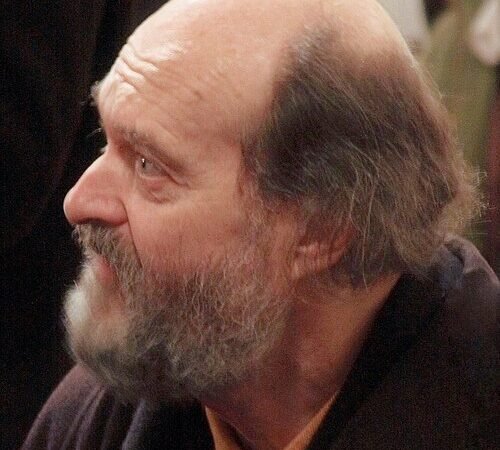
Biography (read more)
Arvo Pärt is an Estonian composer, born 11 September 1935 in Paide, who has worked since the late 1970s in a minimalist style built on tintinnabuli, a compositional technique of his own invention inspired in part by Gregorian chant. After early works in a neoclassical and then twelve-tone serialist idiom drew official Soviet censure, Pärt entered a period of contemplative silence during which he studied medieval and Renaissance polyphony, re-emerging in 1976 with the radically simplified tintinnabuli style heard in Fratres, Cantus in Memoriam Benjamin Britten, and Tabula Rasa (all 1977) and Spiegel im Spiegel (1978). Much of his later output sets sacred Latin or Church Slavonic texts, including large-scale works such as Berliner Messe, the St John Passion, and Te Deum, reflecting his 1972 conversion to Orthodox Christianity. Since 2011 he has repeatedly been named the most performed living composer in the world.
Pärt is widely regarded as the leading figure of ‘holy minimalism,’ a style he pioneered alongside contemporaries such as Henryk Górecki and John Tavener, and his tintinnabuli technique — built from simple triads and stepwise voices rung like bells — offered a radically pared-back alternative to both serialism and lush late-Romantic maximalism. His sustained standing as one of the most performed living composers in the world reflects the depth of his influence on contemporary sacred and concert music, and choral works such as Salve Regina (2001) continue to be taken up by choirs internationally for their combination of austere technique and direct emotional power.
Sources:
Repertoire
Salve Regina2001
Performed by ChoirofRoyalHolloway
Spiegel im Spiegel
Fratres | Yellow Lounge (Live from Stockholm)
Te Deum (Excerpt)
Pärt: RENDEZ-VOUS – MIRRORS: Spiegel im Spiegel (Arr. C.Thomas for Cello and Piano)— Camille Thomas
Performed by Camille Thomas
Pärt: Spiegel im Spiegel (Arr. C.Thomas for Cello and Piano)— Camille Thomas
Performed by Camille Thomas
Pärt: Credo for Piano Solo, Mixed Choir and Orchestra (Live At Sveriges Radio, Berwaldhallen,…— Hélène Grimaud
Performed by Hélène Grimaud