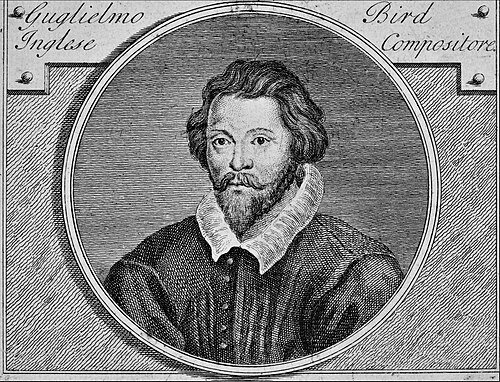
Biography (read more)
William Byrd was an English composer born around 1543, probably in Lincolnshire, who died on 4 July 1623. He was appointed organist of Lincoln Cathedral in 1563 and by 1572 had joined the Chapel Royal in London, sharing organist duties with his teacher Thomas Tallis. Despite being a devout Roman Catholic during a period of enforced Protestant conformity and recusancy laws, William Byrd retained royal favor and produced an enormous output spanning Latin masses and motets for the old faith alongside English anthems and services for the Church of England. He also excelled in secular song, keyboard music, and consort fantasias, making him one of the most versatile composers of his age.
Byrd is regarded as the greatest English composer of the late Renaissance, shaping the course of English sacred and secular music for decades. His mastery of the Latin polyphonic mass and motet, combined with pioneering keyboard and consort works, bridged Continental and English traditions, and his pupils and successors carried his influence into the next century of English composition.
Sources:
Repertoire
Ye Sacred Muses1585
Performed by Caelis Academy Ensemble
My Ladye Nevells Booke1591
Performed by Brilliant Classics
Mass for Four Voicesc. 1592
Performed by Fabrizio Nastari
Ave verum corpus1605
Performed by ЛУЧШАЯ ХОРОВАЯ МУЗЫКА
The Great Servicec. 1606
Performed by pannonia77
Sing Joyfully unto Godc. 1611
Performed by Peter Phillips & The Tallis Scholars
Byrd: The Woods so Wild – 14 Variations (Fitzwilliam 67; MB 28/85)— Kit Armstrong
Performed by Kit Armstrong
Byrd: The Maiden’s Song – 8 Variations (Fitzwilliam 126; Nevell 28; MB 28/82)— Kit Armstrong
Performed by Kit Armstrong
Byrd: John Come Kiss Me Now – 16 Variations (Fitzwilliam 10; MB 28/81)— Kit Armstrong
Performed by Kit Armstrong
Byrd: Pavan “The Earl of Salisbury” (Parthenia 6; MB 27/15a)— Kit Armstrong
Performed by Kit Armstrong
Byrd: Second Galliard “Mris Marye Brownlo” (Parthenia 8; MB 27/15c)— Kit Armstrong
Performed by Kit Armstrong
Byrd: O Mistress Mine – 6 Variations (Fitzwilliam 66; MB 28/83)— Kit Armstrong
Performed by Kit Armstrong
Byrd: The Earl of Oxford’s March (Fitzwilliam 259; Nevell 3; MB 28/93)— Kit Armstrong
Performed by Kit Armstrong
Byrd: Walsingham – 22 Variations (Fitzwilliam 68; Nevell 31; MB 27/8)— Kit Armstrong
Performed by Kit Armstrong
Liber secundus sacrarum cantionum: Laudibus in sanctis— John Eliot Gardiner
Performed by John Eliot Gardiner
Pavana and Galiarda in F Major, No. 1, ” Bray”: Galiarda— Ronn McFarlane
Performed by Ronn McFarlane
Pavan and Galliard in D Major, T 499 “Bray”: No. 1, Pavana (Arr. for Lute)— Hopkinson Smith
Performed by Hopkinson Smith
Byrd: Psalms, Sonets and Songs of Sadnes and Pietie (1588) – 1. O God give ear— Anthony Rooley
Performed by Anthony Rooley
Byrd: Psalms, Sonets and Songs of Sadnes and Pietie (1588) – 5. O Lord How Long— Anthony Rooley
Performed by Anthony Rooley
Byrd: Psalms, Sonets and Songs of Sadnes and Pietie (1588) – 17. If Women Could Be Fair— Anthony Rooley
Performed by Anthony Rooley
Byrd: Psalms, Sonets and Songs of Sadnes and Pietie (1588) – 19. What Pleasure Have Great Princes— Anthony Rooley
Performed by Anthony Rooley
Byrd: Psalms, Sonets and Songs of Sadnes and Pietie (1588) – 22. In Fields Abroad— Anthony Rooley
Performed by Anthony Rooley
Byrd: Psalms, Sonets and Songs of Sadnes and Pietie (1588) – 26. The Match That’s Made— Anthony Rooley
Performed by Anthony Rooley
Byrd: Psalms, Sonets and Songs of Sadnes and Pietie (1588) – 28. All As A Sea— Anthony Rooley
Performed by Anthony Rooley
Byrd: Psalms, Sonets and Songs of Sadnes and Pietie (1588) – 29. Susanna Fair— Anthony Rooley
Performed by Anthony Rooley
Byrd: Psalms, Sonets and Songs of Sadnes and Pietie (1588) – 31. Care For Thy Soul— Anthony Rooley
Performed by Anthony Rooley
Byrd: Psalms, Sonets and Songs of Sadnes and Pietie (1588) – 32. Lullaby— Anthony Rooley
Performed by Anthony Rooley
Byrd: Psalms, Sonets and Songs of Sadnes and Pietie (1588) – 34. Come To Me Grief— Anthony Rooley
Performed by Anthony Rooley
Byrd: Psalms, Sonets and Songs of Sadnes and Pietie (1588) – 35. O That Most Rare Breast— Anthony Rooley
Performed by Anthony Rooley
Fitzwilliam Virginal Book, No. 67: The Woods so Wild (Arr. for Baroque Ensemble by Wolfgang…— Wolfgang Katschner
Performed by Wolfgang Katschner
The Battaile: XII. The Buriing of the dead (No. 39 from Elizabeth Rogers’ Virginal Book)— Joel Cohen
Performed by Joel Cohen