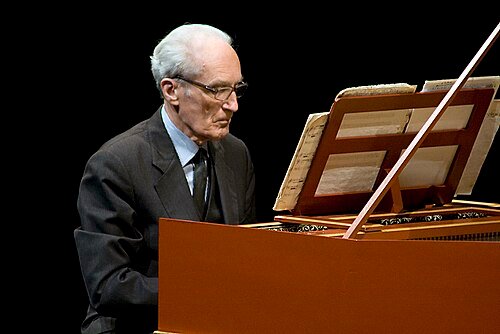
Biography (read more)
Gustav Leonhardt, born Gustav Maria Leonhardt on 30 May 1928 in ‘s-Graveland, Netherlands, died on 16 January 2012 in Amsterdam. He studied organ and harpsichord at the Schola Cantorum Basiliensis in Basel from 1947 to 1950 before making his harpsichord debut in Vienna, where he also studied musicology. Gustav Leonhardt taught at the Vienna Academy of Music and, from 1954, the Amsterdam Conservatory, and in 1955 founded the Leonhardt-Consort. A leading figure in the historically informed performance movement, he performed Renaissance and Baroque keyboard and ensemble music on period instruments, edited the standard edition of Jan Pieterszoon Sweelinck’s keyboard works, and recorded prolifically as harpsichordist, organist and conductor until retiring shortly before his death.
Gustav Leonhardt was one of the founding figures of the early-music revival, establishing period-instrument performance of Renaissance and Baroque keyboard music as a rigorous, mainstream discipline rather than a curiosity. His scholarly edition of Sweelinck’s keyboard works and his landmark recordings of Frescobaldi, Byrd and other early keyboard composers set interpretive standards still followed today. Decades of teaching at the Amsterdam Conservatory shaped generations of harpsichordists and conductors, including Ton Koopman and Christopher Hogwood.
Sources: