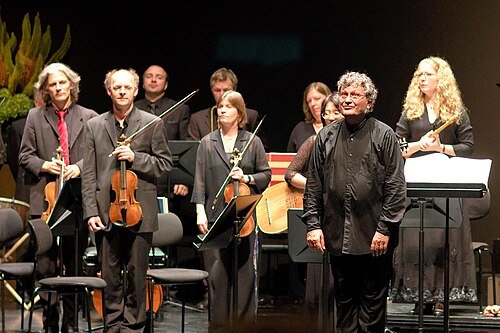
Biography (read more)
René Jacobs was born on 30 October 1946 in Ghent, Belgium, and began as a boy chorister before studying classical philology at the University of Ghent. Encouraged by the Kuijken brothers, Gustav Leonhardt and Alfred Deller, René Jacobs became one of the finest countertenors of his generation, recording rare early Baroque repertoire by composers such as Antonio Cesti and Sigismondo d’India. In 1977 he founded the ensemble Concerto Vocale to explore Baroque vocal and operatic music, and from 1983 he built a parallel career as a conductor, debuting with Cesti’s L’Orontea at the Innsbruck Festival of Early Music. He later led acclaimed recordings of Monteverdi, Handel and Mozart operas with orchestras and choirs across Europe.
René Jacobs helped define the modern performance of early Baroque opera, first as one of the era’s most admired countertenors and later as a conductor whose theatrical, text-driven interpretations of Monteverdi transformed how these works were heard. His recordings of L’Orfeo, Il ritorno d’Ulisse in patria and the Vespro della Beata Vergine are considered benchmark accounts, prized for vivid recitative and dramatic pacing. Through Concerto Vocale and the Innsbruck Festival of Early Music, he championed rediscovered 17th-century repertoire and mentored countertenors including Andreas Scholl.
Sources: