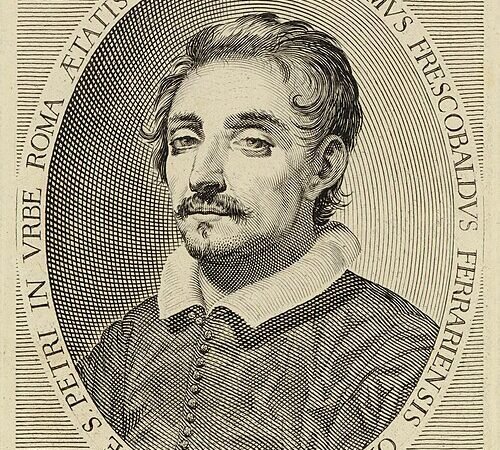
Biography (read more)
Girolamo Frescobaldi was an Italian composer and virtuoso keyboard player born in Ferrara in September 1583 and died in Rome on 1 March 1643. A child prodigy who studied under Luzzasco Luzzaschi, he was appointed organist of St. Peter’s Basilica in Rome in 1608, a post he held, with interruptions for service in Florence under the Medici, until his death. Girolamo Frescobaldi was one of the most important keyboard composers spanning the late Renaissance and early Baroque, publishing influential collections of toccatas, canzonas, and capriccios, culminating in his 1635 masterwork Fiori musicali. His pupil Johann Jakob Froberger carried his innovations north, extending his influence deep into the German Baroque tradition.
Frescobaldi transformed keyboard music from a modest imitative genre into a vehicle for bold personal expression, introducing flexible tempo, dramatic contrasts, and inventive variation techniques. His Fiori musicali remained a model of contrapuntal writing for organists into the 19th century, and his influence passed through Froberger to composers such as Buxtehude and ultimately Bach, shaping the entire North German organ tradition.
Sources:
Repertoire
Capriccio sopra la Battaglia1624
Performed by tuttalamusica
Toccata quarta, da sonarsi alla Levatione1627
Performed by incontrario motu
Aria detta la Frescobalda1627
Performed by France Musique concerts
Fiori musicali1635
Performed by symphonycafe
Cento partite sopra passacagli1637
Performed by incontrario motu
Toccate e partite d’intavolatura di cimbalo, libro primo: Partite sopra l’aria della Romanesca,…— Christophe Rousset
Performed by Christophe Rousset
Toccate e partite d’intavolatura di cimbalo, libro primo: Partite sopra l’aria di Monica, F 2.37— Christophe Rousset
Performed by Christophe Rousset
Toccate e partite d’intavolatura di cimbalo, libro primo: Partite sopra l’aria di Follia, F 2.16— Christophe Rousset
Performed by Christophe Rousset
Toccate e partite d’intavolatura di cimbalo, libro primo: Toccata prima, F 2.01— Christophe Rousset
Performed by Christophe Rousset
Toccate e partite d’intavolatura di cimbalo, libro primo: Cento partite sopra passacagli, F 2.29— Christophe Rousset
Performed by Christophe Rousset
Toccate e partite d’intavolatura di cimbalo, libro primo: Toccata nona, F 2.09— Christophe Rousset
Performed by Christophe Rousset
Toccate e partite d’intavolatura di cimbalo, libro primo: Toccata ottava, F 2.08— Christophe Rousset
Performed by Christophe Rousset
Toccate e partite d’intavolatura di cimbalo, libro primo: Toccata decima, F 2.10— Christophe Rousset
Performed by Christophe Rousset
Toccate e partite d’intavolatura di cimbalo, libro primo: Balletto terzo, corrente e…— Christophe Rousset
Performed by Christophe Rousset
Toccate e partite d’intavolatura di cimbalo, libro primo: Toccata terza, F 2.03— Christophe Rousset
Performed by Christophe Rousset
Toccate e partite d’intavolatura di cimbalo, libro primo: Toccata sesta, F 2.06— Christophe Rousset
Performed by Christophe Rousset
Toccate e partite d’intavolatura di cimbalo, libro primo: Quatro correnti, F 2.20— Christophe Rousset
Performed by Christophe Rousset
Toccate e partite d’intavolatura di cimbalo, libro primo: Toccata settima, F 2.07— Christophe Rousset
Performed by Christophe Rousset
Toccate e partite d’intavolatura di cimbalo, libro primo: Balletto e ciaccona, F 2.32— Christophe Rousset
Performed by Christophe Rousset
Toccate e partite d’intavolatura di cimbalo, libro primo: Toccata Seconda, F 2.02 (Bonus Track)— Christophe Rousset
Performed by Christophe Rousset
Toccate e partite d’intavolatura di cimbalo, libro primo: Balletto Primo, F 2.21 (Bonus Track)— Christophe Rousset
Performed by Christophe Rousset
Toccate e partite d’intavolatura di cimbalo, libro primo: Balletto Secondo, F 2.24 (Bonus Track)— Christophe Rousset
Performed by Christophe Rousset
Arie musicali, Libro 1: No. 16, Aria di Passacaglia. “Così mi disprezzate?”— Jakub Józef Orliński
Performed by Jakub Józef Orliński
Il secondo libro di toccate e canzone: Inno “Ave maris stella”— Philippe Jaroussky
Performed by Philippe Jaroussky
Il primo libro di toccate d’intavolatura di cimbalo: Toccata prima— Scott Ross
Performed by Scott Ross
Il primo libro di toccate d’intavolatura di cimbalo: Toccata ottava— Scott Ross
Performed by Scott Ross
Il primo libro di toccate d’intavolatura di cimbalo: Toccata nona— Scott Ross
Performed by Scott Ross
Il primo libro di toccate d’intavolatura di cimbalo: Toccata decima— Scott Ross
Performed by Scott Ross
Il primo libro di toccate d’intavolatura di cimbalo: Partite sopra l’aria della Romanesca: Nona…— Scott Ross
Performed by Scott Ross
Il secondo libro di toccate: Aria detto Balletto: Ottava e ultima parte— Scott Ross
Performed by Scott Ross
Corente del Baletto, F 2.22 (Arr. for Harp and Baroque Guitar)— Eduardo Egüez
Performed by Eduardo Egüez
Toccata per l’elevatione, F 13.04 (Version Played on Harp)— Eduardo Egüez
Performed by Eduardo Egüez
Toccate e partite d’intavolatura, Libro II: Corrente prima (Arr. for Guitar)— Konrad Ragossnig
Performed by Konrad Ragossnig
Toccate e partite d’intavolatura, Libro II: Aria detta la Frescobalda (Arr. for Guitar)— Konrad Ragossnig
Performed by Konrad Ragossnig
Toccate e partite d’intavolatura, Libro I: Corrente prima (Arr. for Guitar)— Konrad Ragossnig
Performed by Konrad Ragossnig
Toccate e partite d’intavolatura, Libro II: Gagliarda seconda (Arr. for Guitar)— Konrad Ragossnig
Performed by Konrad Ragossnig
Toccate e partite d’intavolatura, Libro I: Cento partite sopra passacagli (Arr. for Guitar)— Konrad Ragossnig
Performed by Konrad Ragossnig
Toccate e partite d’intavolatura, Libro I: Corrente quarta (Arr. for Guitar)— Konrad Ragossnig
Performed by Konrad Ragossnig
Toccate e partite d’intavolatura, Libro 2: Aria detta la Frescobalda (Perf. by Guitar and Organ)— Konrad Ragossnig
Performed by Konrad Ragossnig
Canzona vigesimaprima detta la tegrimuccia, a due, canto e basso— Ugo Nastrucci
Performed by Ugo Nastrucci
Canzona decimaottava detta la masotti, a due, canto e basso— Ugo Nastrucci
Performed by Ugo Nastrucci
Canzona decimanona detta la capriola, a due, canto e basso— Ugo Nastrucci
Performed by Ugo Nastrucci
Canzona seconda detta la bernardina, a canto solo come sta— Ugo Nastrucci
Performed by Ugo Nastrucci
Canzona terza detta la donatina, a canto solo come sta No.4— Ugo Nastrucci
Performed by Ugo Nastrucci
Canzona vigesimaterza detta la franciotta, a due, canto e basso— Ugo Nastrucci
Performed by Ugo Nastrucci
Canzona vigesima detta la lipparella, a due, canto e basso— Ugo Nastrucci
Performed by Ugo Nastrucci
Canzona vigesimaseconda detta la nicollina, a due, canto e basso— Ugo Nastrucci
Performed by Ugo Nastrucci