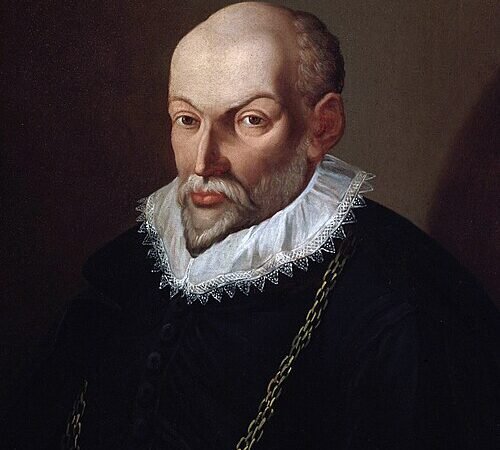
Biography (read more)
Orlando di Lasso, also known as Orlande de Lassus, was a Franco-Flemish composer of the late Renaissance, born around 1532 in Mons in the County of Hainaut and died 14 June 1594 in Munich. After early years in Mantua, Naples, and Rome — where he briefly served as maestro di cappella of St. John Lateran — he joined the court of Duke Albrecht V of Bavaria in Munich in 1556 and remained there for the rest of his career, eventually becoming maestro di cappella. Immensely prolific, Orlando di Lasso wrote more than 2,000 works across Latin, Italian, French, and German genres, including over 530 motets. Emperor Maximilian II ennobled him in 1570, reflecting his extraordinary international fame.
Lasso stands alongside Palestrina and Victoria as one of the supreme masters of late Renaissance polyphony, but distinguished himself through unmatched versatility across languages and secular and sacred genres. His boldly chromatic works, such as the Prophetiae Sibyllarum, anticipated harmonic experiments not fully explored again until centuries later, while his madrigals, motets, and chansons circulated across Europe and influenced generations of continental composers.
Sources:
Repertoire
Prophetiae Sibyllarumc. 1560
Performed by Francisco Parralejo Masa
Susanne un jourc. 1560
Performed by cesarsalgado1972
Timor et tremor1564
Performed by Edward Murray
Matona mia cara1581
Performed by Francisco Parralejo Masa
Psalmi Davidis poenitentiales (Penitential Psalms)1584
Performed by Classical Music/ /Reference Recording
Lagrime di San Pietro1594
Performed by Edoardo Lambertenghi
Io ti vorria contar, LV 658 (Transcr. for Lutes by Evangelina Mascardi)— Evangelina Mascardi
Performed by Evangelina Mascardi
Quand mon mary, LV 153 (Transcr. for Solo Lute by Jean‑Baptiste Besard)— Evangelina Mascardi
Performed by Evangelina Mascardi
Madonna mia pietà, LV 30 (Transcr. for Lutes by Evangelina Mascardi)— Evangelina Mascardi
Performed by Evangelina Mascardi
Du corps absent, LV 171 (Transcr. for Lutes by Evangelina Mascardi)— Evangelina Mascardi
Performed by Evangelina Mascardi
Avecques vous mon amour, LV 38 (Transcr. for Solo Lute by Melchior Neusidler)— Evangelina Mascardi
Performed by Evangelina Mascardi
La nuict froide et sombre, LV 578 (Transcr. for Lutes by Evangelina Mascardi)— Evangelina Mascardi
Performed by Evangelina Mascardi
Veni in hortum meum, LV 114 (Transcr. for Solo Lute by Giovanni Antonio Terzi)— Evangelina Mascardi
Performed by Evangelina Mascardi
Moduli quinis vocibus: No. 3, Verba mea auribus, Pt. 2. Quoniam ad te orabo— Jordi Savall
Performed by Jordi Savall
Moduli quinis vocibus: No. 4, Pater Abraham miserere mei, Pt. 2. Fili recordare— Jordi Savall
Performed by Jordi Savall
Moduli quinis vocibus: No. 7, Stabunt iusti in magna canstantia, Pt. 2. Hi sunt quos habuimus— Jordi Savall
Performed by Jordi Savall
Moduli quinis vocibus: No. 8, Veni dilecte mi, Pt. 2. Videamus si floruit— Jordi Savall
Performed by Jordi Savall
Moduli quinis vocibus: No. 9, Quid prodest homini si mundum, Pt. 2. Futurum est enim— Jordi Savall
Performed by Jordi Savall