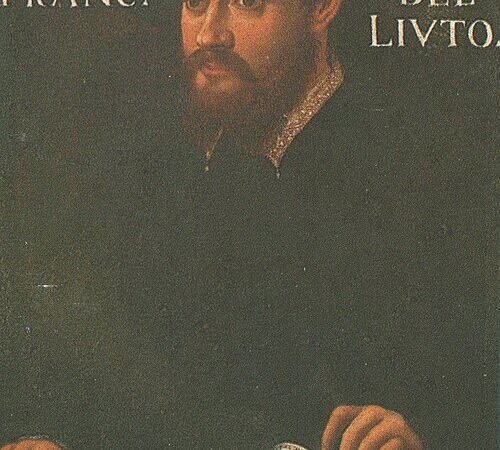
Biography (read more)
Francesco da Milano was an Italian lutenist and composer born on 18 August 1497 near Milan, in Monza, and died on 2 January 1543. He trained in Milan before joining the papal household in Rome by 1514, becoming a private musician to Pope Leo X in 1516 and remaining closely tied to the papal court for most of his career. He later served Cardinal Ippolito de’ Medici and taught lute to Ottavio Farnese, grandson of Pope Paul III. Contemporaries across Europe dubbed him “Il Divino” for his extraordinary skill. More of his music survives than that of any other lutenist of his generation, comprising over a hundred ricercars, fantasias, and intabulations of vocal works.
Francesco da Milano is widely regarded as the greatest lute virtuoso of the sixteenth century and the composer most responsible for elevating the lute from an accompanying instrument into a vehicle for serious solo art music. His ricercars and fantasias pioneered monothematic contrapuntal writing on the lute, influencing generations of Italian, French, and Spanish lutenist-composers, including Narváez, who collected his works. His pieces remained central to the European lute repertoire for over a century after his death.
Sources:
Repertoire
Fantasiac. 1530s
Performed by Hopkinson Smith, Mountains, Water and Music
Ricercarc. 1530s
Performed by namosluteguitar, Lute Society of America
Fantasia (Ness 30)c. 1530s-40s
Performed by Quill Classics, Enrico Zanoni
Recercar & Fantasia on “De mon triste desplaisir”c. 1530s-40s
Performed by Lute Society of America
Fantasia (N21)c. 1530s-40s
Performed by Paul Kieffer
Tiento de vihuela I— Evangelina Mascardi
Performed by Evangelina Mascardi
La Compagna— Xavier Díaz-Latorre
Performed by Xavier Díaz-Latorre
Esordio: La compagna— Xavier Díaz-Latorre
Performed by Xavier Díaz-Latorre
Canto I, Fortuna innamorata: Recercata XII— Xavier Díaz-Latorre
Performed by Xavier Díaz-Latorre
Canto I, Fortuna innamorata: Le plus gorgias du monde— Xavier Díaz-Latorre
Performed by Xavier Díaz-Latorre
Canto I, Fortuna innamorata: Recercata XIII— Xavier Díaz-Latorre
Performed by Xavier Díaz-Latorre
Canto I, Fortuna innamorata: Recercata XXVI— Xavier Díaz-Latorre
Performed by Xavier Díaz-Latorre
Canto II, Saggia fortuna: Recercata V— Xavier Díaz-Latorre
Performed by Xavier Díaz-Latorre
Canto II, Saggia fortuna: Recercata VI— Xavier Díaz-Latorre
Performed by Xavier Díaz-Latorre
Canto II, Saggia fortuna: Recercata VII— Xavier Díaz-Latorre
Performed by Xavier Díaz-Latorre
Canto II, Saggia fortuna: Recercata XXII— Xavier Díaz-Latorre
Performed by Xavier Díaz-Latorre
Canto II, Saggia fortuna: Recercata VIII— Xavier Díaz-Latorre
Performed by Xavier Díaz-Latorre
Canto III, Sconsolata fortuna: Recercata XVII— Xavier Díaz-Latorre
Performed by Xavier Díaz-Latorre
Canto III, Sconsolata fortuna: La sua fantasia (De mon triste)— Xavier Díaz-Latorre
Performed by Xavier Díaz-Latorre
Canto IV, Fortuna serena: Recercata I— Xavier Díaz-Latorre
Performed by Xavier Díaz-Latorre
Canto IV, Fortuna serena: Recercata II— Xavier Díaz-Latorre
Performed by Xavier Díaz-Latorre
Canto IV, Fortuna serena: Recercata III— Xavier Díaz-Latorre
Performed by Xavier Díaz-Latorre
Canto IV, Fortuna serena: Recercata IV— Xavier Díaz-Latorre
Performed by Xavier Díaz-Latorre
Canto V, Tormentata fortuna: Recercata XXV— Xavier Díaz-Latorre
Performed by Xavier Díaz-Latorre
Canto V, Tormentata fortuna: Fort se lament— Xavier Díaz-Latorre
Performed by Xavier Díaz-Latorre
Canto VI, Devota fortuna: Que voles vous dire de moy— Xavier Díaz-Latorre
Performed by Xavier Díaz-Latorre
Canto VI, Devota fortuna: Recercata XXIV— Xavier Díaz-Latorre
Performed by Xavier Díaz-Latorre
Canto VI, Devota fortuna: Recercata XV— Xavier Díaz-Latorre
Performed by Xavier Díaz-Latorre
Canto VI, Devota fortuna: Recercata XVI— Xavier Díaz-Latorre
Performed by Xavier Díaz-Latorre
Canto VI, Devota fortuna: Recercata XIV— Xavier Díaz-Latorre
Performed by Xavier Díaz-Latorre
Canto VII, Fiduciosa fortuna: Recercata XI— Xavier Díaz-Latorre
Performed by Xavier Díaz-Latorre
Canto VII, Fiduciosa fortuna: Recercata XXVII— Xavier Díaz-Latorre
Performed by Xavier Díaz-Latorre
Canto VII, Fiduciosa fortuna: Recercata XXVIII— Xavier Díaz-Latorre
Performed by Xavier Díaz-Latorre
Canto VII, Fiduciosa fortuna: Nous bergières— Xavier Díaz-Latorre
Performed by Xavier Díaz-Latorre
Canto VIII, Fortuna rassegnata: Recercata XXIII— Xavier Díaz-Latorre
Performed by Xavier Díaz-Latorre
Canto VIII, Fortuna rassegnata: Recercata X— Xavier Díaz-Latorre
Performed by Xavier Díaz-Latorre
Canto VIII, Fortuna rassegnata: Recercata IX— Xavier Díaz-Latorre
Performed by Xavier Díaz-Latorre
Canto VIII, Fortuna rassegnata: Recercata XXI— Xavier Díaz-Latorre
Performed by Xavier Díaz-Latorre
Epilogo: Las ye mi plains— Xavier Díaz-Latorre
Performed by Xavier Díaz-Latorre
Fantasia de mon triste— Paul O’Dette
Performed by Paul O'Dette
Fantasia No. 33— Eduardo Egüez
Performed by Eduardo Egüez
Fantasia 38— Eduardo Egüez
Performed by Eduardo Egüez
Fantasia (38)— Paul O’Dette
Performed by Paul O'Dette
Fantasia No. 34 “La compagna”— Hopkinson Smith
Performed by Hopkinson Smith
Fantasia No. 34 “La compagna”— Jakob Lindberg
Performed by Jakob Lindberg
Fantasia No. 33— Jakob Lindberg
Performed by Jakob Lindberg
Fantasia (56)— Paul O’Dette
Performed by Paul O'Dette
Fantasia #56— Paul O’Dette
Performed by Paul O'Dette
Fantasia (39)— Paul O’Dette
Performed by Paul O'Dette
Fantasia #39— Paul O’Dette
Performed by Paul O'Dette
Ricercar (13)— Paul O’Dette
Performed by Paul O'Dette
Ricercar #13— Paul O’Dette
Performed by Paul O'Dette
Fantasia (83)— Paul O’Dette
Performed by Paul O'Dette
Fantasia #83— Paul O’Dette
Performed by Paul O'Dette
Fantasia I in C Minor— Julian Bream
Performed by Julian Bream
Fantasia II in F— Julian Bream
Performed by Julian Bream
Fantasia III in G Minor— Julian Bream
Performed by Julian Bream
Fantasia IV (La Campagna)— Julian Bream
Performed by Julian Bream
Fantasia V in C— Julian Bream
Performed by Julian Bream
Fantasia VI in F— Julian Bream
Performed by Julian Bream
Fantasia VII in F— Julian Bream
Performed by Julian Bream
Fantasia VIII in G— Julian Bream
Performed by Julian Bream
Intavolatura de viola o vero lauto … libro primo: Ricercar No. 51— Ronn McFarlane
Performed by Ronn McFarlane
Intavolatura de viola o vero lauto … libro primo: Ricercar No. 16— Ronn McFarlane
Performed by Ronn McFarlane
Intavolatura de viola o vero lauto … libro primo: Ricercar No. 33— Ronn McFarlane
Performed by Ronn McFarlane
Intavolatura de viola o vero lauto … libro primo: Ricercar No. 34— Ronn McFarlane
Performed by Ronn McFarlane
O bone Jesu (arr. F. da Milano for lute) : O Bone Jesu— Ronn McFarlane
Performed by Ronn McFarlane
Fantasia (3)— Paul O’Dette
Performed by Paul O'Dette
Fantasia (App. 31)— Paul O’Dette
Performed by Paul O'Dette
Fantasia (64)— Paul O’Dette
Performed by Paul O'Dette
Fantasia (16)— Paul O’Dette
Performed by Paul O'Dette
Fantasia (40)— Paul O’Dette
Performed by Paul O'Dette
Fantasia (58)— Paul O’Dette
Performed by Paul O'Dette
Ricercar (4)— Paul O’Dette
Performed by Paul O'Dette
Ricercar (8)— Paul O’Dette
Performed by Paul O'Dette
Fantasia (41)— Paul O’Dette
Performed by Paul O'Dette
Fantasia (20)— Paul O’Dette
Performed by Paul O'Dette
Fantasia (21)— Paul O’Dette
Performed by Paul O'Dette
Ricercar (51)— Paul O’Dette
Performed by Paul O'Dette
Fantasia (30)— Paul O’Dette
Performed by Paul O'Dette
Ricercar (5)— Paul O’Dette
Performed by Paul O'Dette
Fantasia (28)— Paul O’Dette
Performed by Paul O'Dette
Fantasia (66)— Paul O’Dette
Performed by Paul O'Dette
Ricercar (10)— Paul O’Dette
Performed by Paul O'Dette
Fantasia (63)— Paul O’Dette
Performed by Paul O'Dette
Fantasia (33)— Paul O’Dette
Performed by Paul O'Dette
Fantasia (34) “La Compagna”— Paul O’Dette
Performed by Paul O'Dette
Fantasia [Castelfranco Manuscript]— Paul O’Dette
Performed by Paul O'Dette
Pourquoy allez-fous seullette (Anon., Arr. Milano)— Paul O’Dette
Performed by Paul O'Dette
Fantasia #26— Paul O’Dette
Performed by Paul O'Dette
Fantasia #8— Paul O’Dette
Performed by Paul O'Dette
Fantasia dolcissima et amorosa— Paul O’Dette
Performed by Paul O'Dette
Intabolatura de lauto: Ricercar No. 4 (Fantasia)— Paul O’Dette
Performed by Paul O'Dette
Intabolatura de lauto: Ricercar No. 3 (Fantasia)— Paul O’Dette
Performed by Paul O'Dette
Intabolatura de lauto: Fantasia No. 21— Paul O’Dette
Performed by Paul O'Dette
Intabolatura de lauto: Mon per si ma marie— Paul O’Dette
Performed by Paul O'Dette
Intabolatura de lauto: Fantasia No. 38— Paul O’Dette
Performed by Paul O'Dette
Intabolatura de lauto: Ricercar No. 5— Paul O’Dette
Performed by Paul O'Dette
Intabolatura de lauto: Reueillez moy— Paul O’Dette
Performed by Paul O'Dette
Intabolatura de lauto: Fantasia No. 81— Paul O’Dette
Performed by Paul O'Dette
Intabolatura de lauto: Fantasia No. 64— Paul O’Dette
Performed by Paul O'Dette
Intabolatura de lauto: O bone Yhesu— Paul O’Dette
Performed by Paul O'Dette
Intabolatura de lauto: Fantasia No. 40— Paul O’Dette
Performed by Paul O'Dette
Intabolatura de lauto: De mon triste desplaisir— Paul O’Dette
Performed by Paul O'Dette
Intabolatura de lauto: Fantasia de mon triste No. 36— Paul O’Dette
Performed by Paul O'Dette
Intabolatura de lauto: Chi uoleno dir de moy— Paul O’Dette
Performed by Paul O'Dette
Intabolatura de lauto: Vignon uignetta— Paul O’Dette
Performed by Paul O'Dette
Intabolatura de lauto: Fantasia No. 41— Paul O’Dette
Performed by Paul O'Dette
Intabolatura de lauto: Fantasia No. 66— Paul O’Dette
Performed by Paul O'Dette
Intabolatura de lauto: Fantasia No. 28— Paul O’Dette
Performed by Paul O'Dette
Intabolatura de lauto: Fantasia No. 51— Paul O’Dette
Performed by Paul O'Dette
Intabolatura de lauto: Fantasia No. 30— Paul O’Dette
Performed by Paul O'Dette
Intabolatura de lauto: Ricercar No. 16— Paul O’Dette
Performed by Paul O'Dette
Intabolatura de lauto: Ricercar No. 10— Paul O’Dette
Performed by Paul O'Dette
Intabolatura de lauto: Fort se lament— Paul O’Dette
Performed by Paul O'Dette
Intabolatura de lauto: Quand’io penso al martir— Paul O’Dette
Performed by Paul O'Dette
Intabolatura de lauto: Tu discois que je mourroye— Paul O’Dette
Performed by Paul O'Dette
Intabolatura de lauto: Fantasia No. 33— Paul O’Dette
Performed by Paul O'Dette
Intabolatura de lauto: Ricercar No. 34 “La compagna”— Paul O’Dette
Performed by Paul O'Dette
3 Fantasias— Nigel North
Performed by Nigel North
Ricercare— Nigel North
Performed by Nigel North
Fantasia No. 30 dal secondo tono— Hopkinson Smith
Performed by Hopkinson Smith
Recercar No. 5 dal quinto tono— Hopkinson Smith
Performed by Hopkinson Smith
Fantasia No. 64 dal primo tono— Hopkinson Smith
Performed by Hopkinson Smith
Saltarello (Reconstruction)— Hopkinson Smith
Performed by Hopkinson Smith
Recercar No. 3 dal settimo tono— Hopkinson Smith
Performed by Hopkinson Smith
Recercar No. 51 dal quarto tono— Hopkinson Smith
Performed by Hopkinson Smith
Recercar No. 41 dal quinto tono— Hopkinson Smith
Performed by Hopkinson Smith
Ballo ‘doma la donna se solo si sona’— Hopkinson Smith
Performed by Hopkinson Smith
Fantasia No. 55 “La piu bella e divina a che abbia flatto”— Hopkinson Smith
Performed by Hopkinson Smith
Fantasia No. 36 “De mon triste”— Hopkinson Smith
Performed by Hopkinson Smith
Plus de tristesse, prends ta maitresse (Ballo)— Hopkinson Smith
Performed by Hopkinson Smith
Recercar No. 28 dal quinto tono— Hopkinson Smith
Performed by Hopkinson Smith
Fantasia No. 39 dal quinto tono— Hopkinson Smith
Performed by Hopkinson Smith
Recercar No. 2 dal ottavo tono— Hopkinson Smith
Performed by Hopkinson Smith
Sola la dolce sirena (Reconstruction)— Hopkinson Smith
Performed by Hopkinson Smith
Fantasia No. 40 dal ottavo tono— Hopkinson Smith
Performed by Hopkinson Smith
Fantasia No. 33 sopra mi-fa-mi— Hopkinson Smith
Performed by Hopkinson Smith
Mi fato e miserabil sorte (Pavana) (Reconstruction)— Hopkinson Smith
Performed by Hopkinson Smith
Ricercar No. 3— Jakob Lindberg
Performed by Jakob Lindberg
Ricercar No. 51— Jakob Lindberg
Performed by Jakob Lindberg
Fantasia No. 15— Jakob Lindberg
Performed by Jakob Lindberg
Fantasia No. 22— Jakob Lindberg
Performed by Jakob Lindberg
Fantasia No. 66— Jakob Lindberg
Performed by Jakob Lindberg
Fantasia No. 55— Jakob Lindberg
Performed by Jakob Lindberg
Fantasia No. 42: Fantasia (No. 42)— Jakob Lindberg
Performed by Jakob Lindberg
Fantasia No. 38: Fantasia (No. 38)— Jakob Lindberg
Performed by Jakob Lindberg
Intavolatura de viola o vero lauto … Libro terzo: Fantasia (No. 30)— Jakob Lindberg
Performed by Jakob Lindberg
Fantasia No. 31: Fantasia (No. 31)— Jakob Lindberg
Performed by Jakob Lindberg
Fantasia (33) – Recercar [51] – Recercar [16] – Fantasia [64] – Fantasia [28]— Jakob Lindberg
Performed by Jakob Lindberg
Fantasia no. 33— Peter Croton
Performed by Peter Croton
Fantasia No. 33— Massimo Lonardi
Performed by Massimo Lonardi
Fantasia No. 33— Paul Beier
Performed by Paul Beier
Fantasia no. 40— Peter Croton
Performed by Peter Croton
Fantasia No. 40— Massimo Lonardi
Performed by Massimo Lonardi
Fantasia No. 40— Paul Beier
Performed by Paul Beier
Fantasia No. 40— Joachim Held
Performed by Joachim Held
Fantasia no. 30— Peter Croton
Performed by Peter Croton
Fantasia No. 30— Massimo Lonardi
Performed by Massimo Lonardi
Fantasia No. 30— Paul Beier
Performed by Paul Beier
Fantasia No. 30— Joachim Held
Performed by Joachim Held
Fantasia (38)— Peter Croton
Performed by Peter Croton
Fantasia No. 32— Massimo Lonardi
Performed by Massimo Lonardi
Fantasia No. 32— Paul Beier
Performed by Paul Beier
Fantasia No. 32— Joachim Held
Performed by Joachim Held
Ricercar (4)— Peter Croton
Performed by Peter Croton
Fantasia (33)— Peter Croton
Performed by Peter Croton
Fantasia (40)— Peter Croton
Performed by Peter Croton
Ricercar (51)— Peter Croton
Performed by Peter Croton
Fantasia no. 67— Peter Croton
Performed by Peter Croton
Fantasia No. 67— Massimo Lonardi
Performed by Massimo Lonardi
Fantasia no. 81— Peter Croton
Performed by Peter Croton
Fantasia No. 81— Massimo Lonardi
Performed by Massimo Lonardi
Ricercare No. 11— Massimo Lonardi
Performed by Massimo Lonardi
Ricercare No. 11— Joachim Held
Performed by Joachim Held
Ricercare No. 51— Massimo Lonardi
Performed by Massimo Lonardi
Ricercare No. 51— Joachim Held
Performed by Joachim Held
Fantasia No. 41— Massimo Lonardi
Performed by Massimo Lonardi
Fantasia No. 41— Paul Beier
Performed by Paul Beier
Fantasia No. 42— Paul Beier
Performed by Paul Beier
Francesco da Milano: Fantasia No. 42— Anthony Rooley
Performed by Anthony Rooley
Intavolatura de Viola o vero lauto, libro primo: Ricercar No. 16— Paul Beier
Performed by Paul Beier
Fantasia No. 22— Joachim Held
Performed by Joachim Held
Fantasia No. 6— Walter Gerwig
Performed by Walter Gerwig
Ricercar (2)— Peter Croton
Performed by Peter Croton
Fantasia (34)— Peter Croton
Performed by Peter Croton
Ricercar (16)— Peter Croton
Performed by Peter Croton
Fantasia (15)— Peter Croton
Performed by Peter Croton
Fantasia (32, 31 & 61)— Peter Croton
Performed by Peter Croton
Fantasia (67)— Peter Croton
Performed by Peter Croton
Ricercar (91)— Peter Croton
Performed by Peter Croton
Ricercar (84)— Peter Croton
Performed by Peter Croton
Fantasia (82)— Peter Croton
Performed by Peter Croton
Ricercar no. 84— Peter Croton
Performed by Peter Croton
Ricercar no. 15— Peter Croton
Performed by Peter Croton
Fantasia no. 82— Peter Croton
Performed by Peter Croton
Ricercar no. 2— Peter Croton
Performed by Peter Croton
Ricercare per liuto solo No. 1— Massimo Lonardi
Performed by Massimo Lonardi
Ricercare per liuto solo No. 2— Massimo Lonardi
Performed by Massimo Lonardi
Ricercare per liuto solo No. 3— Massimo Lonardi
Performed by Massimo Lonardi
Ricercare per liuto solo No. 4— Massimo Lonardi
Performed by Massimo Lonardi
Ricercare per liuto solo No. 5— Massimo Lonardi
Performed by Massimo Lonardi
Fantasia (Lute Only)— Massimo Lonardi
Performed by Massimo Lonardi
Francesco da Milano : Ricercare, No. 91, C.XXVII— Massimo Lonardi
Performed by Massimo Lonardi
Francesco da Milano : Ricercare, No. 12, C.II— Massimo Lonardi
Performed by Massimo Lonardi
Francesco da Milano : Ricercare, No. 912, C.XII— Massimo Lonardi
Performed by Massimo Lonardi
Francesco da Milano : Ricercare, No. 9, C.IX— Massimo Lonardi
Performed by Massimo Lonardi
Ricercare No. 52— Massimo Lonardi
Performed by Massimo Lonardi
Ricercare No. 85— Massimo Lonardi
Performed by Massimo Lonardi
Ricercare No. 7— Massimo Lonardi
Performed by Massimo Lonardi
Ricercare No. 84— Massimo Lonardi
Performed by Massimo Lonardi
Ricercare No. 70— Massimo Lonardi
Performed by Massimo Lonardi
Fantasia No. 28— Massimo Lonardi
Performed by Massimo Lonardi
Ricercare No. 4— Massimo Lonardi
Performed by Massimo Lonardi
Ricercare No. 2— Massimo Lonardi
Performed by Massimo Lonardi
Toccata del divino Fran. da Milano— Massimo Lonardi
Performed by Massimo Lonardi
Ricercare No. 16— Massimo Lonardi
Performed by Massimo Lonardi
Ricercare No. 64 “La Compagna”— Massimo Lonardi
Performed by Massimo Lonardi
Fantasia No. 6 (Arr. for Lute & Organ)— Konrad Ragossnig
Performed by Konrad Ragossnig
Recercate concertante sulla Fantasia di M. Milanese la quarta (Perf. by Lute and Organ)— Konrad Ragossnig
Performed by Konrad Ragossnig
Francesco da Milano: Lute music – Italy: Fantasia— Konrad Ragossnig
Performed by Konrad Ragossnig
Fantasia No. 13— Paul Beier
Performed by Paul Beier
Fantasia la compagna— Paul Beier
Performed by Paul Beier
Quand’io pens’al martire (Arr. F. da Milano for Lute)— Paul Beier
Performed by Paul Beier
Fantasia No. 38— Paul Beier
Performed by Paul Beier
Fantasia No. 35— Paul Beier
Performed by Paul Beier
Intavolatura de Viola o vero lauto, libro primo: Ricercar No. 11— Paul Beier
Performed by Paul Beier
Intavolatura de Viola o vero lauto, libro primo: Ricercar No. 12— Paul Beier
Performed by Paul Beier
Intavolatura de Viola o vero lauto, libro primo: Le plus gorgais du monde— Paul Beier
Performed by Paul Beier
Intavolatura de Viola o vero lauto, libro primo: Ricercar No. 14— Paul Beier
Performed by Paul Beier
Intavolatura de Viola o vero lauto, libro primo: Fantasia No. 15— Paul Beier
Performed by Paul Beier
Intavolatura de Viola o vero lauto, libro primo: Tu discois que je mourroye— Paul Beier
Performed by Paul Beier
Intavolatura de Viola o vero lauto, libro primo: Ricercar No. 8— Paul Beier
Performed by Paul Beier
Intavolatura de Viola o vero lauto, libro primo: Las, Ye Me Plains— Paul Beier
Performed by Paul Beier
Intavolatura de Viola o vero lauto, libro primo: Ricercar No. 5— Paul Beier
Performed by Paul Beier
Intavolatura de Viola o vero lauto, libro primo: Ricercar No. 19— Paul Beier
Performed by Paul Beier
Intavolatura de Viola o vero lauto, libro primo: O Bone Yhesu— Paul Beier
Performed by Paul Beier
Intavolatura de Viola o vero lauto, libro primo: Ricercar No. 3— Paul Beier
Performed by Paul Beier
Intavolatura de Viola o vero lauto, libro primo: Ricercar No. 13— Paul Beier
Performed by Paul Beier
Intavolatura de Viola o vero lauto, libro primo: Restovit, Arrangement of Jean Mouton’s…— Paul Beier
Performed by Paul Beier
Intavolatura de Viola o vero lauto, libro primo: Ricercar No. 10— Paul Beier
Performed by Paul Beier
Intavolatura de Viola o vero lauto, libro primo: Ricercar No. 7— Paul Beier
Performed by Paul Beier
Intavolatura de Viola o vero lauto, libro primo: Ricercar No. 6— Paul Beier
Performed by Paul Beier
Intavolatura de Viola o vero lauto, libro primo: Can gieto fu marie, Arrangement of Quand…— Paul Beier
Performed by Paul Beier
Intavolatura de Viola o vero lauto, libro primo: Ricercar No. 4— Paul Beier
Performed by Paul Beier
Intavolatura de Viola o vero lauto, libro primo: Chi voleno dir de moy— Paul Beier
Performed by Paul Beier
Intavolatura de Viola o vero lauto, libro primo: Ricercar No. 18— Paul Beier
Performed by Paul Beier
Intavolatura de Viola o vero lauto, libro primo: Mon per si ma marie— Paul Beier
Performed by Paul Beier
Intavolatura de Viola o vero lauto, libro primo: Ricercar No. 2— Paul Beier
Performed by Paul Beier
Intavolatura de Viola o vero lauto, libro primo: Pourquoy Allez-Voux Seullette— Paul Beier
Performed by Paul Beier
Intavolatura de Viola o vero lauto, libro primo: Ricercar No. 9— Paul Beier
Performed by Paul Beier
Intavolatura de Viola o vero lauto, libro primo: Ricercar No. 17— Paul Beier
Performed by Paul Beier
Francesco da Milano: Ricercar No. 13— Anthony Rooley
Performed by Anthony Rooley
Ricercare No. 12— Joachim Held
Performed by Joachim Held
Ricercare No. 1— Joachim Held
Performed by Joachim Held
Ricercare No. 5— Joachim Held
Performed by Joachim Held
Ricercare No. 6— Joachim Held
Performed by Joachim Held
Fantasia No. 64— Joachim Held
Performed by Joachim Held
Fantasia No. 27— Joachim Held
Performed by Joachim Held
Tochata— Joachim Held
Performed by Joachim Held
Ricercare No. 15— Joachim Held
Performed by Joachim Held
Fantasia No. 30— Yavor Genov
Performed by Yavor Genov
Fantasia No. 34 “La Compagna”— Yavor Genov
Performed by Yavor Genov
Fantasia No. 22— Paolo Cherici
Performed by Paolo Cherici
Fantasia (56)— Shirley Rumsey
Performed by Shirley Rumsey
Fantasia (83)— Shirley Rumsey
Performed by Shirley Rumsey
Ricercar (13)— Shirley Rumsey
Performed by Shirley Rumsey
Intabolatura de lauto: Fantasia No. 33— Yavor Genov
Performed by Yavor Genov
Ricercare No. 1— Yavor Genov
Performed by Yavor Genov
Ricercare No. 2— Yavor Genov
Performed by Yavor Genov
Ricercare No. 4— Yavor Genov
Performed by Yavor Genov
Ricercare No. 5— Yavor Genov
Performed by Yavor Genov
Ricercare No. 6— Yavor Genov
Performed by Yavor Genov
Ricercare No. 7— Yavor Genov
Performed by Yavor Genov
Canon— Lynda Sayce
Performed by Lynda Sayce
Canon— Shirley Rumsey
Performed by Shirley Rumsey
Tochata— Paolo Cherici
Performed by Paolo Cherici
Ricercar No. 51— Massimo Marchese
Performed by Massimo Marchese
Fantasia 16— Shirley Rumsey
Performed by Shirley Rumsey
Ricercar 84— Shirley Rumsey
Performed by Shirley Rumsey
Ricercar (2)— Shirley Rumsey
Performed by Shirley Rumsey
Fantasia (82)— Shirley Rumsey
Performed by Shirley Rumsey
Fantasia (63)— Shirley Rumsey
Performed by Shirley Rumsey
Fantasia (30)— Shirley Rumsey
Performed by Shirley Rumsey
Fantasia (64)— Shirley Rumsey
Performed by Shirley Rumsey
Fantasia (67)— Shirley Rumsey
Performed by Shirley Rumsey
Fantasia (66)— Shirley Rumsey
Performed by Shirley Rumsey
Ricercar (10)— Shirley Rumsey
Performed by Shirley Rumsey
Libro de sonata diverse: XI. Fuga— Ugo Nastrucci
Performed by Ugo Nastrucci
Libro de sonata diverse: XV. Fuga (2)— Ugo Nastrucci
Performed by Ugo Nastrucci
Ricercare No. 3— Yavor Genov
Performed by Yavor Genov
Ricercare No. 8— Yavor Genov
Performed by Yavor Genov
Ricercare No. 9— Yavor Genov
Performed by Yavor Genov
Ricercare No. 10— Yavor Genov
Performed by Yavor Genov
La Spagna— Lynda Sayce
Performed by Lynda Sayce
Intavolatura de viola o vero lauto … libro settimo: Ricercar No. 51— Lynda Sayce
Performed by Lynda Sayce
Fantasia No. 21— Paolo Cherici
Performed by Paolo Cherici
Fantasia No. 20— Paolo Cherici
Performed by Paolo Cherici
Ricercare XII (Ness 3 – Chiesa Ricercare III) – Vihuela— Paolo Cherici
Performed by Paolo Cherici
Vignon vignetta – Vihuela— Paolo Cherici
Performed by Paolo Cherici
Ricercare XV (N. 51 – C.Ri XXXVIII) – Vihuela— Paolo Cherici
Performed by Paolo Cherici
Ricercare XVI (N. 30 – C. Fantazia X) – Liuto— Paolo Cherici
Performed by Paolo Cherici
Ricercare XXVII (N. 38 – C.Fa. XVIII) – Vihuela— Paolo Cherici
Performed by Paolo Cherici
Ricercare XXXI (N. 38 – C. Fa.III) – Vihuela— Paolo Cherici
Performed by Paolo Cherici
Las Ye My Plains (Claude de Sermisy) – Vihuela— Paolo Cherici
Performed by Paolo Cherici
Ricercare XXIX (N. 28 – C. Fa. VI) – Vihuela— Paolo Cherici
Performed by Paolo Cherici
Ricercare XXXII (N.66 – C.Fa.XXXIII) – Liuto— Paolo Cherici
Performed by Paolo Cherici
Ricercare XXIII (N. 16 – C.Ri. XVI) – Vihuela— Paolo Cherici
Performed by Paolo Cherici
Ricercare XXI (N. 14 – C.Ri.XIV) – Vihuela— Paolo Cherici
Performed by Paolo Cherici
Ricercare XIX (N. 45 – C.Ri.XXXI) – Vihuela— Paolo Cherici
Performed by Paolo Cherici
Ricercare XX (N. 45 – C. Ri. XXXI) – Vihuela— Paolo Cherici
Performed by Paolo Cherici
Ricercare I (N. 27 – C.Fa.VII) – Liuto— Paolo Cherici
Performed by Paolo Cherici
Ricercare V (N. 33 – C. Fa XIII) – Liuto— Paolo Cherici
Performed by Paolo Cherici
Ricercare III (N. 69 – C.Ri. XLIII) – Liuto— Paolo Cherici
Performed by Paolo Cherici
Ricercare VI (N: 34 – C.Ri. LVII) – Liuto— Paolo Cherici
Performed by Paolo Cherici
Ricercare X (N. 2 – C. Ri. II) – Liuto— Paolo Cherici
Performed by Paolo Cherici
Quand’io penso al martire (Jacques Arcadelt) – Liuto— Paolo Cherici
Performed by Paolo Cherici
Ricercare II (N. 63 – C. Fa. XXX) – Vihuela— Paolo Cherici
Performed by Paolo Cherici
Mon per si ma Marie – Vihuela— Paolo Cherici
Performed by Paolo Cherici
Ricercare XXXIV (N. 11 – C. Ri. XI) – Liuto— Paolo Cherici
Performed by Paolo Cherici
O bone Jesu (Loyset Compère) – Liuto— Paolo Cherici
Performed by Paolo Cherici
Francesco da Milano: La Spagnia— James Tyler
Performed by James Tyler
Fantasia 31— Shirley Rumsey
Performed by Shirley Rumsey
Ricercar (69)— Shirley Rumsey
Performed by Shirley Rumsey
Ricercar (70)— Shirley Rumsey
Performed by Shirley Rumsey
Fantasia quinta— Shirley Rumsey
Performed by Shirley Rumsey
Ricercar prima— Shirley Rumsey
Performed by Shirley Rumsey
Ricercar (73)— Shirley Rumsey
Performed by Shirley Rumsey
Fantasia sexta— Shirley Rumsey
Performed by Shirley Rumsey
Ricercar terza— Shirley Rumsey
Performed by Shirley Rumsey
Fantasia (55)— Shirley Rumsey
Performed by Shirley Rumsey
Fantasia (65)— Shirley Rumsey
Performed by Shirley Rumsey
Fantasia (81)— Shirley Rumsey
Performed by Shirley Rumsey
Ricercar seconda— Shirley Rumsey
Performed by Shirley Rumsey
Fantasia quarta— Shirley Rumsey
Performed by Shirley Rumsey
Ricercar (76)— Shirley Rumsey
Performed by Shirley Rumsey
La Spagna: La spagna— Shirley Rumsey
Performed by Shirley Rumsey
Ricercar (79)— Shirley Rumsey
Performed by Shirley Rumsey