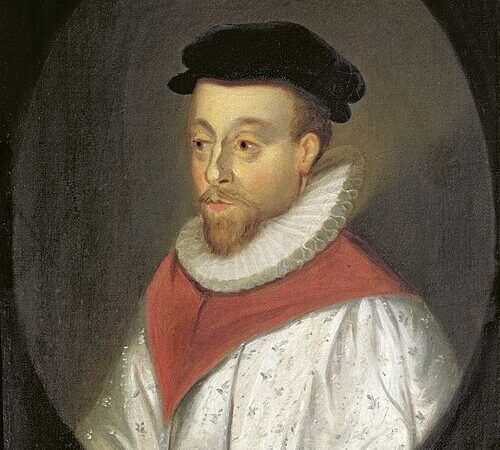
Biography (read more)
Orlando Gibbons was an English composer, organist, and virginalist born in 1583 in Oxford and died in 1625 in Canterbury, regarded as one of the last great masters of the English polyphonic tradition. Coming from a large musical family, he sang as a chorister at King’s College, Cambridge, before earning his degree there in 1606. He was appointed organist of the Chapel Royal under King James I, a post he held until his death, and he later also served as organist of Westminster Abbey. Gibbons composed sacred anthems and services, consort music, keyboard works preserved in the Fitzwilliam Virginal Book, and his celebrated 1612 collection of madrigals and motets, which contains introspective, morally serious settings including “The Silver Swan.”
Gibbons represents the culmination of the English polyphonic and verse-anthem traditions, blending William Byrd’s contrapuntal rigor with a distinctly personal melancholy and expressive restraint. His verse anthems, such as “This Is the Record of John,” helped establish the form as central to Anglican church music, while “The Silver Swan” remains among the most performed English madrigals. His keyboard and consort music also fed into the emerging English Baroque instrumental style.
Sources:
Repertoire
This Is the Record of Johnc. 1611
Performed by Daniel Elgersma – Countertenor, The Gesualdo Six
The Silver Swan1612
Performed by The Tallis Scholars & Peter Phillips, John Rutter & The Cambridge Singers
The Lord of Salisbury his Pavan and Galliardc. 1612
Performed by Spruhski
Fantasia for Four Viols in C majorc. 1620
Performed by Olga Mirator
O Clap Your Hands Together1622
Performed by John Rutter & The Cambridge Singers
Gibbons: Madrigals & Motets, 1612: II. O That the Learned Poets— Anthony Rooley
Performed by Anthony Rooley
Gibbons: Madrigals & Motets, 1612: III. I Weigh Not Fortune’s Frown— Anthony Rooley
Performed by Anthony Rooley
Gibbons: Madrigals & Motets, 1612: IV. I Tremble Not at Noise of War— Anthony Rooley
Performed by Anthony Rooley
Gibbons: Madrigals & Motets, 1612: V. I See Ambition Never Pleased— Anthony Rooley
Performed by Anthony Rooley
Gibbons: Madrigals & Motets, 1612: VI. I Feign Not Friendship— Anthony Rooley
Performed by Anthony Rooley
Gibbons: Madrigals & Motets, 1612: VII. How Art Thou Thralled?— Anthony Rooley
Performed by Anthony Rooley
Gibbons: Madrigals & Motets, 1612: VIII. Farewell All Joys— Anthony Rooley
Performed by Anthony Rooley
Gibbons: Madrigals & Motets, 1612: X. Fair Ladies That to Love— Anthony Rooley
Performed by Anthony Rooley
Gibbons: Madrigals & Motets, 1612: XI. ‘Mongst Thousand Good— Anthony Rooley
Performed by Anthony Rooley
Gibbons: Madrigals & Motets, 1612: XII. Now Each Flowery Bank of May— Anthony Rooley
Performed by Anthony Rooley
Gibbons: Madrigals & Motets, 1612: XIV. What Is Our Life?— Anthony Rooley
Performed by Anthony Rooley
Gibbons: Madrigals & Motets, 1612: XVI. Fair Is the Rose— Anthony Rooley
Performed by Anthony Rooley
Gibbons: Madrigals & Motets, 1612: XVII. Nay Let Me Weep— Anthony Rooley
Performed by Anthony Rooley
Gibbons: Madrigals & Motets, 1612: XVIII. Ne’er Let the Sun— Anthony Rooley
Performed by Anthony Rooley
Gibbons: Madrigals & Motets, 1612: XX. Trust Not too Much Fair Youth— Anthony Rooley
Performed by Anthony Rooley