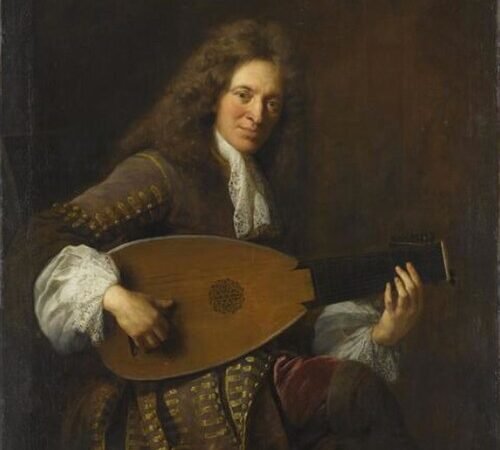
Biography (read more)
Charles Mouton was a French lutenist and composer born in 1617 who died sometime before 1699. Musicians were active on his mother’s side of the family, one of whom served at the French royal court. By 1664 Charles Mouton was living in Paris, where he taught several affluent students, and in 1673 he performed at the Savoyard court in Turin. Back in Paris by 1680, his pupils included René Milleran and Philipp Franz Le Sage de Richée. Around this period he published two books of pieces, Pièces de luth sur différents modes, the first of which included his own notes on performance practice, and he is remembered today partly through a well-known engraved portrait showing him with his lute.
Charles Mouton, together with his contemporary Jacques Gallot, represents the last generation of major French lute composers before the instrument’s decline in popularity. His two published books preserve the mature style brisé in its most refined form, including expressive character pieces and tombeaux, and his own performance annotations offer rare direct insight into 17th-century French lute technique and ornamentation.
Sources:
Repertoire
Le Mouton Fabuleux (recital selections)2008
Performed by permanentflebo
Pièces de Luth in C Minor: II. Tombeau de Madame, Pavanne— Konrad Junghänel
Performed by Konrad Junghänel
Pièces de Luth in C Minor: III. La belle Angloise, Gigue— Konrad Junghänel
Performed by Konrad Junghänel
Pièces de Luth in C Minor: IV. La Libertine, Canarie— Konrad Junghänel
Performed by Konrad Junghänel
Pièces de Luth in C Minor: V. La Deliberée, Courante— Konrad Junghänel
Performed by Konrad Junghänel
Pièces de Luth in C Minor: VIII. La belle Espagnole, Chaconne— Konrad Junghänel
Performed by Konrad Junghänel
Pièces de Luth in C Minor: IX. La belle Danceuse, Gavottes— Konrad Junghänel
Performed by Konrad Junghänel
Pièces de Luth, Livre I in A Minor: No. 2, Tombeau de Gogo— Hopkinson Smith
Performed by Hopkinson Smith
Pièces de Luth, Livre I in A Minor: No. 3, Courante – Double – Courante cy deuant— Hopkinson Smith
Performed by Hopkinson Smith
Pièces de Luth, Livre I in A Minor: No. 5, La fiere courante— Hopkinson Smith
Performed by Hopkinson Smith
Pièces de Luth, Livre I in A Minor: No. 6, La belle homicide – Courante de Mr Gaultier – Double…— Hopkinson Smith
Performed by Hopkinson Smith
Pièces de Luth, Livre I in A Minor: No. 9, L’impromptu. Allemande— Hopkinson Smith
Performed by Hopkinson Smith
Pièces de Luth, Livre II in F Minor: No. 1, La promenade. Prelude— Hopkinson Smith
Performed by Hopkinson Smith
Pièces de Luth, Livre II in F Minor: No. 2, Le dialogue des graces sur Iris— Hopkinson Smith
Performed by Hopkinson Smith
Pièces de Luth, Livre II in F Minor: No. 3, Le racommodement. Courante; double— Hopkinson Smith
Performed by Hopkinson Smith
Pièces de Luth, Livre II in F Minor: No. 4, Le mouton. Canarie— Hopkinson Smith
Performed by Hopkinson Smith
Pièces de Luth, Livre II in F Minor: No. 5, La changeante. Courante— Hopkinson Smith
Performed by Hopkinson Smith
Pièces de Luth, Livre II in F Minor: No. 6, La bizare. Gaillarde— Hopkinson Smith
Performed by Hopkinson Smith
Pièces de Luth, Livre II in F Minor: No. 7, La mallassis. Sarabande— Hopkinson Smith
Performed by Hopkinson Smith
Pièces de Luth, Livre II in F Minor: No. 8, Menuet la ganbade— Hopkinson Smith
Performed by Hopkinson Smith
Pièces de Luth, Livre II in A Minor: No. 9, Prelude en ami tierce majeure— Hopkinson Smith
Performed by Hopkinson Smith
Pièces de Luth, Livre II in A Minor: No. 10, Les amans broüillez. Pavanne— Hopkinson Smith
Performed by Hopkinson Smith
Pièces de Luth, Livre II in A Minor: No. 11, La veritable courante— Hopkinson Smith
Performed by Hopkinson Smith
Pièces de Luth, Livre II in A Minor: No. 12, Sarabande en rondeau— Hopkinson Smith
Performed by Hopkinson Smith
Pièces en Do Majeur: 4. Ballet des Muses: Gavotte, “Vous savez l’amour extrême”— Anthony Bailes
Performed by Anthony Bailes
Second livre de pièces de luth, Suite No. 2 en fa dièse: Prélude. La promenade— Anthony Bailes
Performed by Anthony Bailes
Second livre de pièces de luth, Suite No. 2 en fa dièse: Allemande. Le dialogue des Grâces…— Anthony Bailes
Performed by Anthony Bailes
Second livre de pièces de luth, Suite No. 2 en fa dièse: Allemande. La belle Iris— Anthony Bailes
Performed by Anthony Bailes
Second livre de pièces de luth, Suite No. 2 en fa dièse: Canarie. La Mouton— Anthony Bailes
Performed by Anthony Bailes
Second livre de pièces de luth, Suite No. 2 en fa dièse: Gaillarde. La bizare— Anthony Bailes
Performed by Anthony Bailes
Second livre de pièces de luth, Suite No. 2 en fa dièse: Courante. La cheangeante— Anthony Bailes
Performed by Anthony Bailes
Second livre de pièces de luth, Suite No. 2 en fa dièse: Sarabande. La Mallassis— Anthony Bailes
Performed by Anthony Bailes
Pieces de luth sur differents modes, Book 1: Pieces in A Minor: I. Prelude— Joachim Held
Performed by Joachim Held
Pieces de luth sur differents modes, Book 1: Pieces in A Minor: II. Tombeau de Gogo— Joachim Held
Performed by Joachim Held
Pieces de luth sur differents modes, Book 1: Pieces in A Minor: III. Courante— Joachim Held
Performed by Joachim Held
Pieces de luth sur differents modes, Book 1: Pieces in A Minor: IV. Double de la courante devant— Joachim Held
Performed by Joachim Held
Pieces de luth sur differents modes, Book 1: Pieces in A Minor: V. La belle homicide – Courante…— Joachim Held
Performed by Joachim Held
Pieces de luth sur differents modes, Book 1: Pieces in A Minor: VI. Double de la belle homicide…— Joachim Held
Performed by Joachim Held
Pieces de luth sur differents modes, Book 1: Pieces in A Minor: VII. Sarabande— Joachim Held
Performed by Joachim Held
Pieces de luth sur differents modes, Book 1: Pieces in A Minor: VIII. Gavotte— Joachim Held
Performed by Joachim Held
Pieces de luth sur differents modes, Book 1: Pieces in A Minor: IX. Canarie— Joachim Held
Performed by Joachim Held
Mouton: Pièces de Luth sur differents modes: Le Dialogue des graces sur Iris (Allemande)— Walter Gerwig
Performed by Walter Gerwig
Mouton: Pièces de Luth sur differents modes: La Mallassise (Sarabande)— Walter Gerwig
Performed by Walter Gerwig
Mouton: Pièces de Luth sur differents modes: La Gaubade (Menuett)— Walter Gerwig
Performed by Walter Gerwig
Mouton: Pièces de Luth sur differents modes: La Changeante— Walter Gerwig
Performed by Walter Gerwig
Mouton: Pièces de Luth sur differents modes: L´heurese Hymnen (Passacaglia)— Walter Gerwig
Performed by Walter Gerwig
Mouton: Pièces de Luth sur differents modes: L´amant content (Cantarie)— Walter Gerwig
Performed by Walter Gerwig
Pièces de luth sur les différents modes, Livre second: Allemande “Le dialogue des Grâces sur…— Walter Gerwig
Performed by Walter Gerwig
Pièces de luth sur les différents modes, Livre second: Sarabande “La Mallassis”— Walter Gerwig
Performed by Walter Gerwig
Pièces de luth sur les différents modes, Livre second: Gigue “Le toxin”— Walter Gerwig
Performed by Walter Gerwig
Pièces de luth sur les différents modes, Livre second: Menuet “La gambade”— Walter Gerwig
Performed by Walter Gerwig
Pièces de luth sur les différents modes, Livre second: Courante “La Changeante”— Walter Gerwig
Performed by Walter Gerwig
Pièces de luth sur les différents modes, Livre second: Passacaille” L’heureux hymen”— Walter Gerwig
Performed by Walter Gerwig
Pièces de luth sur les différents modes, Livre second: Canarie “L’amant constant”— Walter Gerwig
Performed by Walter Gerwig
La belle homicide & Courante de M. Gaultier – Double de la belle Homicide— Toyohiko Satoh
Performed by Toyohiko Satoh
Pièces de luth sur différents modes, Book 1 (Excerpts) : No. 1, Prélude— Shigeo Mito
Performed by Shigeo Mito
Pièces de luth sur différents modes, Book 1 (Excerpts) : No. 2, Tombeau de gogo. Allemande— Shigeo Mito
Performed by Shigeo Mito
Pièces de luth sur différents modes, Book 1 (Excerpts) : No. 6, Canarie— Shigeo Mito
Performed by Shigeo Mito
Pièces de luth sur différents modes, Book 1 (Excerpts) : No. 7, La fière. Courante— Shigeo Mito
Performed by Shigeo Mito
Pièces de luth sur différents modes, Book 1 (Excerpts) : No. 8, La belle homicide. Courante de…— Shigeo Mito
Performed by Shigeo Mito
Pièces de luth sur différents modes, Book 1 (Excerpts) : No. 10, Sarabande— Shigeo Mito
Performed by Shigeo Mito
Pièces de luth sur différents modes, Book 1 (Excerpts) : No. 11, Gavotte— Shigeo Mito
Performed by Shigeo Mito
Pièces de luth sur différents modes, Book 1 (Excerpts) : No. 12, L’impromptu. Allemande— Shigeo Mito
Performed by Shigeo Mito
Pièces in F-Sharp Minor (Excerpts) : La dialogue des grâces sur iris allemande— Shigeo Mito
Performed by Shigeo Mito
Pièces in F-Sharp Minor (Excerpts) : Prélude in A Major – Pavanne in A Major “Les aman brouillez”— Shigeo Mito
Performed by Shigeo Mito