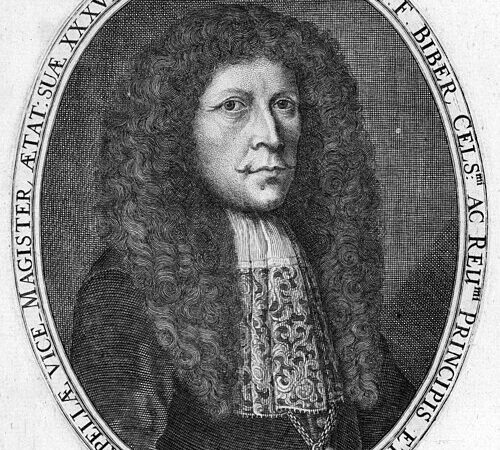
Biography (read more)
Heinrich Ignaz Franz (von) Biber was a Czech-Austrian composer and violinist of the middle Baroque, baptized 12 August 1644 in Wartenberg, Bohemia, and died 3 May 1704 in Salzburg. He worked in Graz and Kroměříž before leaving his employer, Prince-Bishop Karl Liechtenstein-Kastelkorn, without permission to enter the service of the Archbishop of Salzburg, where he remained for the rest of his life, rising from valet to deputy Kapellmeister (1679) and Kapellmeister (1684), and being raised to the nobility by Emperor Leopold I in 1690. Biber was among the greatest violin virtuosos of his era, extending the instrument’s technical range through advanced positions, multiple stops, and scordatura (unusual retuning). His output includes the 15 Mystery (Rosary) Sonatas with their culminating solo violin Passacaglia, the vast 53-part Missa Salisburgensis, and numerous chamber sonatas and partitas.
Biber was regarded in his lifetime, and by later historians such as Charles Burney, as the finest violin composer of the 17th century, and his mastery of scordatura and polyphonic violin writing pushed the instrument’s expressive and technical possibilities further than any of his contemporaries. His unaccompanied Passacaglia in G minor, closing the Mystery Sonatas, is among the earliest and most significant works ever composed for solo violin, predating Bach’s Sonatas and Partitas for Solo Violin by decades and directly anticipating their scope. After a long eclipse, his music enjoyed a major revival in the late 20th century and remains central to the historically informed violin repertoire today.
Sources:
Repertoire
Battalia, à 10 (1673) : II. Die liederliche Gesellschaft von allerley Humor. Allegro— Jordi Savall
Performed by Jordi Savall
Battalia, à 10 (1673) : VIII. Lamento der Verwundten Musquetirer: Adagio— Jordi Savall
Performed by Jordi Savall
Missa Salisburgensis, à 53 (1682) : IV. Sanctus – Benedictus— Jordi Savall
Performed by Jordi Savall
Rosary Sonata No. 1 in D Minor, C. 90 “The Annunciation”: I. Preludium— Bellot Ensemble
Performed by Bellot Ensemble
Rosary Sonata No. 1 in D Minor, C. 90 “The Annunciation”: II. Aria & Variations – III. Finale— Bellot Ensemble
Performed by Bellot Ensemble
Sonata Sancti Polycarpi, à 9 (1673) : () – Allegro – Allegro – Presto— Jordi Savall
Performed by Jordi Savall
Vesperae longiores ac breviores una cum litaniis Lauretanis: Dixit Dominus— Konrad Junghänel
Performed by Konrad Junghänel
Vesperae longiores ac breviores una cum litaniis Lauretanis: Laudate pueri Dominum— Konrad Junghänel
Performed by Konrad Junghänel
Vesperae longiores ac breviores una cum litaniis Lauretanis: Laetatus sum— Konrad Junghänel
Performed by Konrad Junghänel
Vesperae longiores ac breviores una cum litaniis Lauretanis: Nisi Dominus— Konrad Junghänel
Performed by Konrad Junghänel
Vesperae longiores ac breviores una cum litaniis Lauretanis: Lauda Jerusalem— Konrad Junghänel
Performed by Konrad Junghänel
Vesperae longiores ac breviores una cum litaniis Lauretanis: Magnificat— Konrad Junghänel
Performed by Konrad Junghänel
Violin Sonata No. 6 in C Minor, C. 143: II. Passacaglia— Matthew Wadsworth
Performed by Matthew Wadsworth
Passacaglia in C minor (arr. from 1 movement of Sonatas for violin and basso continuo by F….— Joachim Held
Performed by Joachim Held
Violin Sonata in C Minor, Chafe 107: II. Passacagli adagissimo— Eero Palviainen
Performed by Eero Palviainen
Violin Sonata in A major, Chafe 147: Sonata (Adagio – Presto – Adagio – Presto – Grave)— Eero Palviainen
Performed by Eero Palviainen
Violin Sonata in A major, Chafe 147: Aria (11 Variations – Aria)— Eero Palviainen
Performed by Eero Palviainen