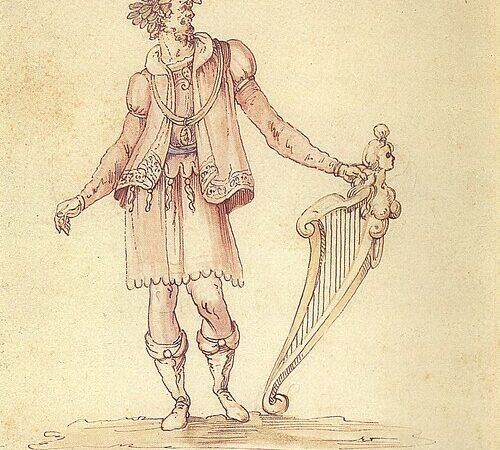
Biography (read more)
Jacopo Peri was an Italian composer, singer, and instrumentalist born in 1561 in Rome or Florence and died in 1633 in Florence, credited with writing the first opera. Educated and employed within Florence’s Medici court and churches, he joined the circle of patron Jacopo Corsi, and together with poet Ottavio Rinuccini they created Dafne around 1598, an attempt to revive Greek tragedy now considered the earliest opera, though most of its music is lost. Peri and Rinuccini’s subsequent collaboration, Euridice, premiered in 1600 for the wedding of Marie de’ Medici and Henry IV of France, and survives complete as the oldest opera whose music has come down to us intact.
Peri’s Euridice established the recitative style, the sung-speech technique bridging aria and chorus that became indispensable to opera’s development. Though soon eclipsed artistically by Claudio Monteverdi, Peri’s pioneering fusion of monody, drama, and continuo accompaniment provided the technical and dramaturgical template that all subsequent opera composers built upon, cementing his historical role as one of the genre’s true originators.
Sources:
Repertoire
Dafnec. 1598
Performed by scoalamuzicala2
Euridice1600
Performed by jwhill7, Pau Malatesta
Tu dormi, e’l dolce sonno1609 (Le varie musiche)
Performed by Víctor Cruz Barítono
Un dì soletto1609 (Le varie musiche, No. 17)
Performed by Emiliano Gonzalez Toro
Peri: L’Euridice, Scene 6: Gioite al canto mio (Arr. Pluhar)— Christina Pluhar
Performed by Christina Pluhar