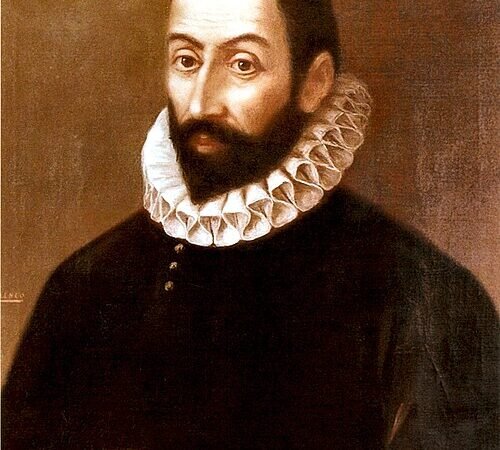
Biography (read more)
Luca Marenzio was an Italian composer and singer born in 1553 or 1554 near Brescia and died in 1599 in Rome, celebrated as one of the most renowned madrigalists of the late Renaissance. He likely trained under Giovanni Contino before moving to Rome, where he served Cardinal Cristoforo Madruzzo and later Cardinal Luigi d’Este, producing many of his finest madrigal books during the 1580s. After further service to the Medici in Florence and various Roman patrons, he traveled in 1595–96 to Warsaw as maestro di cappella to King Sigismund III of Poland, a journey that reportedly damaged his health. Marenzio wrote nearly 500 madrigals ranging from light villanellas to intensely chromatic, expressive settings of Petrarch and other poets.
Marenzio brought the Italian madrigal to its highest point of textual expressiveness, pioneering vivid word-painting and daring chromaticism that influenced Gesualdo and later Monteverdi. His works dominated Nicholas Yonge’s Musica Transalpina (1588), the anthology that ignited the English madrigal craze, directly shaping composers like Thomas Morley, John Wilbye, and Thomas Weelkes. Widely performed across Europe in his lifetime, his madrigals have remained continuously sung ever since.
Sources:
Repertoire
Dolorosi martir, fieri tormenti1580
Performed by Enrico Zanoni
Tirsi morir volea1580
Performed by pannonia77
O voi che sospirate a miglior note1581
Performed by Patrick Allen Music
Scaldava il sol di mezzogiorno l’arco1585
Performed by Catalin I. Petho
Solo e pensoso1599
Performed by Francisco Parralejo Masa
Il primo libro de madrigali a cinque voci: No. 5, Tirsi morir volea— Anthony Bailes
Performed by Anthony Bailes