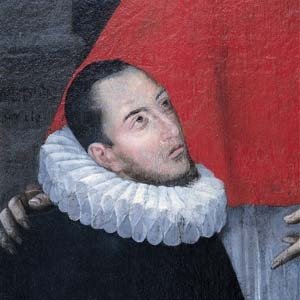
Biography (read more)
Carlo Gesualdo, Prince of Venosa and Count of Conza, was an Italian nobleman and composer born in 1566 and died on 8 September 1613. He is infamously known for murdering his first wife and her lover after discovering their affair in 1590, an act that has long overshadowed his musical legacy. Carlo Gesualdo spent much of his life at his estate in Venosa, though a three-year stay in Ferrara brought him into close contact with leading poets and musicians of the day. He is celebrated for six books of madrigals and volumes of sacred music, including the Tenebrae Responsoria, distinguished by an extravagantly chromatic harmonic language not paralleled again until the late 19th century.
Gesualdo pushed chromaticism and expressive dissonance to extremes unmatched by any composer of his era, using unconventional harmonic shifts to intensify the anguished texts of his late madrigals and sacred works. Largely dismissed by contemporaries as an eccentric aristocrat, he was rediscovered in the 20th century as a radical harmonic innovator whose experiments prefigured much later developments in chromatic and even atonal music.
Sources:
Repertoire
Ave dulcissima Maria1603
Performed by pannonia77
Moro, lasso, al mio duolo1611
Performed by La Compagnia del Madrigale
Tenebrae Responsories for Maundy Thursday1611
Performed by Fabrizio Nastari
Beltà, poi che t’assenti1611
Performed by EtaCarinae2010
“Io parto” e non più dissi1611
Performed by EtaCarinae2010
Sacrarum cantionum liber primus a 5: No. 3, Ave dulcissima Maria— John Eliot Gardiner
Performed by John Eliot Gardiner
Narration 10: “Machiavelli’s The Prince” / Music: Gallarda di Venosa (Harp)— Jordi Savall
Performed by Jordi Savall
Narración 10: “El Príncipe de Maquiavelo” / Música: Gallarda di Venosa (Arpa)— Jordi Savall
Performed by Jordi Savall
Narració 10: “El Príncep de Maquiavel” / Música: Gallarda di Venosa (Arpa)— Jordi Savall
Performed by Jordi Savall
Narrazione 10: “Il Principe di Machiavelli” / Musica: Gallarda di Venosa (Arpa)— Jordi Savall
Performed by Jordi Savall
Gesproken tekst 10: “De Vorst van Machiavelli” / Muziek: Gallarda di Venosa (Harp)— Jordi Savall
Performed by Jordi Savall
Gesualdo: Fifth book of madrigals – 1. Gioite voi col canto— Anthony Rooley
Performed by Anthony Rooley
Gesualdo: Fifth book of madrigals – 2. S’io non miro non moro— Anthony Rooley
Performed by Anthony Rooley
Gesualdo: Fifth book of madrigals – 3. Itene, o miei sospiri— Anthony Rooley
Performed by Anthony Rooley
Gesualdo: Fifth book of madrigals – 4. Dolcissima mia vita— Anthony Rooley
Performed by Anthony Rooley
Gesualdo: Fifth book of madrigals – 8. Se vi duol il mio duolo— Anthony Rooley
Performed by Anthony Rooley
Gesualdo: Fifth book of madrigals – 9. Occhi del mio cor vita— Anthony Rooley
Performed by Anthony Rooley
Gesualdo: Fifth book of madrigals – 10. Languisce al fin— Anthony Rooley
Performed by Anthony Rooley
Gesualdo: Fifth book of madrigals – 11. Merce grido piangendo— Anthony Rooley
Performed by Anthony Rooley
Gesualdo: Fifth book of madrigals – 12. O voi, troppo felici— Anthony Rooley
Performed by Anthony Rooley
Gesualdo: Fifth book of madrigals – 13. Correte, amanti, a prova— Anthony Rooley
Performed by Anthony Rooley
Gesualdo: Fifth book of madrigals – 14. Asciugate i begli occhi— Anthony Rooley
Performed by Anthony Rooley
Gesualdo: Fifth book of madrigals – 15. Tu m’uccidi, o crudele— Anthony Rooley
Performed by Anthony Rooley
Gesualdo: Fifth book of madrigals – 16. Deh, coprute il bel seno— Anthony Rooley
Performed by Anthony Rooley
Gesualdo: Fifth book of madrigals – 17. Poichè l’avida sete— Anthony Rooley
Performed by Anthony Rooley
Gesualdo: Fifth book of madrigals – 19. O tenebroso giorno— Anthony Rooley
Performed by Anthony Rooley
Gesualdo: Fifth book of madrigals – 20. Se tu fuggi, io non resto— Anthony Rooley
Performed by Anthony Rooley