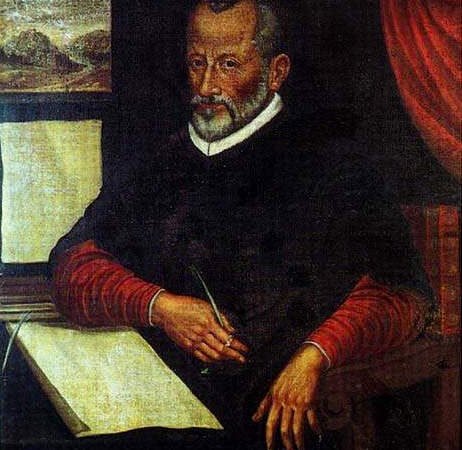
Biography (read more)
Giovanni Pierluigi da Palestrina was an Italian composer born in the town of Palestrina near Rome around 1525, who died in Rome on 2 February 1594. In 1551 Pope Julius III appointed him maestro di cappella of the Cappella Giulia at St. Peter’s Basilica; he later held posts at St. John Lateran and Santa Maria Maggiore before returning to St. Peter’s in 1571, where he remained until his death. The central representative of the Roman School, Palestrina left over 105 masses, more than 300 motets, and roughly 140 madrigals. He is best known for the Missa Papae Marcelli, and his refined, consonant polyphonic style became the model of “classical” Renaissance counterpoint for centuries afterward.
Palestrina’s smooth, carefully controlled treatment of dissonance and clear text-setting became the defining model of late Renaissance sacred polyphony, later codified as species counterpoint by theorist Johann Joseph Fux. His music was long associated with saving polyphony from suppression during the Counter-Reformation, and his contrapuntal technique remained a core teaching foundation for composers, including J.S. Bach, well into the 18th and 19th centuries.
Sources:
Repertoire
Missa Papae Marcellic. 1562
Performed by Peter Randall
Missa Brevisc. 1570
Performed by Mnemósine Amnésica
Canticum Canticorum (Song of Songs), motet cycle1584
Performed by James O'Donnell
Stabat Materc. 1590
Performed by pannonia77
Sicut Cervus1604 (published)
Performed by Stile Antico, VOCES8
Missa Papae Marcelli, Kyrie
Sicut cervus
Il Barbiere di Siviglia : Oh, cielo (Buenos Aires 19/08/1969 Restauración 2023)— Teresa Berganza
Performed by Teresa Berganza
Palestrina: Alma Redemptoris Mater – Ed. J. Dixon— John Eliot Gardiner
Performed by John Eliot Gardiner