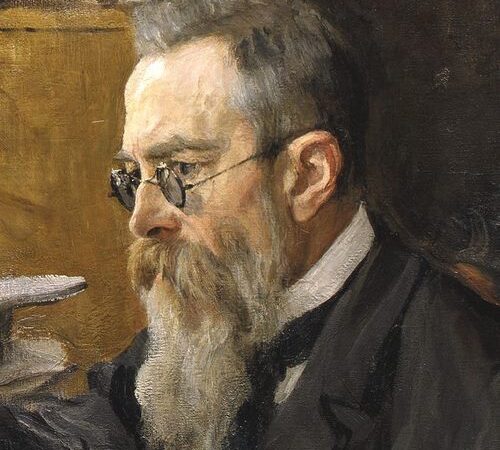
Biography (read more)
Nikolai Andreyevich Rimsky-Korsakov was a Russian composer, born 18 March 1844 and died 21 June 1908, and a member of the nationalist group of composers known as The Five. A career naval officer before becoming a professor of composition, harmony, and orchestration at the St Petersburg Conservatory in 1871, he undertook a rigorous three-year program of self-education to master Western compositional technique, which he then combined with the folk-inspired, orientalist idiom he shared with Glinka and The Five. His best-known orchestral works, including Capriccio Espagnol, the Russian Easter Festival Overture, and the symphonic suite Scheherazade, are staples of the concert repertoire, alongside excerpts from his fifteen operas, among them The Tale of Tsar Saltan, source of the popular orchestral interlude Flight of the Bumblebee.
Rimsky-Korsakov is considered the chief architect of the ‘Russian style’ in classical orchestration, preparing works by fellow members of The Five for performance and shaping a generation of composers through his decades as an educator and his influential orchestration textbook. His command of orchestral colour and folk-inspired melody influenced composers well beyond Russia, including Debussy, Ravel, Dukas, and Respighi, and Flight of the Bumblebee has become one of the most widely recognized displays of orchestral virtuosity in classical music.
Sources:
Repertoire
Flight of the Bumblebee
Scheherazade Op. 35: III. The Young Prince and the Young Princess— André Previn
Performed by André Previn
Rimsky-Korsakov: Scheherazade, Op. 35: I. The Sea and Sinbad’s Ship— André Previn
Performed by André Previn
Rimsky-Korsakov: Scheherazade, Op. 35: II. The Young Prince and The Young Princess— André Previn
Performed by André Previn
Rimsky-Korsakov: Scheherazade, Op. 35: III. The Young Prince and The Young Princess— André Previn
Performed by André Previn
Rimsky-Korsakov: Scheherazade, Op. 35: IV. Festival at Baghdad. The Sea. Ship Breaks upon a…— André Previn
Performed by André Previn
Rimsky-Korsakov: Scheherazade, Op. 35: I. The Sea and Sinbad’s Ship— Vladimir Ashkenazy
Performed by Vladimir Ashkenazy
Rimsky-Korsakov: Scheherazade, Op. 35: III. The Young Prince And The Young Princess— Vladimir Ashkenazy
Performed by Vladimir Ashkenazy
Rimsky-Korsakov: Scheherazade, Op. 35: 1. The Sea and Sinbad’s Ship— Vladimir Ashkenazy
Performed by Vladimir Ashkenazy
Rimsky-Korsakov: Scheherazade, Op. 35: 2. The Story of the Calender Prince— Vladimir Ashkenazy
Performed by Vladimir Ashkenazy
Rimsky-Korsakov: Scheherazade, Op. 35: 3. The Young Prince and the Young Princess— Vladimir Ashkenazy
Performed by Vladimir Ashkenazy
Rimsky-Korsakov: Scheherazade, Op. 35: 4. Festival at Bagdad – The Sea – The Shipwreck against…— Vladimir Ashkenazy
Performed by Vladimir Ashkenazy
Rimsky-Korsakov: Scheherazade, Op. 35: The Story of the Calender Prince— Alice Sara Ott
Performed by Alice Sara Ott
Piano Concerto in C-Sharp Minor, Op. 30: I. Moderato – Allegretto quasi polacca— Jean-Philippe Collard
Performed by Jean-Philippe Collard
Piano Concerto in C-Sharp Minor, Op. 30: II. Andante mosso— Jean-Philippe Collard
Performed by Jean-Philippe Collard
Piano Concerto in C-Sharp Minor, Op. 30: III. Allegro— Jean-Philippe Collard
Performed by Jean-Philippe Collard
Piano Concerto in C-Sharp Minor, Op. 30: I. Moderato— Paul Badura-Skoda
Performed by Paul Badura-Skoda
Piano Concerto in C-Sharp Minor, Op. 30: II. Allegretto duasi polacca— Paul Badura-Skoda
Performed by Paul Badura-Skoda
Piano Concerto in C-Sharp Minor, Op. 30: III. Andante mosso— Paul Badura-Skoda
Performed by Paul Badura-Skoda
Piano Concerto in C-Sharp Minor, Op. 30: IV. Allegro— Paul Badura-Skoda
Performed by Paul Badura-Skoda
Rimsky-Korsakov: Tsar Saltan Suite, Op. 57: I. March “Tsar’s Farewell and Departure”— André Previn
Performed by André Previn
Rimsky-Korsakov: The Tale Of Tsar Saltan – Suite, Op. 57: 1. The Tsar’s Departure And Farewell— Vladimir Ashkenazy
Performed by Vladimir Ashkenazy
Rimsky-Korsakov: The Tale Of Tsar Saltan – Suite, Op. 57: 2. The Tsaritsa And Her Son Afloat In…— Vladimir Ashkenazy
Performed by Vladimir Ashkenazy
Rimsky-Korsakov: The Tale Of Tsar Saltan – Suite, Op. 57: 3. The Three Wonders— Vladimir Ashkenazy
Performed by Vladimir Ashkenazy
Capriccio Espagnol, Op. 34: I. Alborada. Vivo e strepitoso— Plácido Domingo
Performed by Plácido Domingo
Capriccio Espagnol, Op. 34: II. Variations. Andante con moto— Plácido Domingo
Performed by Plácido Domingo
Capriccio Espagnol, Op. 34: III. Alborada. Vivo e strepitoso— Plácido Domingo
Performed by Plácido Domingo
Capriccio Espagnol, Op. 34: IV. Scene and Gypsy Song. Allegro— Plácido Domingo
Performed by Plácido Domingo
Capriccio Espagnol, Op. 34: V. Fandango of the Asturias— Plácido Domingo
Performed by Plácido Domingo
The Snow Maiden Suite: II. Danse des oiseux (Dance of the Birds)— Mikhail Pletnev
Performed by Mikhail Pletnev
The Snow Maiden Suite: IV. Danse des bouffons (Dance of the Clowns)— Mikhail Pletnev
Performed by Mikhail Pletnev
The Legend of the Invisible City of Kitezh and the Maiden Fevroniya Suite: I. Prelude. A Hymn…— Mikhail Pletnev
Performed by Mikhail Pletnev
The Legend of the Invisible City of Kitezh and the Maiden Fevroniya Suite: II. Wedding…— Mikhail Pletnev
Performed by Mikhail Pletnev
The Legend of the Invisible City of Kitezh and the Maiden Fevroniya Suite: III. Battle of…— Mikhail Pletnev
Performed by Mikhail Pletnev
The Legend of the Invisible City of Kitezh and the Maiden Fevroniya Suite: IV. Death of Fevroniya— Mikhail Pletnev
Performed by Mikhail Pletnev
Rimsky-Korsakov: The Golden Cockerel, Suite: I. King Dodon in His Palace— Mikhail Pletnev
Performed by Mikhail Pletnev
Rimsky-Korsakov: The Golden Cockerel, Suite: II. Tsar Dodon on Campaign— Mikhail Pletnev
Performed by Mikhail Pletnev
Rimsky-Korsakov: The Golden Cockerel, Suite: III. Tsar Dodon as Guest of the Queen of Shemakha— Mikhail Pletnev
Performed by Mikhail Pletnev
Rimsky-Korsakov: The Golden Cockerel, Suite: IV. The Wedding and Lamentable End of Dodon— Mikhail Pletnev
Performed by Mikhail Pletnev
Rimsky-Korsakov: The Tale of Tsar Saltan: The Flight of the Bumble-Bee— Sergei Rachmaninoff (pianist)
Performed by Sergei Rachmaninoff (pianist)
The Tale of Tsar Saltan: Flight of the Bumble-bee (arr. S. Rachmaninov for piano) : Tale of…— Sergei Rachmaninoff (pianist)
Performed by Sergei Rachmaninoff (pianist)
Night on Mountain Triglav: Act III Scene 1, Introduction— Mikhail Pletnev
Performed by Mikhail Pletnev
The Tale of Tsar Saltan: Flight of the Bumble Bee (Arr. for Piano by György Cziffra)— Cyprien Katsaris
Performed by Cyprien Katsaris
Flight of the Bumblebee (Interlude from The Tale of the Tsar Saltan)— Arcadi Volodos
Performed by Arcadi Volodos
Rimsky-Korsakov: The Tale of Tsar Saltan: The Flight of the Bumblebee (Transcr. Rachmaninoff…— Howard Shelley
Performed by Howard Shelley
Rimsky-Korsakov: The Tale Of Tsar Saltan: 3. The Flight Of The Bumble-Bee— Vladimir Ashkenazy
Performed by Vladimir Ashkenazy
Rimsky-Korsakov: The Tale of Tsar Saltan: The Flight of the Bumble-Bee (Arr. Piano)— Vladimir Ashkenazy
Performed by Vladimir Ashkenazy
The Tale of Tsar Saltan: Flight of the Bumble-bee (arr. S. Rachmaninov)— Vladimir Horowitz
Performed by Vladimir Horowitz
Rimsky-Korsakov: The Tsar’s Bride – original version Tsarskaya Nevesta by Lev Mey: Overture— Olga Borodina
Performed by Olga Borodina
Rimsky-Korsakov: The Tsar’s Bride – original version Tsarskaya Nevesta by Lev Mey – Act 1:…— Olga Borodina
Performed by Olga Borodina
Rimsky-Korsakov: The Tsar’s Bride – original version Tsarskaya Nevesta by Lev Mey – Act 2:…— Olga Borodina
Performed by Olga Borodina
Rimsky-Korsakov: The Tsar’s Bride – original version Tsarskaya Nevesta by Lev Mey – Act 2: Aria…— Olga Borodina
Performed by Olga Borodina
Rimsky-Korsakov: The Tsar’s Bride / Act 2: Scene 5 “Vot do chego ya dozhila”— Olga Borodina
Performed by Olga Borodina
Rimsky-Korsakov: The Tsar’s Bride – original version Tsarskaya Nevesta by Lev Mey – Act 3:…— Olga Borodina
Performed by Olga Borodina
Rimsky-Korsakov: The Tsar’s Bride – original version Tsarskaya Nevesta by Lev Mey – Act 3: Aria…— Olga Borodina
Performed by Olga Borodina
Rimsky-Korsakov: The Tsar’s Bride – original version Tsarskaya Nevesta by Lev Mey – Act 3: Song…— Olga Borodina
Performed by Olga Borodina
Rimsky-Korsakov: The Tsar’s Bride – original version Tsarskaya Nevesta by Lev Mey – Act 4:…— Olga Borodina
Performed by Olga Borodina
Rimsky-Korsakov: The Clouds Begin to Scatter, Op. 42, No. 3— Olga Borodina
Performed by Olga Borodina
Rimsky-Korsakov: Plenivshis rozoï soloveï: Captivated by the Rose (The Nightingale), Op. 2, No. 2— Olga Borodina
Performed by Olga Borodina
Rimsky-Korsakov: The Golden Cockerel: Hymn to the Sun— Aida Garifullina
Performed by Aida Garifullina
Rimsky-Korsakov: The Golden Cockerel: Tsaritsa’s Dance of Seduction— Aida Garifullina
Performed by Aida Garifullina
Rimsky-Korsakov: Four Songs, Op. 2: Oriental Romance— Aida Garifullina
Performed by Aida Garifullina
Flight of The Bumblebee From The Legend of Tsar Saltan (Excerpt) (P.76)— Yo-Yo Ma
Performed by Yo-Yo Ma
Rimsky-Korsakov: The Tale of Tsar Saltan: Flight of the Bumblebee (Arr. Rachmaninoff for Piano)…— Yuja Wang
Performed by Yuja Wang
The Tale of Tsar Saltan, Act 3: Flight of the Bumblebee (Arr. for Cello & Harp by Julian Riem)— Julian Bream
Performed by Julian Bream