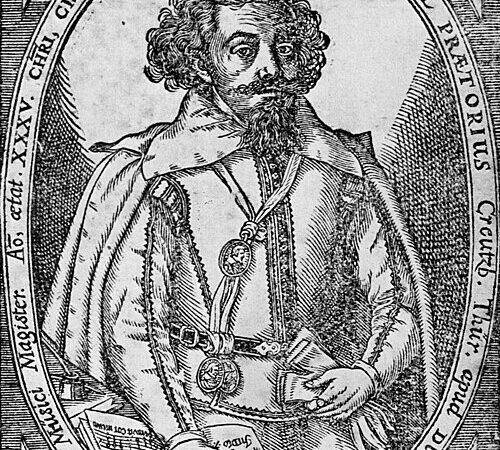
Biography (read more)
Michael Praetorius was a German composer, organist, and music theorist born around February 15, 1571, in Creuzburg, Thuringia, and he died on the same date in 1621 in Wolfenbüttel. Trained in Frankfurt an der Oder, he became organist and later court Kapellmeister to Duke Heinrich Julius of Brunswick-Wolfenbüttel, a post he held for most of his career. After his patron’s death in 1613, Praetorius traveled among German courts, absorbing new Italian musical trends and helping spread them northward. He was remarkably prolific, producing over a thousand chorale settings in the nine-volume Musae Sioniae, and he authored the monumental three-volume treatise Syntagma musicum, a vital source on instruments and performance practice of the era.
Praetorius stands at the hinge between Renaissance and early Baroque German music, importing Venetian polychoral technique and continuo practice into Lutheran church music. His Syntagma musicum remains one of the single most important surviving sources for understanding instruments, tuning, and performance conventions of his time, underpinning much of modern historically informed performance. Terpsichore likewise preserved hundreds of French court dances that would otherwise have been lost, shaping later dance and orchestral traditions.
Sources:
Repertoire
In dulci jubilo1607
Performed by CHOR GESANG – Das Musikmagazin
Es ist ein Ros entsprungenc. 1609
Performed by The Choir of Trinity College Cambridge, Giulia Zarantonello
Puer natus in Bethlehem1609
Performed by aurambros
Puer nobis nascitur (Musae Sioniae VI)1609
Performed by Gabrieli
Terpsichore1612
Performed by Voices of Music, Israel Philharmonic – הפילהרמונית הישראלית