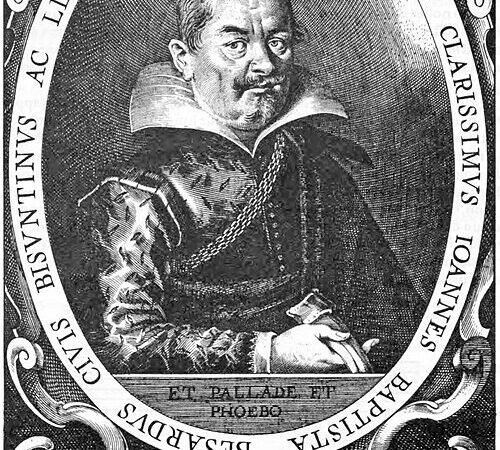
Biography (read more)
Jean-Baptiste Besard was a French lutenist, composer, and anthologist, born around 1567 in Besançon. He studied law at the University of Dole before traveling to Rome, where he studied medicine and also learned lute from the celebrated virtuoso Lorenzino del Liuto. He later worked in Cologne and Augsburg within the Holy Roman Empire. In 1603 he published his most famous work, Thesaurus Harmonicus, a landmark anthology containing 403 arrangements for lute in French tablature, drawing on the work of 21 composers including himself. The collection included an appended primer on lute technique, De modo in testudine libellus, later translated into English by Robert Dowland. He died around 1625.
Jean-Baptiste Besard’s Thesaurus Harmonicus is one of the most important surviving sources of late Renaissance lute music, preserving hundreds of pieces that would otherwise be lost. As both composer and compiler, he helped standardize and disseminate lute repertoire across Europe, and his instructional appendix shaped lute pedagogy for decades.
Sources:
Repertoire
Praeludium (Prelude)1603
Performed by musicapingpong
Allemande: Une Jeune Fillette1603
Performed by Jamie Akers: old guitars and lutes
Ballet1603
Performed by Konrad Ragossnig, Artur Anikeev
Gagliarda vulgo dolorata1603
Performed by Marshall McGuire
Thesaurus harmonicus – Libro quarto, Cantiones gallicae e Airs de court: No. 70v, Ou luis tu…— Eduardo Egüez
Performed by Eduardo Egüez
Thesaurus harmonicus – Libro quarto, Cantiones gallicae e Airs de court: No. 68v, Beaux yeux…— Eduardo Egüez
Performed by Eduardo Egüez
Besard: Lute music – France: Air de cour “J’ai trouvé sur l’herbe assise”— Konrad Ragossnig
Performed by Konrad Ragossnig
Besard: Lute music – France: Gagliarda vulgo dolorata— Konrad Ragossnig
Performed by Konrad Ragossnig